What is the onboarding process in eCommerce?
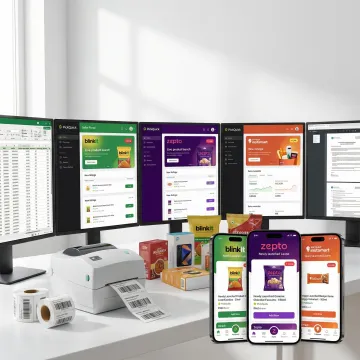
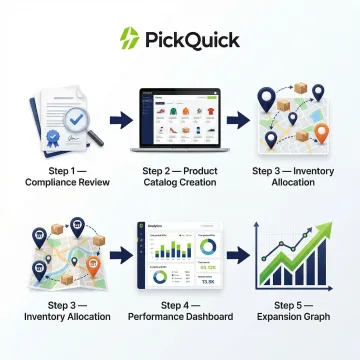
The e-commerce onboarding process for quick commerce platforms involves seller registration, compliance documentation (FSSAI, GSTIN, GS1 barcodes), catalog creation with optimized listings, inventory setup across dark stores, packaging compliance verification, and trial launch coordination. PickQuick manages this end-to-end—handling platform approvals, SKU mapping, replenishment configuration, and go-live execution across Blinkit, Zepto, Swiggy Instamart, and JioMart, achieving 3-5x faster onboarding timelines compared to brands doing it independently.
How long does it take to onboard a brand on quick commerce platforms?
With PickQuick, brands typically go live across Blinkit, Zepto, Swiggy Instamart, and JioMart within 3-6 weeks—significantly faster than the 3-6 month timeline most brands face when onboarding independently. We accelerate the process by handling documentation, compliance, catalog creation, inventory planning, and platform coordination in parallel, while leveraging pre-existing relationships and operational frameworks that eliminate common delays and approval bottlenecks.
What documentation is required to sell on Blinkit, Zepto, and Instamart?
To onboard on quick commerce platforms, you need valid FSSAI licenses (state or central depending on reach), GSTIN registration, GS1-registered barcodes (UPC/EAN), brand authorization letters (if applicable), product liability insurance (for certain categories), and packaging that meets platform-specific labeling standards (MRP, ingredient list, manufacturer details, expiry date). PickQuick handles documentation verification, submission, and platform-specific compliance checks to ensure your brand meets all requirements before inventory moves.
Do I need different SKUs for each quick commerce platform?
Not necessarily. Most brands use the same SKUs across Blinkit, Zepto, Swiggy Instamart, and JioMart, but listing content, imagery, titles, and descriptions are optimized separately for each platform's search algorithm and category structure. PickQuick creates a unified catalog backbone, then tailors metadata and positioning to maximize discoverability on each platform—ensuring consistent branding while adapting to platform-specific ranking factors and customer search behavior.
How does PickQuick help with dark store inventory placement?
We analyze pincode-level demand data, historical sales velocity, and competitive coverage to determine optimal dark store allocation for your SKUs. Then we configure Min-Max inventory limits (the store-level holding capacity that determines replenishment frequency), set up automated RO (Replenishment Order) cycles, and coordinate with your warehouses and distributors to ensure the right stock reaches the right stores at the right time—preventing stockouts while minimizing ageing and overstock risk.
What is a trial cluster launch and why is it important?
A trial cluster launch involves going live in a controlled set of 10-15 dark stores to validate your product's operational readiness before full-scale expansion. During this phase, we monitor sales velocity, picker accuracy (how easily store staff locate and pack your product), complaint rates, packaging quality, fill rates, and GRN (Goods Received Note) cleanliness. This allows us to identify and fix issues—like barcode scanability problems or packaging damage—before scaling distribution citywide, reducing risk and ensuring a smooth expansion.
Can regional brands with limited distribution sell on quick commerce?
Absolutely. Quick commerce is ideal for regional brands with strong offline demand in specific cities or states. PickQuick specializes in onboarding regional champions—helping them launch in their home markets first, stabilize availability and velocity, then expand to neighboring cities methodically. We handle hyperlocal distribution planning, regional assortment optimization, and pincode-level stocking strategies that allow regional brands to dominate their core markets before scaling nationally across platforms.
How much does it cost to onboard a brand on quick commerce platforms?
Quick commerce onboarding costs vary by platform and are typically structured as a combination of one-time setup fees (inwarding, cataloging) and ongoing operational fees (commission, fulfillment, storage). For example, Blinkit charges ₹5/unit inwarding, 2-18% commission on selling price, and ₹50 per delivered order. PickQuick provides transparent fee breakdowns during consultation and manages the entire economic model—ensuring you understand platform costs, payout cycles, deductions, and profitability before going live.