For brands on Blinkit, Zepto, and Swiggy Instamart, warehouse inventory management is no longer a back-office function—it's a competitive advantage. This guide covers the core process, best practices, techniques, technology enablers, and KPIs that define warehouse excellence in 2026.
TLDR:
- Quick commerce demands sub-2-minute fulfillment cycles where inventory accuracy directly impacts platform visibility
- ABC analysis and cycle counting raise accuracy from 88% to 97% within 6 months
- AI-driven forecasting reduces errors by 20-50% and cuts lost sales by up to 65%
- RFID implementation boosts accuracy from 63% to 95% and reduces stockouts by 50%
- Platform availability % and replenishment cycle time are critical KPIs for QC operators
What Is Warehouse Inventory Management?
Warehouse inventory management is the end-to-end process of receiving, storing, tracking, and replenishing goods within a facility. It combines physical organization with data accuracy to ensure products are available when needed, in the correct quantity, at the correct location.
This differs from broader inventory management, which focuses on stock levels, ordering, and demand planning across the entire business. Warehouse management governs physical operations inside the facility—picking, packing, shipping, and space utilization.
The two functions are related but distinct: inventory management tracks stock across an organization with multiple locations, while warehouse management handles day-to-day operations within a single facility, according to ASCM.
Why This Distinction Matters in Quick Commerce
For dark stores operating on Blinkit or Zepto, a lapse in inventory accuracy triggers a chain reaction. A listing goes dark, platform rank drops, and high-intent buyers are lost in real time. When availability dips below 80%, Blinkit's algorithm triggers demotion—reducing search ranking and active pincode coverage.
Knowing what you have (inventory management) and controlling how you handle it (warehouse management) are two separate disciplines. When your fulfillment window is under 10 minutes, that separation becomes operationally decisive.
The Core Warehouse Inventory Management Process
The six core warehousing processes are receiving, storing, picking, packing, shipping, and returns. Each step must be standardized, trackable, and minimally reliant on manual judgment.
The six-step workflow:
- Receiving — Goods arrive and are logged into the system; errors here cascade downstream
- Put-Away & Storage — Items are assigned locations based on velocity and category; poor slotting wastes picker time
- Order Processing — The system queues orders and allocates inventory; delays here compress fulfillment speed
- Picking — Workers retrieve items from shelves; incorrect picks trigger returns and complaints
- Packing — Orders are packed and labeled; packaging failures cause DN penalties on QC platforms
- Shipping — Orders are dispatched to riders or delivery zones; late shipments miss cutoff windows
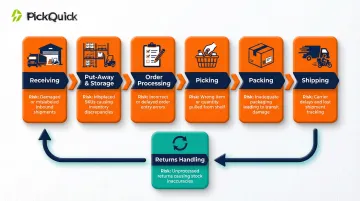
Returns handling is the seventh step most operations overlook. Returned items must be inspected, re-classified, and re-entered into stock records promptly — delays here silently erode inventory accuracy over time.
In quick commerce, where dark stores run picking and packing cycles under 75 seconds, every step in this chain must execute without friction. Operators like PickQuick manage this end-to-end process across Blinkit, Zepto, Swiggy Instamart, and JioMart — keeping dark store replenishment, slotting, and returns cycles tight enough to sustain those windows at scale.
Best Practices for Warehouse Inventory Management in 2026
ABC Analysis and SKU Prioritization
ABC analysis categorizes inventory into three tiers based on value and velocity:
- A-category: High-value, fast-moving SKUs (typically top 20% of items generating 80% of revenue)
- B-category: Moderate value and turnover
- C-category: Slow-moving, low-value items
Research confirms that roughly 80% of revenue comes from 20% of SKUs, making A-category products the operational priority. For quick commerce brands, A-category SKUs should be positioned closest to dispatch zones and restocked most aggressively. One e-grocery retailer reduced SKUs by 36% through assortment optimization while growing sales and margins by 1-2%.
Implement Cycle Counting Over Annual Audits
Cycle counting means counting small sections of inventory on a rolling schedule instead of shutting operations for full stock-takes. This reduces disruption while maintaining accuracy. ABC-based weekly cycle counts raised inventory record accuracy from 88% to 97% in six months for one regional eCommerce seller.
Recommended frequency:
- A-category items: Weekly or bi-weekly
- B-category items: Monthly
- C-category items: Quarterly
Organizations report accuracy improvements of up to 40% compared to annual counting alone.
Set Min-Max Replenishment Thresholds
Defining a minimum stock level (trigger point for reorder) and maximum level (to prevent overstock) for each SKU prevents both stockouts and dead inventory. In dark store operations, these thresholds must account for platform-level demand signals and delivery lead times by pincode.
Brands working with operators like PickQuick leverage pincode-level demand visibility to set thresholds with precision, ensuring dark stores maintain optimal stock without overloading limited storage space.
Demand Forecasting Using Historical and Seasonal Data
Accurate forecasting starts with the right data inputs. Key variables to track include:
- Past sales velocity by SKU and pincode
- Seasonal spikes from festivals, weather shifts, and promotions
- Platform-level demand trends from Blinkit, Zepto, and Swiggy Instamart dashboards
- Regional consumption patterns influenced by monsoons or revised tax slabs
McKinsey estimates that a 10-20% improvement in demand forecast accuracy can trim inventory costs by about 5%. For brands running ₹5-7 crore/month in offline volume, that reduction translates directly into working capital freed for platform expansion.
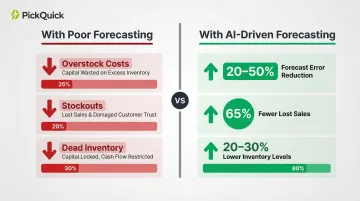
India's FMCG demand variability is high. Rural markets are growing while urban metros shift toward quick commerce. Dynamic forecasting models — ones that adapt to regional shifts in real time — are no longer optional for multi-city QC operations.
Apply FEFO/FIFO Protocols for Perishable SKUs
For FMCG, dairy, masala, and food brands, inventory must rotate by expiry date or receipt date to minimize wastage and returns.
- FEFO (First Expired, First Out): Stock closest to expiry is dispatched first
- FIFO (First In, First Out): Oldest stock is dispatched first
Failing to implement these protocols leads to expired stock, quality complaints, and regulatory risk. FEFO is the preferred method for perishable categories.
Maintain Supplier Alignment and Lead Time Buffers
Staying ahead of supplier delays — through agreed lead times and early warning systems — lets teams maintain safety stock buffers without over-investing in working capital. For multi-city QC expansion, this means aligning with regional distributors, not just national suppliers.
Missing a replenishment cycle on Blinkit or Zepto doesn't just cause a stockout. It can trigger availability penalties that drop your dark store's search ranking and suppresses your SKU visibility until stock stabilizes. Coordinating regional distributors in advance is how brands avoid that cycle entirely.
Essential Inventory Management Techniques
Safety Stock Calculation
Safety stock is a buffer quantity held above average demand to absorb supply chain variability. The calculation factors in demand variability and supplier lead time variability.
A simplified formula: Safety Stock = (Maximum Daily Usage × Maximum Lead Time) – (Average Daily Usage × Average Lead Time)
For dark store operations, recalibrate safety stock weekly rather than monthly — demand velocity on quick commerce platforms shifts faster than traditional distribution channels.
Economic Order Quantity (EOQ)
EOQ determines the optimal reorder quantity that minimizes total inventory costs (ordering cost + holding cost). For fast-moving FMCG SKUs on quick commerce platforms, EOQ models need frequent recalibration to reflect real-time velocity changes rather than static historical averages.
Batch Tracking for Quality Control
Assigning lot or batch numbers to inventory groups allows teams to trace expiry dates, identify defective batches, and execute targeted recalls without disrupting entire stock. For food, dairy, and personal care categories, this is a FSSAI compliance requirement — a single untracked batch can trigger a full-category recall rather than an isolated one.
Perpetual Inventory Management
Perpetual inventory uses real-time scanning (barcode, RFID, or WMS integrations) to update stock counts instantly with every movement — receiving, picking, dispatch. This eliminates reliance on periodic manual counts and is foundational for dark stores needing live availability data.
According to a GS1 US RFID retail supply chain study, RFID implementation raises inventory accuracy from 63% to 95% and cuts retail out-of-stocks by up to 50%.
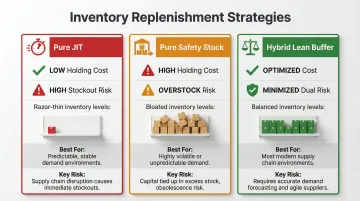
Just-in-Time (JIT) vs Safety Stock Trade-off
JIT minimizes holding costs by ordering only when needed, but it exposes operations to supply chain disruptions. For QC brands with high velocity and thin replenishment windows, a hybrid approach works better than pure JIT:
| Approach | Best For | Risk |
|---|---|---|
| Pure JIT | Predictable demand, long lead times acceptable | High — any supply delay causes stockouts |
| Pure Safety Stock | Unpredictable demand spikes | Higher holding costs, potential wastage |
| Hybrid (lean buffer + frequent top-ups) | High-velocity QC SKUs, dairy, perishables | Balanced — minimizes both overstock and stockout exposure |
Technology That Powers Modern Warehouse Inventory Management
Warehouse Management Systems (WMS)
A WMS is the operational backbone: it tracks every item's location, guides picking sequences, automates replenishment alerts, and generates accuracy reports. When integrated with QC platform data — availability percentages and fill rates by dark store — it gives brand operators a real-time view of inventory health across every node.
RFID and Barcode Scanning
These technologies eliminate manual entry errors during receiving and picking. RFID offers hands-free, batch-scan capability for high-throughput environments. Barcodes are lower cost and sufficient for most FMCG dark store settings.
Key differences at a glance:
- RFID: Hands-free batch scanning, faster cycle counts — cuts cycle count times by 96%, ideal for high-throughput nodes
- Barcodes: Lower cost, simpler implementation, sufficient for most FMCG dark store volumes
Both enable perpetual inventory tracking and complete audit trails.
AI-Driven Demand Forecasting Tools
AI and ML models analyze platform sales velocity, promotional uplift, and regional demand patterns to predict reorder needs far more accurately than spreadsheet-based forecasting. The impact is measurable:
- Forecasting errors drop by 20–50%, according to McKinsey, with lost sales and unavailability reduced by up to 65%
- Inventory levels can fall 20–30% through machine learning and demand pattern segmentation
Real-Time Inventory Visibility Platforms for Quick Commerce
For brands operating across multiple dark stores and QC platforms simultaneously, a centralized visibility layer — tracking availability by SKU, by pincode, by platform — is critical for preventing listing downtime.
PickQuick manages dark store replenishment and Min-Max optimization using platform-level availability data, helping brands hold stable in-stock rates across Blinkit, Zepto, Swiggy Instamart, and JioMart — without brands needing to monitor each node directly.
Key KPIs to Track Warehouse Inventory Performance
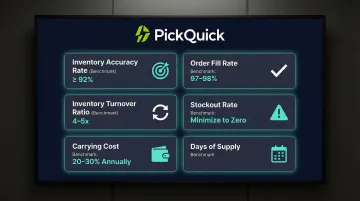
Tracking the right numbers separates brands that scale on Quick Commerce from those that quietly lose ranking. These six core metrics apply across warehouse and platform operations alike:
- Inventory Accuracy Rate: Best-in-class benchmark is ≥92% — gaps below this point to WMS sync failures or physical count errors
- Order Fill Rate: Industry-acceptable range is 97-98%, though sector medians sit closer to 94%; anything lower signals chronic stockout risk
- Inventory Turnover Ratio: India's top FMCG brands turn stock 4-5 times annually — low turnover ties up capital and inflates carrying costs
- Stockout Rate: 69% of online shoppers abandon purchases entirely when hitting a stockout, making zero-stock events a direct revenue event, not just an ops metric
- Carrying Cost of Inventory: Typically 20-30% of total inventory value per year — excess safety stock costs more than most brands expect
- Days of Supply: Current stock divided by average daily demand; signals whether replenishment cadence is keeping pace with sell-through
Platform-Specific KPIs for Quick Commerce
On QC platforms, two operational metrics go beyond the warehouse and directly determine what shoppers see — and what the algorithm surfaces:
- Platform Availability %: What percentage of time a SKU shows as "in stock" on the app; Blinkit expects brands to sustain above 90%, with penalties triggered below 80%
- Replenishment Cycle Time: How quickly stock is topped up after depletion in a dark store; slower replenishment shrinks active pincode coverage and pulls the SKU down in search results
On Blinkit and Zepto, dropping below fill rate thresholds triggers algorithmic demotion — cutting search ranking, ad visibility, and active pincode coverage in one move.
Frequently Asked Questions
What is the inventory management process in a warehouse?
The core flow covers receiving and logging goods, storing them in designated locations, picking and packing orders, shipping to customers, and handling returns. Every movement is tracked through a WMS or inventory system to maintain accuracy and traceability.
Is warehouse management the same as inventory management?
No. Inventory management focuses on stock levels, ordering, and demand planning across the business. Warehouse management covers all physical operations inside the facility—receiving, storing, picking, packing, and shipping. Inventory management is a component within the broader warehouse management function.
What are the key KPIs for warehouse inventory management?
The most important KPIs are inventory accuracy rate, order fill rate, inventory turnover ratio, stockout rate, carrying cost, and days of supply. Tracking all six consistently gives a clear picture of warehouse health and replenishment efficiency.
What are the 4 types of inventory management systems?
The four main types are periodic inventory systems (count at set intervals), perpetual inventory systems (real-time tracking), barcode-based systems, and RFID-based systems. Most modern warehouses use a combination of perpetual tracking with barcode or RFID scanning for accuracy and speed.
What is FEFO and FIFO?
FIFO (First In, First Out) dispatches the oldest stock first. FEFO (First Expired, First Out) dispatches stock closest to expiry first. FEFO is the preferred method for perishable FMCG, dairy, and food products to minimize wastage and ensure product quality.
What is the 80/20 rule in inventory management?
The 80/20 rule (Pareto Principle) states that roughly 80% of a warehouse's revenue typically comes from 20% of its SKUs. This principle underpins ABC analysis, where Category A items (the vital 20%) receive the most attention, storage priority, and replenishment urgency.