Introduction
Picture this: A masala brand in Maharashtra has built steady offline demand across 200+ retail outlets. Monthly sales hit ₹6 crore through traditional distribution. The founder decides it's time to go digital and approaches Blinkit to list their bestselling 100g turmeric powder pouch. The platform representative asks one question: "What's your GTIN?"
The founder pauses. GTIN? Barcode? UPC? Aren't they the same thing? That confusion is common — and costly.
A GS1-registered Global Trade Item Number is the non-negotiable entry point for any FMCG brand entering Quick Commerce. Without one, that product cannot be listed on Blinkit, Zepto, Swiggy Instamart, or JioMart. No exceptions, no workarounds.
This guide covers what a GTIN is, how its formats differ, why Quick Commerce platforms mandate it, and how Indian brands can obtain one through GS1 India.
Key Takeaways
- A GTIN is a globally unique product identifier managed by GS1, required for listing products on retail and Quick Commerce platforms
- Four formats exist (GTIN-8, -12, -13, and -14), each suited to different packaging levels and markets
- The GTIN is the number itself; a barcode is just the visual representation scanned at checkout
- Indian brands get GTINs by registering with GS1 India, which assigns a Company Prefix used to generate unique codes per SKU
- Without valid GTINs, brands face listing rejections and blocked expansion across Quick Commerce platforms
What is a Global Trade Item Number (GTIN)?
A GTIN is a globally unique, standardised number used to identify a product or trade item at any point in the supply chain—from manufacturer to retailer to consumer. "Globally unique" means no two products anywhere in the world share the same GTIN.
Who manages GTINs?
GTINs are governed and issued by GS1, a not-for-profit international organisation that manages product identification standards across more than 100 countries. In India, GS1 India serves as the local member organisation, established by the Ministry of Commerce and Industry alongside industry bodies like CII, FICCI, ASSOCHAM, and BIS.
What qualifies as a trade item?
According to GS1, a trade item is any product or service that is priced, ordered, or invoiced at any point in the supply chain. This includes:
- Individual consumer packs (a 100g masala pouch)
- Inner packs (a bundle of 6 pouches)
- Shipping cases (a carton of 24 pouches)
Each of these packaging levels needs its own GTIN — which brings us to how the number itself is structured.
GTIN structure: Three core components
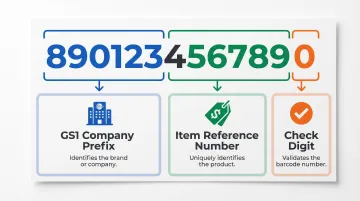
Every GTIN consists of three embedded elements:
- GS1 Company Prefix — Uniquely identifies the brand or manufacturer, assigned by GS1 India
- Item Reference Number — Assigned by the brand owner to each distinct SKU
- Check Digit — A mathematically calculated final digit that validates the entire number is error-free
Real-world example:
A masala brand sells turmeric powder in three pack sizes:
- 100g pouch → GTIN: 8901234567890
- 200g pouch → GTIN: 8901234567891
- 500g pack → GTIN: 8901234567892
Even though it's the same product, each unique size, variant, or packaging configuration requires its own GTIN. Any change in pack size, flavour, or outer packaging design means a new GTIN is required — the number follows the product configuration, not just the product itself.
The 4 Types of GTIN Formats Explained
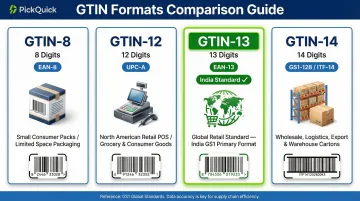
GTINs come in four digit-length formats—8, 12, 13, and 14 digits—each suited to different product types, packaging levels, and geographic markets.
GTIN-8
GTIN-8 is the shortest format at 8 digits, encoded in an EAN-8 barcode. It's reserved for very small physical products where packaging space is extremely limited, such as:
- Small confectionery items
- Lip balm tubes
- Single-serve sachets
In India, this format is rarely used. FMCG brands default to GTIN-13 unless packaging constraints make GTIN-8 unavoidable. GS1 strictly reserves it for items where the total printable area is under 80 cm², the largest label is under 40 cm², or the product is cylindrical with a diameter below 30 mm.
GTIN-12 (UPC)
GTIN-12 is a 12-digit number used predominantly in North America, encoded in a UPC-A barcode — also called the Universal Product Code (UPC).
If you're exporting to the US or listing on platforms that accept UPC codes (like Amazon US), you'll need GTIN-12. For domestic Quick Commerce platforms in India — Blinkit, Zepto, Swiggy Instamart, and JioMart — GTIN-13 is the standard.
GTIN-13 (EAN)
GTIN-13 is the standard 13-digit format used internationally, including India. It's encoded in an EAN-13 barcode and is the most commonly required format for products sold at retail Point-of-Sale (POS) and on Indian Quick Commerce platforms.
- Also called EAN (European Article Number)
- Required for consumer-facing packaging scanned at checkout
- The default format for FMCG brands in India
Example structure:
A GTIN-13 consists of a 7-digit GS1 Company Prefix + 5-digit Item Reference + 1 Check Digit = 13 digits total.
GTIN-14
GTIN-14 is a 14-digit format used for trade or wholesale packaging—cases, pallets, or multi-packs—rather than individual consumer units. It's not scanned at Point-of-Sale but is critical for warehouse logistics, dispatch, and B2B ordering.
- Typically encoded in a GS1-128 barcode or ITF-14 symbology
- The first digit is an indicator digit (1 to 8) that denotes packaging level — case, pallet, or higher
- Used for inventory tracking from motherhubs to dark stores in Quick Commerce supply chains
Example:
If your 100g masala pouch has a GTIN-13 of 8901234567890, the shipping case containing 24 pouches might have a GTIN-14 of 18901234567897, where the leading "1" indicates it's a case-level trade item.
GTIN vs. Barcode vs. UPC: Key Differences
These three terms get used interchangeably on marketplace listing interfaces — but they refer to different things entirely. Here's how they stack up:
| Term | What It Is | Example |
|---|---|---|
| GTIN | The numeric identifier — the data itself | 8901234567890 |
| Barcode | The visual symbol that encodes the GTIN | Black-and-white lines scanned at checkout |
| UPC / EAN | A specific barcode format | UPC-A (GTIN-12) in North America; EAN-13 (GTIN-13) in India and most of the world |
Removing a barcode from your packaging doesn't erase the GTIN — the number still exists in databases, inventory systems, and platform catalogs. And without a valid GTIN behind it, a barcode is meaningless in any supply chain context.
When a platform like Blinkit or Zepto asks for a "barcode" or "UPC" during listing, they're really asking for the GTIN. Think of the three layers this way:
- The data layer = GTIN (the number)
- The symbol layer = Barcode (the visual encoding)
- The format layer = UPC-A, EAN-13, ITF-14 (specific barcode types)
Books are a useful parallel: ISBN numbers are also a form of GTIN-13, absorbed into the same universal standard. This pattern repeats across industries — GTIN is the umbrella that brings legacy numbering systems under one framework.
Why GTINs Are Essential for Quick Commerce and E-Commerce in India
Most major retail and e-commerce platforms—including Amazon India, Flipkart, and Quick Commerce platforms like Blinkit, Zepto, and Swiggy Instamart—require a valid GTIN (usually GTIN-13/EAN) when onboarding new products to their catalogs.
Platform-specific requirements:
- Amazon India: Product IDs (GTINs) are generally required to create new listings. Sellers can apply for a GTIN exemption only if they sell private-label, handmade, generic, or bundled products that lack a manufacturer-issued GTIN.
- Flipkart: EAN/UPC codes are mandatory for listing brand-registry products and for items fulfilled via the 'Fulfilled by Flipkart' (FBF) network.
- Blinkit, Zepto, Swiggy Instamart: GS1 barcodes are preferred. Platforms require barcode images with EAN/UPC clearly visible during catalog onboarding. Without valid GTINs, platforms reject listings or exclude them from promotional features.
- Google Merchant Center: Google "strongly recommends" submitting GTINs for all products with a manufacturer-assigned GTIN. Products missing GTINs may experience limited visibility.
GTINs as the Catalog Backbone
When a brand lists a product on multiple platforms, the GTIN is the common identifier that links the same SKU across all databases. This prevents duplicate listings, enables accurate inventory tracking across dark stores, and ensures the correct product is picked and dispatched to the customer.
Search Visibility and Conversion
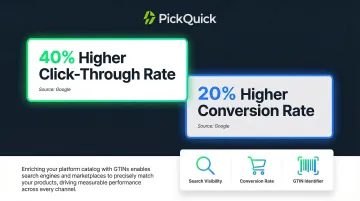
Google reports that GTIN-matched listings achieve a 40% higher click-through rate and 20% higher conversion rate. Platforms use GTINs to enrich product pages with existing catalog data, improving search-to-conversion rates. In Quick Commerce, where speed and accuracy define customer experience, GTINs ensure that search algorithms surface the right product instantly.
That same precision matters even more at the supply chain level.
Supply Chain Traceability for FMCG
In categories like dairy, masala, and packaged food—where batch recalls and expiry rotation are business-critical—GTINs enable traceability from manufacturer to dark store shelf. The GS1 Global Traceability Standard extends GTINs with Key Data Elements like batch/lot numbers and expiry dates, often encoded in 2D barcodes like GS1 DataMatrix.
This supports compliance and quality control, ensuring products approaching expiry are rotated before they reach the customer.
How PickQuick Handles GTIN Compliance
For regional brands scaling to Quick Commerce, coordinating GS1 registration, barcode readiness, catalog structuring, and platform onboarding simultaneously is time-consuming and easy to get wrong. PickQuick manages GTIN compliance as part of its pre-launch preparation for brands going live on Blinkit, Zepto, Swiggy Instamart, and JioMart — covering everything from GS1 registration to catalog submission. Brands that onboard through PickQuick typically go live 3–5x faster than those navigating platform requirements independently.
How to Get a GTIN for Your Product in India
In India, GTINs are issued through GS1 India, the local GS1 member organisation. Brands must first register with GS1 India to obtain a GS1 Company Prefix, which becomes the foundation for generating all their GTINs.
GS1 India Pricing Tiers
GS1 India allocates barcodes based on tiered capacities and the applicant company's annual sales turnover. Fees include a registration fee, an annual subscription fee, and a security deposit. The minimum tier is 100 barcodes — unlike GS1 US, which offers a single-GTIN purchase option, GS1 India does not offer this.
- 100 barcodes — Suitable for small brands with limited SKU counts
- 1,000 barcodes — For growing brands with expanding product lines
- 10,000 barcodes — For established brands with extensive catalogs
- 100,000 barcodes — For large enterprises managing thousands of SKUs
(Current pricing varies by turnover. Check the GS1 India website for the latest fee structure.)
Once registered, generating your GTINs is a straightforward five-step process.
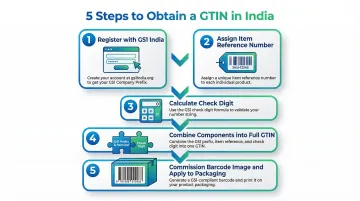
Step-by-step process to obtain a GTIN:
- Register with GS1 India — Visit the GS1 India website and complete the registration process. You'll receive a GS1 Company Prefix unique to your brand.
- Assign a unique Item Reference Number — For each distinct SKU (product variant, pack size, flavour), assign a unique item reference number.
- Calculate the Check Digit — Use GS1's free online Check Digit Calculator to generate the correct check digit for your GTIN.
- Combine the three components — Your GS1 Company Prefix + Item Reference + Check Digit = Full GTIN (13 digits for GTIN-13).
- Commission a barcode image — Generate an EAN-13 barcode image and apply it correctly to your product packaging. Ensure the barcode is scannable and meets GS1 print quality standards.
Avoid "Free GTIN" Scams
Third-party resellers sell GTINs cheaply online, but these are not GS1-issued and are not accepted by major retailers or Quick Commerce platforms. GS1 India explicitly warns against purchasing barcodes from unauthorized resellers. Using them can lead to:
- Listing rejections on Amazon, Flipkart, Blinkit, Zepto, and Swiggy Instamart
- Scanning issues at retail POS and dark stores
- Costly packaging reprints when platforms verify GTIN authenticity against the GS1 database
GS1 registration is the only route to platform-accepted GTINs — there are no legitimate free alternatives.
Frequently Asked Questions
When is a Global Trade Item Number required?
A GTIN is required when selling through major retail stores, online marketplaces like Amazon and Flipkart, and Quick Commerce platforms like Blinkit, Zepto, and Swiggy Instamart. It's also mandatory for EDI-based B2B trade with large retail chains or distributors.
What is the format of a Global Trade Item Number?
GTINs come in four numeric formats: GTIN-8 (8 digits), GTIN-12 (12 digits), GTIN-13 (13 digits), and GTIN-14 (14 digits). Each comprises a GS1 Company Prefix, an Item Reference Number, and a Check Digit.
What is an example of a Global Trade Item Number?
For example, 8901234567890 is a valid GTIN-13 — built from a 7-digit GS1 Company Prefix, a 5-digit Item Reference, and a single Check Digit. Each unique product variant or pack size gets its own distinct number.
How do I get a Global Trade Item Number for my product?
Register with GS1 India to obtain a GS1 Company Prefix. Then assign Item Reference Numbers to each SKU and calculate the Check Digit using GS1's free online calculator to generate valid, platform-accepted GTINs.
Can I get a Global Trade Item Number for free?
No. Legitimate, platform-accepted GTINs are not free—they require a paid annual subscription with GS1 India. Cheap third-party GTINs sold online are often not accepted by major retailers or Quick Commerce platforms and can result in listing rejections and packaging reprints.
How do I find my Global Trade Item Number?
Check the barcode already printed on your product packaging — the number beneath the barcode lines is your GTIN. You can also log into your GS1 India account to view all GTINs registered under your Company Prefix.