
This isn't a demand problem. It's an inventory visibility problem.
In Quick Commerce, where delivery promises are measured in minutes and dark stores carry limited SKU depth, even a 15-minute data lag can mean a lost sale and an algorithmic penalty. For brands selling across multiple platforms and dozens of pincodes, the complexity multiplies. Without real-time visibility into stock location, movement, and status, you're always reacting—never planning.
This guide explains what inventory visibility actually means in a QC context, why it's critical for platform ranking and expansion, and the specific steps regional brands can take to improve it.
Key Takeaways
- Inventory visibility means knowing the real-time location, quantity, and status of stock across every dark store and platform
- Poor visibility causes stockouts that directly damage search rankings, trigger Max shrinkage, and stall expansion
- Six core components keep stock data accurate: real-time tracking, multi-location sync, SKU-level data, reconciliation, alerts, and analytics
- Brands improve visibility through barcode scanning, centralized platforms, Min-Max optimization, and automated replenishment triggers
- Pincode-level demand visibility and platform-integrated tracking — offered by operators like PickQuick — cut go-live timelines significantly
What Is Inventory Visibility?
Inventory visibility is the ability to track and monitor the real-time location, quantity, status, and movement of stock at every stage—from procurement through last-mile delivery—across all sales channels, warehouses, and fulfillment points.
In GT/MT distribution, knowing your central warehouse stock is enough. In Quick Commerce, you need to know exactly how many units of each SKU are available in each dark store, whether motherhub stock is aging, and which pincodes are running low — in real time.
QC platforms run on micro-fulfillment models. Inventory sitting in a central mother warehouse is invisible to a customer searching for your product on Blinkit or Zepto. What matters is whether your SKU is physically present in the dark store serving their 2km radius.
The Difference Between Stock Counting and True Visibility
Basic stock counting gives you a periodic snapshot — a physical count once a week or month that updates your records. True inventory visibility provides continuous, near-real-time awareness.
In a 10-minute delivery model, that gap is costly. A 15-minute data lag means:
- A customer sees your product as "available" when it's already sold out
- They place an order you can't fulfill
- The platform logs a stockout against your availability score
According to research on Quick Commerce fill rate economics, if availability dips below 80%, one in every five customers sees an out-of-stock message — a direct 20% churn risk on every search.
Inventory Visibility vs. Order Visibility
These two terms are often confused, but they cover different scopes:
Order visibility tracks a single customer order from purchase to delivery — where is it, and when does it arrive?
Inventory visibility covers your entire stock pool across all locations — how many units exist, where they are, and whether they can fulfill the next order.
You need both. Flawless order tracking means nothing if a high-demand pincode is hours away from a stockout. Closing that gap is where the real operational work begins.
Why Inventory Visibility Matters for Quick Commerce Brands
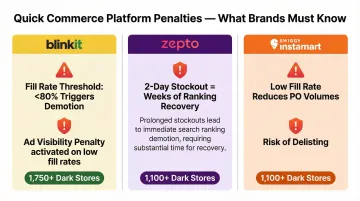
Quick Commerce platforms penalize brands for poor availability. Blinkit requires sustained 90%+ fill rates; dropping below 80% triggers algorithmic demotion, reducing search ranking and ad visibility. Zepto de-ranks out-of-stock SKUs—a two-day stockout can set back search placement by weeks.
| Platform | Algorithmic Penalty | Dark Store Count |
|---|---|---|
| Blinkit | <80% fill rate = demotion + reduced ad visibility | 1,750+ stores |
| Zepto | 2-day stockout = weeks of ranking recovery | 1,100+ stores |
| Swiggy Instamart | Low fill rate = reduced PO volumes + delisting risk | 1,100+ stores |
Poor visibility creates a compounding problem: brands overstock to compensate for uncertainty, driving up carrying costs and expiry risk, while simultaneously experiencing stockouts on fast-moving SKUs.
Consider a dairy brand managing 30 SKUs across Blinkit, Zepto, and Instamart in Delhi. Without pincode-level visibility, you can't tell whether a stockout is city-wide (a motherhub supply issue) or location-specific (one dark store with unusually high velocity).
The result: broad replenishment that overstocks slow-moving pincodes while high-demand areas continue to run dry.
Traditional FMCG companies average 45-50 Days of Inventory, but QC dark stores require 2-3 days DOH to prevent expiry write-offs. This compression leaves no margin for error.
Multi-Platform Complexity
A brand active on Blinkit, Zepto, Swiggy Instamart, and JioMart simultaneously has inventory distributed across dozens of dark stores in multiple cities. Without unified visibility, brands are always one missed RO cycle away from an availability penalty.
Each platform runs its own Replenishment Order (RO) cycle with different timing and cut-offs. Without consolidated visibility, you discover imbalances only after Seller Hub flags availability penalties.
You can't see that Blinkit dark stores in one pincode are depleting fast while Zepto stores in the same geography are sitting on excess stock.
Business Outcomes Enabled by Visibility
Accurate, real-time stock data enables:
- Better demand forecasting based on actual consumption patterns by pincode
- Prevention of over-purchasing slow-moving SKUs
- Smarter Min-Max thresholds set at the dark store level
- Confident city expansion backed by current stock performance data
Inventory visibility is the foundation for scaling to new cities. Brands that get this right expand faster — and without the costly stockout-and-recovery cycles that erode platform rankings.
Key Components of Inventory Visibility
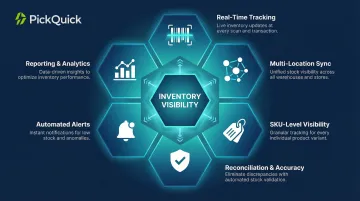
Six core components work together to keep stock data accurate across Quick Commerce networks:
Real-Time Tracking
Barcode scanners, RFID tags, and IoT sensors capture stock movement as goods are received, transferred, picked, and dispatched. In QC, this extends to individual dark store stock levels updating in near-real-time.
Every scan creates a timestamped record that keeps the system accurate without manual entry — receipt at the motherhub, transfer to a dark store, and pick for dispatch are each logged automatically.
| Technology | Accuracy Gain | Cost | QC Feasibility |
|---|---|---|---|
| Barcode/GS1 | Baseline (depends on compliance) | Negligible | Standard for QC |
| RFID (UHF) | 93-99% accuracy | ₹4-12 per tag | High cost for low-margin FMCG |
For most FMCG brands, barcode scanning remains the practical choice. GS1 is pushing global 2D-barcode adoption by 2027 to enhance traceability.
Multi-Location Synchronization
Centralized systems aggregate inventory data across warehouses, dark stores, distribution centres, and in-transit stock. A single dashboard reflects accurate available inventory regardless of where the product physically sits.
Without synchronization, a brand managing 40 dark stores across four platforms cannot see that they have 500 units in the motherhub while stores are requesting stock at different velocities.
SKU-Level Visibility
Granular visibility at the individual SKU level, rather than just category or brand level, is what actually drives assortment health on QC platforms.
For a masala brand with 40+ SKUs, SKU-level visibility means tracking which regional blends are moving fastest in which cities, which pack sizes are preferred in specific pincodes, and which variants are experiencing availability issues.
Reconciliation and Accuracy
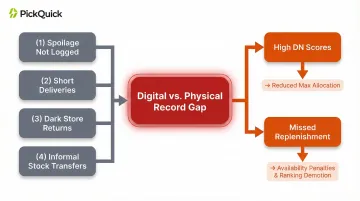
Spoilage, short deliveries, dark store returns, and informal stock transfers often go unlogged in real time, causing the system record to diverge from physical reality.
Manual tracking errors affect inventory accuracy significantly — without advanced tracking, retail inventory accuracy typically hovers around 65-75%.
Automated cycle counts replace periodic wall-to-wall inventory counts, surfacing discrepancies earlier and keeping the digital record aligned with physical stock.
Automated Alerts and Replenishment Triggers
Threshold-based alerts notify operations teams when stock at a dark store drops below a defined minimum. This reduces reliance on manual checking and enables proactive replenishment.
When a store's inventory drops below the minimum threshold, a Replenishment Order (RO) cycle is triggered automatically. RO speed is a ranking signal — delayed confirmation or slow dispatch reduces platform trust and throttles expansion.
Reporting and Analytics
Dashboards give brand managers the numbers they need to make confident restocking and assortment decisions:
- Turnover rates and sell-through velocity
- SKU-level fill rates by location
- Demand trend lines by pincode
- Availability percentage tracking
- Motherhub ageing alerts
Without this layer, a brand managing 30+ dark stores is essentially reacting to stockouts rather than preventing them.
Common Inventory Visibility Challenges
Legacy and Fragmented Systems
Many brands manage inventory across spreadsheets, WhatsApp groups, and disconnected platform dashboards. This creates data silos where no single source shows the true stock position.
Fragmented systems force brands to toggle between Blinkit Seller Hub, Zepto's dashboard, Instamart's portal, and internal spreadsheets. By the time you manually reconcile data, it's already outdated.
The result: duplicate ordering on one end (overstocking because you can't see total inventory) and missed replenishment on the other (stockouts because you didn't know a specific dark store was low).
Manual Processes and Unrecorded Changes
In high-throughput dark store environments, where order picking happens in under 3 minutes, manual tracking degrades rapidly.
Unrecorded events include:
- Spoilage or damage not logged in real time
- Short deliveries during motherhub inwarding
- Dark store returns not reflected in inventory
- Informal stock transfers between stores
These create a growing gap between digital records and physical reality. High DN (Discrepancy Note) scores during inwarding result in replenishment penalties—the platform reduces your Max allocation and throttles expansion.
Demand Uncertainty Across Pincodes
Without pincode-level demand data, brands cannot distinguish between a city-wide stockout and a location-specific gap.
A masala brand might see "Delhi stockout" and respond with broad replenishment, overstocking areas with weak demand while high-velocity pincodes continue to stock out.
Store-level demand visibility is what makes targeted replenishment possible — calibrating Min-Max thresholds by dark store rather than by city, so stock goes exactly where velocity demands it.
How to Improve Inventory Visibility
Adopt Barcode Scanning or RFID at Every Touchpoint
Digitizing the physical movement of goods is the foundational step. Every scan creates a timestamped data record:
- Goods receipt at motherhub: Validate inward quantity, expiry, barcode accuracy
- Transfer to dark store: Track movement between locations
- Dispatch for delivery: Record final inventory reduction
This eliminates reliance on manual entry and keeps the system accurate without human error.
Centralize Inventory Data into a Single Platform
Shift from spreadsheets and siloed platform dashboards to a centralized inventory management system (IMS) or ERP that aggregates stock data across all channels and locations in real time.
Brands implementing centralized OMS report 99.9% fulfillment rates and significant reductions in order processing time.
A single source of truth eliminates context-switching and enables faster, more confident decisions. Brand managers see unified visibility across Blinkit, Zepto, Instamart, and JioMart in one dashboard.
Set Data-Driven Min-Max Thresholds by Location
Rather than applying blanket reorder points across all dark stores, analyze SKU-level velocity and demand patterns by city or pincode to set location-specific minimum and maximum stock levels.
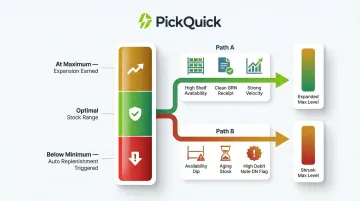
Min-Max optimization works like this:
- Minimum = threshold triggering automatic replenishment request
- Maximum = ceiling on how much inventory a dark store can hold
Max levels expand when stores maintain high availability, clean GRNs, and strong velocity. Max shrinks when availability dips, motherhub stock ages, or DN scores rise.
This prevents both stockouts (in high-velocity stores) and overstock (in slow-moving locations) simultaneously.
Automate Cycle Counts and Reconciliation
Replace periodic wall-to-wall inventory counts with automated, continuous cycle counts. This reduces labour costs, surfaces discrepancies earlier, and keeps the digital record aligned with physical stock.
In dark stores where throughput is high and counting windows are narrow, automated reconciliation is essential. The motherhub inwarding process should validate quantity, expiry, barcode accuracy, and packaging integrity for each unit before it enters the system.
Partner with a Specialized QC Operator for Platform-Level Visibility
For brands scaling across multiple Quick Commerce platforms and cities, building visibility infrastructure independently takes months and significant investment.
PickQuick's end-to-end QC management covers the full visibility stack across Blinkit, Zepto, Swiggy Instamart, and JioMart:
- Pincode-level demand visibility and real-time availability tracking
- Min-Max optimization calibrated by city and SKU velocity
- Unified Control Tower dashboards showing stock levels, availability metrics, and operational health across all channels
Brands go live with complete visibility in weeks rather than months, using pre-built infrastructure across 10,000+ pincodes, existing motherhub operations, and platform-integrated tracking tools.
Frequently Asked Questions
What is real-time inventory visibility?
Real-time inventory visibility means continuously updated, live data on the quantity, location, and status of stock across all channels and locations. It differs from periodic or batch-updated records that lag behind actual physical movement.
Why is inventory visibility important?
Inventory visibility prevents stockouts and overstock, enables accurate demand forecasting, and supports on-time order fulfillment — directly affecting customer satisfaction and profitability. On QC platforms, it also determines search ranking and expansion eligibility.
How to improve inventory visibility?
Start with these five steps:
- Adopt barcode or RFID scanning at every touchpoint
- Centralize data into a unified platform
- Set location-specific Min-Max thresholds
- Automate replenishment triggers
- Reconcile physical stock against digital records regularly
What is SKU level visibility?
SKU-level visibility means tracking stock status, location, and movement for each individual product variant separately, not just at a category or brand level. This enables precise replenishment and assortment decisions.
How are inventory levels monitored in retail stores?
Retail inventory is monitored through barcode scanning at point-of-sale, periodic cycle counts, automated alerts for low-stock thresholds, and integration between POS systems and central inventory management platforms.
Which platforms offer real-time inventory tracking?
WMS and ERP systems provide real-time tracking for warehouses and distribution. Quick Commerce platforms — Blinkit, Zepto, Swiggy Instamart, and JioMart — offer seller-facing dashboards, though third-party operator tools typically give more consolidated, cross-platform visibility.