
Introduction
A customer opens Blinkit at 9 PM, searches for their favourite masala blend, and finds it out of stock. The sale vanishes in seconds—but so does something more valuable: the brand's search ranking.
In India's quick commerce ecosystem, where 10-minute delivery has become the standard, inventory replenishment is no longer a back-office task managed weekly by warehouse teams. It's a front-line growth lever that determines whether a regional dairy brand scales from 15 dark stores to 500, or whether a masala company holds its ground in its home city.
This guide covers the fundamentals of inventory replenishment—what it is, why it matters, the core methods brands use, the factors that drive replenishment decisions, and how the process works differently in dark stores versus traditional warehouses.
TLDR:
- Replenishment is the process of restocking products to meet demand without excess inventory
- Stockouts cost retailers 2-3% of annual sales and trigger algorithmic penalties on QC platforms
- Four main methods exist: reorder point, top-off, periodic review, and demand-driven replenishment
- Quick commerce dark stores require Min-Max models with pincode-level precision
- PickQuick manages dark store replenishment across 10,000+ pincodes with real-time availability tracking
What Is Inventory Replenishment?
Inventory replenishment (also called stock replenishment) is the process of restocking products—either by moving goods from reserve storage to active picking locations, or by ordering new stock from suppliers—to ensure demand is consistently met without accumulating excess inventory.
The goal is to keep shelves full enough to serve customers, but not so full that capital is tied up in slow-moving stock.
Replenishment vs. Inventory Control
These terms are related but distinct:
- Inventory control tracks what's already on hand—monitoring stock levels, locations, and movements
- Inventory replenishment is the active decision to reorder or restock at the right time and in the right quantity
In practice, control gives you the data; replenishment is what you do with it.
Where Replenishment Fits in the Inventory Cycle
Replenishment connects the entire inventory management cycle:
- Receiving — stock arrives from suppliers
- Storing — inventory is placed in reserve or active locations
- Replenishing — stock is moved or reordered based on demand signals
- Picking — items are pulled for customer orders
- Fulfilling — orders are delivered
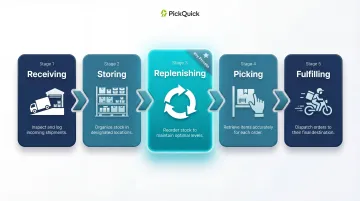
Without effective replenishment, the cycle breaks—stockouts stall picking, and excess inventory locks up working capital.
Why Inventory Replenishment Matters for Your Business
Poor replenishment creates two equally damaging scenarios: stockouts and overstocking.
The Cost of Stockouts
European retail data puts the average out-of-stock rate at 8.6%. When shoppers face an empty shelf, 43% of those incidents result in direct lost sales — the customer buys nothing or switches stores entirely.
In quick commerce, the stakes are higher. Platforms like Blinkit actively suppress out-of-stock items to prevent cart abandonment. Brands dropping below 80% fill rate face severe algorithmic demotion, losing search ranking and ad visibility that takes weeks to recover.
The Hidden Drain of Overstocking
To avoid stockouts, many brands overcompensate—creating a different problem. Industry data shows that inventory carrying costs typically account for 20% to 30% of total inventory value annually. For every ₹1 crore in inventory held, a brand spends ₹20-30 lakh yearly just to maintain it through storage, insurance, shrinkage, and obsolescence.
For perishable categories like dairy, masala, or beverages, overstocking also means expiry waste—dead stock that destroys margins.
Operational Efficiency Impact
Well-timed replenishment reduces:
- Split shipments and emergency restocks
- Expedited freight costs
- Warehouse congestion
- Picking errors due to disorganized storage
When replenishment runs on a tight cycle, logistics become predictable — and that predictability compounds into lower fulfillment costs and stronger platform availability scores over time.
The 4 Main Types of Inventory Replenishment Methods
Most brands use a combination of these methods across different SKU categories.
1. Reorder Point Method
Stock is replenished when it hits a pre-set threshold—the reorder point (ROP).
Formula:
Reorder Point = (Average Daily Sales × Lead Time) + Safety Stock
Example: A masala brand selling on Blinkit moves 50 units daily. Supplier lead time is 5 days. Safety stock is 100 units.
ROP = (50 × 5) + 100 = 350 units
When inventory drops to 350 units, the system triggers a reorder automatically.
Best for: High-velocity "A" items like packaged snacks, dairy, or staples that need continuous dark store availability.
2. Top-Off Method
Fast-moving SKUs are restocked during downtime or slower periods to ensure picking shelves are always full when demand peaks.
In dark stores, this means moving stock from the backroom to pick-faces during off-peak hours (midnight to 6 AM) so stores are fully loaded before morning rush.
Best for: High-velocity products like beverages, bread, or milk where a stockout during peak hours directly costs you the order.
3. Periodic Replenishment Method
Inventory is reviewed and restocked at fixed intervals—weekly, bi-weekly, or monthly—regardless of current stock levels.
This works well for brands with predictable demand and ample storage, but carries the risk of running out between review periods.
Best for: Slow-moving "C" items or scheduled distributor milk-runs where ordering costs are high relative to holding costs.
4. On-Demand (Demand-Driven) Method
Replenishment is triggered by actual customer orders or real-time demand signals rather than fixed schedules or thresholds.
Quick commerce brands increasingly use this approach as platform-level demand data from Blinkit, Zepto, and Swiggy Instamart becomes accessible via direct API integration.
Best for: Brands with API-level access to quick commerce platforms, enabling replenishment decisions based on real consumption patterns rather than guesswork.
Choosing the Right Method: A Quick Reference
| Method | Trigger | Best SKU Type | Risk |
|---|---|---|---|
| Reorder Point | Stock hits threshold | High-velocity staples, dairy | Inaccurate safety stock calculation |
| Top-Off | Fixed schedule (off-peak) | Beverages, bread, milk | Overstocking slow movers |
| Periodic | Fixed time interval | Slow-moving "C" items | Stockout between review periods |
| On-Demand | Real-time demand signal | API-integrated QC brands | Data dependency |
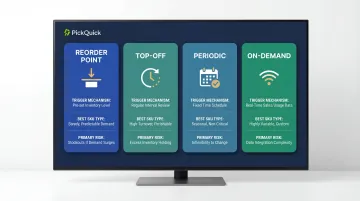
Most brands combine methods by SKU tier: reorder point or top-off for A-category fast movers, periodic reviews for C-category SKUs, and demand-driven triggers for seasonal or promotional lines. Matching the method to the SKU's velocity and criticality is what keeps availability metrics clean without tying up excess working capital.
Key Factors That Drive Inventory Replenishment Decisions
Lead Time
Lead time is the gap between placing an order and receiving stock. Longer lead times require earlier reorders and higher safety stock.
Even a 1-2 day delay can cause stockouts in fast-moving categories. For example, a dairy brand with a 3-day lead time must reorder when stock hits 6 days of supply to maintain a buffer.
Demand Forecasting
Historical sales data, seasonality, and trend analysis predict future demand. Accurate forecasting reduces both stockouts and overstock. When forecasting breaks down, it's typically the first place replenishment failures trace back to.
For regional brands, demand varies dramatically by pincode. A masala blend that dominates in Pune may have zero demand in Bangalore—forecasting must be localized.
Safety Stock
Safety stock is the buffer inventory held to absorb unexpected demand spikes or supply delays.
Formula:
Safety Stock = (Maximum Daily Sales − Average Daily Sales) × Lead Time
Example: A snack brand's average daily sales are 100 units, but maximum daily sales hit 150 units. Lead time is 4 days.
Safety Stock = (150 − 100) × 4 = 200 units
The right safety stock level varies by SKU velocity and supplier reliability. High-velocity SKUs need tighter buffers; unreliable suppliers force brands to carry higher safety stock.
Reorder Point vs. Reorder Quantity
Once you know your safety stock, two decisions follow:
- Reorder point tells you when to replenish
- Reorder quantity (often using Economic Order Quantity or EOQ) tells you how much to order to balance holding costs against ordering costs
EOQ Formula:
EOQ = √(2DS/H)
Where D = annual demand, S = ordering cost per order, H = holding cost per unit per year.
EOQ works best for stable demand and fixed costs. In volatile quick commerce environments, EOQ serves as a baseline that must be adjusted dynamically.
SKU-Level Segmentation
Not all products have the same replenishment needs. High-velocity SKUs need tighter monitoring and more frequent replenishment than slow-movers.
Brands that apply a one-size-fits-all approach often end up with the wrong products overstocked and the right ones out of stock.
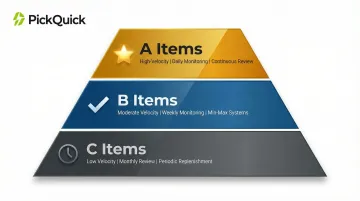
ABC Analysis:
- A items: High-value, high-velocity: daily monitoring, continuous review
- B items: Moderate velocity: weekly monitoring, Min-Max systems
- C items: Low velocity: monthly review, periodic replenishment
Inventory Replenishment in Quick Commerce and Dark Stores
Quick commerce platforms operate through dark stores—small, hyper-local fulfillment hubs with limited storage space. This changes how replenishment works entirely.
The Dark Store Model
Dark stores are micro-warehouses located within 2-3 kilometers of customers, optimized purely for fulfillment speed. Blinkit operates over 1,000 dark stores, each stocking 5,000-25,000 SKUs. Zepto operates 950+ stores, while Swiggy Instamart has expanded to an average of 3,889 sq ft per store.
There's no room for safety stock excess, and a stockout directly drops a brand's search visibility and conversion rate on the platform.
Min-Max Replenishment in Dark Stores
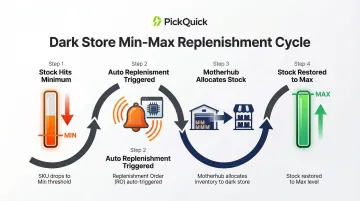
Dark stores use a Min-Max replenishment model: stores keep inventory between a minimum threshold (below which a replenishment order is triggered) and a maximum level (above which storage is wasted).
How it works:
- Each dark store has a Min and Max for each SKU
- When stock drops to Min, a Replenishment Order (RO) is triggered
- The motherhub allocates inventory to bring the store back to Max
- Max levels expand only when brands maintain high availability, clean GRNs, and fast RO confirmation
Getting Min-Max parameters right at the pincode level is hard—and that complexity multiplies across cities.
The Challenge of Multi-City, Multi-Platform Replenishment
A masala brand strong in Karnataka may have very different demand patterns across 50 dark stores in different pincodes versus its stores in Tamil Nadu or Maharashtra. Replenishment must be localized, not centralized.
Regional brands face:
- Managing Min-Max levels independently across hundreds of stores
- Confirming replenishment orders quickly across multiple cities
- Forecasting demand at the pincode level, not just the city level
- Preventing expiry waste as inventory ages across distributed motherhubs
- Maintaining packaging compliance across multiple logistics partners
How PickQuick Manages Dark Store Replenishment
PickQuick manages dark store replenishment for regional brands using a predictive supply model built on pincode-level demand visibility. Rather than reacting to stockouts, the system triggers action before availability drops:
- Live inventory tracking across 10,000+ pincodes
- Automated PO processing synchronized with distributor operations
- Platform-level API integrations with Blinkit, Zepto, Swiggy Instamart, and JioMart
- Dark-store level analytics monitoring availability, ageing, and velocity
- Operational alerts triggering action before stockouts occur
For brands scaling across cities, this means stable availability metrics and clean replenishment records on every platform—the operational baseline that platforms require before expanding a brand's store coverage.
Best Practices for Smarter Inventory Replenishment
Automate Where Possible
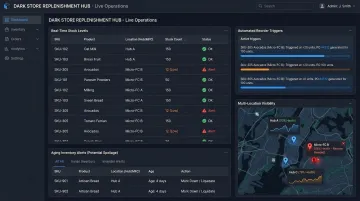
Manual replenishment across dozens of SKUs and locations is error-prone and slow. Inventory management systems (IMS) or integrated platform dashboards that automatically trigger reorders when stock hits a threshold save time and reduce human error.
What to look for in automation tools:
- Real-time stock visibility across all locations
- Automated reorder triggers based on Min-Max or ROP thresholds
- Integration with supplier systems for automated PO creation
- Alerts for aging inventory or approaching expiry dates
- Multi-location rebalancing to shift excess stock between stores
Run Regular Inventory Audits and Cycle Counts
Even automated systems need validation against physical stock. Full stocktakes require operational shutdowns, which are impractical for 10-minute delivery dark stores.
Cycle counting is the better approach: count a portion of inventory on a rolling basis rather than doing a full stocktake. This integrates into daily workflows and catches discrepancies early before they cause replenishment errors.
Best practice:
- Count high-velocity "A" items daily or weekly
- Count moderate "B" items bi-weekly
- Count slow-moving "C" items monthly
Monitor Supplier Reliability as a KPI
Lead time variability from suppliers is one of the biggest wild cards in replenishment planning. According to McKinsey's consumer sector research, poor On-Time In-Full (OTIF) compliance from suppliers is one of the primary drivers of on-shelf availability failures — a pattern that plays out just as sharply in India's quick commerce dark stores, where a missed delivery window can mean a direct stockout within hours.
Track:
- On-time delivery rate by supplier
- In-full delivery rate (no short shipments)
- Lead time consistency (standard deviation of delivery times)
Build contingency plans for critical SKUs — identify backup distributors or regional stockists so a single supplier delay doesn't halt replenishment across your dark store network.
Frequently Asked Questions
What are the different types of inventory replenishment?
The four main types are reorder point (continuous review), top-off (restocking during downtime), periodic review (fixed intervals), and on-demand (demand-driven triggers). Most businesses use a mix depending on SKU velocity and storage capacity.
How to calculate inventory replenishment?
Use the reorder point formula: Reorder Point = (Average Daily Sales × Lead Time) + Safety Stock. The reorder quantity can be optimized using the EOQ formula to balance ordering and holding costs.
When to replenish stock?
Replenish when inventory hits its reorder point — a level calculated from lead time, average daily sales, and your desired safety stock buffer.
What is the process for replenishing stock?
The key steps are: monitoring stock levels, triggering a reorder when the reorder point is hit, placing a purchase order with the supplier, receiving and verifying the stock, and moving it to active picking locations.
How can you automate the replenishment of stock levels?
Inventory management software or WMS platforms can monitor real-time stock levels and auto-generate purchase orders or alerts when stock drops below set thresholds.
What is a stock replenishment system?
A stock replenishment system tracks inventory levels, triggers reorders automatically, and routes stock from suppliers or reserve storage to active fulfilment locations to maintain consistent availability.