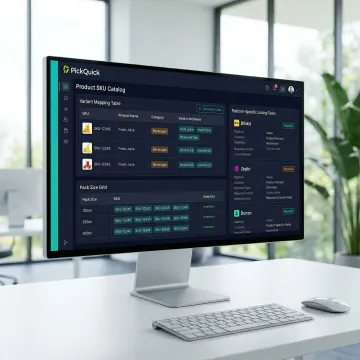
A SKU (Stock Keeping Unit) catalog is a structured database of all your products, where each SKU represents a unique variant — defined by attributes like product name, brand, pack size, MRP, and category. On quick commerce platforms, a well-built SKU catalog ensures every product is listed with the right fields, correct pricing, and optimized titles so customers can find and purchase it easily.
What are SKU-based services?
SKU-based services are operational and catalog management functions organized around individual product units. For quick commerce brands, these include SKU creation, variant mapping, title optimization, compliance verification, pricing updates, and performance tracking at the individual product level. PickQuick's AI-powered approach automates these workflows across Blinkit, Zepto, Swiggy Instamart, and JioMart simultaneously, reducing manual effort and listing errors.
How long does it take to get my products listed on quick commerce platforms?
With PickQuick's fast onboarding process, most brands go live across quick commerce platforms in weeks rather than months — achieving 3–5x faster go-live compared to traditional onboarding. We handle everything upfront: packaging compliance, barcode readiness, professional imaging, catalog creation, and seller hub setup, so platforms receive a ready-to-scale brand from day one.
Which quick commerce platforms does PickQuick support for SKU cataloging?
PickQuick manages SKU cataloging and mapping across all four major quick commerce platforms in India — Blinkit, Zepto, Swiggy Instamart, and JioMart. Each platform has unique listing formats, mandatory data fields, image requirements, and search ranking criteria. We build platform-specific catalogs for each while maintaining a unified product master, ensuring consistency and compliance everywhere.
What information is required to create a SKU listing on quick commerce platforms?
A complete quick commerce listing requires: brand name, product name, variant, pack size, MRP, selling price, landing price, product dimensions, gross weight, category mapping, shelf life, ingredient list, FSSAI license details, HSN code, and GST rate. Image requirements include Front of Pack, Back of Pack with regulatory information, picker image showing outer packaging, and a barcode image with a clearly visible UPC or EAN code.
How does AI improve the SKU cataloging and mapping process?
AI accelerates catalog structuring by automatically extracting product attributes, standardizing data formats, identifying keyword opportunities, and flagging compliance gaps before submission. It enables bulk SKU processing across multiple platforms simultaneously, reducing human error and turnaround time. PickQuick's AI-powered approach also incorporates real-time performance signals — search conversion data and demand patterns — to continuously refine catalog quality.
Can PickQuick help with catalog management after my products go live?
Yes. PickQuick provides ongoing post-live catalog health management, including listing health checks, pricing updates, promotional field updates, and catalog refresh cycles. Real-time dashboards track SKU-level performance metrics across all platforms, and our team proactively addresses listing issues, discrepancies, or platform policy changes to ensure your catalog remains optimized and fully compliant at all times.
Does PickQuick handle catalog setup for regional and hyper-local product brands?
Absolutely. PickQuick holds operator rights to hundreds of regional consumer brands across India and has built deep expertise in hyper-local catalog strategies. We incorporate regional product names, cuisine cues, intensity indicators, and location-specific search terms into listings — ensuring that regional brands achieve strong discoverability in their home cities and successfully expand to neighboring markets without losing catalog relevance.