What is eCommerce catalog management for Quick Commerce?
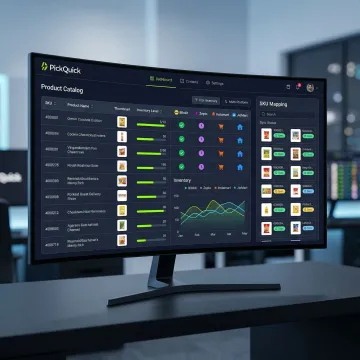
eCommerce catalog management for Quick Commerce involves structuring, optimizing, and maintaining your product listings across platforms like Blinkit, Zepto, Swiggy Instamart, and JioMart. It includes SKU mapping to match each platform's taxonomy, creating search-optimized titles and descriptions, managing variant hierarchies, ensuring compliance with packaging and labeling standards, and maintaining real-time inventory accuracy. Effective catalog management ensures your products are discoverable, correctly categorized, and ready to convert while meeting each platform's technical requirements and operational standards.
How long does it take to onboard a catalog onto Quick Commerce platforms in India?
With PickQuick's fast onboarding service, brands can go live across Quick Commerce platforms in 3-5 weeks, compared to 3-6 months when onboarding independently. We handle all compliance documentation (FSSAI, GSTIN, GS1 barcodes), prepare product images meeting platform specifications, create optimized listings, configure seller portals, and set up replenishment systems before your first inventory arrives. The timeline depends on catalog complexity and documentation readiness, but our pre-built templates and established platform relationships significantly accelerate the process, especially for brands entering multiple Indian cities simultaneously.
What's the difference between managing catalogs on Blinkit, Zepto, Swiggy Instamart, and JioMart?
Each platform has unique requirements: Blinkit emphasizes pack-size variants and strong picker images, with L0-L5 expansion stages requiring careful Min-Max management. Zepto has stricter listing approval processes but rewards well-structured catalogs with excellent visibility once live. Swiggy Instamart excels at variety acceptance and cooking accompaniments, requiring detailed ingredient and usage information. JioMart focuses on bulk pack sizes with GT-style purchasing patterns. Successful multi-platform catalog management requires understanding these nuances while maintaining operational consistency. PickQuick's unified system handles these platform-specific variations automatically while providing centralized visibility and control.
How do you optimize catalog listings for Quick Commerce search visibility?
Quick Commerce search optimization combines keyword research with platform-specific ranking signals. We optimize listing titles with high-intent search terms, include relevant category keywords, and structure descriptions to match customer search patterns. Product images must be high-quality and clearly show front-of-pack details. We also focus on maintaining strong availability metrics, as stockouts hurt search rankings. Review ratings, pricing competitiveness, and catalog freshness also impact visibility. For regional brands serving specific Indian cities, we incorporate local terminology and cuisine-specific keywords that resonate with the hyperlocal customer base on each platform.
What catalog data is needed to launch on Quick Commerce platforms?
Essential catalog data includes: product name, brand name, variant details (size/flavor/pack), MRP and selling price, dimensions and gross weight, shelf life and manufacturing details, FSSAI license number, HSN code and GST rate, barcode (UPC/EAN), category mapping, and ingredient list. Images required: front-of-pack, back-of-pack with regulatory info, picker image showing outer packaging, and clear barcode image. Additional requirements vary by platform—Blinkit needs Min-Max inventory levels, Zepto requires specific compliance documentation, Instamart needs detailed usage descriptions. PickQuick prepares all this data in the correct format for each platform during onboarding.
How is inventory synchronized across multiple Quick Commerce platforms?
PickQuick uses a Quick Commerce Control Tower that integrates with platform APIs and OMS systems to maintain real-time inventory synchronization. When stock moves from your warehouse to platform dark stores, availability updates automatically across all channels. Our system tracks inventory at the dark-store level, generates replenishment orders (ROs) based on Min-Max thresholds, monitors stock aging, and flags potential stockouts before they impact sales. This prevents overselling, reduces operational errors, and ensures consistent availability across platforms. For brands operating across multiple Indian cities, we provide pincode-level inventory visibility and automated replenishment signals.
What are Min-Max levels and why do they matter for catalog performance?
Min-Max levels are store-level inventory holding limits that Quick Commerce platforms use to manage dark store capacity and replenishment frequency. The 'Min' triggers automatic replenishment orders when stock dips below threshold; the 'Max' caps how much inventory a dark store can hold for your SKU. Strong performance—high velocity, clean GRNs (Goods Received Notes), low DNs (Discrepancy Notes)—expands your Max, allowing deeper inventory placement and better availability. Weak performance contracts your Max, limiting availability and sales. Proper Min-Max management is critical for maintaining consistent on-shelf availability and avoiding lost sales during peak demand periods.
How do you handle catalog expansion to new cities and pincodes in India?
Hyperlocal expansion requires pincode-level planning based on demand signals, competitor presence, and dark store coverage. PickQuick starts by identifying high-potential pincodes within a city, then maps available dark stores and analyzes which SKUs perform best in similar markets. We prioritize regional favorites, adjust pack sizes for local preferences, and use city-specific keywords in listings. For masala brands, we emphasize regional blends; for dairy, we focus on shelf life and cold chain reliability. Expansion happens in phases—trial clusters first (10-15 stores), then scaling based on velocity, availability, and complaint metrics. Our 10,000+ pincode network provides benchmarking data to guide smart expansion decisions.