Introduction: Why Dairy Scheduling & Dispatch Optimization Can't Be Ignored
Dairy products are among the most unforgiving goods in any supply chain. A delayed milk delivery means spoiled inventory, lost revenue, and a customer lost for good. Unlike shelf-stable FMCG products, dairy operates within narrow perishability windows: fresh paneer has a shelf life of just 1-2 days at ambient temperatures, while traditional milk-based sweets spoil within 1-4 days. The Food Safety and Standards Authority of India mandates that pasteurized milk must be stored below 8°C, making temperature control non-negotiable.
Perishability is only one constraint. Dairy demand spikes unpredictably: 67% of South Indian consumers drink milk at breakfast, creating predictable morning peaks, yet festivals like Diwali can drive 1.9x Gross Order Value surges on Quick Commerce platforms.
Multi-channel complexity compounds this further. Supplying retail chains, HoReCa partners, D2C subscriptions, and Quick Commerce dark stores simultaneously means scheduling becomes the line between profit and waste.
Getting that scheduling right requires a clear framework. This guide covers four pillars: the unique challenges of dairy logistics, how to build an optimized dispatch schedule, Quick Commerce-specific dark store replenishment, and the KPIs that prove your system works.
Key Takeaways
- Dairy scheduling must balance perishability, route complexity, and demand volatility — all at once
- Manual planning, poor demand visibility, and disconnected systems cause the biggest scheduling failures
- Quick Commerce requires pincode-level demand tracking and Min-Max inventory logic for dark store replenishment
- Route optimization and QC ops platforms together cut delivery costs while reducing stockouts
- On-time delivery rate, route efficiency, fill rate, and location-level availability are the KPIs that reveal where scheduling breaks down
Why Dairy Scheduling Is Fundamentally Different from Standard Logistics
The Perishability Constraint
Unlike general freight, dairy products require unbroken cold chains and strict time-to-market schedules. Shelf life is tight across the category:
- Fresh paneer: 5–6 days under refrigeration
- Traditional milk-based sweets: 1–4 days
- Pasteurized milk: requires continuous storage below 8°C
Any scheduling system must factor in production time, cooling time, and delivery windows together. A late dispatch is as damaging as no dispatch at all.
The FSSAI mandates storage temperatures not exceeding 8°C for pasteurized milk, meaning temperature deviations during transport directly impact product safety and shelf life.
The Demand Pattern Problem
Dairy demand in India follows highly predictable daily patterns, but volume spikes are anything but predictable. Morning milk runs dominate consumption: 67% of South Indian consumers use milk during breakfast, while 54% consume it as an evening snack.
Festival periods compound this further. RedSeer data shows New Year's Eve drives ~1.9x GOV uplift on on-demand platforms, while standard holidays generate ~1.3x GMV increases driven entirely by higher order volumes. Scheduling systems that ignore these spikes will understock during peaks and overstock during troughs — and multi-channel operations make this balancing act even harder.
Multi-Channel Complexity
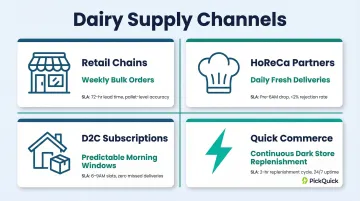
Modern dairy brands simultaneously supply:
- Retail chains with weekly bulk orders
- HoReCa partners requiring daily fresh deliveries
- D2C subscriptions with predictable morning delivery windows
- Quick Commerce platforms needing continuous dark store replenishment
Each channel has different lead times, order sizes, and SLA requirements. A single dispatch schedule must accommodate all four without creating conflicts or capacity bottlenecks.
Key Challenges in Dairy Scheduling & Dispatch
Challenge 1: Manual Scheduling Bottlenecks
Most small and mid-size dairy operations still build dispatch plans manually—often over phone calls or WhatsApp groups. This creates errors in order aggregation, missed time windows, and zero visibility into driver status or vehicle capacity utilization.
According to DPIIT data, small firms (turnover up to ₹5 crore) incur logistics costs of 16.9% of their output, compared to just 7.6% for large firms (turnover above ₹250 crore). This disparity highlights the cost penalty of lacking integrated, digitized supply chains.
McKinsey analysis reveals that "blind handoffs"—inefficient manual coordination between shippers, dispatchers, and carriers—can account for 13-19% of total logistics costs. These manual errors lead to customer dissatisfaction, with 85% of consumers stating they won't shop with a retailer again after a poor delivery experience.
Challenge 2: Last-Mile Route Inefficiency
Without route optimization, dairy drivers often follow habitual routes rather than optimal ones, leading to unnecessary mileage, fuel waste, and late deliveries. Multi-stop route planning for dairy must account for:
- Delivery sequence (priority customers first)
- Road conditions and traffic patterns
- Vehicle load weight and capacity
- Time windows for each stop
Manual route planning ignores these factors, resulting in routes that cover more distance than necessary while missing delivery windows.
Challenge 3: Inventory-Dispatch Disconnect
When warehouse inventory data isn't synced with the dispatch schedule in real time, drivers leave with incomplete loads, or products allocated to one channel get dispatched to another.
This is especially costly for high-frequency SKUs like toned milk or flavoured yoghurt. A stockout at one location while another holds excess creates immediate revenue loss—and it's entirely preventable with real-time sync.
Challenge 4: Demand Forecasting Gaps
The inventory sync problem above often has a root cause upstream: forecasting. Dairy brands that rely on historical averages rather than dynamic forecasting frequently face stockouts during demand peaks and waste during slow periods.
Globally, the FAO estimates that 20% of dairy products are lost due to poor harvesting, storage, transportation, and marketing. In India, FICCI reports that post-harvest losses average 47% for perishables overall—a figure that points directly to the gap between what's produced and what actually reaches the consumer.
The forecasting problem compounds in summer. During peak summer months, chilled dairy shrinkage in Indian retail and dark stores ranges between 1.5% and 3.5% of category throughput value. Most of that loss traces back to visibility gaps—manual temperature checks that miss hours of refrigeration drift when units are under stress.
Without dynamic, SKU-level forecasting, brands face three compounding problems:
- Over-ordering on slow SKUs ties up cold chain capacity
- Under-ordering on fast movers triggers stockouts at peak demand
- No early warning system to catch spoilage before it hits throughput metrics
Challenge 5: Scaling Complexity Across Cities and Platforms
As dairy brands expand geographically or add Quick Commerce as a sales channel, scheduling complexity compounds fast. Each new city adds depots, delivery zones, and platform-specific replenishment requirements that manual systems simply weren't built to handle.
The breaking point typically hits when brands try to coordinate dark store replenishment across Blinkit, Zepto, and Swiggy Instamart simultaneously while keeping retail and D2C deliveries on schedule. Without integrated tooling, something always slips.
How to Build an Optimized Dairy Dispatch Schedule
Demand Forecasting as the Foundation
An optimized dispatch schedule must begin with accurate demand signals, not static historical data. Build demand forecasts using:
- Past sales velocity by SKU and location
- Seasonal patterns including festivals, weekends, and regional events
- Upcoming promotional events that drive demand spikes
- Platform-level order trends (e.g., Blinkit order spikes on Sunday mornings)
Pincode-level or zone-level demand visibility—rather than city-level averages—allows dispatch planners to allocate the right quantities to the right micro-locations, reducing both overstock and stockouts.
Route Planning & Load Optimization
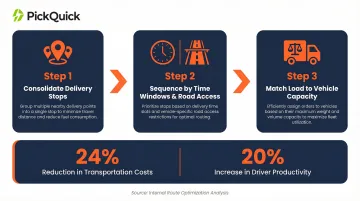
The multi-stop route planning process should:
- Consolidate all delivery stops for a given zone
- Sequence them by delivery time windows and road access
- Match load weight to vehicle capacity before dispatch
Locus reports that implementing advanced route planning constraints resulted in a 24% reduction in transportation costs and a 20% increase in driver productivity. Similarly, FarEye notes that companies adopting intelligent route planning see a 15-25% reduction in last-mile delivery costs.
Load optimization involves grouping SKUs by:
- Weight distribution
- Fragility requirements
- Temperature zones
This maximizes the number of stops per trip while avoiding product damage.
Real-world example: The National Dairy Development Board initiated a GIS-based milk route optimization exercise in August 2022 under the Vidarbha Marathwada Dairy Development Project. By redesigning routes for four milk chilling centres, the pilot reduced route distances by 88 km per shift without reducing the number of transport vehicles, cutting per-shift fuel and operational costs proportionally.
Scheduling Cadence & Real-Time Adjustment
Optimized routes only hold their value when the schedule behind them stays current. Static schedules (set once per day or week) work for small operations with predictable demand. Dynamic schedules—adjusted in real time based on new orders, cancellations, or route delays—are essential once you're managing three or more vehicles across multiple zones.
Dispatch exceptions should trigger automatic rerouting:
- A driver running late
- A customer rejecting an order
- A vehicle breakdown
Automated reallocation reduces the manual back-and-forth that slows dispatch teams, ensuring the schedule adapts to reality without human intervention at every step.
Quick Commerce & Dark Store Replenishment Scheduling for Dairy Brands
The Fundamental Shift
Quick Commerce platforms—Blinkit, Zepto, Swiggy Instamart, JioMart—have introduced a fundamentally different scheduling requirement for dairy brands. Instead of scheduling deliveries to end consumers, brands now schedule replenishment to dark stores: fulfillment centers that must stay stocked at all times to fulfill 10-minute delivery promises.
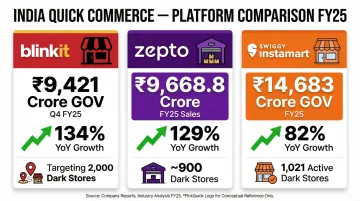
Key platform metrics (2024-2026):
| Platform | Metrics |
|---|---|
| Blinkit | ₹9,421 crore GOV in Q4 FY25 (134% YoY growth); targeting 2,000 dark stores by Dec 2025 |
| Zepto | ₹9,668.8 crore total sales for FY25 (129% YoY growth); ~900 dark stores |
| Swiggy Instamart | ₹14,683 crore GOV in FY25 (82% YoY growth); 1,021 active dark stores |
Min-Max Inventory Logic for Dark Store Scheduling
Each dark store has:
- Min threshold — below which a replenishment order is triggered
- Max capacity — above which replenishment stops
- Velocity — how quickly a store sells through its stock
Dairy brands must schedule replenishment runs to hit the sweet spot, especially for high-velocity items like milk packets, butter, and paneer.
The Unique Challenge of Dairy SKUs in QC Dark Stores
Dairy products have short shelf lives, meaning overstocking is as dangerous as understocking. Replenishment scheduling must align with daily sell-through rates for each SKU. Expired stock at a dark store directly impacts a brand's availability metrics and platform ranking.
During peak summer months, chilled dairy shrinkage in Indian retail and dark stores ranges between 1.5% and 3.5% of category throughput value—often due to visibility gaps where manual temperature checks miss hours of drift when refrigeration units are stressed by frequent door openings.
Demand Patterns Vary by Pincode and Dark Store
A dark store in a residential colony in Bengaluru sees peak milk demand at 7–9 AM. A dark store serving a commercial area hits its peak closer to noon. Scheduling replenishment uniformly across all dark stores ignores this variation and causes localized stockouts.
Actowiz Solutions notes that understanding pincode-level delivery speed and slot availability allows brands to optimize inventory placement and predict demand patterns, directly impacting cart conversions.
Example: Amul leverages its ₹50 milk pouch as a high-frequency "hook" to drive a 93% availability rate on QC platforms, utilizing its cold-chain logistics to supply directly to Blinkit and Zepto dark stores.
The PickQuick Advantage
This pincode-level complexity is where most dairy brands hit an operational ceiling. Managing replenishment schedules in-house across Blinkit, Zepto, Swiggy Instamart, and JioMart simultaneously—across multiple cities—becomes unmanageable without dedicated infrastructure.
PickQuick's end-to-end QC operations model is built for exactly this. For dairy brands like Nandini Dairy and Aavin Dairy, PickQuick uses pincode-level demand visibility and clean replenishment practices to maintain stable availability metrics across 10,000+ pincodes.
Technology Tools That Power Dairy Scheduling & Dispatch
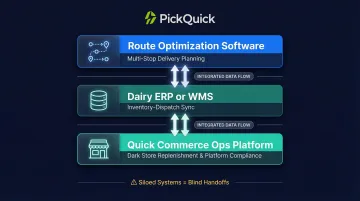
Modern dairy operations use a three-layer technology stack:
- Route optimization software for multi-stop delivery planning
- Dairy ERP or WMS for syncing inventory with dispatch
- Quick Commerce ops platforms for managing dark store replenishment and platform compliance across Blinkit, Zepto, and Swiggy Instamart
The most effective implementations integrate all three layers rather than running them in silos.
What to Look for in Route Optimization Tools for Dairy
Dairy-specific route optimization tools must include:
- Temperature-zone awareness to maintain cold chain compliance
- Time-window enforcement to meet delivery SLAs
- Real-time driver tracking for visibility and accountability
- Dynamic re-routing capability mid-delivery to handle exceptions
GPS-only tools miss the scheduling intelligence that perishable delivery actually demands.
The Role of Mobile Apps for Drivers
A driver mobile app that syncs with the dispatch schedule in real time can:
- Eliminate paper-based manifests
- Reduce missed stops
- Allow proof-of-delivery capture
Each completed delivery generates data — stop timings, deviation patterns, proof captures — that feeds directly back into tighter scheduling for the next cycle.
Adoption Rates and NDDB Initiatives
India's cooperative dairy sector has accelerated this shift at scale. The NDDB Dairy ERP (NDERP) has been implemented in nine organizations across India to digitize mass balancing and reduce Fat and Solid-Not-Fat (SNF) losses. The Automatic Milk Collection System (AMCS) is operational in 12 states, covering over 26,000 Dairy Cooperative Societies and benefiting over 17.3 lakh milk producers.
ROI and Efficiency Gains
The business case for digitizing dairy dispatch is well-documented. Key benchmarks from McKinsey's digital logistics research show:
- 10–20% performance improvement in the short term after adopting digital dispatch tools
- 20–40% gains within two to four years as routing and scheduling mature
- 35–40% reduction in direct logistics costs when real-time visibility is combined with AI workflow automation
For dairy brands scaling across Quick Commerce platforms, these gains compound — cleaner replenishment cycles mean fewer stockouts, better fill rates, and stronger availability scores on Blinkit and Zepto.
KPIs to Measure Dairy Scheduling & Dispatch Performance
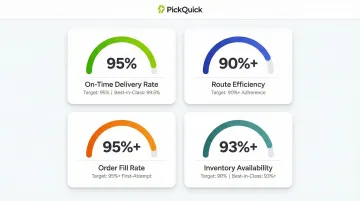
Four Essential KPIs
1. On-Time Delivery Rate
Percentage of deliveries arriving within the committed time window. In optimized Indian logistics networks, best-in-class platforms achieve 99.5% SLA adherence for on-time delivery.
2. Route Efficiency
Actual kilometers driven versus optimal planned route. This KPI reveals whether drivers are following optimized routes or reverting to habitual patterns that waste fuel and time.
3. Order Fill Rate
Percentage of orders fulfilled completely on the first dispatch attempt.
4. Inventory Availability Rate
Percentage of time a SKU is in stock and orderable at a given location. For QC platforms, this gap is significant: Amul achieves an estimated 93% availability rate on Blinkit through predictive inventory AI, compared to roughly 67% for unbranded or local competitors.
How to Use These KPIs to Identify Failure Points
Each KPI points to a specific process to fix:
- Fix demand forecasting or inventory-dispatch sync when fill rate drops
- Review route planning and vehicle capacity when on-time delivery slips
- Audit replenishment scheduling when availability falls below target
- Check driver compliance and route logic when efficiency lags planned routes
Industry Benchmarks
Use these thresholds to gauge where your operation stands against FMCG and dairy leaders in India:
- On-time delivery rate: Aim for 95%+ (best-in-class: 99.5%)
- Route efficiency: Target 90%+ adherence to planned routes
- Order fill rate: Target 95%+ first-attempt fulfillment
- Inventory availability: Target 90%+ (best-in-class: 93%+)
Frequently Asked Questions
What is the difference between dairy scheduling and dairy dispatch optimization?
Scheduling refers to planning when and how much product to move—production timing, replenishment windows, delivery slots. Dispatch optimization refers to the real-time execution layer: assigning routes, vehicles, and drivers efficiently to fulfill that schedule.
How does route optimization reduce costs for dairy deliveries?
Route optimization reduces fuel consumption, minimizes overtime hours, and increases stops per vehicle per day. In practice, brands report 15–25% reductions in last-mile delivery costs and up to 24% lower transportation spend—directly improving margin per delivery.
What is dark store replenishment and why does it matter for dairy brands?
Dark stores are micro-warehouses used by QC platforms like Blinkit and Zepto to fulfill 10–20 minute deliveries. Dairy brands must schedule replenishment runs based on real-time sell-through rates and min-max thresholds—falling short means stockouts; overshooting means spoilage.
How often should a dairy brand update its dispatch schedule?
High-frequency dairy operations should update dispatch schedules daily or in real time, especially for QC replenishment. Static weekly plans only hold up for very small operations with genuinely predictable demand—rare in dairy.
What technologies do dairy brands use for scheduling and dispatch?
Dairy brands use route optimization software, dairy ERP/WMS platforms, driver mobile apps, and QC ops management tools. Integration between these systems is more important than any single tool—siloed systems create the blind handoffs that drive up costs.
Can a small dairy brand benefit from dispatch optimization?
Yes. Even small dairy operations with 2-5 vehicles can reduce fuel costs and missed deliveries through basic route planning tools. The ROI scales significantly as the number of delivery stops and channels increases.