This isn't a hypothetical scenario. It's the reality for most regional FMCG brands entering India's ₹6-7 billion quick commerce market. The strategic question isn't whether to choose Blinkit or quick commerce—it's understanding that Blinkit is one platform within a broader ecosystem, and knowing when to expand from single-platform dominance to multi-platform reach.
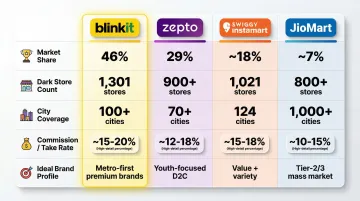
According to Motilal Oswal's November 2024 market analysis, Blinkit commands approximately 46% of India's quick commerce market, while Blinkit, Zepto, and Swiggy Instamart collectively control over 85% of all orders. For brands, this means Blinkit is the proven starting point—but the remaining 54% of the market represents millions of customers you're not reaching.
Key Takeaways
- Blinkit holds ~46% of India's quick commerce market and serves as the most structured entry point for regional FMCG brands, with its level progression system and seller-led controls
- The broader QC ecosystem—Blinkit, Zepto, Swiggy Instamart, and JioMart—covers 85%+ of all quick commerce orders, each serving distinct customer demographics
- Zepto excels with younger urban demographics and tech-led operations; Instamart dominates essentials and masala categories across 124 cities; JioMart delivers tier-2 city penetration
- Multi-platform presence consistently outperforms single-platform focus once a brand hits Level 2+ on Blinkit with a 90%+ fill rate and positive contribution margins
- Managing operations across all four platforms simultaneously is the real challenge — complexity compounds fast without a structured execution system in place
Blinkit vs Quick Commerce: Quick Comparison
| Dimension | Blinkit | Zepto | Swiggy Instamart | JioMart |
|---|---|---|---|---|
| Market Share | ~46% (Nov 2024) | ~29% | Part of 85%+ top 3 | Emerging player |
| Dark Store Count | 1,301 (Mar 2025) | 900+ | 1,021 (Mar 2025) | 800+ |
| City Coverage | 100+ cities | 70+ cities | 124 cities | 1,000+ cities |
| Commission Range | 2-18% (price-tiered) | 22-23% take rate | 15.2% take rate | Not publicly disclosed |
| Inventory Model | Seller-led (Seller Hub) | Vendor/PO model | Vendor/PO model | Vendor/PO model |
| Expansion Target | 2,000 stores by Dec 2025 | 1,200 stores by Mar 2025 | Megapods (10-12k sq ft) | Tier-2/3 city focus |
| Primary Customer | Metro households, repeat-purchase FMCG | Young urban professionals | Essentials-driven, food ecosystem | Tier-2 city families, bulk buyers |
| Onboarding Complexity | Moderate (Seller Hub learning curve) | High initially, scales easily | Moderate (Vendor Score focus) | Lower for regional brands |
| Ideal Brand Profile | First-time QC entrants, FMCG category leaders | Premium positioning, younger demographics | Masala/essentials brands, high variety | Regional champions, tier-2 presence |
The Core Contrast: Blinkit runs a structured seller-led model with defined progression tiers and centralized controls. Each competing platform operates differently — distinct inventory models, replenishment cycles, and customer acquisition logic. A masala brand dominant in South India, for instance, may find JioMart or Instamart essential for tier-2 reach that Blinkit's 100-city footprint doesn't yet cover.
What is Blinkit?
Blinkit is India's largest quick commerce platform, delivering groceries, FMCG, personal care, and electronics in 10-15 minutes through a dark store micro-fulfillment model. Owned by Zomato since August 2022 for $568 million, it represents a fundamentally different supply chain architecture than traditional e-commerce.
Instead of centralized warehouses shipping nationwide, Blinkit operates 1,301 dark stores (as of March 2025) embedded 2-3 km inside residential neighborhoods, each stocked with 2,000-4,000 SKUs optimized for hyperlocal demand.
This model demands a different operational approach. Brands can't ship inventory once and forget it—they must manage daily replenishment cycles, maintain 90%+ fill rates across dozens or hundreds of dark stores, and optimize Min-Max inventory levels at the store level. Success on Blinkit isn't about product quality alone; it's about supply chain precision.
Market Position and Expansion Trajectory
Blinkit is aggressively expanding toward 2,000 dark stores by December 2025, up from 638 stores just 18 months prior. This expansion translates directly into brand visibility and pincode coverage. Blinkit's Gross Order Value grew from ₹12,469 crore in FY24 to ₹22,371 crore in FY25, with order volumes doubling from 203 million to 424 million. For brands, this growth represents expanding customer access—but only if they can maintain operational discipline across the network.
The Blinkit Seller Hub and Level Progression System
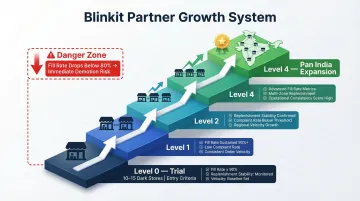
Blinkit's Level system is how brands scale from trial to nationwide presence. Every brand enters at Trial (Level 0) with 10-15 dark stores testing demand and operational readiness. Performance determines progression through Levels 1-3 toward Pan India (Level 4), where brands achieve city-wide dominance.
Crucially, level advancement is earned, not purchased. Blinkit's algorithm evaluates:
- Availability percentage (target: 90%+)
- Replenishment stability (clean RO cycles, zero ageing)
- Velocity (how fast stores consume max inventory)
- Complaint rates (picker accuracy, packaging quality)
- Fill rate consistency (the danger zone: below 80% triggers demotion)
When these metrics are strong, Blinkit expands brands automatically. When they weaken, expansion stalls regardless of marketing spend. Strong metrics unlock automatic expansion; weak metrics freeze it—making operational execution the single biggest lever brands control.
Category Performance on Blinkit
Blinkit excels in high-frequency, repeat-purchase categories:
- FMCG staples (rice, atta, dal, edible oils)
- Packaged foods and snacks (namkeen, biscuits, ready-to-eat)
- Beverages (dairy, juices, energy drinks)
- Personal care and household essentials
- Gifting (increasingly important during festivals)
The platform's repeat-purchase depth makes it powerful for regional brands. A customer ordering your masala once might become a weekly buyer—Blinkit's 10-minute delivery encourages habitual purchases that traditional e-commerce can't match on speed.
Critical Metrics Brands Must Track
Tracking the right numbers separates brands that grow from those that stall. The three metrics that matter most:
| Metric | What Blinkit Watches | What Happens If You Miss |
|---|---|---|
| Fill Rate | Sustained 90%+ across all dark stores | Below 80% triggers demotion — search rank drops, ads lose visibility, expansion halts |
| Daily Run Rate | Sales velocity per store | Strong velocity prompts Blinkit to raise Max allocation and expand to more stores |
| Contribution Margin per SKU per City | Unit economics at city and SKU level | Negative margin cities drain revenue even when topline looks healthy |
Commission rates range from 2% (products under ₹300) to 18% (above ₹1,200), plus ₹5 inwarding fees, storage charges, and ₹50 fulfillment fees per order. Brands need to model these costs at the city and SKU level before scaling — not after.
What is Quick Commerce?
Quick commerce is an ecosystem of 10-15 minute delivery services that collectively represent a fundamental shift in urban Indian retail. This ecosystem currently includes Blinkit, Zepto, Swiggy Instamart, and JioMart, with emerging players like Flipkart Minutes scaling rapidly. Together, these platforms processed over ₹6,000 crore in GMV during 2024, and RedSeer projects the market will reach ₹35,000 crore by 2030 at a ~40% CAGR.
This isn't a niche channel—it's a dominant force cannibalizing traditional e-commerce in high-frequency categories. For regional FMCG brands, quick commerce operates less as a sales channel and more as a fulfillment layer on top of existing consumer demand.
Platform Differentiation: Who Reaches Which Customers
Zepto — Younger Demographics, Tech-Forward Monetization
Zepto operates 900+ dark stores across 70+ cities with a vendor/PO model that differs structurally from Blinkit's seller-led approach. The platform holds approximately 29% market share and targets younger urban professionals with tech-forward features like "Swap & Save"—an ad format that intercepts consumers' carts when they add a competitor's product, offering the advertising brand's product as a better-value alternative with a single tap.
Zepto's take rate has climbed to 22-23%, the highest among major platforms, reflecting its premium positioning and aggressive monetization strategy ahead of its planned IPO. For brands, Zepto delivers complementary reach beyond Blinkit—particularly in metro cities where younger demographics prefer Zepto's interface and assortment.
Swiggy Instamart — Essentials Depth and Cross-Category Reach
Swiggy Instamart operates 1,021 dark stores across 124 cities, leveraging Swiggy's food delivery ecosystem to cross-sell essentials. The platform uses a vendor/PO model with a Vendor Score system tracking OTIF (On Time In Full), LTA (Late Turnaround), Line Fill Rate, and Unit Fill Rate to determine PO allocations.
With a 15.2% take rate in Q2 FY25, Instamart runs strong in essentials-driven categories. For masala brands specifically, it's widely recognized as the best platform in India—offering the highest variety acceptance, excellent repeat-purchase behavior, and strong performance across both CTC (Chilli, Turmeric, Coriander, Cumin) and blended masalas.
JioMart — Tier-2 and Tier-3 Reach, Offline-to-Online Bridge
JioMart operates across 5,000 pincodes through 800+ dark stores in 1,000+ cities, with a 30-minute delivery model focused heavily on tier-2 and tier-3 markets. For regional FMCG brands with strong offline presence in these markets, JioMart provides an offline-to-online bridge that other platforms don't match. The platform's reach into smaller cities creates incremental revenue opportunities beyond metro-focused competitors.
Who These Platforms Actually Reach
The same product serves different consumers on different platforms:
- A young professional in Bengaluru's Koramangala orders your masala on Zepto during evening cooking
- A homemaker in Pune adds it to her weekly essentials basket on Instamart alongside atta and rice
- A family in tier-2 Mysore discovers it on JioMart while transitioning from offline kirana purchases
These are not the same customer. Single-platform presence means you're visible to one segment while competitors capture the other two.
The Supply Chain Reality of Multi-Platform QC
Each platform uses a different operational model:
- Blinkit: Seller-led Seller Hub with direct RO (Replenishment Order) creation and Min-Max control
- Zepto: Vendor/PO model where the platform generates purchase orders brands must fulfill
- Instamart: Vendor/PO model with Vendor Score-based PO allocation and motherhub coordination
- JioMart: Vendor model with tier-2 city distribution networks
Operating across all four means brands need:
- Pincode-level demand visibility across four separate platforms
- Platform-specific replenishment cycles (Blinkit's RO discipline differs from Zepto's PO timing)
- Separate account management relationships and compliance protocols
- Distinct ad wallet management and promotional strategies
The operational load doesn't scale linearly—it compounds. Managing four platforms independently requires four times the catalog work, four separate inventory allocation strategies, four account manager relationships, and four analytics dashboards.
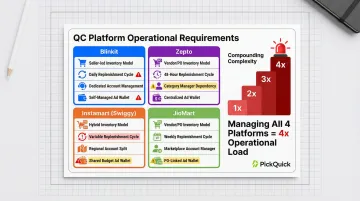
Most brands hit this wall and either stall on expansion or start bleeding margin on compliance failures.
High-Performance Categories Across QC
The quick commerce ecosystem excels in:
- High-frequency staples (atta, rice, dal, edible oils)
- Dairy and fresh products (milk, curd, paneer)
- Beverages (packaged drinks, dairy, energy drinks)
- Masalas and spices (both CTC and blended varieties)
- Personal care essentials (soaps, shampoos, skincare)
- Packaged snacks (namkeen, biscuits, chips)
Regional brands with ₹5-7 crore/month GT/MT (General Trade/Modern Trade) presence are well-positioned. The consumer demand already exists—QC becomes a fulfillment layer delivering the same products faster. The real challenge is whether your supply chain can support hyperlocal fulfillment across dozens of dark stores simultaneously.
Blinkit vs Quick Commerce: What's Better for Your Brand?
The answer depends on five factors: QC maturity stage, operational capacity, category type, geographic ambition, and budget for inventory and advertising.
Key Evaluation Factors
- QC maturity stage — First-time entrants face different risks than brands already validating unit economics on an active platform
- Operational capacity — Multi-platform replenishment requires real-time inventory visibility, Min-Max optimization, and motherhub coordination; most regional brands build this over time
- Category type — Impulse categories (snacks, beverages, gifting) scale differently than daily essentials (staples, dairy, personal care); repeat-purchase velocity determines platform prioritization
- Geographic footprint — Demand concentrated in 2-3 metros behaves differently than multi-city GT/MT presence; the answer changes whether multi-platform reach adds revenue or just complexity
- Budget for ads and inventory — Plan for 30-60 days of inventory float across motherhubs and dark stores, plus quarterly ad spend commitments before you see returns
Choose Blinkit First If:
You're entering QC for the first time. Blinkit's Seller Hub gives you free keyword and demand data before you pay a listing fee, and the level progression system creates a clear feedback loop — perform well, earn expansion. It's the lowest-risk entry point.
Your supply chain isn't dark-store-ready across cities. Managing one platform's replenishment cycles, Min-Max optimization, and fill rate discipline is simpler than coordinating vendor/PO models across three or four simultaneously. Get the operational fundamentals right on Blinkit first.
You need to validate unit economics before committing capital. Blinkit's tiered commission structure (2-18% based on price), plus fulfillment fees and storage charges, creates a transparent cost model. Prove positive contribution margins here before expanding inventory across platforms.
Choose Full QC (Multi-Platform) If:
The primary reason brands stall at single-platform presence isn't strategic — it's operational. Managing separate dashboards, ad wallets, inventory allocation, and account manager relationships across four platforms creates fragmentation that drains margin and slows decision-making.
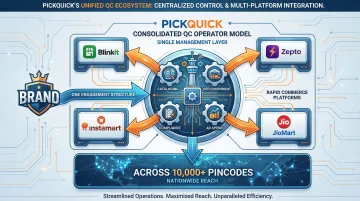
This is where consolidated QC operators deliver measurable value. PickQuick manages 25+ category-leading brands across all major QC platforms and 10,000+ pincodes — handling cataloging, replenishment, ad spend, and compliance under a single engagement. Brands get cross-platform visibility without multiplying internal headcount.
Brands with ₹5-7 crore/month offline demand that expand through a consolidated operator see 3-5x faster go-live timelines and more stable availability metrics than brands coordinating platforms independently. Execution bandwidth, not strategy, is what separates brands that scale QC from brands that stall on it.
Ready to Move Beyond Single-Platform?
If your brand has validated Blinkit performance and you're ready to activate across Zepto, Instamart, and JioMart without multiplying operational overhead, schedule a 30-minute QC strategy consultation to map platforms, timelines, and integration points specific to your category and city footprint.
Conclusion
For brands entering quick commerce, Blinkit is the proven first step. Its level progression system, free Seller Hub analytics, and seller-led model create the most direct feedback loop between operational discipline and growth. You learn what quick commerce demands—fill rate discipline, Min-Max optimization, replenishment stability—on a single platform before scaling complexity.
For brands that have validated Blinkit performance (Level 2 or higher, 90%+ fill rate, positive contribution margins), the real growth ceiling is single-platform reach. The quick commerce ecosystem isn't Blinkit alone: Blinkit, Zepto, Instamart, and JioMart collectively cover 85%+ of all QC orders and reach meaningfully different customer segments.
Staying on one platform means ceding 50%+ of the market to competitors already operating across all four.
Quick commerce rewards precision. Fill rates, Min-Max replenishment, pincode-level demand visibility, and motherhub coordination determine success regardless of platform count. The brands that win treat QC as a distinct commercial model requiring dedicated operational infrastructure, not a faster version of e-commerce. For brands ready to scale across all four platforms, working with a multi-platform operator like PickQuick can compress that expansion from months to weeks.
Frequently Asked Questions
How does Blinkit deliver so fast?
Blinkit operates small micro-warehouses (dark stores) embedded 1-3 km inside residential neighborhoods, stocked with 2,000-4,000 fast-moving SKUs. Algorithmic order routing and dedicated delivery riders enable most orders to be picked, packed, and delivered within 10-15 minutes.
Is Blinkit better than Zepto for FMCG brands?
Blinkit's seller-led model and level progression system give FMCG brands more direct control and demand visibility, making it the stronger starting point. Zepto's younger demographic and vendor/PO model offer complementary reach in metro cities. Running both platforms together captures audiences neither reaches alone.
What is a dark store in quick commerce?
Dark stores are small, consumer-facing warehouses (typically 2,500-4,000 sq ft) located inside residential neighborhoods, stocked exclusively with fast-moving SKUs and designed for rapid order picking. Unlike traditional retail stores, dark stores serve online orders only—customers never enter them.
Should I list my brand on just Blinkit or all QC platforms?
Start with Blinkit to validate unit economics and supply chain readiness. Once your fill rate consistently exceeds 90% and contribution margins are proven, expand to Zepto and Instamart. Multi-platform presence maximizes reach, but operational discipline is non-negotiable.
What commission does Blinkit charge compared to other QC platforms?
Blinkit's commission ranges from 2% (products under ₹300) to 18% (above ₹1,200). Zepto's take rate is 22-23%, while Instamart's is approximately 15.2%. Commission is just one cost component—fulfillment fees, storage charges, and inwarding fees add to total platform costs.
How do I manage operations across multiple quick commerce platforms without losing control?
Most scaling brands consolidate under a single QC operator who handles replenishment, ad spend, compliance, and account management across all platforms. Operators like PickQuick manage this across 10,000+ pincodes, cutting go-live time by 3-5x compared to managing each platform independently.