
Introduction
Here's where most regional FMCG brands, staples sellers, and masala manufacturers get tripped up: if your annual turnover is below ₹40 lakh (or ₹20 lakh in special category states), you're exempt from GST registration under standard rules. On JioMart, that exemption doesn't apply.
E-commerce marketplaces fall under Section 24 of the CGST Act, which makes GST registration mandatory regardless of turnover. This guide covers the general rule — a GSTIN is required for virtually all JioMart sellers in 2026 — and the narrow exception available to sellers of certain unprocessed goods.
Key Takeaways
- GST registration is mandatory for nearly all JioMart sellers; Section 24 overrides the standard ₹40 lakh turnover threshold for e-commerce
- One exception: unregistered suppliers below the turnover threshold can sell intra-state on marketplaces, per the 48th GST Council ruling
- JioMart requires a valid GSTIN during seller registration—without it, product listings cannot go live
- Selling GST-exempt items (unbranded fresh produce, certain unprocessed foods) allows GSTIN-free operation, but covers a narrow product range
Is GST Mandatory to Sell on JioMart in 2026?
Section 24 Overrides Standard Thresholds
Yes—GST registration is mandatory for virtually all JioMart sellers. Section 24(ix) of the CGST Act, 2017 requires compulsory registration for "persons who supply goods or services through electronic commerce operators who are required to collect tax at source under Section 52." The statute begins with "Notwithstanding anything contained in sub-section (1) of Section 22," meaning the standard offline thresholds (₹40 lakh for goods in normal states, ₹20 lakh in special category states) do not apply to e-commerce sellers.
JioMart's GSTIN Requirement
JioMart operationalizes this requirement strictly. According to the official JioMart seller FAQ: "Do I need GST number to sell on JioMart Seller? Yes. Regular GST (NOT composite) is needed to do business via JioMart platform except for Sellers selling Books only."
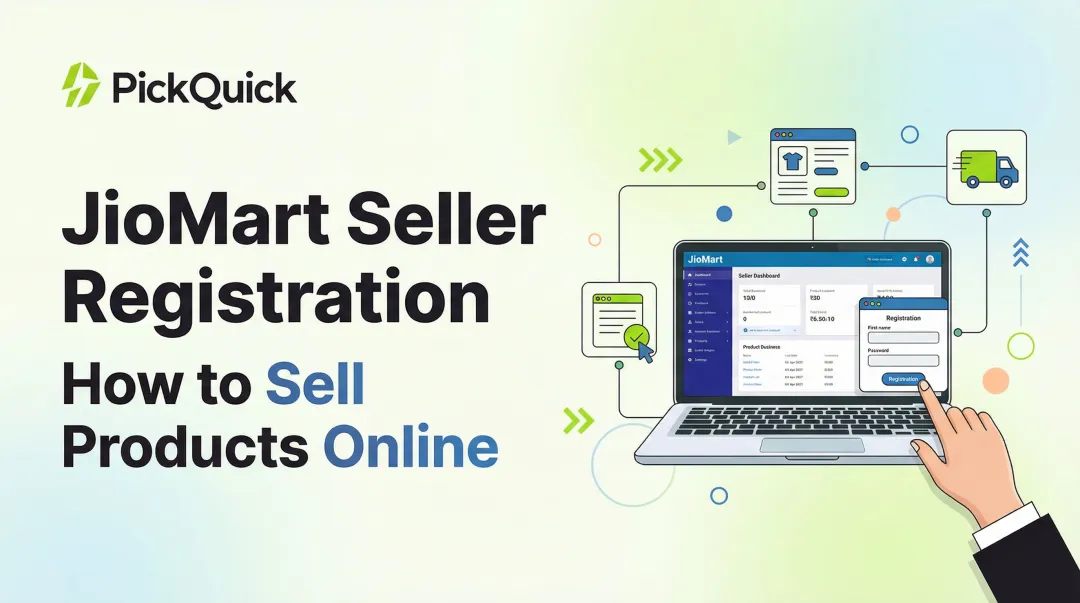
During seller onboarding at seller.jiomart.com, a GSTIN is a mandatory field—without it, registration cannot be completed and product listings cannot go live.
TCS (Tax Collected at Source) Mechanism
JioMart, as an Electronic Commerce Operator, deducts TCS on every sale and deposits it with the government. Effective July 10, 2024, the TCS rate is 0.5% (0.25% CGST + 0.25% SGST). Sellers can only claim this credit against their GST liability if they have a registered GSTIN—without one, that TCS amount becomes permanently unrecoverable. That financial penalty alone makes operating without a GSTIN economically unviable.
JioMart's Product Categories Require GST
JioMart operates as a quick commerce and grocery delivery platform, not a general marketplace. The dominant product categories—FMCG, packaged foods, staples, personal care, dairy, and masala brands—are largely taxable. Pre-packaged and labelled goods attract GST, making GST registration a given for sellers in these categories.
The one exception: Sellers dealing exclusively in books are exempt under JioMart's own policy. Every other seller—regional FMCG brands, masala manufacturers, dairy brands, packaged food companies—must have an active regular GSTIN before going live on the platform.
When Can You Sell on JioMart Without GST?
The 48th GST Council Provision
A narrow exception exists. The 48th GST Council Meeting (December 17, 2022) approved allowing unregistered suppliers to make intra-state supplies of goods through ECOs, operationalized via Notification No. 34/2023-Central Tax effective October 1, 2023. Key conditions:
- Supplier's aggregate turnover must not exceed the Section 22 thresholds (₹40 lakh for goods in normal states, ₹20 lakh in special category states)
- Supplies must be intra-state only—the seller and buyer must be in the same state
- Supplier must declare their PAN on the GST portal to receive an enrolment number
Practical limitation: Intra-state restriction severely limits reach on a national platform like JioMart, which processes 16 lakh daily orders across 5,000+ pincodes](https://www.ril.com/sites/default/files/2026-01/Presentation_for_RIL_Analyst_Meeting_v1.pdf).
GST-Exempt Product Categories
Even setting aside the intra-state provision, certain products attract 0% GST even with a GSTIN. Exempt categories include:
- Unbranded fresh fruits and vegetables
- Unprocessed cereals and pulses
- Fresh milk
- Eggs
- Certain raw agricultural produce
Critical caveat: Effective July 18, 2022, the taxability trigger shifted from "branded" to "pre-packaged and labelled" under Notification No. 06/2022-Central Tax (Rate). Once these products are pre-packaged (as defined under the Legal Metrology Act, 2009) or branded, GST applies.
One carve-out applies: packages exceeding 25 kg or 25 litres fall outside the "pre-packaged and labelled" definition and remain exempt.
JioMart Portal Reality
Even for exempt-category sellers, JioMart's seller registration system requires a GSTIN field to be completed. The platform does not currently provide a documented workaround or special provision for purely exempt-category sellers in their 2026 onboarding documentation.
The "without GST" scenario on JioMart is extremely narrow—limited to intra-state, below-threshold sellers dealing in a small set of unprocessed or exempt goods. For any brand with multi-state ambitions or taxable product categories, the exception does not apply.
Documents and Steps to Get GST for JioMart
Required Documents for GST Registration
Core documents needed:
- PAN card (business or proprietor)
- Aadhaar card
- Bank account proof (cancelled cheque or statement)
- Business address proof (electricity bill, rent agreement, or property tax receipt)
- Photographs of the business premises
- Digital Signature Certificate (DSC) (Class II or III)—mandatory for Private Limited Companies, LLPs, and Public Limited Companies
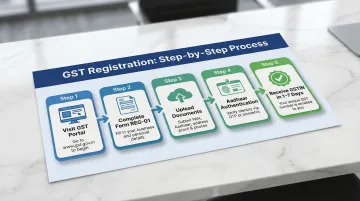
GST Registration Process
The process is straightforward:
- Visit the GST portal
- Complete Form REG-01 with business details
- Upload required documents
- Complete Aadhaar authentication
- Receive GSTIN (typically within 1-7 working days if documents are in order)
Two compliance updates to keep in mind before you log in:
- MFA is mandatory for all GST portal logins as of April 1, 2025
- GSTR-3B auto-populated liabilities are hard-locked as of July 2025—manual edits are no longer permitted
JioMart Seller Portal Entry
With your GSTIN in hand, you're ready to complete seller registration. Head to identity.seller.jiomart.com/seller_registration and keep the following in mind:
- Enter your GSTIN exactly as issued — the portal validates it against GST authority records
- Your Principal Place of Business (PPOB) address must match what's registered with GST authorities
- Selling across multiple states requires a separate GST registration for each state under Section 25(1) of the CGST Act
What Happens If You Sell on JioMart Without a GSTIN?
Platform-Level Consequences
JioMart will not approve seller accounts without a valid GSTIN. Consequences include:
- Seller registration cannot be completed
- Product listings cannot go live
- Existing accounts found non-compliant face listing suppression
- Account suspension for compliance violations
Legal and Financial Consequences
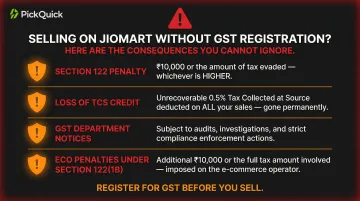
Operating without mandatory GST registration carries serious penalties:
- Penalties under Section 122(1)(xi): Up to ₹10,000 or the amount of tax evaded, whichever is higher
- Loss of TCS credit: Unable to claim TCS collected by JioMart on sales
- GST department notices: Exposure to audits and compliance actions
- ECO penalties: Section 122(1B) (effective October 1, 2023) holds ECOs liable for allowing unregistered sellers—penalty of ₹10,000 or tax involved, whichever is higher
Tightened Enforcement in 2025-2026
Compliance enforcement has intensified. Two changes took effect in July 2025:
- GSTN hard-locked auto-populated sales liability values in GSTR-3B, blocking manual edits to Table 3 values from the July 2025 tax period onward
- Taxpayers are now barred from filing GST returns after three years from the due date
After GST: How to Go Live on JioMart Quickly
JioMart Seller Onboarding Steps
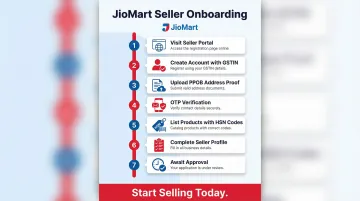
Once GST registration is complete:
- Visit the JioMart Seller Portal
- Create account with business details and GSTIN
- Upload PPOB address proof documents
- Verify OTP on email and mobile
- List products with accurate descriptions, images, HSN codes
- Complete seller profile with shipping and return policies
- Await approval
Achieving Operational Excellence
Getting approved is just the starting point. Achieving visibility across JioMart's 3,000+ stores in 1,000+ cities and scaling across pincodes requires operational infrastructure most regional brands don't have in-house.
For FMCG, food, and staples brands that need fast go-live timelines, working with a platform operator like PickQuick compresses onboarding from months to weeks. PickQuick handles the full operational scope across Blinkit, Zepto, Swiggy Instamart, and JioMart:
- Seller registration and compliance documentation
- Listing creation with HSN codes and imagery
- Dark store inventory placement and replenishment cycles
- Promotional campaign planning and execution
Critical Performance Metrics
JioMart tracks seller performance rigorously:
- Order cancellation rate — High cancellations trigger listing restrictions
- On-time shipping — Delayed dispatch impacts seller health score
- Customer ratings — Poor ratings reduce visibility
- Return ratios — High returns signal quality issues
Sellers who underperform on these metrics risk listing restrictions or account suspension. Getting compliance right is step one — keeping the account healthy is an ongoing operation.
Frequently Asked Questions
Can I sell on JioMart without GST in 2026?
For most sellers, GST registration is mandatory on JioMart regardless of turnover. A narrow exception exists for intra-state, below-threshold sellers in exempt categories, but JioMart's onboarding system requires a GSTIN to complete registration for virtually all taxable product categories.
How do I register to sell on JioMart?
Visit the JioMart Seller Portal at identity.seller.jiomart.com/seller_registration with your GSTIN, PAN, and PPOB address proof ready. After OTP verification and product listing, approval typically takes 1-2 weeks for compliant sellers.
What documents are required to sell on JioMart?
Essential documents include GSTIN, PAN card, bank account details, business address proof, and contact verification. PPOB address proof (electricity bill or rent agreement) must match the GST registration address. Private Limited Companies and LLPs also need a Digital Signature Certificate.
Which product categories are GST-exempt on JioMart?
Key exempt categories include unbranded fresh fruits and vegetables, unprocessed cereals and pulses, fresh milk, eggs, and certain raw agricultural produce. However, branded or pre-packaged versions of these products attract GST under current regulations.
What happens if I sell on JioMart without GST registration?
Platform consequences include account rejection or suspension and suppressed listings. Legal consequences include GST penalties up to ₹10,000 or the amount of tax evaded (whichever is higher), loss of TCS credit collected on sales, and potential notices from GST authorities.
How can I increase sales on JioMart?
Focus on accurate listings (titles, HSN codes, images), competitive pricing, and strong seller health metrics like low cancellations and on-time dispatch. For FMCG and grocery sellers, pincode-level availability and clean GRN scores are what drive store coverage expansion.