Introduction
Brands distributing across multiple locations—warehouses, retail outlets, or dark stores—face a persistent inventory problem: too much stock sitting idle in one location while another runs dry. Excess inventory ties up working capital, increases carrying costs, and risks expiry or dead stock losses. Stock shortages trigger lost sales, platform availability penalties, and customer drop-off.
Distribution Requirements Planning (DRP) is the supply chain methodology that solves this. It synchronizes inventory movement across an entire distribution network using time-phased demand data—calculating exactly when and how much stock to move to each location based on forecasted demand, safety stock requirements, and lead times.
For FMCG brands scaling across dark stores, general trade, and quick commerce platforms, DRP replaces reactive reordering with a structured, data-driven replenishment logic. This guide breaks down what DRP is, how it works in practice, and where it fits into modern multi-channel operations.
TLDR: Key Takeaways
- DRP calculates when and how much inventory to move across distribution points using time-phased demand forecasts and safety stock levels
- It focuses on outbound finished goods flow (warehouse to dark stores or retail outlets), while MRP manages inbound raw materials for manufacturing
- For multi-location brands, DRP prevents stockouts and reduces carrying costs by replacing reactive reordering with data-driven replenishment schedules
- Quick commerce brands need DRP-like logic to manage dark store replenishment across tight inventory buffers and multiple platforms
- Implementing DRP improves availability by 15–25% while reducing inventory holding costs by 15–25% as well
What Is Distribution Requirements Planning (DRP)?
Distribution Requirements Planning (DRP) is a supply chain planning method used to schedule and coordinate inventory replenishment across multiple distribution locations, ensuring the right quantity of product arrives at the right place at the right time. The APICS/ASCM Dictionary defines DRP as "the function of determining the need to replenish inventory at branch warehouses using a time-phased order point approach where planned orders at the branch warehouse level are exploded via MRP logic to become gross requirements on the supplying source."
Origins and Evolution
DRP evolved directly from Material Requirements Planning (MRP) but was adapted for the distribution side of the supply chain. While MRP manages the inbound flow of raw materials and components needed for manufacturing, DRP covers the outbound movement of finished goods from central warehouses to regional distribution centres, retail outlets, or dark stores.
Two Related Terms
The term "DRP" appears in supply chain literature with two meanings:
- Distribution Requirements Planning — Focuses specifically on inventory needs and replenishment quantities
- Distribution Resource Planning (DRP II) — Extends the concept to include physical resources like warehousing capacity, labour, transport equipment, and freight
In practice, these terms are often used interchangeably, though DRP II represents a broader scope.
Who Uses DRP
FMCG brands, retailers, and distributors coordinating stock across multiple locations rely on DRP. Common examples include:
- Regional dairy brands replenishing 50+ retail outlets on daily cycles
- Masala manufacturers supplying dark stores across 10 or more cities
- Apparel brands managing inventory across distributed warehouse networks
Core Logic
DRP consolidates demand signals from multiple downstream locations (regional warehouses, stores, dark stores) and rolls them up into planned orders for the central supply source. This creates a synchronized replenishment schedule across the entire distribution network, replacing reactive, siloed reordering decisions with a single, coordinated replenishment plan across the entire network.
How DRP Works: Inputs, Variables, and Calculation Logic
DRP operates on a structured set of inputs and variables that generate time-phased replenishment orders.
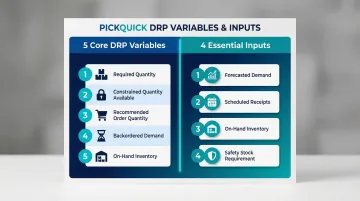
Five Core DRP Variables
Supply chain literature defines five essential DRP variables:
- Required quantity of product at the start of a period
- Constrained quantity available at the start of a period
- Recommended order quantity at the start of a period
- Backordered demand at the end of a period
- On-hand inventory at the end of a period
Four Essential Inputs
To function properly, DRP needs:
- Forecasted demand for a future period (weekly or monthly buckets)
- Scheduled receipts — incoming inventory already in transit
- On-hand inventory at the beginning of the period
- Safety stock requirement for the period
Basic DRP Calculation Logic
The core calculation in DRP is the Projected Available Balance (PAB) formula:
PAB = On-hand inventory + Scheduled receipts – Forecasted demand
When PAB drops below safety stock, a planned order is triggered.
Simple Example:
A regional dairy brand operates a distribution centre serving 20 retail outlets:
- On-hand inventory: 200 units
- Scheduled receipts (in transit): 50 units
- Forecasted demand (next week): 180 units
- Safety stock requirement: 30 units
Calculation: PAB = 200 + 50 – 180 = 70 units
Since 70 units exceeds the 30-unit safety stock, no immediate order is triggered. However, if next week's forecasted demand is 150 units, PAB would drop to -80 units (70 – 150), falling well below safety stock and triggering a planned replenishment order.
Time-Phased Planning
DRP doesn't calculate just one replenishment order—it creates a rolling schedule across multiple planning periods (weekly or monthly buckets), factoring in lead times so orders are placed early enough for stock to arrive before projected shortfalls occur.
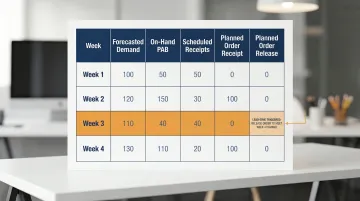
Example DRP Grid:
| Week | Forecasted Demand | On-Hand (PAB) | Scheduled Receipts | Planned Order Receipt | Planned Order Release |
|---|---|---|---|---|---|
| 1 | 100 | 150 | 200 | 0 | 0 |
| 2 | 120 | 250 | 0 | 0 | 0 |
| 3 | 90 | 130 | 200 | 0 | 200 |
| 4 | 110 | 240 | 0 | 200 | 0 |
In Week 1, on-hand inventory of 150 units minus demand of 100 units plus scheduled receipts of 200 units yields a Week 2 PAB of 250 units. By Week 3, demand draws the balance down to 130 units. To maintain buffer stock through Week 4, a planned order receipt of 200 units is required in Week 4 — which means the order must be released in Week 3 to account for lead time.
Scaling Across a Network
In a multi-echelon distribution setup, each downstream location generates its own DRP plan. These individual plans aggregate upward into a consolidated demand signal for the central warehouse or manufacturer. For example, if 10 regional warehouses each generate planned orders for 200 units in Week 3, the central warehouse sees a consolidated requirement of 2,000 units — giving procurement a precise, time-phased trigger to act on.
DRP vs. MRP vs. ERP: Key Differences Explained
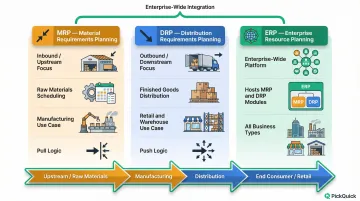
Conflating these three systems is a common mistake — and an expensive one. Using MRP logic to solve an outbound distribution problem, for instance, means planning for the wrong direction entirely.
| System | Directional Focus | Primary Role | |--------|-------------------|--------------|\n| MRP (Material Requirements Planning) | Inbound/Upstream | Schedules raw materials and components for manufacturing using a Master Production Schedule | | DRP (Distribution Requirements Planning) | Outbound/Downstream | Manages finished goods distribution from warehouses to stores using centralized push logic | | ERP (Enterprise Resource Planning) | Enterprise-wide Platform | Integrated software suite hosting finance, HR, procurement, and supply chain modules |
The right choice depends on where your supply chain challenge sits. Here's a quick decision guide:
When to Use Each
- Distribution and retail brands: DRP governs outbound inventory flow from warehouse to shelf
- Manufacturers: MRP handles inbound raw material scheduling against production plans
- Integrated manufacturers and distributors: Both MRP and DRP run in parallel, often within a single ERP
- All business types: ERP acts as the host platform executing whichever planning logic applies
Both DRP and MRP use the same time-phased logic — the key difference is direction. Understanding which layer applies to your operation is what determines whether your planning system actually solves the right problem.
Core Benefits of Implementing DRP
Stockout Prevention and Improved Availability
Time-phased planning ensures stock arrives before it runs out, reducing lost sales and maintaining consistent on-shelf availability. According to a 2023 study by IHL Group, out-of-stock losses cost global retailers $1.2 trillion annually. For quick commerce specifically, a stockout doesn't just mean a lost order — it means a customer switching to a competing app within minutes.
Inventory Cost Reduction Through Leaner Stocking
DRP prevents over-ordering by basing replenishment on actual demand forecasts rather than gut feel or blanket reorder quantities. Inventory carrying costs typically run 15–30% of total inventory value annually, covering storage, insurance, handling, shrinkage, and obsolescence. For perishable FMCG categories — dairy, fresh bakery, beverages — that figure can climb to 30–40%.
DRP reduces these costs by aligning replenishment to real demand signals, keeping stock lean without sacrificing fill rates.
Improved Coordination Across Multi-Location Distribution Networks
DRP creates a single, synchronized replenishment plan across all locations, replacing reactive or siloed reordering decisions with a consistent, data-driven schedule. This is especially valuable for brands managing 5, 10, or 50+ distribution points simultaneously, where manual coordination simply doesn't scale.
A peer-reviewed case study of Juhayna Food Industries documented measurable operational improvements from automating DRP:
- Daily DRP plan execution time reduced from 3 hours to 30 minutes
- DRP accuracy improved to 80-85%, eliminating manual spreadsheet modifications
- Factories transitioned from constant overstocking to precise 15-day safety stock coverage

DRP in Quick Commerce: Managing Dark Store Replenishment at Scale
Why DRP is Critical for Quick Commerce
Dark stores operate on razor-thin inventory buffers—often just 1-3 days of stock—which means replenishment must be triggered accurately and frequently. India's quick commerce market reached an estimated $6-7 billion in 2024, up from $1.5 billion in 2022, with Bain projecting over 40% CAGR through 2030. A missed replenishment window leads directly to a stockout that shows up as "unavailable" on Blinkit, Zepto, or Swiggy Instamart—hurting both sales and platform ranking.
How DRP Logic Maps to QC Replenishment
Each dark store acts as a downstream distribution node:
- Demand is forecast at the pincode or city level
- Safety stock thresholds (Min-Max levels) are set per SKU per location
- Planned orders flow upward to the brand's warehouse or regional distributor
- Replenishment cycles run multiple times daily rather than weekly
That last point marks a fundamental break from traditional FMCG. Replenishment cycles of 7-15 days simply don't work here. Zomato's investor presentations state that Blinkit relies on "inventory replenishment in stores multiple times daily", with high-velocity SKUs requiring restocks every 24-48 hours.
The Algorithmic Penalty of Stockouts
Stockouts in quick commerce carry a cost beyond the immediate lost sale. Platform algorithms actively deprioritize products that frequently show "out of stock" status, creating a visibility problem that compounds over time. Even a 24-hour stockout can result in a ranking drop that takes 2-3 weeks to recover, as the algorithm shifts visibility to competitors.
Blinkit's Seller Hub documentation explicitly warns brands that they require a minimum of 3 units per dark store to keep items available, stating: "If you send less than minimum recommended quantity, it will affect your availability and sales."
The Challenge of Multi-Platform Coordination
Brands on Blinkit, Zepto, and Swiggy Instamart face separate inventory pools, different demand patterns, and platform-specific replenishment windows. As of late 2025, Blinkit operates over 1,816 dark stores, Swiggy Instamart over 1,136, and Zepto over 1,000. Managing DRP logic manually across this fragmented network is impractical at scale—which is where operator-level execution becomes the deciding factor for regional brands.
PickQuick's Operator-Level DRP Execution
As an end-to-end Quick Commerce operator managing 25+ category-leading brands across 10,000+ pincodes in India, PickQuick applies DRP-like logic in practice through:
- Real-time stock and availability tracking across all dark stores and pincodes
- Automated replenishment order generation based on Min-Max thresholds and demand signals
- Predictive supply models that place the right stock in the right dark store before demand spikes
- Platform API integrations that surface demand signals directly from Blinkit, Zepto, Instamart, and JioMart
- Motherhub-to-dark-store flow management ensuring inventory moves without ageing issues
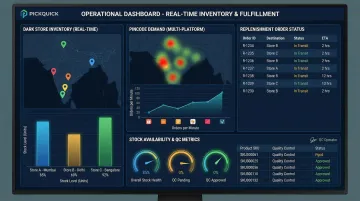
For regional brands scaling to multi-city quick commerce, this execution model converts DRP theory into consistent on-shelf availability—without requiring brands to build the internal infrastructure to manage it.
Frequently Asked Questions
What is distribution replenishment planning?
Distribution replenishment planning and DRP refer to the same process: determining when and how much inventory to restock at each node in a distribution network. Decisions are driven by forecasted demand, safety stock thresholds, and scheduled receipts.
What is the difference between DRP and ERP?
DRP is a specific methodology for planning inventory replenishment across a distribution network, while ERP is a broad enterprise software system covering finance, HR, operations, and supply chain functions. DRP can function as a module within an ERP system.
What are the 4 steps in distribution process?
The four core steps are:
- Demand forecasting — determine what's needed and when
- Inventory positioning — place stock across the right distribution nodes
- Replenishment order generation — trigger orders when projected shortfalls appear
- Order fulfillment — deliver inventory to the end destination on schedule
What is the DRP formula or calculation?
The core formula is: Projected Available Balance = On-hand inventory + Scheduled receipts – Forecasted demand. When this figure falls below safety stock, a planned order is triggered for the next planning period.
How does DRP differ from MRP?
MRP plans inbound raw material needs for manufacturing, while DRP plans outbound finished goods movement from warehouses to distribution points. Both use the same time-phased planning logic, but MRP pulls materials toward production while DRP pushes finished goods toward end customers.
Can DRP work for brands selling on Quick Commerce platforms?
Yes. In quick commerce, each dark store functions as a distribution node with its own demand forecast, safety stock level, and replenishment schedule — exactly the structure DRP is built for. The key difference is that QC replenishment cycles run daily or sub-daily, far tighter than traditional distribution planning windows.