Introduction
Picture this: It's 7 PM on a Tuesday. You're halfway through cooking dinner when you realize the coriander powder is empty. No problem—you open Blinkit, tap "Goldie Masala Coriander Powder," and it's at your door in 9 minutes. No planning, no detour, no interruption to the stove.
This isn't a futuristic scenario—it's everyday life for millions of urban Indians. The monthly supermarket run has given way to a series of instant, need-driven micro-purchases across groceries, masalas, dairy, snacks, and personal care.
For FMCG brands, that shift in behavior is both an opportunity and an operational challenge.
This guide covers what quick commerce is, how Blinkit built India's leading QC platform, which players are shaping the landscape, and what it takes for FMCG brands to go live, stay in stock, and grow revenue on these platforms.
Key Takeaways
- Blinkit is India's largest quick commerce platform, delivering groceries and essentials in 10–15 minutes through 1,301 dark stores across 153 cities
- Quick commerce uses micro-warehouses (dark stores) within 2–3 km of customers—not centralized fulfillment centers—enabling hyperlocal speed
- Blinkit, Zepto, Swiggy Instamart, and JioMart are the major players—all competing for the same urban consumer wallet
- FMCG brands now treat QC as a primary high-frequency sales channel, not a secondary one
- Partner with a QC operator to go live across all platforms in weeks—covering onboarding, supply, and ads
What is Quick Commerce?
Quick commerce (Q-commerce) is the delivery of everyday products within 10–30 minutes of ordering, enabled by hyperlocal dark stores positioned close to residential areas. Unlike traditional e-commerce — which relies on centralized warehouses and 1–3 day delivery windows — QC operates on proximity and speed.
The Consumer Shift That Created This Market
Urban Indian consumers have moved from planned, value-seeking monthly shopping trips to smaller, more frequent, convenience-driven purchases. According to Bain & Company's "How India Shops Online 2025" report, quick commerce captured over two-thirds of India's e-grocery orders in 2024. The market hit $6–7 billion in GMV and is projected to grow at 40%+ CAGR through 2030, potentially reaching $27–50 billion.
This shift in buying behavior demanded an entirely different infrastructure — one built around speed rather than selection.
What Makes QC Structurally Different
Three elements distinguish quick commerce from both traditional e-commerce and 30–45 minute grocery delivery:
- Stocks 2,000–5,000 fast-moving SKUs per dark store, not the 50,000+ found in e-commerce warehouses
- Positions dark stores within 1–3 km of high-density demand clusters, not in distant industrial zones
- Keeps dedicated riders at dark stores, ready to dispatch within minutes of order confirmation
Who Drives QC Demand
Urban millennials, Gen Z, and dual-income households are the core audience — and Gen Z alone accounts for nearly 40% of e-retail shoppers. These consumers prioritize convenience over bulk discounts and will pay higher prices for instant availability. For FMCG brands, they're also the most brand-loyal, high-LTV segment worth capturing.
How Blinkit Works: Dark Stores and 10-Minute Delivery
Blinkit started as Grofers in December 2013, a conventional online grocery service. In December 2021, the company rebranded to Blinkit to signal its full pivot to quick commerce. By 2022, Zomato (now Eternal Limited) had acquired Blinkit for $568 million. As of March 2025, the platform operates 1,301 dark stores across 153 cities, with FY25 revenues of ₹5,206 crore.
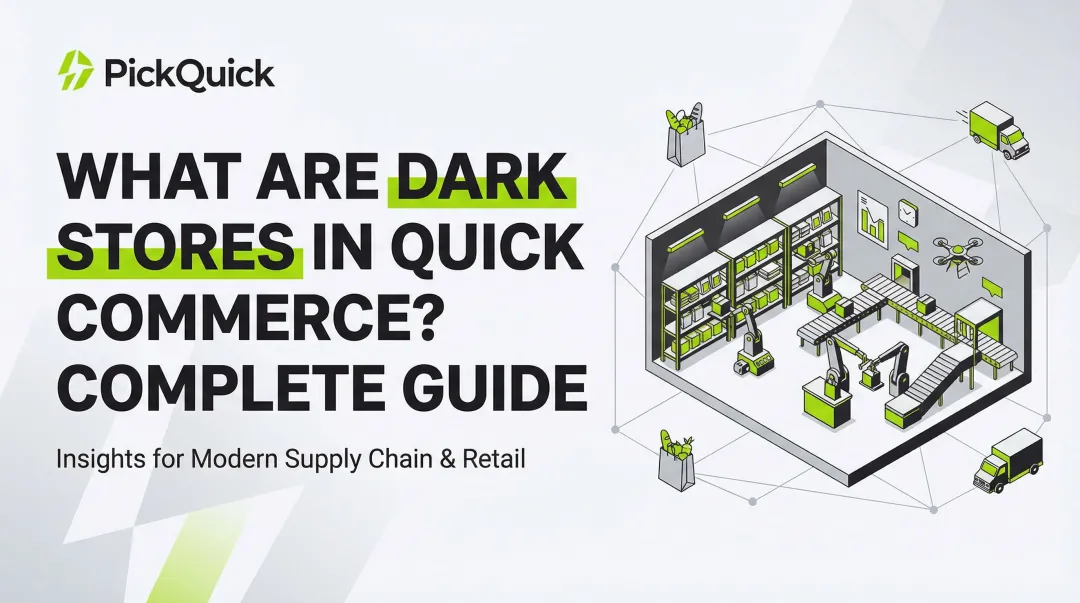
The engine behind this speed is the dark store — a micro-warehouse stocked with 2,000–5,000 fast-moving SKUs, positioned within 1–3 km of high-density residential zones. When a customer places an order, a picker inside assembles it in minutes while a delivery partner on standby completes the last-mile run.
The order lifecycle:
- Customer opens the Blinkit app and selects items
- Order is routed to the nearest dark store
- A picker fulfills the order (typically in 2–4 minutes)
- A delivery partner collects and delivers (typically in 6–8 minutes)
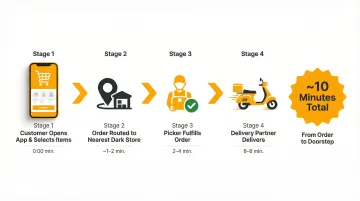
The 10-minute promise depends on all three legs — store proximity, picker speed, and delivery radius — being optimized simultaneously.
That speed also relies on who stocks the dark stores. Blinkit's partner ecosystem has three tiers:
- Express partners: Large retailers operating Blinkit-exclusive dark stores on commission
- Spotlight partners: Emerging brands given visibility and logistics support
- Local shop integrations: Neighborhood stores onboarded to expand geographic coverage
This structure lets Blinkit scale its SKU depth and city footprint without carrying all inventory on its own books.
What Can You Order on Blinkit?
Blinkit has expanded well beyond groceries. The full product range now includes:
- Food & fresh: Groceries, staples, fruits and vegetables, dairy, eggs, meat, seafood, and bakery
- Packaged goods: Snacks, beverages, and ready-to-cook products
- Personal & home care: Hygiene, baby care, and pet care essentials
- Lifestyle & accessories: Flowers, stationery, mobile accessories, and select electronics
For FMCG brands, this breadth matters. Categories like masalas, dairy, branded snacks, and personal care now see strong repeat-purchase behavior on Blinkit — meaning shelf availability on the platform directly affects monthly volumes, not just trial.
India's Quick Commerce Landscape: Key Players
Four dominant platforms shape India's quick commerce ecosystem:
| Platform | Dark Stores | City Coverage | Key Financials |
|---|---|---|---|
| Blinkit (Eternal/Zomato) | 1,301 (Mar 2025) | 153 cities | FY25 Revenue: ₹5,206 crore |
| Zepto (Standalone, founded 2021) | ~1,110 (2025) | 80+ cities | FY25 Total Sales: ₹9,668.8 crore |
| Swiggy Instamart (Swiggy ecosystem) | 1,021 (Mar 2025) | 124 cities | FY25 Gross Revenue: ₹2,252 crore |
| JioMart (Reliance-backed) | 600+ (Oct 2025) | 1,000+ cities, 5,000+ pincodes | 1.6M+ daily orders (Q3 FY26) |
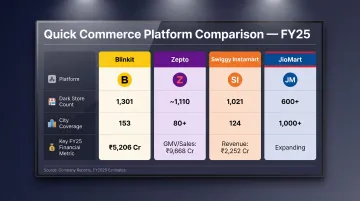
A Bank of America survey (Nov 2025) found that 53% of consumers use Blinkit, 43% use Zepto, and 41% use Instamart — often switching between apps based on offers and availability.
That split has a direct cost for brands. A product unavailable on even one platform hands that sale to a competitor already stocked there. Multi-platform coverage is the baseline, not the advantage.
Why Brands Can't Afford to Ignore Quick Commerce
QC Is the New Discovery Channel
When a consumer searches "chilli powder" or "butter" on Blinkit, the brand that appears first with strong availability wins the sale. Product discovery on QC is largely search-driven, and organic visibility beyond the first fold is irrelevant. Higher sales velocity directly improves organic rank — which means brands that show up consistently tend to pull further ahead over time.
The Real Cost of a Stockout
50% of consumers will switch to another QC platform if a product is unavailable, and 70% will search Amazon or Flipkart. Only 5% are willing to wait. A single stockout doesn't just lose one sale — it trains consumers to look elsewhere by default.
This risk is especially acute in high-frequency categories. Dairy, masalas, staples, snacks, and personal care drive impulse and repeat purchases — exactly the buying occasions QC owns. Brands like Nandini Dairy, Goldie Masala, and Vasant Masala, already strong offline, are now capturing buyers mid-cooking or during daily routines because they're present and in stock when it matters.
Presence on QC also unlocks a data layer that offline channels can't offer. Brands get real-time visibility into which SKUs are moving and where stockouts are happening — pincode by pincode. That intelligence can reshape production planning and distribution decisions in ways GT/MT data never could.
The competitive risk of staying off QC is concrete, not theoretical. If a regional brand with strong offline demand isn't on Blinkit or Zepto, a national competitor or private label fills that slot instead. Platform-owned brands like Swiggy's 'Noice' and Zepto's 'Relish' have grown to 6–8% of QC sales, competing directly in high-margin categories. Absence from QC is not a neutral position — it's actively ceding ground.
How Brands Can Get Listed and Scale on Quick Commerce
The Operational Reality of QC Onboarding
Getting onto QC dark stores is operationally complex. Each platform has its own:
- Onboarding requirements and approval cycles
- Assortment mandates and SKU mapping standards
- Min-Max inventory thresholds
- Replenishment timelines and RO (Replenishment Order) discipline
- Advertising structures and search optimization rules
Brands that attempt to manage this independently across multiple platforms often face delays, stockouts, and poor search visibility.
The Operator Model as an Accelerated Path
Instead of navigating each platform independently, brands can work with a QC operator like PickQuick, which manages end-to-end QC operations—from dark store onboarding and replenishment to advertising and availability tracking—across Blinkit, Zepto, Swiggy Instamart, and JioMart.
Before inventory reaches the platforms, PickQuick handles:
- Packaging compliance and barcode/GS1 readiness
- Professional product imaging and catalogue creation
- Listing setup and Seller Hub readiness
- Replenishment configuration with Min-Max planning
This gets brands live across QC platforms in weeks rather than months—3-5x faster than traditional onboarding.
What Drives QC Success After Go-Live
Listing is only the starting point. Sustained growth depends on:
- Maintaining high availability: Minimizing stockouts across dark stores
- Search-to-conversion optimization: Correct catalogue and pricing setup
- Pincode-level assortment depth: Stocking SKUs in cities where offline demand already exists
- Consolidated advertising budgets: Predictable quarterly ROI across platforms
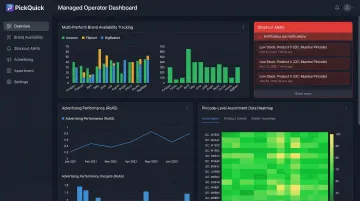
PickQuick's operator model consolidates all these functions under one managed service—eliminating the need to coordinate across multiple vendors and getting brands fully operational across all four major QC platforms at once.
Frequently Asked Questions
What is Blinkit and is it a quick commerce platform?
Yes, Blinkit is India's leading quick commerce platform, formerly known as Grofers. Now owned by Eternal Limited (Zomato's parent), it operates 1,301 dark stores across 153+ cities, delivering groceries and essentials in under 10–15 minutes.
What is quick commerce and how does quick commerce delivery work?
Quick commerce delivers everyday products within 10–30 minutes using micro-warehouses (dark stores) located within 1–3 km of residential areas. A picker assembles orders in minutes, and a delivery partner on standby brings it to your door. The entire cycle, from order to doorstep, typically takes under 15 minutes.
What items does Blinkit deliver?
Blinkit delivers groceries, fresh produce, dairy, meat, snacks, personal care, baby care, electronics accessories, stationery, and flowers.
How is Blinkit different from Zepto and Swiggy Instamart?
All three platforms promise 10-minute delivery but differ in ownership, city coverage, and dark store count. For consumers, the distinction comes down to availability and offers. For brands, being live on all three platforms is what maximizes reach.
Is quick commerce available outside metro cities in India?
Yes, QC has expanded significantly beyond metros. Blinkit alone covers 153 cities as of March 2025, including many Tier 2 cities. While dark store density and delivery speed may differ from metros, expansion is ongoing across all platforms.
How can a brand get listed on Blinkit?
Brands can apply through Blinkit's Seller Hub portal directly, or work with a QC operator like PickQuick that already holds platform relationships and operator rights. Working with an operator cuts onboarding time and handles inventory and listing setup correctly from the start.