Introduction
It's 11 PM in Mumbai. A customer opens Blinkit, adds milk, bread, and shampoo to the cart, and hits order. Twelve minutes later, the delivery rider hands over a bag at the door. The customer never sees where the products came from—but a few streets away, a dark store has just completed another dispatch cycle at full speed.
This experience defines quick commerce (q-commerce): a retail model built on sub-30-minute delivery that has changed consumer expectations in India. Dark stores are the physical infrastructure that makes this speed possible. These micro-fulfillment centers are invisible to customers but run constantly, processing hundreds of orders every hour.
This guide covers what dark stores are, how they operate, how they differ from traditional retail, and what it means for brands scaling on platforms like Blinkit, Zepto, and Swiggy Instamart.
What Is a Dark Store?
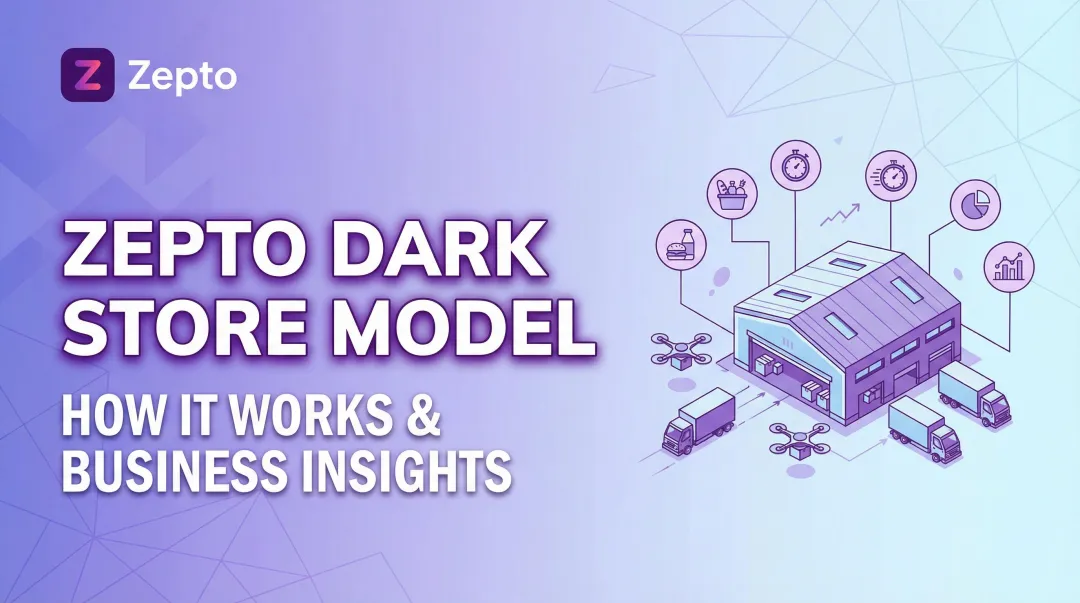
A dark store is a micro-fulfillment center closed to the public, located in a dense urban or residential area, and built solely to receive, store, pick, pack, and dispatch online orders as fast as possible. No checkout counters, no product displays, no walk-in customers.
The name "dark" refers to the fact that the store is dark to shoppers—there's no signage, no browsing aisles, no front-of-house setup. The lights are on for workers, but the public never enters.
Origin and Evolution
The term originated in the UK in 2009 when Tesco opened customer-free supermarkets in Croydon and Aylesford to handle surging online grocery orders. However, the Indian quick commerce dark store operates on a different model entirely.
While UK dark stores evolved into massive, highly automated Customer Fulfillment Centers spanning 300,000–400,000 sq ft, Indian q-commerce dark stores are hyper-local micro-warehouses embedded deep within residential neighbourhoods. They typically measure just 2,000–3,000 sq ft and rely on manual, rapid picking rather than heavy robotics.
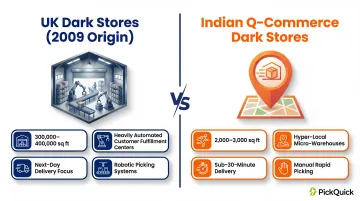
Quick Commerce Dark Stores vs. Traditional Formats
Indian dark stores serving platforms like Blinkit, Zepto, and Swiggy Instamart are designed around one metric: time to delivery:
- Size: Under 2,000–3,000 sq ft (some megapods reach 8,000–12,000 sq ft)
- SKU count: 1,500–3,000 high-demand items in standard stores; up to 50,000 in megapods
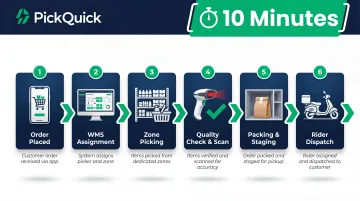
- Dispatch target: 10-minute order fulfillment from click to rider pickup
- Location strategy: Residential density zones, not commercial shopping districts
- Inventory approach: Data-curated, high-velocity SKUs based on pincode-level demand patterns
Older "dotcom centers" — the warehouse-style facilities that powered early online grocery — prioritized broad selection and next-day delivery. Quick commerce dark stores flip that trade-off entirely: fewer SKUs, far smaller footprint, and fulfillment measured in minutes.
How Does a Dark Store Work? Step-by-Step Inside the Operation
The moment a customer places an order on a QC app, the process begins instantly. The order is pushed to the dark store's Warehouse Management System (WMS), which assigns it to an available picker and displays the order ID, item list, and bin/shelf location on their handheld device.
The Picking Process
Dark stores are divided into zones based on storage requirements:
- Dry goods
- Chiller (dairy, fresh produce)
- Freezer (ice cream, frozen foods)
- Ambient temperature items
Pickers follow an optimized digital route. Fast-moving items like dairy and beverages sit closest to the dispatch zone to cut pick time. Fragile items like eggs are picked last to prevent damage in transit.
Each item is scanned against the order to catch errors before packing. The difference in outcomes is significant:
| Method | Error Rate | Picks Per Hour |
|---|---|---|
| Barcode-assisted picking | 2.31% | 150–200 |
| Manual paper picking | 6.86% | 60–70 |
Quality Control During Picking
Packers check expiry dates and product condition in real time, especially for perishables. Items that fail quality checks are flagged and removed from the system immediately. In practice, this lifts order accuracy from 91.4% in traditional retail to 97.8% in dark store operations.
Packing and Staging
Once packed, bags are placed in labeled pigeon holes or dispatch slots color-coded to each order. Delivery riders arrive, scan the barcode on the pigeon hole, pick up the bag, and leave—fully contactless, never entering the storage area.
Order Batching and Route Optimization
The Order Management System (OMS) batches nearby orders so a single rider delivers 2–4 orders per trip. This directly shapes delivery economics: batching cuts per-order delivery costs from ₹40–50 to around ₹30, though it may extend delivery times from strict 10-minute promises to 15–20 minutes for customers 1.5–2 km away.
Feeding into all of this is real-time inventory sync with the customer app—preventing orders from being placed for out-of-stock items and eliminating the frustration of post-order cancellations.
Dark Store vs. Traditional Retail Store: Key Differences
| Dimension | Traditional Retail Store | Quick Commerce Dark Store |
|---|---|---|
| Customer Access | Open to public with browsing aisles | Closed to public; staff and riders only |
| Design Priority | Customer experience and product discovery | Picker efficiency and dispatch speed |
| Staff Role | Customer service and sales | Fulfillment and order accuracy |
| Location Strategy | High-footfall commercial areas | Residential density zones |
| Inventory Approach | Broad selection for browsing | Data-curated high-velocity SKUs |
| Success Metrics | Foot traffic and sales per sq ft | Orders per hour and delivery speed |
The 2-3 Km Radius Rule
Dark stores operate on a strict 2-3 km delivery radius. Proximity to demand matters more than foot traffic, which is why dark stores are placed in residential neighborhoods rather than shopping districts.
That said, delivery speed varies within this radius. Customers within 500-700 meters consistently receive orders in under 10 minutes; those 1.5-2 km away typically see 15-20 minute delivery times.
What a Dark Store Is NOT
To clarify common confusion:
- Ghost kitchens handle food-only preparation — dark stores stock physical retail SKUs across categories
- Traditional warehouses sit far outside city centers and are built for bulk throughput, not sub-20-minute dispatch
- E-commerce fulfillment centers (think Amazon) are optimized for 2-5 day shipping, not 10-minute delivery
- Not a kirana store — dark stores have no walk-in counter and run on platform-driven demand signals, not neighborhood relationships
Why Dark Stores Power Quick Commerce in India
India's quick commerce sector generated $6-7 billion in GMV in 2024, with projections reaching $35 billion by 2030. This explosive growth is concentrated in metros and Tier-1 cities, where platforms have built dense networks of dark stores to achieve comprehensive coverage.
Platform Scale and Dark Store Density
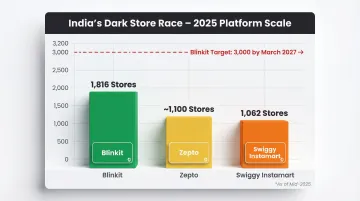
Major players are engaged in an aggressive expansion race:
- Blinkit: 1,816 dark stores as of September 2025, targeting 3,000 by March 2027
- Zepto: Approximately 1,100 dark stores as of mid-2025
- Swiggy Instamart: 1,062 dark stores as of June 2025
Over 80% of quick commerce GMV is generated in top metro cities, with 54% of dark stores located in secondary micro-markets and 31% in suburban micro-markets.
Hyperlocal Demand Reality
A dark store doesn't serve a city—it serves a 2-3 km zone. The inventory stocked in that store must match the buying behavior of that specific neighborhood.
A dark store in Indiranagar, Bengaluru stocks differently than one in Whitefield. Demand shifts by pincode, time of day, season, and even weather.
Platforms like Swiggy Instamart use ML models trained on local event calendars and hour-by-hour consumption data to predict demand spikes before they happen.
The Brand Implication
To get consistent sales on QC platforms, a brand's products need to be listed and in stock across the right dark stores in the right pincodes. Being listed on Blinkit nationally means nothing if the product is repeatedly out of stock at the dark store level.
Availability at the dark store is what drives discovery, ranking, and repeat purchases. When fill rate drops below 80%, Blinkit's algorithm responds in three ways:
- Demotes the product's search ranking
- Reduces paid ad visibility
- Removes the listing from active pincodes entirely
Managing Multi-Platform Dark Store Inventory
Managing stock replenishment across hundreds of dark stores on multiple platforms is operationally intensive. For brands scaling across Blinkit, Zepto, Swiggy Instamart, and JioMart, each platform runs its own systems, replenishment windows, and compliance requirements.
Handling this store-by-store across platforms is where most brands hit a wall. PickQuick manages Min-Max inventory optimization and replenishment for brands so they don't have to. With 25+ category-leading brands across 10,000+ pincodes, PickQuick provides unified dark store operations across all major platforms from a single control layer.
Dark Store Inventory Management: How Brands Stay Available and Get Reordered
The Min-Max inventory model is the foundation of dark store availability. Each SKU has a minimum stock threshold (the reorder point) and a maximum stock level (the cap based on physical space and demand velocity). When stock drops to the minimum, a replenishment order is triggered.
Managing these levels correctly across multiple dark stores determines whether a brand scales or stagnates.
What Happens When Inventory Management Fails
Stockouts mean lost sales and algorithmic punishment. When a product appears as "unavailable" on the app, the customer buys a competitor's product, and the platform's algorithm deprioritizes the brand in search results.
50% of consumers will switch to another QC platform to find their preferred brand if it's out of stock, rather than substituting with a competitor on the same app. Stockouts don't just lose one sale — they leak high-intent customers to rival platforms.
On the flip side, overstocking ties up capital and drives expiry losses — especially for perishable or short-shelf-life products. When motherhub stock ages, platforms automatically throttle dark store consumption to prevent loss, creating a vicious cycle.
Data Tools and Demand Forecasting
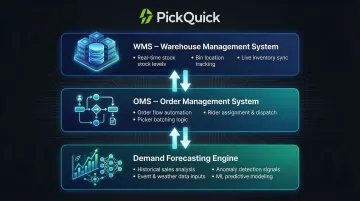
Dark stores rely on several integrated systems:
- WMS tracks real-time stock levels and bin locations across every dark store
- OMS manages order flow, picker batching, and rider assignment
- Demand forecasting tools pull historical sales, local event calendars, weather data, and anomaly signals to predict when and where demand will spike
Platforms like Zepto offer "Zepto Atom," a subscription-based analytics platform that provides brands with real-time, hyper-local sales and demand analytics, tracking which products are trending in specific neighborhoods at specific times of the day.
Replenishment Cycles in Practice
QC platforms typically have specific replenishment windows. Brands or their operators need to push stock into dark stores on a defined schedule, ensuring products are available during peak demand hours (typically evenings and weekends in India).
Late or incomplete replenishment directly impacts in-stock rates and platform visibility. For brands managing this independently, the coordination challenge is significant:
- Hundreds of dark store managers to liaise with
- Different replenishment windows per platform
- No unified system for tracking availability across pincodes
PickQuick's model consolidates this into a single operational layer, providing clean replenishment, stable availability metrics, and pincode-level visibility. The company's predictive supply model uses real-time demand signals to trigger replenishment before stockouts occur — keeping the right stock in the right dark store without manual intervention.
Economics of Dark Stores: Costs, Challenges, and the Path to Profitability
Dark store economics are challenging. Most networks are not yet profitable at a company level—the model is a high-volume, thin-margin game requiring strict operational discipline.
Major Cost Components
Real estate: Premium rent for small, well-located urban units in residential areas
Labor: Pickers, packers, and store managers with demanding productivity KPIs (items picked per minute, or IPP)
Last-mile delivery: Rider costs per delivery—the single largest variable expense at ₹40-50 per order
Customer acquisition: Heavy discounting and platform spending in the early phase of market development
Profitability Levers
Dark store economics improve as:
- Order density increases: More orders per store per hour spread fixed costs across more deliveries
- Average Order Value (AOV) rises: Higher basket sizes improve contribution margins
- Rider efficiency improves: Order batching reduces per-delivery costs
Dark stores only achieve profitability when they cross 1,000-1,500 orders per day. Below this threshold, variable delivery costs exceed contribution margins.
Platform Profitability Progress
Recent platform performance shows progress toward sustainability:
- Blinkit: Achieved Adjusted EBITDA breakeven in March 2024, with AOV reaching ₹613
- Swiggy Instamart: Reported AOV of ₹514 for FY25
- Zepto: Reports AOV between ₹625 and ₹650
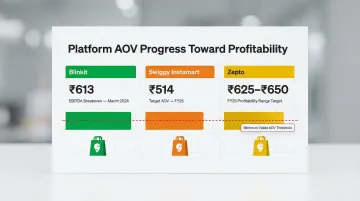
Platforms take 15-18% gross margin on AOV and are actively prioritizing higher-margin FMCG, beauty, and premium SKUs to improve profitability.
What This Means for Brands
As platforms sharpen their focus on contribution margins, brand strategy on quick commerce needs to follow suit. Brands that help platforms improve AOV get rewarded — in rankings, in visibility, and in category manager attention.
Practically, this means:
- High-margin or premium SKUs rank higher with category managers and search algorithms
- Larger pack sizes lift basket value and earn preferential catalog placement
- Strong fill rates and listing quality are now baseline requirements, not differentiators
- Availability metrics are tracked closely — stockouts directly hurt platform margins
Frequently Asked Questions
How do dark stores differ from regular retail stores?
Dark stores are closed to the public and built entirely around fulfillment speed. Unlike retail stores, they use narrow aisles instead of display spaces, staff pickers instead of service staff, sit in residential zones instead of commercial areas, and measure success in orders per hour rather than sales per sq ft.
What is the difference between a micro-fulfillment center and a dark store?
All quick commerce dark stores are a type of micro-fulfillment center, but not all micro-fulfillment centers are dark stores. An MFC can also be a small automated hub that supplies other retail stores, whereas a dark store specifically fulfills direct-to-consumer quick delivery orders exclusively.
Are dark stores open to the public?
No. Dark stores are not open to customers—there are no checkout counters, no walk-in aisles, and no public signage. Access is restricted to store staff and delivery riders only.
How big are dark stores and how are they set up as warehouses?
Quick commerce dark stores in India are typically 1,000-3,000 sq ft, divided into zones (dry, chiller, freezer, ambient), with narrow aisles and fast-moving products staged closest to the dispatch area for picker efficiency. Some newer "megapods" reach 8,000-12,000 sq ft to accommodate broader assortments.
How do you manage inventory in a dark store?
Inventory is managed using a WMS with real-time stock tracking, Min-Max replenishment triggers, and demand forecasting. Accurate replenishment cycles across each dark store's pincode catchment area prevent both stockouts and overstocking that leads to ageing.
What does a dark store manager do?
A dark store manager oversees picker productivity (items picked per minute), replenishment schedules, quality checks on perishables, staff coordination, and order dispatch targets to keep availability metrics consistently on track.