Swiggy Instamart is a major player in a three-way race with Blinkit and Zepto, but what does that actually mean for the industry and for brands looking to sell on the platform? This article examines Instamart's market position, the dark store model that powers it, financial performance, competitive pressures, and what it all means for brands navigating India's quick commerce landscape.
Key Takeaways
- Swiggy Instamart launched in August 2020, operating 1,100+ dark stores across 128 cities
- Ranks third in market share behind Blinkit and Zepto, but remains critical in a fast-growing sector
- Quick commerce drove revenue growth while contributing to losses—Instamart's EBITDA margin improved from -14.3% to -12.1% as of Q2 FY26
- India's QC market is marked by "irrational competition"—heavy discounts, rapid expansion, and thin margins
- For brands, Instamart offers major distribution reach—but only with strong dark store visibility, replenishment discipline, and platform expertise
What is Swiggy Instamart? India's Quick Commerce Service Explained
Swiggy Instamart is Swiggy's dedicated quick commerce arm, launched in August 2020 as demand for instant grocery delivery surged during the COVID-19 pandemic. It replaced Swiggy Stores and pivoted fully to a dark store model—moving from retail partnerships to company-operated micro-warehouses built for speed.
Quick commerce (Q-commerce) means delivering groceries, household essentials, and consumer goods in 10–30 minutes. Unlike traditional retail partnerships, Instamart relies on strategically located micro-warehouses called dark stores, stocked with fast-moving SKUs and positioned within 2–3 km of dense residential areas.
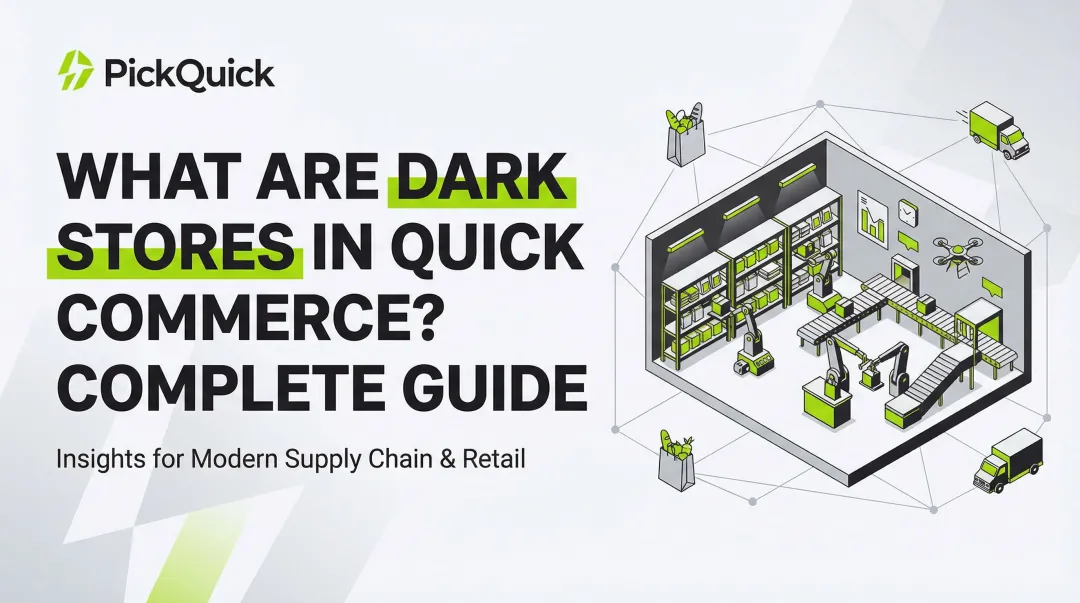
How the Dark Store Model Works
Dark stores are small-format fulfillment warehouses, not consumer-facing retail shops. They stock high-velocity products and operate purely for last-mile delivery. Swiggy Instamart's dark store network has expanded sharply over the past year:
- 557 dark stores (June 2024) → 1,102 dark stores (October 2025)
- Dark store area: 1.7 million sq. ft. → 4.6 million sq. ft.
- City presence: 32 cities (mid-2024) → 128 cities (2025)
- Traditional format: 800–1,500 sq. ft. per store, focused on top-velocity SKUs
- Megapod format: 8,000–10,000 sq. ft., capable of housing up to 50,000 SKUs
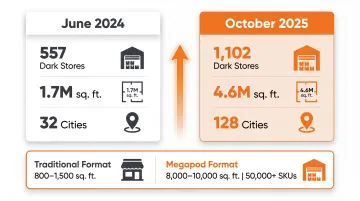
The shift to Megapods enables broader assortments and higher average order values—a direct response to platforms competing on selection depth, not just delivery speed.
What Swiggy Instamart Delivers
Beyond speed, Instamart's breadth of categories is central to its positioning as a round-the-clock neighborhood store. Current assortment includes:
- Groceries, fresh produce, and dairy
- Beverages, snacks, and packaged foods
- Personal care and home care products
- FMCG staples and cooking essentials
- OTC medicines (via PharmEasy partnership, launched October 2024)
The PharmEasy partnership uses a "shop-in-shop" model within Instamart dark stores, enabling 10-minute medicine deliveries in select cities without requiring separate regulatory approvals. Swiggy also launched its private label brand, Supreme Harvest, in July 2022, covering pulses, oils, spices, and flour.
Swiggy Instamart's Market Position: Third Place in a Three-Way Race
As of mid-to-late 2025, India's quick commerce market is a three-player race: Blinkit (owned by Zomato/Eternal), Zepto, and Swiggy Instamart. Blinkit leads by a significant margin, with Zepto having overtaken Instamart in early 2025 on the back of aggressive VC-funded expansion.
| Platform | Market Share | Daily Orders |
|---|---|---|
| Blinkit | 46–50%+ | 1.65–1.75 million |
| Zepto | 28–30% | 1.45–1.55 million |
| Swiggy Instamart | 23–25% | 1.05–1.15 million |
Zepto's rise came while Swiggy conserved cash ahead of its IPO — a deliberate trade-off that cost it the second-place ranking.
How Instamart Competes
Swiggy Instamart competes through several structural advantages:
- Integration with food delivery for cross-sell opportunities
- Strong brand recognition across India
- Swiggy One subscription bundling (combining food delivery and quick commerce)
- Scenes/Dineout ecosystem creating multi-service user relationships
Competitive tactics include deep discounts, free delivery thresholds, dark store expansion in Tier 2 cities, and premium/private label products. However, Swiggy has signaled a more conservative, margin-focused approach compared to peers.
The November 2024 IPO and Strategic Shift
Swiggy listed on the NSE and BSE on November 13, 2024, at ₹390 per share, valuing the company at approximately ₹94,000 crore (around $11.3 billion). The IPO marked a strategic pivot from "growth-at-all-costs" to unit economics and profitability. Analysts from Bernstein and S&P Global noted this shift distinguishes Swiggy's post-IPO mindset from earlier aggressive expansion.
For brands on the platform, this matters. A more margin-conscious Instamart is likely to tighten dark store selection, rationalize SKU depth, and reduce blanket discount subsidies — putting greater pressure on brands to maintain strong availability and conversion metrics to retain shelf visibility.
Swiggy's Quick Commerce Financial Performance
For FY25, Swiggy reported consolidated adjusted revenue of ₹16,333 crore. Instamart generated Gross Order Value (GOV) of ₹14,683 crore, accounting for approximately one-third of Swiggy's total B2C GOV.
That growth comes at a cost. Quick commerce is Swiggy's highest-growth segment, but it remains the primary source of losses — dark store investments, subsidized deliveries, and elevated marketing spend continue to pressure margins.
Quarterly progression shows improvement:
| Metric | Q1 FY26 | Q2 FY26 | Change |
|---|---|---|---|
| Consolidated Revenue | ₹5,308 Cr | ₹5,911 Cr | +11.4% |
| Net Loss | ₹1,197 Cr | ₹1,092 Cr | Narrowed |
| EBITDA Margin | -4.7% | -3.6% | +111 bps |
| Instamart EBITDA Margin | -15.8% | -12.1% | +375 bps |
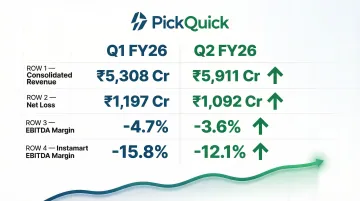
Instamart's margin recovered from -14.3% in FY25 to -12.1% in Q2 FY26, aided by a 40% YoY increase in Average Order Value (AOV) to ₹697. Swiggy's guidance indicates absolute losses will decline as new dark store additions slow — the platform is now prioritizing contribution margin improvement over dark store count, a meaningful posture shift for brands planning new city entry.
What's Fueling and Limiting Swiggy Instamart's Expansion
India's quick commerce market grew from USD $6.1 billion in 2024 to a projected USD $12.9 billion in 2025, according to Datum Intelligence — with forecasts reaching USD $59 billion by 2030. The scale of that trajectory explains why every major platform, Swiggy Instamart included, is racing to lock in market share now.
Demand drivers include:
- Rising smartphone penetration—India reached 969.1 million internet subscribers by March 2025
- Urban convenience culture and time-poor dual-income households
- Post-COVID normalization of online grocery buying
- Behavioral shift: 58% of online grocery buyers now use quick commerce for full monthly shopping, not just impulse purchases
Key constraints and risks:
- Intense price-based competition described by analysts as "irrational"
- Rising delivery costs and thin margins
- Delivery partner safety concerns and regulatory scrutiny
- Challenge of maintaining profitability in smaller cities with lower order density
The 10-Minute Delivery Reality Check
The "10-minute delivery" promise has faced serious regulatory pushback. On New Year's Eve 2025, over 200,000 gig workers went on a nationwide strike protesting dangerous working conditions, prompting the Indian Labour Ministry to intervene. By January 2026, the government ordered platforms to drop "10-minute" marketing claims entirely, citing road safety and rider welfare concerns.
Swiggy's actual measured average delivery time sits at around 12.6 to 13 minutes. That's genuinely fast — just not the number that was being marketed.
Strategic Moves to Address Constraints
Swiggy is adapting on several fronts:
- Partnering with PharmEasy to add medicine delivery to its platform mix
- Stabilizing dark store count rather than pursuing aggressive expansion
- Prioritizing higher basket sizes and premium SKUs to improve per-order economics
What Swiggy Instamart's Growth Means for Brands and Sellers
As Instamart expands to 128 cities and deepens its dark store network, it opens significant distribution reach for FMCG, food, and consumer goods brands. This is particularly valuable for regional brands that previously had no viable path to instant delivery at scale.
FMCG brands now derive 30-60% of their online sales from quick commerce platforms. Nestle India reported that quick commerce contributed 60% of its domestic e-commerce sales in the September 2024 quarter. Instamart's higher AOV (₹514 in FY25) signals consumers increasingly bundle premium products and non-grocery items.
What Brands Need to Win on Swiggy Instamart
Winning on Instamart demands operational discipline across several variables simultaneously:
- Dark store-level inventory management: Maintaining optimal stock across 1,100+ individual locations
- Pincode-specific assortment planning: Tailoring product mix to local demand patterns
- Competitive pricing: Balancing margins with platform expectations
- Platform advertising: Ads within Instamart search results, costing roughly ₹8-10 lakh per quarterly brand pack
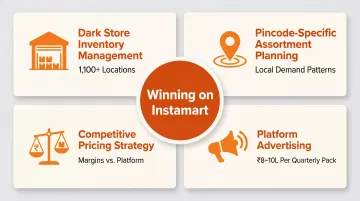
Platform advertising is where this complexity compounds. Ad revenues reach 3-4% of Gross Order Value, and brands must bid on generic category keywords — for example, "oats" instead of brand names — to drive visibility. Managing this across dozens of dark stores and cities simultaneously is where most brands hit a wall.
The Challenge for Regional Brands
Regional category leaders risk being invisible on Instamart despite strong offline demand. Quick commerce rankings are heavily driven by availability, fulfillment rates, and advertising performance—not just product quality or brand heritage.
Without operational depth and platform expertise, regional brands struggle with:
- Replenishment order delays and stockouts
- Motherhub inventory aging that blocks expansion
- Poor packaging compliance causing inwarding penalties
- Lack of pincode-level demand visibility
- Inability to consolidate advertising budgets effectively
How PickQuick Enables Brand Success on Instamart
PickQuick operates as the full Quick Commerce division for brands scaling on Swiggy Instamart, Blinkit, Zepto, and JioMart — handling onboarding, dark store replenishment, advertising, and availability from day one. Brands go live across platforms in weeks, not months.
With 25+ category-leading brands across 10,000+ pincodes, PickQuick delivers:
- Complete catalog compliance and SKU mapping
- Min-Max inventory optimization across dark stores
- Real-time pincode-level demand visibility
- Consolidated advertising budgets for better platform negotiation
- Replenishment discipline that maintains 95%+ availability
Brands that already have strong GT/MT distribution but lack the operational infrastructure for Quick Commerce get a functional QC division without the overhead of building one in-house.
Frequently Asked Questions
Is Swiggy a quick commerce?
Swiggy operates a quick commerce service called Swiggy Instamart, launched in August 2020, which delivers groceries and essentials in 10–30 minutes via dark stores. Swiggy itself is primarily a food delivery platform that also runs this QC arm.
What is the name of Swiggy's grocery app?
Swiggy's grocery and quick commerce service is called Swiggy Instamart. It's accessible directly within the main Swiggy app, with no separate standalone app required. Swiggy did launch a dedicated Instamart app in early 2025 to capture direct quick-commerce traffic.
How does Swiggy delivery work?
Orders are picked from nearby micro-warehouses (dark stores) stocked with fast-moving SKUs and delivered by gig delivery partners. The target is delivery in under 30 minutes for quick commerce orders, with actual average times of 12–13 minutes.
Can I sell groceries on Swiggy?
Brands can list products on Swiggy Instamart through the seller/brand onboarding process. Winning placement and availability at the dark store level requires operational expertise and platform management that many brands outsource to QC operators like PickQuick.
What areas does Swiggy deliver to?
Swiggy food delivery operates in 700+ cities as of 2025, while Swiggy Instamart's quick commerce service is available in 128 cities, with coverage concentrated in metro and Tier 1/2 urban areas.
What is Swiggy?
Swiggy is an Indian online food and grocery delivery platform founded in 2013, headquartered in Bengaluru, and publicly listed on NSE and BSE since November 2024. It operates food delivery, quick commerce (Instamart), and dining services across India.