Introduction
Quick commerce advertising is no longer a supplementary channel. For FMCG, regional, and D2C brands in India, it has become the highest-intent, fastest-converting ad environment available. Brands that treat QC ads like traditional digital ads consistently underperform — because the mechanics are different. Consumer decisions happen in seconds, not sessions, and visibility is entirely inventory-led.
According to Publicis Commerce, digital ad budgets allocated to quick commerce have surged from 3–5% to 15–20% over the last two years. Some leading FMCG brands now allocate over 50% of their digital budgets to QC platforms, driven by superior conversion rates and real-time attribution.
This guide covers what separates winning QC advertisers from those burning spend on out-of-stock SKUs:
- QC ad mechanics and how they differ from traditional digital
- Platform-specific formats across Blinkit, Zepto, Swiggy Instamart, and JioMart
- Hyperlocal campaign structures and time-band bidding
- Inventory-ad alignment and measurement frameworks
Key Takeaways
- QC ads reach consumers with active purchase intent and a 10-minute delivery expectation — the decision is made in seconds
- Ad formats vary by platform (Blinkit, Zepto, Swiggy Instamart, JioMart) and require platform-native strategy, not copy-paste campaigns
- Targeting by city, dark store zone, and pincode outperforms national or category-wide campaigns
- Ads running on out-of-stock SKUs is one of the most common and costly mistakes brands make on QC platforms
Why Quick Commerce Advertising Is Different From Traditional Digital Ads
The Core Difference in Consumer Psychology
On Google, brands capture intent. On Instagram, they build desire. On QC apps, intent already exists — but patience doesn't. A consumer opening Blinkit or Zepto already knows what they want. The decision window is measured in seconds, not sessions.
There's no research phase, no comparison shopping across tabs, no cart abandonment to retarget later.
This creates a fundamentally different advertising environment. Traditional digital ads operate with a built-in lag: a consumer sees an ad, clicks through, and may purchase days later. Quick commerce collapses this funnel entirely. The entire journey from ad impression to checkout happens in a single session, typically under 10 minutes, with direct real-time attribution at the SKU and city level.
Retail Media Compressed Into a High-Stakes Mobile Moment
QC ad environments are unlike any other digital channel because urgency, active search intent, and instant checkout all converge in a single session. When a consumer searches for "milk" on Blinkit at 7 AM, they need it now. Sponsored listings at that moment intercept purchase intent with nothing standing between discovery and delivery.
What makes this format behave differently from standard retail media:
- Homepage banners operate in a 3–5 minute browsing window, not 20 minutes like Amazon
- Category pages show only 10–15 visible SKUs per screen, not hundreds
- Stock availability is pincode-specific — if the dark store serving that area is out, your ad won't show regardless of bid
This compression changes the rules for every format you run.
The Budget Migration: Beauty, Snacks, and Personal Care Lead the Shift
Industry reports from MMA Global, Bain, and Redseer now recognise QC retail media as a distinct, standalone advertising channel. That recognition is translating directly into budget shifts. Digital ad budgets allocated to quick commerce have surged from 3–5% to 15–20%, with some D2C brands like Wellbeing Nutrition (backed by HUL) shifting 55% of their marketing budget to QC, up from 30% just six months prior.
Categories driving this growth include:
- Groceries and staples — high-frequency repurchase cycles
- Beauty and personal care — impulse purchases and subscription behaviour
- Snacks and beverages — evening cravings and occasion-based demand
- Dairy and breakfast essentials — morning urgency and daily needs
Brands in these categories are treating QC not just as a sales channel, but as their primary lower-funnel performance marketing engine.
Quick Commerce Ad Formats: Platform-by-Platform Breakdown
Understanding platform-specific ad inventory is critical because what works on Blinkit doesn't automatically translate to Zepto or Instamart. Each platform has unique ad products, pricing models, and audience behaviours.
Common Ad Inventory Types Across QC Platforms
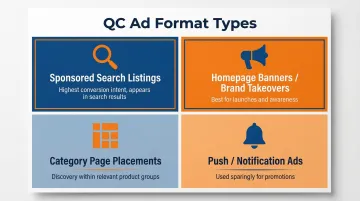
The major ad formats you'll encounter across platforms:
- Sponsored/Search Listings — Appear in search results when users search specific terms; highest conversion intent
- Homepage Banners/Brand Takeovers — High-visibility placements on the app's home screen; best for launches and awareness
- Category Page Placements — Appear while users browse a category; good for discovery within relevant product groups
- Push/Notification Ads — Limited, platform-specific; used sparingly for promotions
Blinkit Ad Formats
Blinkit operates a self-serve advertising interface called Brand Central. The platform charges a ₹25,000 listing fee per SKU per state, which is returned fully as ad credits. This makes Blinkit's entry barrier transparent and performance-driven.
Primary ad products include:
- Product Boosters (Sponsored Search) — Keyword-based listings that appear at the top of search results
- Sponsored Brand Banners — Visual placements on homepage and category feeds
- Category Page Takeovers — Premium visibility within specific product categories
- Brand Stores — Dedicated collection pages showcasing your full catalogue
Blinkit's high urban order density makes homepage and top-of-search placements extremely competitive. CPC ranges from ₹2 to ₹15 depending on category and city competitiveness. The platform provides real-time SKU-level ROAS tracking, making it easier to optimise spend quickly.
Zepto Ad Formats
Zepto's in-house AI ad platform, Jarvis, offers keyword targeting, bid recommendations, and campaign automation. Entry packages typically start at ₹5–6 lakh bundled commitments, making Zepto more accessible for mid-sized brands than premium platforms.
Key ad offerings include:
- Sponsored Search — Keyword-targeted listings similar to Blinkit
- Banner/Display Ads — Homepage and category placements
- Swap and Save — A unique competitor conquesting format that shows your product the moment a consumer adds a competitor's item to their cart, offering a one-tap switch
Zepto also offers Atom, a subscription-based analytics tool (around ₹30,000/month) that provides hyperlocal, pincode-by-pincode market share data and heatmap-style demand insights.
For regional FMCG brands running time-based campaigns, this geographic visibility is a direct input for pincode-level bid optimisation — particularly useful when demand patterns vary sharply across city zones.
Swiggy Instamart Ad Formats
Swiggy Instamart's structural advantage is its integration with Swiggy's food delivery app. Over 30% of users engage with multiple Swiggy services, creating strong cross-sell behaviour — especially for food-adjacent categories like snacks, beverages, dairy, and masala.
Ad products include:
- Keyword Ads — Search-based sponsored listings
- Display Ads — Homepage and category banners
- Item Boosts — Includes Browse Boost, Go-To-Items, and Last-Minute Add-Ons at checkout
- Search Inline Banners — Visual placements within search results
- Push Notifications — Limited promotional messaging
Quarterly brand packages typically range from ₹8–10 lakh, bundling display, push notifications, and item boosts. For masala, snack, and dairy brands, Item Boosts — especially Last-Minute Add-Ons at checkout — tend to deliver the strongest incremental uplift given the food-first user context.
JioMart Ad Formats
JioMart's positioning is unique: it has a strong tier-II and tier-III city user base, making it particularly relevant for regional brands with offline GT/MT strongholds trying to convert familiar customers online. With 800+ dark stores and coverage across 5,000 pincodes, JioMart leverages Reliance Retail's existing footprint.
Ad placements include:
- Digital Commerce Platform Ads — Search and display inventory similar to other platforms
- QR-Based In-Store Discovery Pilot — Reliance Retail is testing a search-and-discovery platform where customers scan QR codes at physical stores (like Trends, Yousta, and Smart Bazaar) to discover products tailored to their preferences
For regional brands, the QR-based pilot is worth monitoring closely — it's one of the few ad touchpoints that bridges physical retail familiarity with online conversion, a gap that most QC platforms haven't addressed.
Hyperlocal Campaign Structure: Thinking by City, Dark Store, and Pincode
National or even city-level broad campaigns underperform on QC because the same SKU can have completely different demand profiles in Lower Parel versus Koramangala. Campaign structure must reflect dark store traction, local demand patterns, and fulfilment availability at a granular level.
Why National Campaigns Waste Budget
QC advertising is strictly inventory-led. If a brand bids on a keyword at the city level, but the product is out of stock in specific neighbourhood dark stores, the ad simply won't show in those pincodes. Brands must sync their media plans at a granular SKU × keyword × geography × time-slot level.
As of early 2026, the dark store landscape looks like this:
- Blinkit: 2,027 dark stores (targeting 3,000 by March 2027)
- Swiggy Instamart: 1,021 active dark stores
- Zepto: 1,000+ dark stores
- JioMart: 800+ dark stores leveraging 3,000+ retail locations
Each dark store services a specific set of pincodes. Your ad visibility is entirely dependent on physical stock presence in these micro-warehouses.
Building a City-First Campaign Architecture
Start with top-performing cities based on sales data, map dark store coverage within each city, and create separate ad groups or campaigns per city zone rather than running blanket metro campaigns.
Step-by-step approach:
- Start in cities where you already have strong offline demand or existing QC traction — limit to 2–3 to begin.
- Within each city, identify which neighbourhoods have multiple dark stores with consistent stock availability.
- Build separate campaigns for zones like South Delhi, Central Mumbai, or North Bangalore rather than broad city-level campaigns.
- Allocate budget proportionally — weight spend toward zones with proven velocity and stable fulfilment history.
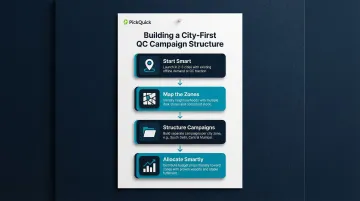
This structure allows you to pause underperforming zones without killing entire city campaigns, and scale winning zones faster.
The Role of Pincode-Level Demand Visibility
Brands with access to real-time pincode data can allocate bids to zones where both demand and fulfilment reliability are high, reducing wasted spend on pincodes with low dark store density or frequent OOS patterns.
Building this infrastructure internally takes time most brands don't have. PickQuick's management of 10,000+ pincodes across India gives brands ready infrastructure for hyperlocal advertising intelligence from day one. The platform tracks availability, outages, and demand signals at the pincode level — letting brands shift budgets dynamically, pulling spend from underperforming pincodes and reinvesting in high-ROI zones where fulfilment capacity matches demand.
Geo-Led Creative Adaptation
Tailor ad copy and creative to local context rather than using a single national creative across all markets. Practical tactics include:
- Lead with city-specific copy — "Mumbai's favourite masala" consistently outperforms "India's best masala" in local search
- Overlay regional languages where relevant — Tamil in Chennai, Marathi in Pune
- Time creatives to local occasions — Onam for Kerala, Ganesh Chaturthi for Maharashtra
This localization improves click-through rates and conversion because it signals relevance to the consumer in the moment of search.
Multi-City Scaling Strategy
Start with 2–3 proven dark store clusters and validate ROAS before scaling. Launching ads in cities where dark store coverage or replenishment is unstable burns budget without building velocity. Follow this sequence:
- Achieve 90%+ availability and strong velocity in your home city before expanding elsewhere.
- Move next to adjacent high-density cities with similar demographics and consumption patterns.
- Enter new geographies only after replenishment stability is confirmed — dark store depth must be adequate before media spend begins.
Each expansion stage should produce stable ROAS data before triggering the next. Scaling faster than your fulfilment infrastructure can support is the most common reason QC advertising underperforms at city entry.
Time-Band Bidding and SKU Selection: The Hidden Edge in QC Ads
Consumer intent shifts sharply throughout the day. Aligning ad spend with peak-intent windows dramatically improves ROAS, yet time-band targeting remains one of the most underutilized tactics in QC advertising.
Mapping Intent Windows: When Demand Peaks
Platform data reveals sharp micro-seasonal demand spikes:
- Morning (6:00 – 9:00 AM): Surges in milk, cereals, tea, coffee, and breakfast staples
- Afternoon/Evening (5:00 – 7:00 PM): Peaks in savory snacks and beverages
- Late Night (9:00 PM – Midnight): Impulse purchases, chocolates, and desserts
Running flat bids across 24 hours wastes budget during low-intent periods. Instead, apply bid multipliers during category-specific peak windows.
Practical framework:
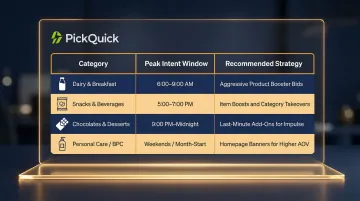
| Category | Peak Intent Window | Recommended Strategy |
|---|---|---|
| Dairy & Breakfast | 6:00 – 9:00 AM | Aggressive Product Booster bids on generic terms ("milk," "oats") |
| Snacks & Beverages | 5:00 – 7:00 PM | Item Boosts and Category Takeovers to capture evening cravings |
| Chocolates & Desserts | 9:00 PM – Midnight | Last-Minute Add-Ons (Cart Injection) for impulse buys |
| Personal Care / BPC | Weekends / Month-start | Homepage banners for higher AOV baskets |
Metro versus non-metro behaviour patterns also differ. Metros show sharper evening peaks driven by office-return timing, while non-metros spread demand more evenly across the day.
SKU Selection Strategy: Fast-Moving vs. Long-Tail
Advertising the entire catalogue dilutes budget on QC platforms, where users scroll fast and category pages reward the top few results. Brands should identify the top fast-moving SKUs per city and concentrate spend on those.
Hero SKU selection criteria:
- Sales velocity — Which SKUs rotate fastest at the dark store level?
- Margin — Which SKUs deliver the best unit economics?
- Availability rate — Which SKUs hold 90%+ in-stock rates consistently?
Focus ad budgets on 3–5 high-potential hero SKUs rather than spreading spend across a long-tail catalogue. Once organic rank improves for top-sellers, gradually shift spends to larger packs or secondary items.
Occasion-Led and Burst Campaign Planning
QC advertising performs exceptionally during festivals, cricket events, and seasonal peaks. Unlike traditional e-commerce where festive shopping peaks days in advance, QC festive sales spike on the actual day of the occasion itself.
During the 2025 festive season, QC platforms generated an estimated ₹3,000–3,500 crore in ad revenues, with ad rates surging by 40–50% for premium placements. Brands should pre-plan inventory buildup and increase bids during these windows, not reactively.
Burst campaign checklist:
- Identify key occasions 4–6 weeks in advance (Diwali, IPL, Rakhi, Onam)
- Coordinate with replenishment teams to build motherhub stock ahead of the event
- Increase bids 2–3 days before the occasion
- Monitor availability in real time during the event window
- Pull back spend immediately if stockouts occur
Automated and Smart Bidding Considerations
QC platforms offer algorithmic bidding that auto-adjusts based on conversion likelihood — but whether to use it depends on where your campaign stands:
- Use automated bidding when you have sufficient conversion data (100+ conversions) and stable inventory
- Use manual bids when launching new campaigns, testing new cities, or during high-stakes festive windows where you need tight control
- Set bid floors and caps to prevent overspending during competitive windows without losing visibility entirely
Why Inventory-Ad Alignment Is the Foundation of QC Success
Brands frequently run sponsored ads on SKUs that are out of stock at the dark store level, burning budget on clicks that can't convert. This is unique to QC because inventory is hyperlocal and can go OOS within hours of a demand spike.
The Core Problem: OOS Rates and Conversion Impact
On platforms like Blinkit, ad delivery is strictly inventory-led. If a product is out of stock in a specific dark store, the ad will not surface for users in that pincode, regardless of the brand's wallet balance or bid amount. Most brands, however, lack real-time visibility into dark store inventory — and that gap directly causes budget burn.
Platforms don't publicly publish national OOS rates, but third-party tracking indicates weekend stock-outs can reach 40–60% OOS levels across platforms — especially in dairy, snacks, and beverages. Running ads during these windows wastes spend and damages algorithmic ranking simultaneously.
The Solution Framework: Stock-Sync Discipline
Ensure dark store replenishment cycles are aligned with ad campaign schedules. This means:
- Pre-campaign inventory audit — Verify stock levels across all dark stores in target pincodes before launching ads
- Set minimum inventory thresholds — Pause SKU-level campaigns when inventory drops below a minimum threshold (e.g., 20% of Max)
- Real-time availability monitoring — Use platform dashboards to monitor availability during campaign periods
- Coordinate with replenishment teams — Ensure replenishment order cycles accelerate during high-demand windows
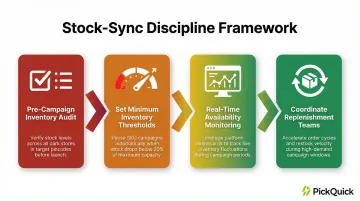
PickQuick integrates dark store replenishment and Min-Max inventory optimization directly with ad campaign planning. The Quick Commerce Control Tower monitors pincode-level availability in real time, triggering operational alerts when stock drops below campaign thresholds — before OOS gaps drain ad budgets.
How Availability Consistency Affects Organic Ranking
Consistent in-stock performance signals reliability to the platform and improves organic search placement, reducing reliance on paid ads over time. Blinkit's internal ranking system prioritizes availability, replenishment stability, and velocity — in that order.
Fill rate is the most critical metric. Blinkit expects brands to sustain a fill rate above 90%. Dropping below 80% consistently triggers algorithmic demotion across three fronts:
- Search rank falls, reducing organic discovery
- Ad visibility narrows, even with active budgets
- Pincodes go dark entirely until availability recovers
OOS events damage algorithmic ranking for weeks — the penalty persists long after shelves are restocked.
Brands that maintain high fill rates earn compounding returns: better organic placement lowers cost per acquisition, which frees budget for targeted ad placements during peak demand windows rather than spending defensively to compensate for ranking losses.
How to Measure and Optimize QC Ad Performance
Platform-reported ROAS needs to be validated against actual GMV data, not taken at face value. Brands that skip this validation routinely overpay for inventory that drives zero incremental demand.
Core QC Advertising Metrics
ROAS at the SKU and City Level
Track revenue generated per rupee spent using net selling price after platform discounts — not MRP. Zepto and Swiggy Instamart dashboards frequently calculate ROAS based on MRP rather than actual selling price, artificially inflating reported returns by up to 47%.
CTR on Sponsored Listings and Banners
Healthy CTR for Instamart sponsored ads ranges from 1.5% to 3.0%. Lower CTR indicates poor keyword targeting or weak creative relevance.
Conversion Rate from Ad Click to Purchase
Track how many users who click your ad actually complete checkout. Low conversion despite high CTR points to pricing issues, out-of-stock problems, or a weak product detail page.
Share of Search / Sponsored Visibility Rate
What percentage of searches in your category surface your sponsored listing? This directly reflects competitive positioning and bid effectiveness.
Incremental Sales Contribution (Paid vs. Organic Split)
Platform-reported ROAS doesn't always equal incremental sales. Because QC discovery is largely search-led, ads often capture users who already intended to buy the category. Track the paid-organic split at the SKU and city level weekly to identify which spend is actually moving the needle.
Structured Optimization Cadence
QC requires a performance marketer's mindset — with daily responsiveness during high-stakes periods like weekends, festive windows, and new dark store launches.
Weekly bid reviews by city and SKU:
- Identify underperforming SKUs (ROAS below 3x) and pause or reduce bids
- Identify overperforming SKUs (ROAS above 6x) and increase bids or expand to new pincodes
- Check availability rates — if a high-performing SKU shows declining availability, coordinate with replenishment before scaling spend
Monthly budget reallocation based on ROAS performance:
- Shift budgets from low-ROAS cities to high-ROAS cities
- Reallocate from supporting SKUs to hero SKUs that drive the majority of conversions
- Test new ad formats (for example, shifting from search to category placements) in cities with saturated search inventory
Quarterly strategy resets are where you step back from SKU-level execution and reassess the full campaign structure. Review which platform is outperforming in your category, reassess city prioritization as dark stores expand into new markets, and update hero SKU selection for seasonal shifts and new launches.
Benchmarking Performance Across Platforms
Blinkit, Zepto, Instamart, and JioMart have different CPCs, audience profiles, and ad inventory types. Comparing absolute ROAS across platforms without accounting for these differences will lead to misallocated budgets.
Typical performance benchmarks (third-party estimates):
| Metric | Blinkit | Zepto | Swiggy Instamart | JioMart |
|---|---|---|---|---|
| CPC Range | ₹2 – ₹15 | ₹5 – ₹12 | ₹3 – ₹10 | Not disclosed |
| Target ROAS | 4x – 6x | 4x – 5x | 5x – 7x | 3x – 5x |
| CTR (Sponsored Search) | 2.0% – 3.5% | 1.8% – 3.0% | 1.5% – 3.0% | Not disclosed |
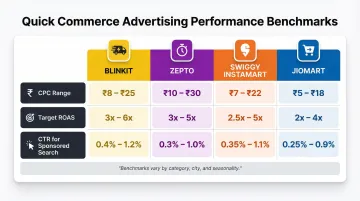
These benchmarks shift with category, city competitiveness, and seasonality. If your ROAS consistently lands below the lower end of the range, the problem is typically bid structure or availability — not platform selection.
Frequently Asked Questions
What is the quick commerce strategy?
A QC strategy combines hyperlocal inventory positioning, platform-specific advertising, and demand-aligned operations. The goal is to be visible, in stock, and competitively placed at the exact moment a consumer is ready to buy within a 10–20 minute delivery window.
How do quick commerce ads differ from traditional ecommerce ads?
QC ads target consumers with pre-existing, immediate purchase intent in a compressed decision window, unlike ecommerce or social ads where the journey from awareness to purchase is longer. Ad formats are hyperlocal and inventory-linked rather than audience-segment based — visibility depends entirely on whether the SKU is physically present in the dark store servicing that pincode.
Which ad formats perform best on Blinkit, Zepto, and Swiggy Instamart?
Sponsored search listings consistently deliver the highest conversion intent across all three platforms since they intercept active searchers. Homepage banners and category placements work better for new product launches or brand awareness goals, but conversion rates are typically lower than search-based formats.
How much should a brand allocate to quick commerce advertising?
Budget allocation varies by category and scale, but digital budgets allocated to QC platforms have surged from 3–5% to 15–20%, with the percentage rising for brands in high-velocity categories like snacks, dairy, and personal care. Some high-frequency FMCG brands now allocate over 50% of their digital budgets to QC.
Why do QC ads underperform despite high budgets?
The most common causes are running ads on out-of-stock SKUs, using national or category-broad targeting instead of city- and dark-store-level structure, and ignoring time-band optimization. All of these cause budget burn without proportional conversions — and failing to cross-check platform-reported ROAS against actual GMV data masks underperformance just as reliably.
How does dark store coverage affect QC ad strategy?
Ads should only be active in geographies where dark store coverage is stable and replenishment is consistent. Launching ads before adequate dark store depth is in place leads to poor delivery experience, high OOS rates, and wasted ad spend. Start with proven clusters, validate ROAS, then expand to new cities only once replenishment stability is confirmed.