What is catalog management?
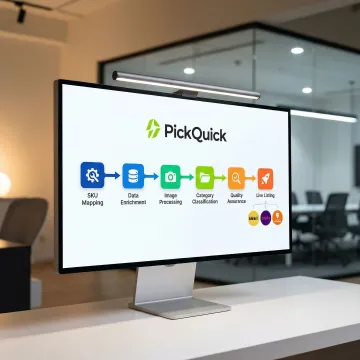
Catalog management is the process of creating, organizing, and maintaining product listings across sales channels to ensure accuracy, compliance, and discoverability. In quick commerce, it includes SKU mapping, variant alignment, title and description optimization, category mapping, compliance documentation, and continuous listing health monitoring — all structured to maximize search visibility and conversion rates on platforms like Blinkit, Zepto, and Instamart.
Which quick commerce platforms does PickQuick manage catalogs on?
PickQuick manages catalogs across all four major quick commerce platforms in India — Blinkit, Zepto, Swiggy Instamart, and JioMart. Each platform has distinct listing formats, mandatory fields, and category taxonomies. PickQuick handles platform-specific structuring for each, ensuring your SKUs are mapped, compliant, and optimized for search on every channel simultaneously.
What information is needed to create a listing on quick commerce platforms?
A complete quick commerce listing requires brand name, product name, variant, pack size, MRP, selling price, landing price, dimensions, gross weight, category mapping, shelf life, ingredient list, FSSAI details, HSN code, and GST information. Image assets must include Front of Pack, Back of Pack with regulatory info, Picker Image, and a clear Barcode Image. PickQuick prepares and validates all of these before submission.
How long does it take to get a catalog live on quick commerce platforms?
With PickQuick's fast onboarding process, brands typically go live in weeks rather than months — achieving a 3–5x faster timeline compared to traditional self-managed onboarding. This is possible because PickQuick prepares all compliance assets, images, listings, and Seller Hub configurations in parallel before submission, eliminating the back-and-forth that causes most delays.
How does catalog management affect product discoverability on quick commerce?
Platform search algorithms rank listings based on keyword relevance, listing completeness, availability, and velocity. A well-structured catalog with optimized titles, accurate category mapping, regional search terms, and complete compliance fields significantly improves search ranking. PickQuick's catalog strategy incorporates platform-specific keyword signals, regional terminology, and cuisine or usage cues to maximize organic discoverability.
Does PickQuick manage catalog updates and ongoing listing health?
Yes. PickQuick provides continuous listing health monitoring as part of its daily operations management. This includes pricing updates, promotional content changes, resolution of listing discrepancies, compliance flag management, and image refreshes. Any listing that is suppressed, flagged, or de-ranked is identified and corrected in real time to maintain uninterrupted product availability.
Can PickQuick manage catalogs for brands with many SKUs across multiple categories?
Absolutely. PickQuick is experienced in managing large, multi-SKU catalogs spanning food, FMCG, dairy, masala, personal care, and staples categories. The team handles variant mapping, pack-size alignment, and category-specific compliance for each SKU — consolidating everything into a unified catalog system that pushes accurate, platform-ready listings across all channels simultaneously.
What makes PickQuick's catalog management different from doing it in-house?
PickQuick brings operator-level platform access, pre-existing relationships with QC platform category teams, and a purpose-built catalog management system covering 10,000+ pincodes. Unlike in-house teams navigating platform rules independently, PickQuick has managed 25+ category-leading brands and understands the nuances of listing optimization, GRN compliance, and search performance across Blinkit, Zepto, Instamart, and JioMart — translating that experience directly into faster go-lives and stronger conversion rates.