Introduction
India's quick commerce market has scaled to over $10 billion in Gross Merchandise Value (GMV) and is projected to grow at over 40% annually through 2030. Zepto, commanding a 29% market share and processing over 1.7 million orders daily, has become synonymous with 10-minute grocery delivery. That delivery promise runs on a tightly engineered operational infrastructure: the dark store network.
Yet most brand managers and FMCG entrepreneurs don't fully understand how this model actually works. They know consumers are buying on Zepto, but they don't grasp how inventory moves from warehouse to doorstep in under 15 minutes—or why their products keep going out of stock despite strong demand.
That knowledge gap has real costs: poor inventory planning, missed platform listings, and fulfillment failures that quietly erode brand visibility and revenue.
This guide breaks down how Zepto's dark store model actually works—from physical setup to order flow to AI-driven inventory logic—and what it means for brands operating on the platform.
Key Takeaways
- Zepto dark stores are 2,000–4,400 sq. ft. micro-warehouses closed to the public, placed within 2–3 km of dense urban neighbourhoods
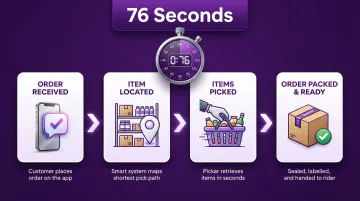
- Each order routes to the nearest dark store, where staff pick and pack within 76 seconds before rider dispatch
- AI demand forecasting decides which 2,500–3,000 SKUs stock each location, driven by pincode-level purchase patterns
- Zepto is shifting to a franchised operator model, offering 3% base commissions to third-party store managers
- For brands, dark store placement, stock availability, and replenishment discipline directly determine visibility and sales
What Is a Zepto Dark Store?
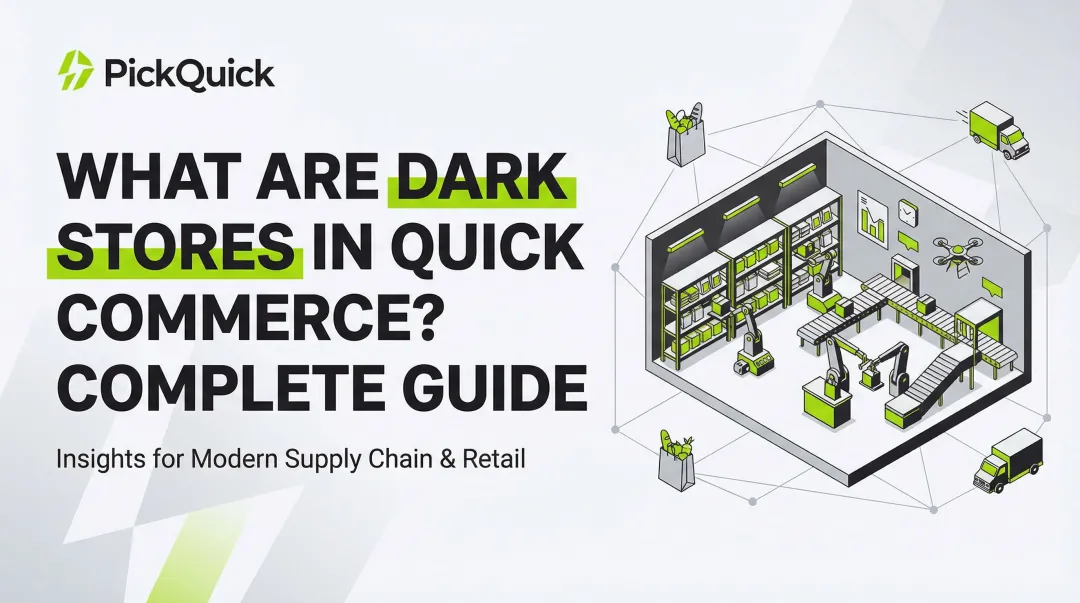
A dark store is a small, closed-access fulfillment warehouse designed exclusively to process and dispatch online orders—not a retail outlet open to shoppers. Think of it as a micro-warehouse optimized for speed, not customer browsing.
Dark stores exist because traditional retail and regional warehouses are too far from customers and too slow for sub-15-minute delivery. Zepto's promise requires inventory positioned within 2-3 km of the customer, not 20 km away in a distribution center.
By eliminating all customer-facing friction—no aisles to navigate, no checkout lines, no parking lots—dark stores become dedicated fulfillment hubs.
What a dark store is NOT:
- Not a regular store that happens to be closed after hours
- Not a standard warehouse managing regional supply chains
- Not accessible to walk-in shoppers under any circumstances
Physical characteristics of a typical Zepto dark store:
- 2,000 to 4,400 sq ft — compact enough to sit inside dense residential zones
- Ground-floor or easy-access buildings in high-footfall residential and commercial areas
- 2,500 to 3,000 SKUs curated for local demand patterns
- Serves customers within a 1.5 to 3 km radius
Unlike traditional warehouses that optimize for storage capacity and regional distribution, dark stores optimize for picking speed and hyperlocal fulfillment. Every square foot is arranged to shorten the seconds between picking an item and packing the order.
How Does the Zepto Dark Store Model Work?
Zepto's fulfillment operates as a tightly choreographed sequence where every stage is engineered to minimize seconds, not just minutes.
Order Placement and Routing
When a customer places an order on the Zepto app, the platform's algorithm instantly routes it to the nearest dark store based on the customer's pincode and real-time stock availability at that location. The routing is fully automated: no human intervention decides which store fulfills which order.
If the nearest dark store is out of stock for a requested item, the platform either routes to a secondary nearby store or displays the item as unavailable. This routing logic is why brands must maintain consistent availability across multiple dark stores. When stock runs out at the closest location, the sale is typically lost rather than fulfilled from farther away.
Picking and Packing
Once an order lands at a dark store, staff follow a tightly sequenced pick-and-pack process. The store layout places high-frequency items—staples, dairy, snacks, personal care—closest to packing zones, reducing walk time per order.
Zepto co-founder Aadit Palicha revealed the operational benchmark: "Within 76 seconds of an order being placed, the order is packed and made ready for pickup." This isn't an average—it's the standard. Store layout decisions, SKU placement, and picker training all support this sub-90-second target.
Inventory Monitoring and Replenishment Control
Zepto uses real-time inventory tracking and AI-driven tools to monitor stock levels across each dark store. The system employs Min-Max optimization: every SKU has a minimum threshold (triggers replenishment when stock hits this level) and a maximum ceiling (prevents overstock that could age or expire).
Replenishment flow:
- Who supplies: Brands or distributors deliver to Zepto's Motherhub (central receiving center)
- From Motherhub to dark store: Stock moves based on demand forecasts and Min-Max triggers
- Frequency: Multiple replenishment cycles daily, depending on velocity
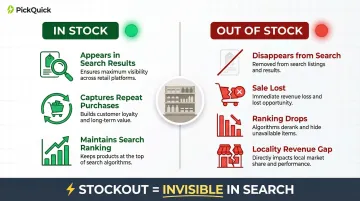
- Consequence of failure: If replenishment lags, the product goes out of stock and disappears from search results—making availability metrics a direct driver of discoverability and revenue
Last-Mile Delivery
Packed orders are handed to delivery riders stationed at or near the dark store. Route optimization algorithms (using Dijkstra's algorithm for real-time mapping) reduce delivery time to the customer. Zepto's median delivery time is 8 minutes and 47 seconds—a benchmark that requires flawless execution in every upstream stage.
If picking is slow or inventory data is inaccurate, the last-mile stage absorbs the cost in delayed deliveries and customer dissatisfaction. For brands, this means a problem at replenishment or cataloging shows up as a fulfillment failure—even when the rider did everything right.
The Technology and Inventory Logic Behind Zepto Dark Stores
Zepto's dark store network runs on purpose-built algorithms that decide which products appear in which stores, when to replenish, and how to route orders.
AI and demand forecasting: Zepto uses statistical and machine learning models including ARIMA, Facebook's Prophet, Random Forest, and LSTM to forecast demand at the pincode level. The system processes real-time inputs like weather, local events, and time of day to predict what customers in each neighborhood will order.
SKU selection for dark stores: Not every product appears in every store. High-velocity, everyday items—staples, dairy, snacks, personal care—dominate the assortment. Slow-moving items are deprioritized or excluded entirely. For brands, this means:
- Getting listed on Zepto doesn't guarantee presence in all stores
- SKU placement is driven by locality-level demand signals
- Low-velocity products may only appear in select high-demand pincodes
These SKU-level decisions don't happen manually — they're enforced by the underlying technology stack in real time. Zepto's order routing engine, warehouse management system, and delivery coordination platform operate together continuously. The platform uses the 0/1 Knapsack Problem algorithm to maximize stocked item value within physical space limits, and Bipartite Matching for optimal rider assignment — meaning shelf space and delivery capacity are both algorithmically allocated, not negotiated.
When a brand's product is assigned to a dark store but replenishment lags, it goes out of stock and disappears from search results entirely. Availability metrics directly drive discoverability — a stockout at a single pincode can wipe out sales for that locality until the next replenishment cycle. For high-frequency FMCG brands, that's not a minor gap; it's lost repeat purchase volume that rarely recovers the same day.
What the Zepto Dark Store Model Means for Brands
The dark store model fundamentally changes how brands manage fulfillment. Unlike traditional retail, where a brand ships to a distributor and waits for sell-through, Zepto requires active replenishment across dozens of dark stores simultaneously. Each location functions as a mini-stockpoint — and a single gap in availability has downstream consequences.
Key brand-side operational challenges:
- Coordinating inventory across dozens or hundreds of dark stores in multiple cities
- Managing pincode-level demand variation, where the same SKU sells very differently by neighborhood
- Monitoring availability in real time — brands without dedicated QC operations often miss stockouts until rankings have already dropped
- Hitting replenishment windows consistently, since missed orders trigger visibility penalties on the platform
How Specialized QC Operators Bridge the Gap
Working with an end-to-end Quick Commerce operator removes this complexity entirely. PickQuick, for example, handles dark store replenishment, Min-Max optimization, and platform onboarding for regional brands across Zepto, Blinkit, Swiggy Instamart, and JioMart:
- Predictive inventory management at the dark store level
- Daily RO (Replenishment Order) creation and confirmation
- Real-time availability monitoring across 10,000+ pincodes
- Multi-city expansion without operational fragmentation
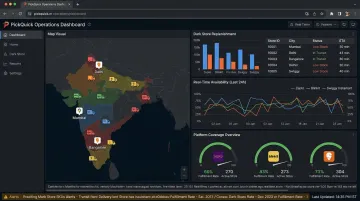
The result: brands go live across platforms in weeks, maintain clean availability metrics, and expand to new cities without building internal QC infrastructure from scratch.
Zepto's Dark Store Scale and Operator Model
Network Scale
As of early 2026, Zepto operates over 1,000 dark stores across major urban centers including:
- Bangalore, Chennai, Hyderabad, Pune
- Delhi, Ghaziabad, Gurgaon, Noida
- Kolkata, Mumbai
The Shift to a Marketplace Model
Zepto registered "Zepto Marketplace Private Limited" in October 2024 to transition from a B2B2C structure to a marketplace approach. Rather than running all stores directly, Zepto now partners with third-party operators who manage day-to-day operations under Zepto's SOPs and technology stack.
According to reviewed documents, the franchisee commission structure breaks down as:
- Major markets (Delhi, Bengaluru, Mumbai): 3% of gross sales value
- Newer markets: 2.75% of gross sales value
- SLA-based bonus: Up to 1.25% additional for meeting performance targets
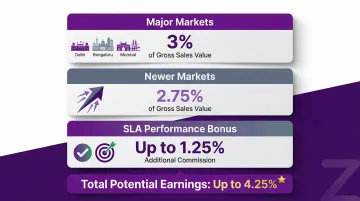
These rates are positioned above most competitors to attract quality operators.
Who Owns and Runs Dark Stores
Zepto operates a hybrid model:
- Company-operated stores: Zepto owns and runs these directly
- Franchisee-operated stores: Third-party operators invest in infrastructure and staffing, managing stores under Zepto's oversight
This hybrid structure means store performance is no longer uniform across the network. A franchisee-run store in Pune may operate differently from a company-owned store in Mumbai — different staffing, different SLA adherence, different stock discipline.
For brands supplying into Zepto, this makes centralized replenishment tracking non-negotiable. Availability gaps at one operator's stores won't automatically surface unless someone is actively monitoring fill rates by location.
Conclusion
Zepto's 10-minute delivery runs on a precisely engineered system. Hyper-local dark store placement within 2-3 km of customers, AI-driven inventory control using pincode-level demand forecasting, sub-76-second picking benchmarks, and last-mile route optimization all work in sequence — each layer dependent on the one before it.
For brands, understanding how dark stores work — especially how SKU placement, replenishment frequency, and availability metrics interact — is the difference between growing on Zepto and getting delisted. Brands that maintain 98%+ availability across dark stores expand to more locations. Brands that let stock run out disappear from search results and lose ranking.
Managing this operational complexity across multiple cities and platforms is where QC operators like PickQuick create measurable value. For regional FMCG brands that want to scale on Zepto without building the infrastructure in-house, PickQuick manages catalog setup, dark store replenishment, and availability tracking across platforms — delivering faster go-live and cleaner metrics from day one.
Frequently Asked Questions
What is a Zepto dark store?
A Zepto dark store is a small, closed-access micro-warehouse (2,000–4,400 sq. ft.) located in dense urban areas, designed exclusively to fulfill online orders. It's not open to the public and exists solely to enable sub-15-minute deliveries through fast, structured picking and dispatch workflows.
How does Zepto manage its dark stores?
Zepto manages dark stores through AI-driven inventory systems, real-time order routing, and standardized operating procedures. The company is shifting toward an operator-managed model where third-party franchisees handle day-to-day operations under Zepto's technology infrastructure and oversight.
How many dark stores does Zepto have?
Zepto operates over 1,000 dark stores across India as of early 2026, covering major cities including Bangalore, Mumbai, Delhi, Hyderabad, Chennai, Pune, and Kolkata. New locations are added as Zepto pushes deeper into Tier 2 cities.
Who owns Zepto dark stores?
Zepto operates a mix of company-owned and franchisee-run dark stores. Regardless of ownership, Zepto controls the technology, SOPs, and inventory planning — keeping operations consistent across all locations.
Are Zepto dark stores open to the public?
No. Dark stores are not open to walk-in customers — every aspect of the space is built for order fulfillment, not retail browsing. The layout, SKU placement, and workflows are optimized for fast picking and dispatch by staff, not customer navigation or browsing.
Why is Zepto very cheap?
Zepto's pricing efficiency comes from eliminating retail overheads — no customer-facing stores, no floor staff for shoppers, no checkout infrastructure. Operating at volume across dense urban areas and using technology to reduce picking and logistics costs per order keeps per-order costs low enough to pass savings to customers.