Introduction
Buyers now expect groceries, personal care items, and snacks delivered in under 30 minutes. That expectation has pushed the entire logistics stack to rebuild around speed—new store formats, new replenishment models, and a fundamentally different relationship between inventory and the consumer.
According to Datum Intelligence's 2024 consumer survey, 69% of Indian online grocery buyers prefer 10-minute delivery over scheduled next-day delivery, and 73% are willing to pay a premium for this speed. Speed has become the default expectation, not a premium feature.
This guide covers what hyperlocal fulfillment means, how it works through dark stores, its core benefits for brands, how it differs from traditional distribution, and how regional brands in India can activate it on Quick Commerce platforms.
TLDR:
- Hyperlocal fulfillment stores inventory within 1–5 km of consumers in small dark stores, enabling 10–30 minute delivery
- Dark stores use pincode-level demand signals and Min-Max replenishment to maintain availability
- Speed, higher conversion rates, and regional market penetration are key brand benefits
- India's QC platforms operate 3,500+ dark stores across 100+ cities, creating ready-made infrastructure
- Regional brands can go live on QC platforms in weeks with the right onboarding and replenishment setup
What is Hyperlocal Fulfillment?
Hyperlocal fulfillment places inventory in small, decentralized fulfillment points within 1–5 km of buyers—so orders can be picked, packed, and delivered in minutes, not hours. The product is already near the customer before the order is even placed.
What "Hyperlocal" Really Means
"Hyperlocal" isn't just fast delivery—it's proximity-based inventory placement. The product already lives near the buyer before the order is even placed. The "hyper" distinguishes it from ordinary local delivery through three factors:
- Tighter radius: Typically 1–5 km, not city-wide
- Minute-level SLAs: Delivery measured in 10–30 minutes, not hours
- Pincode-level stock decisions: Inventory placement driven by neighborhood demand patterns
The Evolution of Fulfillment Architecture
The shift to hyperlocal fulfillment represents a fundamental restructuring:
Traditional Model: Large centralized distribution centers → Regional warehouses (50,000+ sq ft) → Consumer doorstep (1–5 days)
Hyperlocal Model: Micro-fulfillment centers (1,000–3,000 sq ft) positioned inside dense urban neighborhoods → Consumer doorstep (10–30 minutes)
This evolution was driven by two forces: rising consumer expectations for immediacy and the explosive growth of on-demand ordering. India's quick commerce sector now accounts for over two-thirds of all e-grocery orders, representing a $6–7 billion (approximately ₹55,000–58,000 crore) market in 2024.
For brands operating in this market, understanding the mechanics matters. The terms "fulfillment" and "delivery" get used interchangeably—but they're not the same thing.
Fulfillment vs. Delivery
Hyperlocal fulfillment differs from hyperlocal delivery:
- Fulfillment: The entire process of storing, picking, and dispatching inventory
- Delivery: The last leg—transporting the order to the customer's door
- The key difference: A brand doing hyperlocal fulfillment has restructured where inventory lives, not just how it moves
A brand that only optimizes delivery speed without repositioning inventory will always be constrained by distance.
Relevant Product Categories
Hyperlocal fulfillment works best for high-frequency, everyday products:
- Grocery and staples (rice, flour, cooking oil)
- Dairy products (milk, yogurt, paneer)
- Masala and spices (regional blends, cooking essentials)
- Personal care (shampoo, soap, toothpaste)
- Snacks and bakery (chips, biscuits, namkeen)
These are products consumers want immediately and cannot wait for next-day delivery.
How Hyperlocal Fulfillment Works: The Dark Store Model
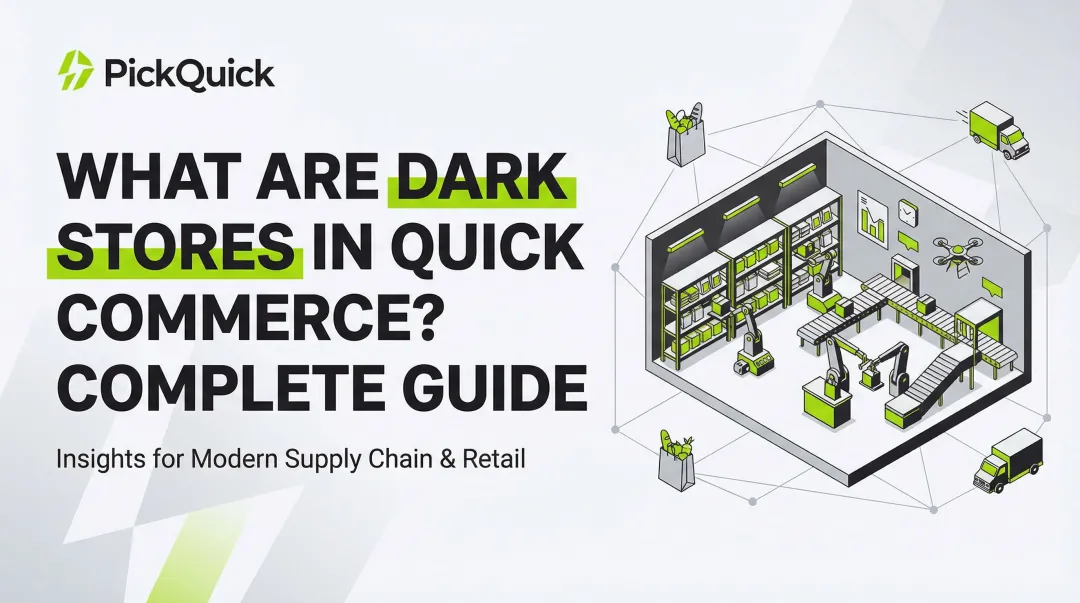
Dark stores are the physical backbone of hyperlocal fulfillment. These are small, warehouse-only facilities—typically 1,000–3,000 sq ft—located inside residential neighborhoods, not open to the public, and optimized entirely for fast order picking rather than retail display.
The Order Flow
Here's how an order moves through the system:
- Consumer places order on a Quick Commerce platform (Blinkit, Zepto, Swiggy Instamart, JioMart)
- Platform algorithm routes order to the nearest dark store with the item in stock
- Picker fulfills order in under 2 minutes
- Delivery partner dispatches from the store
- Order reaches consumer within 10–30 minutes
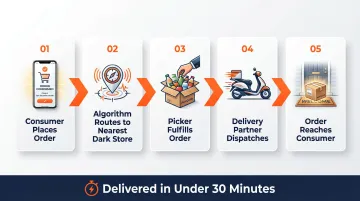
Blinkit reported an average delivery time of 12.5 minutes in March 2024, with ~75% of orders delivered within two minutes of the promised time. Zepto's median delivery time stands at 8 minutes 47 seconds.
Pincode-Level Inventory Intelligence
Each dark store stocks a curated, high-velocity SKU assortment based on neighborhood-level demand signals:
- Purchase history
- Search trends
- Time of day patterns
- Local preferences
A dark store in one pincode may stock a regional masala brand while one two kilometers away might not. For regional brands, this means presence in the right pincodes—not just the right platforms—determines actual sales volume.
Dark Store Size Variations
Platforms are diversifying their formats:
| Format Type | Size Range | SKU Count | Purpose |
|---|---|---|---|
| Compact nodes | 1,500–2,500 sq ft | 10,000–20,000 | Speed-focused, core grocery |
| Standard stores | 3,500–4,500 sq ft | 20,000–30,000 | Balanced assortment |
| Megapods | 10,000–12,000 sq ft | 45,000–50,000 | Higher AOV, non-grocery expansion |
Swiggy Instamart has begun deploying megapods to accommodate expanded categories beyond grocery, while maintaining compact nodes for ultra-fast delivery.
Min-Max Replenishment
Min-Max replenishment is the system that keeps dark stores stocked:
- Minimum threshold: Triggers automatic reorder when stock falls below this level
- Maximum threshold: Capacity ceiling for each SKU in each store
For brands, this system has direct commercial consequences. A stockout on a QC platform loses the immediate sale and simultaneously reduces the brand's search ranking and availability score—cutting discoverability for future orders. Replenishment must happen before stock hits the minimum threshold, not after.
The Role of QC Platforms
Beyond replenishment, brands depend on QC platforms for the infrastructure layer that makes delivery possible:
- Own or partner to operate dark store networks
- Manage delivery fleets
- Provide consumer-facing apps
- Control search algorithms and ranking
Brands must plug into this infrastructure at the inventory level to participate in hyperlocal fulfillment. The platform controls what gets seen, what gets ordered, and how fast it arrives—brands supply the product, but the platform sets the rules.
Key Benefits of Hyperlocal Fulfillment for Brands
Speed as a Competitive Moat
Delivery windows tell the story:
- Hyperlocal QC: 10–30 minutes
- Traditional e-commerce: 1–5 days
That gap translates directly to conversions. 73% of Indian consumers are willing to pay a premium for faster delivery, giving platforms room to move beyond discount-driven growth.
Higher Search-to-Conversion Rates
When a brand's product is available in the dark store closest to the searching consumer, two things happen:
- It surfaces higher in platform search results
- It converts at a much higher rate than products sourced from distant warehouses
Products that maintain 95%+ availability earn algorithmic preference on QC platforms. Stockouts trigger immediate deranking — so availability directly shapes discoverability.
Lower Effective Last-Mile Costs
Shorter delivery distances — often under 3 km — and batched dispatch from shared hyperlocal locations can reduce last-mile costs by 20–30% compared to regional warehouse-to-doorstep models. That cost structure is what makes free or subsidized delivery economically viable at scale.
Stronger Regional Market Penetration
Hyperlocal fulfillment allows brands to establish genuine presence at the neighborhood level. For regional brands with strong offline demand in specific cities or states, this translates into digital visibility where their buyers already live.
A masala brand dominant in Maharashtra or a dairy brand with strong general trade presence in Karnataka can achieve city-level hyperlocal coverage without physical retail expansion—if their inventory is correctly placed in the right dark stores.
PickQuick manages 10,000+ pincodes and operates across all four major QC platforms to help regional brands achieve exactly this kind of coverage.
Hyperlocal Fulfillment vs. Traditional Distribution
These two models are built for opposite use cases — one for speed and daily replenishment, the other for planned, high-volume purchases.
| Parameter | Hyperlocal Fulfillment | Traditional Distribution |
|---|---|---|
| Delivery Time | 10–30 minutes | 1–5 days |
| Inventory Location | Many small dark stores (1–5 km radius) | 1–2 large central warehouses |
| SKU Depth per Node | Curated (10,000–50,000 SKUs) | Long-tail (millions of SKUs) |
| Order Volume | Small baskets (5–10 items), impulse/top-up | Bulky, planned bulk purchases |
| Replenishment Frequency | Multiple times daily | Weekly or bi-weekly |
| Geographic Flexibility | Pincode-level precision | City or region-wide |
| Ideal Categories | Grocery, FMCG, snacks, dairy, personal care | Large appliances, furniture, fashion |
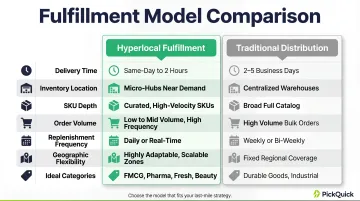
The table above makes the tradeoffs clear. Choosing the right model comes down to what your customer is actually buying — and when they need it.
When Each Model is Appropriate
Traditional distribution suits:
- Large-ticket, low-frequency purchases
- Bulky items consumers plan in advance
- Long-tail discovery (niche products with small audiences)
Hyperlocal fulfillment works best for:
- High-frequency, low-ticket consumables
- Everyday products requiring immediate availability
- Categories driving Quick Commerce in India — dairy, masalas, staples, snacks, and personal care
Hyperlocal Fulfillment in India's Quick Commerce Landscape
Market Size and Growth
India's Quick Commerce sector has reached critical scale:
- Over two-thirds of all e-grocery orders in 2024 occurred on QC platforms
- Market size: $6–7 billion in 2024
- Projected growth: 40%+ annually through 2030
- Category expansion: 15–20% of QC GMV now comes from non-food categories
Platform Infrastructure
India's QC platforms have built the largest hyperlocal fulfillment networks in the country:
| Platform | Dark Stores | City Coverage | As of |
|---|---|---|---|
| Blinkit | 1,301 | 100+ cities | March 2025 |
| Swiggy Instamart | 1,021 | 124 cities | March 2025 |
| Zepto | 900+ | Major cities | Sept 2025 |
| JioMart | 600+ dark stores (plus 3,000+ retail stores) | 1,000+ cities / 5,000+ pincodes | Jan 2026 |
Blinkit and Swiggy Instamart have crossed the 1,000-store threshold. JioMart is leveraging its 3,000+ physical retail stores alongside 600+ dedicated dark stores to achieve the widest pincode penetration.
Platform Monetization
Gross Order Value (GOV) figures demonstrate platform scale:
- Blinkit: ₹22,371 crore GOV for FY25
- Swiggy Instamart: ₹14,683 crore GOV for FY25
- Zepto: ~₹24,500 crore ($3 billion) annualized GOV in January 2025
Together, these platforms operate a pre-built hyperlocal fulfillment infrastructure that brands can access without building their own. For regional brands, this scale represents a direct route to city-level distribution.
The Regional Brand Opportunity
A masala brand dominant in Maharashtra, a dairy brand with strong GT presence in Karnataka, or a snacks brand popular in Tamil Nadu can achieve city-level hyperlocal coverage without any physical retail expansion, provided their inventory is correctly placed in the right dark stores.
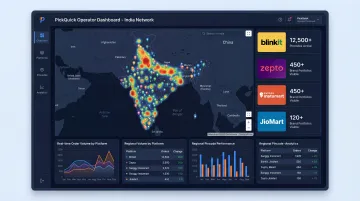
PickQuick manages 10,000+ pincodes across all four major QC platforms, holding operator rights to hundreds of regional brands. When platforms enter new cities, PickQuick already represents most of the top local brands — enabling faster expansion cycles and deeper regional catalogues for every brand it manages.
How Regional Brands Can Activate Hyperlocal Fulfillment
Step 1: Platform Onboarding and Catalog Setup
Getting listed on Blinkit, Zepto, Swiggy Instamart, and JioMart requires:
Documentation:
- FSSAI license
- GST registration
- Business registration documents
- Bank account details
Catalog Creation:
- Product images (front, back, picker, barcode)
- Accurate product information (name, variant, pack size, MRP, dimensions)
- Category mapping
- Ingredient lists and regulatory details
- HSN codes and GST classification
Common Errors That Delay Go-Live:
- Incorrect LP-SP alignment (Landing Price vs. Selling Price)
- Poor barcode scanability
- Missing or low-quality product images
- Incomplete regulatory information
- Packaging that fails inwarding compliance
Errors at this stage delay go-live by weeks. Establishing a new dark store presence and integrating systems takes 25–50 days for brands managing the process independently.
Step 2: Dark Store Coverage Strategy
Identify which pincodes and cities have the strongest offline demand for your brand, then prioritize getting inventory placed in dark stores serving those neighborhoods.
Key Considerations:
- Where does your brand already dominate offline (GT/MT)?
- Which pincodes show highest consumption density?
- What are the velocity patterns by neighborhood?
Brands must work with platform teams or operators to negotiate dark store allocation and assortment inclusion—this is not automatic upon listing. Platforms prioritize brands that demonstrate operational maturity, clean replenishment cycles, and proven demand.
Step 3: Consistent Replenishment and Availability Management
Availability is the single most important ongoing metric on QC platforms. Brands must ensure dark stores are replenished before stock reaches the minimum threshold, with clean purchase order execution and no gaps in supply.
Critical Metrics:
- Maintain store-level availability at 95%+ to qualify for dark store expansion
- Control motherhub ageing — stale stock reduces dark store pull-through
- Confirm replenishment orders (ROs) quickly to avoid supply gaps
- Keep GRN/DN scores clean by minimizing Goods Receipt Note mismatches
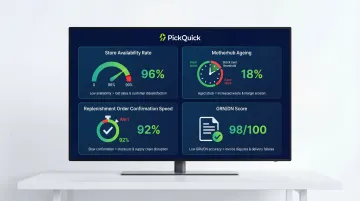
Falling below 80% fill rate triggers algorithmic demotion, reducing search ranking and ad visibility. Recovery requires weeks of consistent performance.
Managing all three steps simultaneously — onboarding, coverage, and replenishment discipline — is where most regional brands stall. PickQuick handles this end-to-end, so brands don't have to build a QC operations team from scratch:
- Onboards brands across Blinkit, Zepto, Swiggy Instamart, and JioMart
- Manages dark store replenishment with Min-Max optimization
- Tracks real-time availability across 10,000+ pincodes
- Automates PO processing and dispatch coordination
- Drives platform growth strategy and category expansion
PickQuick's operator model delivers 3–5x faster QC go-live compared to managing the process independently — weeks instead of months. With 25+ category-leading brands under management, the company acts as a single QC partner replacing dozens of fragmented vendor relationships.
Frequently Asked Questions
What is hyperlocal fulfillment?
Hyperlocal fulfillment is the storage and dispatch of inventory from small, neighborhood-level fulfillment nodes (dark stores) within 1–5 km of the consumer, enabling delivery in minutes rather than days. It relies on pincode-level demand intelligence and Min-Max replenishment systems.
What does hyperlocal mean?
"Hyperlocal" refers to an extremely tight geographic scope—typically a single neighborhood or a radius of a few kilometers. In commerce, it describes proximity-driven operations serving customers within that narrow area, with inventory decisions made at the pincode level.
What does local fulfillment mean?
Local fulfillment means sourcing and dispatching orders from a nearby store or warehouse within the same city, typically with 1–2 day delivery. Hyperlocal fulfillment goes further—inventory is placed inside the neighborhood itself, cutting delivery time from days to under 30 minutes.
What is an example of a hyperlocal business?
Blinkit, Zepto, and Swiggy Instamart are the most prominent examples in India. They operate dark store networks across 100+ Indian cities, fulfilling grocery and FMCG orders within 10–30 minutes through pincode-level inventory placement and optimized last-mile routing.
How is hyperlocal fulfillment different from traditional fulfillment?
Traditional fulfillment uses large centralized warehouses serving wide regions with 1–5 day delivery. Hyperlocal fulfillment uses many small dark stores placed inside neighborhoods, with delivery measured in minutes and inventory decisions made at the pincode level based on local demand patterns.
What are dark stores in hyperlocal fulfillment?
Dark stores are small, non-public warehouse facilities (typically 1,000–3,000 sq ft) located within dense residential areas. They're stocked with a curated assortment of high-frequency SKUs and optimized entirely for fast order picking and dispatch rather than customer browsing.