Introduction
In traditional retail, a customer finding an empty shelf might walk to the next aisle or visit another store. In quick commerce, that customer simply scrolls—and your competitor's product replaces yours in search results, often within the same 10-minute delivery window. The consequences hit faster and run deeper than a single lost sale.
On QC platforms like Blinkit and Zepto, a stockout triggers algorithmic penalties that suppress your product's visibility for days or weeks after you restock — not just during the gap. Studies on FMCG buying behavior consistently find that roughly 70% of consumers will switch to a competing brand when their preferred product is unavailable, and close to half will abandon the platform entirely rather than wait.
These aren't one-time losses. Each stockout compounds: lower visibility → fewer conversions → weaker ranking signals → another stockout cycle.
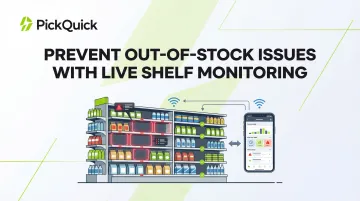
Live shelf monitoring in the quick commerce context means real-time visibility into dark store inventory levels across platforms and pincodes, tracking SKU-level availability continuously rather than through end-of-day reports. For regional FMCG brands managing hundreds of dark stores across multiple cities, this visibility is now the difference between consistent revenue and suppressed rankings.
Key Takeaways
- Out-of-stock on QC platforms tanks your availability score and drops your ranking in platform search results—losing far more than a single sale
- Root causes include inventory visibility gaps, miscalibrated Min-Max settings, replenishment lags, and platform-driven listing suppression
- Live shelf monitoring uses real-time dark store data to flag low-stock situations before they affect discoverability
- Pincode-level demand forecasting, automated replenishment triggers, and platform-synced inventory tracking sharply reduce stockout frequency
- Brands across 10,000+ pincodes need unified visibility across Blinkit, Zepto, Swiggy Instamart, and JioMart
Why Out-of-Stock Moments Are Costlier on Quick Commerce
Algorithmic Ranking Penalties Compound the Damage
An out-of-stock event doesn't just lose one transaction—it causes algorithm-driven ranking penalties that suppress the product's visibility in category and search pages for future buyers. On Blinkit, dropping below an 80% fill rate triggers algorithmic demotion, reducing search ranking, ad visibility, and active pincode coverage. The platform actively penalizes poor supply chain performance because consumer experience depends on reliable fulfillment.
Blinkit's ad system is inventory-led. Ads only surface in pincodes where the product is physically present in the nearest dark store. If your product is out of stock locally, ad spend is completely suppressed in that area, regardless of your budget. You're paying for visibility you can't deliver.
The Availability Score Determines Shelf Space
Quick commerce platforms track availability scores and fill rates to measure how often a listed product is actually fulfillable. This metric functions as a gatekeeping mechanism:
- Blinkit expects brands to sustain fill rates above 90%—falling below 80% consistently reduces future purchase order allocations
- Low availability scores limit shelf space, promotional eligibility, and platform support
- The platform may remove listings from active pincodes entirely if availability remains poor
Brand Switching Happens Instantly
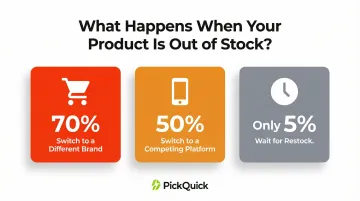
In high-frequency categories like dairy, staples, and masala, stockouts trigger fast defection. The numbers are stark:
- 70% of shoppers buy a different brand when their regular choice is unavailable
- 50% switch to a competing quick-commerce platform to find their preferred product
- Only 5% are willing to wait for the item to return in stock
Repeat Purchase Disruption Breaks Loyalty Loops
QC shoppers build habitual carts and reorder patterns. A single stockout breaks that loop. The shopper picks the next available option—and that substitute becomes their new default for every future order.
The Market Is Betting Billions on Shelf Availability
The global on-shelf availability solution market is projected to reach $6.2 billion USD in 2025, while the Digital Shelf Analytics market is forecast to grow from $2.11 billion USD in 2026 to $5.84 billion USD by 2035, expanding at a 12% CAGR. For brands competing in India's quick commerce market—where a single pincode going dark costs both revenue and rank—real-time shelf visibility has shifted from a nice-to-have to an operational baseline.
Common Causes of Out-of-Stock on QC Platforms
Inventory Visibility Gaps at the Dark Store Level
Stock recorded in the central warehouse may not reflect what's actually available in individual dark stores across pincodes, leading to phantom inventory: the system shows stock, but the shelf is empty. Globally, the retail industry loses $1.73 trillion annually to inventory distortion (out-of-stocks and overstocks), with 58% of retail brands operating below 80% inventory accuracy.
In quick commerce, this gap is particularly acute because dark stores operate with thin inventory buffers. A thousand units sitting in a central Mother Warehouse don't prevent stockouts if distribution hasn't reached the specific dark stores serving active demand pincodes.
Min-Max Threshold Miscalibration
When reorder points are set too low or not adjusted for local demand spikes, replenishment kicks in too late. Common miscalibration scenarios include:
- Uniform thresholds across all locations despite vastly different consumption velocities between high-demand and low-demand pincodes
- Static safety stock levels that don't account for festivals, weekends, or weather-driven demand surges in specific cities
- Ignoring regional preferences—mustard oil peaks in Kolkata while coconut oil dominates in Kerala; masala demand varies dramatically by city and community
For regional FMCG brands, Min-Max miscalibration emerges as the most common root cause of stockouts because it reflects a fundamental mismatch between national inventory thinking and hyper-local quick commerce reality.
Replenishment Lag Between Brand Warehouse and Dark Store
Delayed inbound logistics or priority conflicts in multi-brand dark stores mean products sit in transit while the shelf shows zero. Traditional FMCG runs on monthly or quarterly replenishment cycles; quick commerce demands restocks at individual dark stores, often multiple times daily.
This gap between current dark store stock depleting and the next replenishment arriving is the "Inventory Gap" window — a critical failure point. Common contributors include:
- Slow RO (Replenishment Order) confirmation from the brand side
- Delayed dispatch from the Mother Warehouse
- Ageing inventory held at the Motherhub waiting for allocation
Platform-Level Listing Suppression
A product can appear in-stock internally yet be automatically delisted by the platform due to low availability signals — a gap that manual auditing misses entirely.
Quick commerce platforms use listing suppression to protect consumer experience. If inventory hasn't been distributed to specific dark stores, the product listing and its ads won't appear in those areas, regardless of what the central warehouse shows.
How Live Shelf Monitoring Works on QC Platforms
Real-Time, Continuous Inventory Tracking
Live shelf monitoring in the QC context means real-time, continuous tracking of SKU-level inventory across every dark store and every platform—Blinkit, Zepto, Swiggy Instamart, and JioMart. This is a different operational posture entirely from periodic stock audits or end-of-day reports.
Advanced platforms sync stock levels with consumer-facing apps every minute to prevent selling unavailable items. Tools like Zepto Atom provide minute-by-minute visibility into sales, customer impressions, and conversion data at the pincode level, allowing brands to monitor fill rates and inventory turnover in near real-time.
Pincode-Level Demand Visibility
Monitoring at granular geography reveals which dark stores are burning through inventory faster than others, allowing proactive restock before a stockout occurs. Demand in India is hyper-localized—consumer profiles and purchasing habits vary widely even within a single city.
For example, Blinkit's predictive demand systems account for local preferences, noting that mustard oil sells heavily in Kolkata while coconut oil dominates in Kerala. Without real-time, store-level tracking data, brands cannot accurately forecast these micro-market variations, leading to simultaneous overstocking in one pincode and stockouts in another.
Automated Low-Stock Alert Systems
When a SKU drops below a defined threshold in a dark store, an alert triggers replenishment workflows—removing the dependence on manual shelf checks or platform dashboard reviews. Warehouse Management Systems alert supply teams the moment inventory crosses critical thresholds, enabling action before availability metrics are impacted.
Key outcomes from automated replenishment triggers:
- Removes reliance on manual dashboard reviews for each platform
- Fires replenishment workflows in real time, not end-of-day
- Connects WMS alerts directly to supply teams across dark stores
- Reduces stockout risk by up to 35% compared to manual replenishment workflows
Cross-Platform Data Unification
Brands selling on multiple QC platforms face fragmented inventory signals. Live monitoring consolidates these into a single availability view, so a stockout on Zepto is visible alongside Blinkit data in one dashboard rather than siloed reports. For regional brands managing hundreds of dark stores across platforms, this matters most when activity spikes in one city and quietly drains stock in another.
Smarter Min-Max Optimization
Historical sell-through rates by pincode, day, and season inform tighter reorder bands—reducing both stockouts and wasteful overstocking of perishable or high-value SKUs.
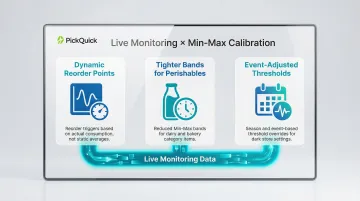
Monitoring data feeds directly into Min-Max calibration, enabling:
- Dynamic reorder points based on actual consumption patterns, not static national averages
- Tighter inventory bands for perishable categories like dairy and bakery
- Season- and event-adjusted thresholds at the dark store level
Strategies to Prevent Stockouts with Live Shelf Monitoring
Demand-Driven Min-Max Calibration by Pincode
Instead of applying uniform reorder thresholds across all dark stores, segment stores by demand velocity and set location-specific safety stock levels.
How this works in practice:
- High-velocity stores (urban centers, high-density pincodes): Set higher minimum thresholds to prevent rapid depletion
- Medium-velocity stores (suburban areas, mixed demand): Apply moderate buffers with weekly recalibration
- Low-velocity stores (newer markets, lower penetration): Use tighter thresholds to prevent inventory ageing
Example for masala brands: A biryani masala brand might set a minimum of 50 units in Hyderabad dark stores (high regional demand) versus 15 units in Mumbai stores (lower regional preference), based on historical pincode-level consumption data.
For dairy brands: Maintain stricter expiry-based Min-Max bands in high-velocity stores to ensure rapid rotation, while reducing maximum levels in slower stores to prevent wastage from ageing inventory.
Automate Replenishment Triggers
Integrate live stock level data with replenishment workflows so that when inventory crosses a threshold, a restocking order is automatically initiated to the brand's nearest fulfillment hub—eliminating the human lag that causes most QC stockouts.
Key implementation steps:
- Define critical thresholds for each SKU in each dark store based on velocity and lead time
- Integrate WMS with platform APIs to receive real-time inventory updates
- Automate RO (Replenishment Order) creation and confirmation to maintain tight RO discipline
- Track dispatch timing to ensure on-time fulfillment and maintain platform trust scores
Monitor Availability Score as a KPI
Treat platform availability score as a primary operational KPI rather than a secondary metric. Track the four core signals that platforms like Blinkit use to control replenishment and expansion:
| Signal | What It Measures | Impact of Poor Performance |
|---|---|---|
| Store-Level Availability % | Percentage of time SKU is in stock | Max inventory levels shrink; expansion throttled |
| Motherhub Ageing | Age of inventory at distribution center | Dark stores stop pulling inventory to prevent expiry loss |
| RO Discipline | Speed and consistency of replenishment order confirmation | Reduces trust; limits future PO allocations |
| GRN/DN Score | Quality of goods received and discrepancy rates | Directly lowers Max levels; reduces store confidence |
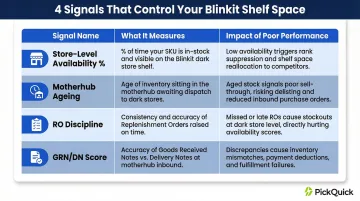
Tracking these proactively reveals which SKUs and dark stores need priority attention before stockouts occur.
Align Supplier and Inbound Cadence with Real-Time Demand
Use live monitoring data to optimize inbound delivery schedules from brand warehouses to dark stores. This shifts replenishment from fixed weekly cycles to demand-triggered top-ups based on actual sell-through velocity per location.
Operational approach:
- Maintain a strict Days on Hand (DOH) target: Falling below 2-3 days of coverage for a specific SKU in a specific city is an active emergency
- Track Daily Run Rates (DRR): Make inventory gaps visible weeks before they open
- Implement demand-driven top-ups: Replenish based on actual consumption velocity rather than predetermined schedules
Run Periodic Ghost Stock Audits
Ghost or phantom inventory occurs when the platform system shows a unit available while it's physically missing, damaged, or in transit. On QC platforms, fast-moving operations and thin inventory buffers make this especially likely.
Audit process:
- Schedule regular reconciliation checks between platform-reported stock and physical dark store counts
- Validate barcode accuracy, packaging integrity, and expiry date matching during inwarding
- Monitor GRN (Goods Receipt Note) and DN (Discrepancy Note) scores to identify systemic accuracy issues
- Address root causes (misplacement, shrinkage, administrative errors) that create false availability signals
How PickQuick Keeps Brands In-Stock Across Dark Stores
Pincode-Level Demand Visibility Across 10,000+ Locations
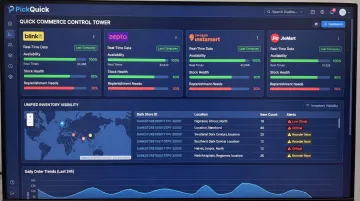
With operations across 10,000+ pincodes and 25+ category-leading brands, PickQuick monitors real-time availability across all major QC platforms through its Quick Commerce Control Tower—a dedicated operating system that consolidates Blinkit, Zepto, Swiggy Instamart, and JioMart data into a single unified view.
The Control Tower provides:
- Real-time stock and availability tracking across dark stores and platforms
- Automated PO processing synchronized with distributors and warehouses
- Dark-store level analytics revealing consumption velocity by location
- Operational alerts and replenishment signals that flag low-stock situations before they impact customer orders
Together, these signals give brand managers a single source of truth for availability—without building the infrastructure themselves.
Min-Max Optimization Expertise at the Dark Store Level
The Control Tower doesn't just surface data—it acts on it. PickQuick applies dark-store-level replenishment logic informed by historical demand patterns, seasonal trends, and platform-specific sell-through data, preventing both stockouts and dead stock build-up.
The system operates on an availability-first model, recognizing that Blinkit prefers a brand with 400 orders/day and 98% availability over one with 1,200 orders/day and 60% availability. PickQuick's post-launch operations management includes replenishment and Min-Max optimization, RO discipline, and dark store availability improvements as core services.
Operational Advantage for Regional Brands
Brands like Nandini Dairy, Goldie Masala, and Vasant Masala operate across multiple cities with very different shelf dynamics. PickQuick's consolidated availability view removes the fragmentation that makes multi-platform monitoring difficult to manage independently.
Pincode-level visibility enables strategies tailored to each brand type:
- Regional masala brands get location-specific inventory allocation based on micro-market demand, not uniform national averages
- Dairy brands get rapid rotation logic and ageing management that minimizes wastage within tight expiry windows
- Multi-city brands get a single cross-platform view rather than siloed data from each distributor or platform account
The result: brands maintain consistent availability across cities without staffing a dedicated QC operations team.
Frequently Asked Questions
Frequently Asked Questions
How can retailers prevent out-of-stock situations with live view shelf monitoring?
Live shelf monitoring tracks SKU-level inventory in real time across dark stores and triggers automated replenishment alerts when stock falls below set thresholds. This prevents gaps before they impact customer orders or platform availability scores—without waiting on manual shelf checks or end-of-day reports.
Which inventory strategies help eliminate dead stock and reduce overstocking?
Demand-driven Min-Max calibration, pincode-level safety stock segmentation, and demand-triggered replenishment cycles are the primary strategies. Setting location-specific thresholds based on actual consumption velocity reduces stockouts in high-demand areas while preventing excess inventory buildup in slower markets.
Can AI be used to manage inventory and prevent out-of-stock issues?
AI-powered inventory tools analyze sell-through patterns, flag anomalies like phantom stock, and predict demand spikes, enabling proactive restocking before a stockout occurs. Platforms like Zepto Atom provide minute-level sales data, while Blinkit's predictive systems account for local preferences and seasonal variation.
What is the impact of stockouts on Quick Commerce platform rankings?
Frequent stockouts lower a brand's algorithmic ranking in category and search pages. On Blinkit, dropping below an 80% fill rate triggers demotion, ad suppression, and reduced pincode coverage—making availability a stronger ranking signal than sales volume alone.
How does pincode-level demand affect inventory planning for QC brands?
Demand velocity varies significantly by geography—city, neighborhood, and dark store cluster. Applying uniform stock thresholds across all locations leads to stockouts in high-demand pincodes while excess builds up elsewhere. Regional preferences (mustard oil in Kolkata, coconut oil in Kerala) require location-specific Min-Max calibration to match supply with actual local consumption patterns.
What is Min-Max optimization in dark store inventory management?
Min-Max is a replenishment framework where the minimum stock level triggers a restocking order and the maximum level caps inbound inventory. Calibrating these bands per SKU per dark store—based on velocity, lead time, and regional demand—is the primary mechanism for eliminating stockouts without accumulating excess.