Introduction
A dairy brand scaling across Blinkit and Zepto doesn't lose money at the checkout — it loses money in the stockroom. Storage costs are rising, demand shifts pincode by pincode, and Quick Commerce platforms like Blinkit, Zepto, and Swiggy Instamart require fulfilment in under 30 minutes. At that pace, inventory decisions become cost decisions, made dozens of times a day.
This article breaks down the specific, measurable ways inventory management removes waste, prevents costly mistakes, and compounds savings for brands scaling across dark stores, pincodes, and platforms.
Key Takeaways
- Inventory management reduces operational costs by eliminating excess stock, preventing stockouts, and freeing up working capital for growth
- The three biggest cost-reduction wins: lower carrying costs, fewer stockout losses, and tighter procurement discipline
- Without structured inventory management, brands face reactive firefighting, rising holding costs, and an inability to scale efficiently
- Real-time stock visibility is what separates brands that control costs from brands that react to them
What Is Inventory Management?
Inventory management is the ongoing process of tracking, ordering, storing, and controlling stock so the right products are available in the right quantities at the right time—without excess and without shortfall.
For FMCG, dairy, masala, and consumer brands operating across Quick Commerce platforms, inventory management governs everything from dark store replenishment cycles to SKU-level availability across pincodes.
In practice, it determines how often a Blinkit dark store reorders your masala SKU, how much stock Zepto holds in its micro-fulfillment centres, and whether your dairy brand shows "in stock" or "out of stock" when a customer searches in their pincode.
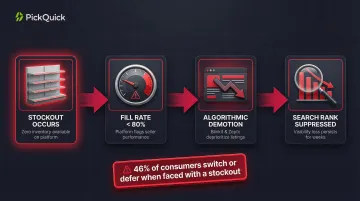
Inventory management is the mechanism by which brands protect margin, maintain platform rankings, and ensure customers are never turned away. On Quick Commerce platforms, availability at the pincode level drives algorithmic visibility. Stockouts don't just cost you today's sale—they can suppress your search ranking for weeks.
For regional brands scaling across cities, getting this right means:
- Protecting gross margin by avoiding overstock write-offs and emergency restocking costs
- Maintaining platform visibility through consistent availability scores
- Keeping customers from switching to a competing SKU that's actually in stock
Key Advantages of Inventory Management
The advantages below are grounded in operational reality. Each one maps to a cost line or efficiency metric that businesses actively track and directly impacts profitability. Applied consistently, these advantages compound—brands see improvements accumulate over weeks and months, not just within single transactions.
Reduced Carrying and Storage Costs
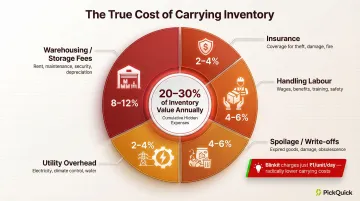
Carrying costs—which include warehousing fees, insurance, handling labour, utility overhead, and the risk of spoilage or obsolescence—are one of the largest hidden costs in any product business. Excess inventory amplifies every one of them.
Typical inventory carrying costs range from 20% to 30% of total inventory value annually. For brands managing inventory across Quick Commerce dark stores, the costs are both immediate and measurable. Blinkit charges ₹1 per unit per day for storage under its Sale or Return model, making overstock directly and measurably expensive.
How structured inventory management reduces carrying costs in practice:
- Setting Min-Max thresholds per SKU based on actual consumption velocity
- Analysing velocity data to right-size reorder quantities
- Clearing slow-moving or near-expiry stock through targeted promotions before write-offs occur
- Using pincode-level demand signals to reduce safety stock buffers without increasing stockout risk
Every unit sitting unsold in a dark store or warehouse represents capital that cannot be redeployed. When brands track stock velocity by SKU and by location, those decisions become data-driven rather than guesswork.
KPIs impacted:
- Inventory holding cost as a percentage of total cost
- Days inventory outstanding (DIO)
- Dead stock ratio
- Warehouse space utilisation
When this advantage matters most:
This advantage is most critical for perishable and high-frequency categories—dairy, masalas, snacks, fresh FMCG—where product shelf life creates hard deadlines on excess inventory. For brands managing stock across multiple QC platforms, slot costs accumulate across dark stores in different cities, and every excess unit becomes a direct drain on margin.
Prevention of Stockouts and Their Downstream Costs
A stockout is not simply a missed sale. On Quick Commerce platforms, going out of stock affects search visibility, platform ranking scores, and customer repurchase behaviour, creating a chain of losses that extends well beyond the immediate transaction.
CPG retailers in the US alone lost 7.4% of sales to stockouts in 2021, costing over $82 billion. When faced with empty shelves, 46% of consumers take actions that result in lost sales—they postpone purchases, buy from competitors, or shift to another platform entirely.
How inventory management prevents stockouts in practice:
- Demand forecasting using historical sales patterns and seasonal signals
- Automated reorder triggers at predefined stock thresholds
- Real-time availability monitoring at the pincode or dark store level
- Daily RO (Replenishment Order) cycles with confirmed speed
The true cost of a stockout goes well beyond the missed sale. It includes emergency replenishment costs (significantly higher than planned orders), platform ranking penalties, and long-term customer churn. In Quick Commerce, where customers expect delivery in 10–30 minutes, a gap in availability cannot be covered by rerouting orders. Inventory accuracy at the nearest dark store level is the only buffer.
Blinkit requires a 90% fill rate; dropping below 80% triggers algorithmic demotion—your search rank drops, ad visibility falls, and pincodes go dark. Zepto's algorithm de-ranks out-of-stock SKUs aggressively; a two-day stockout can set back search placement by weeks.
KPIs impacted:
- Availability rate (fill rate)
- Out-of-stock frequency
- Platform search ranking position
- Repeat purchase rate
- Emergency procurement spend
Where stockout risk is highest:
Stockout prevention is most valuable during peak demand periods—festivals, weekends, promotional events—and for high-frequency staple categories where customers have zero tolerance for unavailability and will simply switch to a competitor SKU on the same platform.
Improved Cash Flow Through Smarter Procurement
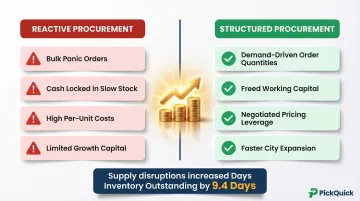
When inventory is ordered reactively—bulk purchases to hit supplier MOQs, or panic-buying to avoid stockouts—cash gets locked into stock that moves slowly. That leaves less capital available for operations, marketing, or expansion.
Structured inventory management fixes this by using actual consumption velocity and lead time data to calculate optimal order quantities. Platform-specific Min-Max logic lets brands place smaller, more frequent orders that align with real demand, reducing both overstocking and tied-up capital at any point in time.
Freeing up working capital from over-ordered inventory directly increases a brand's financial flexibility. Cash that was sitting in slow-moving SKUs can be redirected to marketing spend, new city launches, or product innovation. Global supply chain disruptions caused Days Inventory Outstanding to increase by 9.4 days, trapping critical working capital that brands need for growth.
Why this matters beyond procurement:
When brands order consistently and with reasonable lead times rather than placing emergency orders, they gain leverage to negotiate better pricing and payment terms, further reducing per-unit costs. This compounds quickly for regional brands scaling across cities, where capital efficiency determines how fast expansion can be funded without external financing.
KPIs impacted:
- Inventory turnover ratio
- Working capital cycle
- Order frequency
- Cost per unit procured
- Cash conversion cycle
What Happens When Inventory Management Is Missing or Ignored
Without structured inventory management, brands order in bulk when they feel low, accumulate excess on some SKUs while running dry on others, and spend management time firefighting instead of growing.
Holding costs rise quietly. Excess stock occupies storage slots, insurance liabilities grow, and write-offs from expired or obsolete products hit the P&L unpredictably. Globally, unsold food and surplus management costs retailers approximately 1.8% of sales revenue — a margin drain that scales directly with inventory volume.
On Quick Commerce platforms, inconsistent availability creates a compounding problem. Platform algorithms deprioritise brands with poor fill rates, cutting organic visibility at the moment brands most need sales volume to justify their QC investment.
Brands managing inventory manually or across disconnected spreadsheets face higher error rates in replenishment decisions. The result is either chronic overstock or chronic stockout, depending on who placed the last order and when. Inventory record inaccuracy triggers redundant replenishments and lost sales — compounding both holding costs and missed revenue simultaneously.
The downstream consequences are consistent across FMCG categories:
- Excess stock ageing in dark stores, driving write-offs and shrinkage
- Stockouts triggering algorithmic ranking penalties on Blinkit, Zepto, and Swiggy Instamart
- Replenishment cycles driven by gut feel rather than store-level data
- Management bandwidth consumed by reactive firefighting instead of growth planning
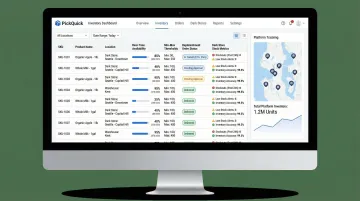
This is where structured systems make the difference. PickQuick's Min-Max optimisation and real-time replenishment engine replace guesswork with continuous tracking — store-level availability percentage, motherhub ageing, RO discipline, and GRN/DN scores — so replenishment cycles stay predictable and both stockout and overstock patterns are caught before they compound.
How to Get the Most Value from Inventory Management
Inventory management delivers maximum cost reduction when applied to real, location-specific data—not just aggregate stock levels, but SKU-level velocity by dark store, pincode, or platform. Aggregate averages mask the outliers where cost actually accumulates.
A masala brand may see strong velocity for blended masalas in Karnataka but slow movement for the same SKUs in Delhi. A dairy brand may experience rapid turnover in metro dark stores but slower consumption in tier-2 cities. Granular, SKU-level tracking is essential for Quick Commerce success over aggregate store data.
To turn that data into actual cost savings, three practices make the biggest difference:
- Review performance in short cycles. Weekly or bi-weekly replenishment windows let teams catch over-ordering and understocking before they compound. Quick Commerce requires daily run rate tracking — monthly or quarterly reviews miss the signals entirely.
- Act on what the data shows. Identifying a slow-moving SKU only matters if it changes the next purchase order. Brands that treat inventory reports as records rather than decision inputs absorb preventable waste every cycle.
- Localize replenishment decisions. A single reorder policy across all dark stores will over-serve low-velocity pincodes and under-serve high-demand ones. SKU-level thresholds by location are what keep availability metrics stable without inflating holding costs.
Conclusion
Inventory management removes the guesswork from procurement, eliminates the hidden costs of excess stock, and ensures every dark store slot is driving revenue rather than draining it. That's what makes it a lever on operational costs — not just in theory, but quarter over quarter.
Brands that apply this correctly see improved availability, healthier cash flow, and lower per-unit costs — not just in one replenishment cycle, but consistently as the model matures.
The brands scaling fastest on Quick Commerce treat this as a daily operational rhythm. That means:
- Monitoring availability in real time across dark stores
- Adjusting Min-Max thresholds as velocity data shifts
- Maintaining clean replenishment cycles that support platform expansion
Brands that do this consistently are the ones that hold their position — and grow it.
Frequently Asked Questions
Frequently Asked Questions
How does inventory management reduce operational costs?
Inventory management reduces costs by eliminating excess stock (which drives down carrying and storage expenses), preventing stockouts (which trigger expensive emergency replenishment and lost sales), and enabling smarter procurement that frees up working capital.
How does inventory management affect operational efficiency?
Better inventory management reduces time spent on reactive firefighting, improves order fulfilment accuracy, and frees teams to focus on growth rather than chasing stock imbalances. The result is predictable availability, fewer errors, and the platform trust needed to expand to new cities and pincodes.
What is the 80/20 rule in inventory management?
The 80/20 rule (Pareto Principle) in inventory management means roughly 20% of SKUs generate 80% of sales. Identifying this top tier allows brands to prioritise storage space, replenishment frequency, and procurement budgets on the products that drive the most revenue, reducing cost on lower-priority SKUs.
What are the biggest inventory-related costs for FMCG and regional brands?
The main cost categories are holding and storage fees on excess stock, write-offs from expired or obsolete inventory, emergency procurement triggered by stockouts, and platform ranking drops from poor availability. On Quick Commerce platforms, storage is charged per unit per day — making overstock an immediate, measurable cost rather than a theoretical one.
What is the difference between overstocking and understocking in terms of cost impact?
Overstocking drives up holding costs, ties up cash, and increases the risk of spoilage or write-offs. Understocking leads to lost sales, emergency replenishment at premium cost, and platform visibility penalties. Both erode margins — overstocking slowly through carrying costs, understocking sharply through lost revenue and ranking drops.
How does real-time inventory tracking help reduce costs?
Real-time tracking closes the gap between actual stock movement and procurement decisions. Brands can act the moment a SKU approaches its reorder point — before a stockout or overstock develops — avoiding the emergency responses that manual or delayed tracking routinely forces.