Introduction
Blinkit's 10-minute delivery promise isn't just a marketing claim—it's an operational constraint that reshapes every inventory decision a brand makes. Unlike traditional retail, where stock sits in large warehouses for days or weeks, Blinkit requires inventory stored in micro-warehouses called dark stores, replenished multiple times daily, and tracked in real-time across thousands of pincodes.
This creates demands most FMCG and regional brands aren't built for: smaller SKU depth per location, hyper-local demand patterns, and zero tolerance for availability gaps. A single stockout doesn't just mean a lost sale—it triggers search ranking penalties that compound over time.
Blinkit's inventory system spans everything from how brands stock dark stores to how orders reach a doorstep in under ten minutes. For FMCG and regional brands already winning offline, understanding this system is the difference between scaling on quick commerce and stalling on it.
This article explains how Blinkit's inventory management works end-to-end, what factors affect it, and what common mistakes brands make.
Key Takeaways
- Dark stores enable 10-minute delivery by storing inventory in micro-warehouses within a 2-4 km radius
- Blinkit now operates a fully inventory-led model where it purchases stock directly from brands
- Min-Max thresholds and pincode-level velocity data drive automated replenishment decisions
- Stockouts trigger search ranking drops and compound revenue loss beyond the missed sale
- Brands that align supply to dark store demand cycles — not just overall volume — consistently outperform on availability and ranking
What Is Blinkit's Inventory Management Process?
Blinkit's inventory management is the system by which products are sourced from brands or distributors, stocked into dark stores, tracked in real-time, and dispatched to fulfill customer orders—all happening simultaneously across thousands of pincodes. This process must operate reliably to maintain the platform's delivery promise and keep products visible to customers.
The platform has transitioned to a fully inventory-led model as of 2025, where Blink Commerce Private Limited (BCPL) purchases stock directly from brands rather than operating as a marketplace where sellers hold inventory. By Q3 FY26, approximately 90% of Blinkit's Net Order Value came from its own inventory, fundamentally changing how brands interact with the platform operationally.
That's a fundamentally different model from traditional e-commerce warehouse management. The 10-minute delivery requirement, smaller SKU depth per dark store, and hyper-local demand patterns make quick commerce inventory management its own discipline entirely.
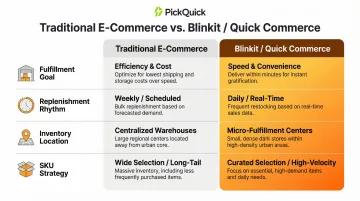
| Traditional E-Commerce | Blinkit / Quick Commerce | |
|---|---|---|
| Fulfillment goal | Bulk storage, next-day delivery | Instant availability, same-hour dispatch |
| Replenishment rhythm | Weekly or bi-weekly | Multiple cycles per day |
| Inventory location | Central warehouse | Hyper-local dark stores |
| SKU strategy | Deep catalog per SKU | Tight, high-velocity SKU selection |
How Blinkit's Inventory Management Works: From Supplier to Doorstep
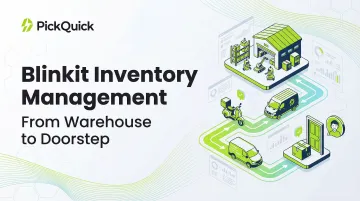
Blinkit's inventory system is engineered around one hard constraint: delivery in minutes. Every operational decision — what to stock, how much, and where — is made at the dark store level, not from a central warehouse. The flow runs as follows:
- Brand/distributor → dark store inward
- Inventory storage and slotting
- Order trigger → pick, pack, dispatch
- Last-mile delivery to customer
Step 1: Supplier Onboarding and Stock Inward
Under the inventory-led model, brands raise purchase orders directly with Blinkit's procurement team, which then purchases and holds the stock. The inward process involves cataloguing, tagging, and slotting SKUs at the dark store level. Blinkit enforces strict compliance requirements at this stage:
- Carton labeling and barcode scanability
- FSSAI standards and expiry validation
- Packaging quality checks
Any mismatch during inwarding generates a Delivery Note (DN) that directly affects future replenishment and expansion eligibility.
Step 2: Dark Store Storage and Real-Time Tracking
A dark store is a small, closed micro-warehouse serving a specific delivery radius—typically within 2-3 km of customers. Inventory is physically organized by category, velocity, and pick frequency to maximize speed during order fulfillment.
Blinkit's inventory system tracks stock in real-time at the dark store level, updating product availability on the app instantly and triggering replenishment alerts based on Min-Max thresholds. This ensures customers only see products actually available in their delivery radius, eliminating the "ghost inventory" problem common in traditional e-commerce.
Step 3: Order Fulfillment — Pick, Pack, and Dispatch
That real-time availability data directly drives order routing. When a customer places an order, the system assigns it to the nearest dark store with stock. A picker receives the order on a handheld device, locates items within seconds using smart pick-path optimization, packs the order, and hands it to a delivery partner. Products are packed in under two minutes using technology that optimizes picker routes through the store.
Step 4: Replenishment and Stock Refill
Blinkit determines when to reorder stock using Min-Max inventory logic: when inventory hits a minimum threshold, the system triggers a replenishment order to refill it to a maximum level. This is informed by historical demand, seasonal spikes, and pincode-level velocity data. Blinkit's Automatic Replenishment System (ARS) places orders directly into vendors' ERP systems using Electronic Data Interchange (EDI), keeping stock flowing without manual follow-up.
Key Factors That Affect Inventory Performance on Blinkit
Pincode-Level Demand Variability
Demand velocity varies sharply by pincode, city, and neighborhood. A SKU that sells fast in one dark store may be dead stock in another. Brands must analyze store-level data rather than city-level aggregates when planning inventory, as aggregated metrics hide the performance differences that determine expansion eligibility.
Min-Max Threshold Calibration
Setting Min-Max levels too conservatively leads to frequent stockouts and ranking drops, while setting them too aggressively ties up capital in slow-moving stock. The right calibration depends on three variables:
- SKU velocity — how quickly each product turns over at a given dark store
- Replenishment lead time — the gap between ordering and restocking
- Shelf life — especially for perishable and semi-perishable categories
Max levels grow only when brands demonstrate clean availability, stable replenishment orders, perfect GRNs, and zero ageing. Blinkit treats Min-Max as a performance signal, not just an inventory cap.
Shelf Life and Perishability Constraints
For dairy, bakery, and fresh categories, inventory decisions must account for expiry windows. Overstock is as harmful as understock because aged inventory triggers automatic consumption throttling. Zomato's Hyperpure integration enables flexible supply chains that drive better margins through lower wastage, but a February 2026 report highlighted monthly wastage allowances of ₹2,25,000 for a single Mumbai warehouse handling fruits and vegetables, demonstrating the scale of the perishability challenge.
Search Ranking and Availability Feedback Loop
Physical availability failures don't stay physical — they translate directly into algorithmic penalties. Blinkit's search ranking rewards consistent availability, so a product that goes out of stock loses search visibility on top of the missed sale itself.
The downstream effect compounds quickly:
- Stockouts reduce search visibility
- Lower visibility reduces order volume
- Reduced orders signal weaker demand to the algorithm
- Weaker demand signals shrink inventory allocation further
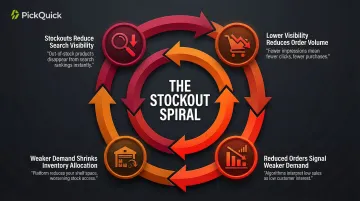
Breaking this cycle requires maintaining high availability metrics consistently across all active dark stores — not just at the city level, but at each individual store.
Common Inventory Mistakes Brands Make on Blinkit
Bulk Distribution Instead of Localized Replenishment
The most common mistake is treating Blinkit like a bulk e-commerce channel — pushing large stock quantities to a few dark stores rather than distributing smaller, more frequent replenishments across a wider network based on local demand signals. This approach causes inventory to age in some locations while others face stockouts.
"Set and Forget" Inventory Management
Brands that onboard their SKUs but don't monitor dark store-level stock health face invisible stockouts: the product appears available in the catalog, but a specific dark store has zero units. Sales and rankings drop before the brand even notices because platform-level aggregate metrics mask store-level failures.
Assuming Blinkit Handles All Supply Coordination
Many brands assume Blinkit's systems handle inventory management end-to-end. They don't.
Under both the marketplace and inventory-led models, brands are responsible for keeping supply available to Blinkit's procurement team on schedule. Delays directly impact availability metrics and expansion eligibility — two factors that determine whether Blinkit activates new dark stores for your brand.
When Blinkit's Inventory Model Gets Complicated — and What to Do
Blinkit's 2025 shift to an inventory-led model creates specific challenges for smaller or regional brands: Blinkit now holds the inventory and controls purchasing decisions, meaning brands lose direct control over stocking levels and must ensure they have a reliable supply relationship with Blinkit's procurement team. Sellers were required to opt into the new system by July 30, 2025, with formal implementation on September 1, 2025.
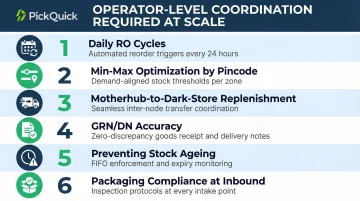
The model becomes operationally difficult for brands with wide SKU catalogues, high demand variability across regions, or multi-city scaling ambitions. These scenarios require operator-level coordination that most brand teams aren't equipped to handle in-house:
- Managing daily RO cycles across hundreds of dark stores
- Optimizing Min-Max levels based on pincode-level velocity
- Coordinating Motherhub-to-dark-store replenishment flows
- Maintaining GRN/DN accuracy to avoid reconciliation gaps
- Preventing stock ageing across slow-moving pincodes
- Ensuring packaging compliance at point of inbound
For brands scaling across multiple cities, these execution demands multiply fast. Working with a dedicated quick commerce operator like PickQuick — which handles dark store replenishment, Min-Max settings, and availability tracking across all platforms — lets internal teams stay focused on product and marketing. Most brands go live within weeks, with clean inventory operations from day one.
Frequently Asked Questions
How to manage inventory in Blinkit?
Managing inventory on Blinkit requires monitoring dark store-level stock health, setting correct Min-Max thresholds, and ensuring timely replenishment. Brands should track availability by store, not just by city or platform aggregate, as store-level stockouts directly impact search rankings.
Does Blinkit have its own inventory?
Yes, Blinkit transitioned to a fully inventory-led model where it purchases stock directly from brands. Unlike the earlier marketplace model where seller-partners held stock, brands now deal with stricter compliance requirements and tighter fill-rate expectations from Blinkit directly.
How does Blinkit manage its store operations?
Blinkit manages dark store operations through real-time inventory tracking, Min-Max-based replenishment, picker assignment via handheld devices, and delivery partner coordination — all calibrated to hit 10-minute delivery windows.
What is a dark store and how does it work in Blinkit's supply chain?
A dark store is a small, closed micro-warehouse (not open to the public) that stores inventory for a specific delivery radius. Blinkit operates hundreds of these across India to enable hyperlocal instant delivery, with each store serving customers within 2-3 km.
What is Min-Max inventory optimization and why does it matter on Blinkit?
Min-Max is a replenishment rule that triggers a stock refill order when inventory drops below a minimum level and refills it to a maximum. On Blinkit, incorrect Min-Max settings are a leading cause of stockouts and search ranking drops — brands that get this wrong often find themselves invisible in high-demand pincodes before they realize the issue.