Most QC commentary is written from only one vantage point. This piece examines quick commerce simultaneously through three lenses—seller, consumer, and citizen—and argues that the full picture demands all three.
Key Takeaways
- QC platforms offer real revenue upside for FMCG sellers, but dark store slot limits, platform margin structures, and co-funded discounting pressure make it a managed game, not a passive one
- For consumers, QC is a convenience revolution that reduces decision fatigue and bypasses friction unique to Indian urban life—speed is only part of it
- As citizens, QC raises uncomfortable questions about gig worker welfare, residential neighbourhood disruption, and cultural dependence on instant gratification
- Visibility on QC platforms demands assortment discipline, inventory depth, and platform-specific strategy from day one
- Regional brands scaling QC across cities move faster when an operator already holds dark store access, platform relationships, and replenishment infrastructure for their category
The Seller Perspective: Opportunity With Real Operational Weight
Quick commerce represents a genuine growth channel for brands—HUL reported that QC doubled year-over-year and now accounts for 25-30% of their e-commerce sales, while Dabur stated QC contributes roughly 30% to their e-commerce business. But the operational model differs fundamentally from traditional e-commerce.
The Supply Chain Difference
E-commerce typically involves shipping inventory to one central warehouse. Quick commerce requires supplying multiple regional dark stores in smaller, more frequent consignments, increasing both logistics complexity and cost. Instead of one large monthly shipment, sellers manage continuous replenishment across dozens of micro-fulfillment centres, each holding limited stock with tight availability requirements.
Assortment: The Dark Store Constraint
Dark stores stock far fewer SKUs than e-commerce platforms. While Amazon and Flipkart carry millions of products, a typical QC dark store stocks between 2,000 and 10,000 SKUs. Specifically, Blinkit stocks 7,000-12,000 SKUs, Zepto around 10,000, and Swiggy Instamart 5,000-8,000 per standard store.
This constraint forces sellers to make hard decisions about which products to prioritize rather than listing everything. Being de-listed from a dark store due to low velocity is a real risk.
Products that fit the QC model tend to share a few traits:
- High purchase frequency (bought weekly or more often)
- Low return rates (consumables, not durables)
- Standardised variants (limited SKU complexity)
- Price points that fit impulse or necessity buying (₹50-₹500 sweet spot)
Categories that thrive:
- Dairy and beverages
- Snacks and confectionery
- Masalas and cooking essentials
- Personal care and OTC pharma
- Staples and packaged foods
Categories that struggle:
- Low-frequency purchases (seasonal items, specialised equipment)
- High-return categories (apparel, electronics)
- Bulky or fragile items with high logistics costs
- Ultra-premium products with narrow customer bases
The Margin Economics
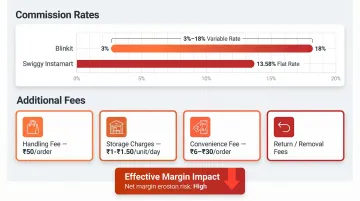
QC platforms typically demand higher discounts from sellers compared to e-commerce due to elevated logistics and warehousing costs. Blinkit shifted to a variable commission model charging sellers 3-18% depending on category, while Swiggy Instamart reported a take rate of 13.58% in FY24.
Beyond commissions, platforms charge additional fees:
- Handling and fulfilment fees (₹50 per delivered order on Blinkit)
- Storage and ageing charges (₹1-₹1.50 per unit per day)
- Small-cart convenience fees (₹6-₹30 per order)
- Return and removal fees
On top of these fees, platforms increasingly ask sellers to co-fund promotional pricing. Even large FMCG brands struggle to resist, given QC's strategic importance as a growth channel. This co-funding erodes price parity, forcing brands to weigh platform demands against consistent pricing in offline retail.
Inventory Management and Ads
Margin pressure makes availability discipline even more consequential. On QC, stockouts don't just mean missed sales — platforms prioritise availability in their ranking algorithms, so running out of stock means immediate loss of visibility and potential removal from dark stores entirely.
Sellers must track inventory continuously across pincodes, maintain Min-Max levels, and respond to replenishment orders (ROs) within tight windows. Dark stores turn inventory 15-20 times annually for fast-moving items, compared to the e-commerce average of 10.19 turns, requiring far tighter supply chain management.
Advertising is the other lever worth tracking. QC platforms are aggressively building ad revenue — Blinkit's ad revenue grew 220% year-over-year in Q3 FY24, and both Blinkit and Zepto crossed ₹1,000 crore in annual advertising revenue by FY25. Unlike offline retail's upfront listing fees, QC ads offer an accessible growth lever. Blinkit charges a ₹25,000 listing fee per SKU per state, returned as ad credits, making entry relatively low-risk for brands already invested in the channel.
The Consumer Perspective: Why QC Stuck
Quick commerce isn't just about speed—it's about solving real daily frictions unique to Indian urban life.
The curated shelf advantage: Because dark stores stock so few SKUs, platforms effectively pre-vet brands. Consumers face less decision fatigue than on e-commerce, where sorting through dozens of options by ratings is the norm. This curation is partly quality-based and partly ad-spend-driven—platforms surface products that meet velocity thresholds and pay for visibility.
Why QC resonates in Indian cities specifically:
Indian urban infrastructure makes 10-minute delivery an answer to real pain points, not just laziness. Bengaluru's average travel time is 34 minutes 10 seconds per 10 km, Pune's is 33 minutes 22 seconds, and Mumbai's is 29 minutes 26 seconds. Add long checkout queues even for 2-3 items, and the value proposition becomes clear.
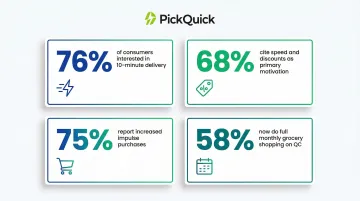
76% of consumers show interest in 10-minute delivery. Speed alone isn't the full story, though — 68% cite speed and discounts combined as their primary purchase motivation, pointing to a value equation, not just convenience.
The impulse economy unlocked: QC has created buying occasions that didn't exist before—midnight snacks, missing ingredients mid-cook, last-minute medicines. 75% of online shoppers report increased unplanned/impulse purchases due to QC, and 20% of online chocolate GMV is generated post 9 PM, highlighting late-night impulse buying.
What started as impulse-driven usage has since shifted into routine habit. 58% of surveyed users now do their full monthly grocery shopping on QC platforms — displacing both traditional e-commerce and offline stores across FMCG and grocery categories.
The Citizen Perspective: The Costs Behind the Convenience
Quick commerce delivers genuine value. It also imposes real costs on communities, workers, and local commerce.
Neighbourhood disruption: Dark stores located in residential areas bring increased two-wheeler traffic, delivery riders congregating on footpaths, sanitation issues, and noise. These aren't isolated incidents.
In 2024, residents in Kodathi Panchayat, Bengaluru, reported severe respiratory issues due to daily open garbage burning of plastic and thermocol at a local dark store dump site. In response, Bengaluru Solid Waste Management Limited announced criminal cases and fines up to ₹1 lakh for burning waste.
Residents of Poseidon Society in Versova, Mumbai, filed complaints with the BMC regarding a 24/7 Blinkit dark store operating without an NOC, citing noise, 50+ parked bikes, and safety hazards. In Pune, the Maharashtra FDA suspended a Blinkit dark store license for operating without a food safety license and maintaining unhygienic conditions.
In most of these cases, residents had no say in the zoning decisions that allowed commercial operations in their neighbourhoods.
Gig worker welfare: QC has created over 400,000 delivery jobs in India's instant-delivery ecosystem. These roles, however, typically come with no PF, no health insurance, no skill development pathway, and high injury risk.
Gross earnings average ₹102-105 per hour, but net monthly incomes compress to ₹18,000-22,000 after accounting for fuel and vehicle maintenance. Workers face opaque ID deactivations and gamified "streak" incentives that reset instantly if a shift is interrupted—leading to lost bonuses.
In January 2026, the Union Ministry of Labour ordered Blinkit, Zepto, and Swiggy to drop "10-minute" delivery claims due to safety concerns. India records over 27,500 two-wheeler deaths annually, and algorithmic time pressure is directly linked to signal violations and speeding.
These jobs offer income where few alternatives exist — but they don't build the technical skills or labour protections that a maturing Indian workforce requires.
The cultural cost: QC reinforces instant gratification dependency, reduces incidental physical activity and social interaction (the neighbourhood kirana visit), and may displace kirana store employment. India has approximately 13 million kirana stores, and 46% of QC users have reduced purchases from kiranas, with 5% stopping completely.
The displacement data is hard to ignore:
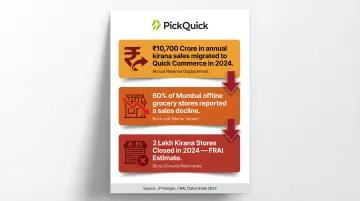
- An estimated $1.28 billion (approx. ₹10,700 crore) in annual kirana sales migrated to QC platforms in 2024
- 60% of offline grocery stores in Mumbai reported a sales decline due to dark stores, per a JP Morgan study
- The Federation of Retailer Associations of India estimates 2 lakh kirana stores closed in 2024
None of this makes QC inherently harmful. But these tradeoffs — community disruption, precarious labour, kirana displacement — deserve honest accounting as the sector scales.
How to Get Listed on Quick Commerce Platforms
Getting listed on QC platforms requires more than signing up. Baseline eligibility includes:
- Relevant licenses (FSSAI for food products, applicable certifications for other categories)
- Consistent supply capability across multiple regional dark stores
- Product categories suited to QC assortment (high velocity, low complexity)
- At least some existing brand recognition or offline traction
Purely unknown new brands face steeper scrutiny. Platforms prioritise brands with proven demand and operational maturity.
Platform-Specific Entry Points
Each major platform has distinct characteristics:
| Platform | Scale | AOV | Strengths |
|---|---|---|---|
| Blinkit | 1,544 dark stores, 100+ cities | ₹669 | Snacking, personal care, gifting; 30,000+ SKUs |
| Zepto | 10+ cities | ₹430–470 | Premium & beauty; AI ad platform "Jarvis" for keyword targeting |
| Swiggy Instamart | 1,021 dark stores, 124 cities | ₹514 | Groceries, dairy, F&B; Megapods stock 50,000 SKUs |
| JioMart | 4,000+ pincodes, 2,100+ stores | — | FMCG & staples; Reliance Smart/Fresh as fulfilment nodes |
Rather than listing every SKU, brands should select a focused set of high-velocity, QC-appropriate products. Fewer, well-chosen SKUs consistently outperform a bloated catalogue in dark store conditions.
Inventory and Supply Readiness
Supply readiness means the ability to replenish multiple regional dark store networks on tight cycles, maintain Min-Max inventory levels, and forecast demand by pincode. For regional brands new to QC, this is operationally harder than it appears.
The core challenges include:
- Coordinating replenishment across dark stores in multiple cities simultaneously
- Maintaining pincode-level demand visibility to avoid stockouts
- Navigating platform-specific SKU mapping requirements and approval cycles
- Managing logistics constraints without a dedicated QC operations team
Regional brands benefit from working with operators like PickQuick, which manages end-to-end QC operations across Blinkit, Zepto, Swiggy Instamart, and JioMart — covering dark store replenishment, ads management, and pincode-level availability tracking. Brands that attempt independent launches typically spend months on approvals and logistics setup; operator-managed onboarding compresses that to weeks, often 3–5x faster.
What High-Performing Brands Do Differently on QC
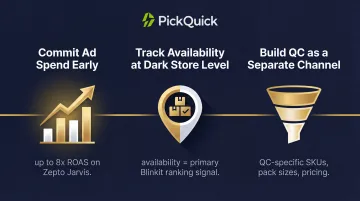
The gap between brands that grow on QC and those that stall usually comes down to three operational decisions made early.
Commit ad spend before you need results. Brands that invest in platform ads from day one build search visibility and recommendation loops that compound over time. Zepto's Jarvis platform delivers up to 8x ROAS for sellers, and a Free Range Eggs brand achieved a blended 6.9x ROAS across platforms—8.7x on Blinkit, 7.9x on Zepto, and 4.1x on Swiggy Instamart.
Track availability at the dark store level, not the city level. The best QC brands monitor sell-through by pincode, catching stockouts before they trigger visibility penalties. On Blinkit especially, availability is the primary ranking signal—not sales volume alone.
Build QC as a separate channel with its own logic. High performers maintain a QC-specific SKU mix (standardised variants, right pack sizes), QC-appropriate pricing, and separate inventory forecasting. Dark stores run on just-in-time consumption, not warehouse storage—mirroring an e-commerce catalogue doesn't work here.
Frequently Asked Questions
How to get listed on quick commerce platforms?
Brands need relevant licenses (e.g., FSSAI for food), a portfolio of high-velocity SKUs suited to QC, and supply capability across regional dark stores. Approaching platforms directly or through an operator partner like PickQuick significantly speeds up the process.
What are the biggest challenges for sellers on quick commerce?
The top three seller pain points are:
- Limited assortment slots in dark stores, forcing hard SKU prioritisation decisions
- Higher platform margins than e-commerce, driven by elevated logistics costs
- Inventory complexity across multiple regional warehouses with tight replenishment cycles
How is quick commerce different from regular e-commerce for brands?
QC operates on a B2B purchase model where the platform buys outright from the seller. It requires multi-location supply to dark stores, real-time inventory tracking, and a tight assortment of high-velocity SKUs—unlike e-commerce's broader catalogue model with centralised warehouse shipping.
Are quick commerce delivery workers treated fairly?
QC has created significant employment—over 400,000 delivery jobs in India. However, current gig worker conditions remain a legitimate concern: no PF, no health insurance, high injury risk, and no skill development pathway. The industry has not fully addressed these policy and social issues.
Which product categories perform best on quick commerce in India?
Categories with the strongest QC performance include groceries and staples, dairy and beverages, snacks and confectionery, personal care and OTC pharma, and masalas and cooking essentials—all high-frequency, low-return, impulse or necessity categories that fit the dark store model.
Is quick commerce profitable for regional brands?
Profitability depends on margin structure, assortment selection, and operational efficiency. Regional brands with strong offline demand and high-velocity SKUs can perform well on QC, particularly when an operator manages platform costs, dark store inventory, and replenishment at scale.