Introduction
E-commerce growth and rising consumer expectations for ultra-fast delivery are pushing warehouses toward a fundamental shift in how fulfillment operates. In India, quick commerce platforms are projected to reach ₹2.4 lakh crore (roughly $30 billion) by 2028, with 40% of global consumers now expecting sub-two-hour grocery delivery. This surge is forcing brands to rethink traditional fulfillment models entirely.
The term "dark warehouse" refers to two distinct but related concepts: large-scale, fully automated distribution centers where human presence is minimal enough that lighting becomes optional, and in the Quick Commerce context, "dark stores" — small, consumer-facing micro-fulfillment nodes powering 10-minute delivery on platforms like Blinkit, Zepto, and Swiggy Instamart.
Dark warehousing promises significant operational gains — but the trade-offs are real. High upfront capital expenditure, technical complexity, and inflexibility with irregular SKUs create barriers that make this model unsuitable for many operations.
This article examines what dark warehouses are, how they work, their advantages and disadvantages, best practices for implementation, and whether this model fits your operation.
Key Takeaways
- A dark warehouse is a fully automated facility operating with minimal human labor, using robots, ASRS, and smart software
- In Quick Commerce, "dark warehouse" also refers to dark stores — small micro-fulfillment hubs powering rapid delivery
- Key advantages: 24/7 operations, reduced long-term labor costs, 99.9% picking accuracy, and space optimization
- Key disadvantages: high upfront capital costs, limited SKU flexibility, and cybersecurity risk
- Best practices: phase automation incrementally, enforce Min-Max replenishment discipline, and integrate WMS tightly with platform operations
What Is a Dark Warehouse?
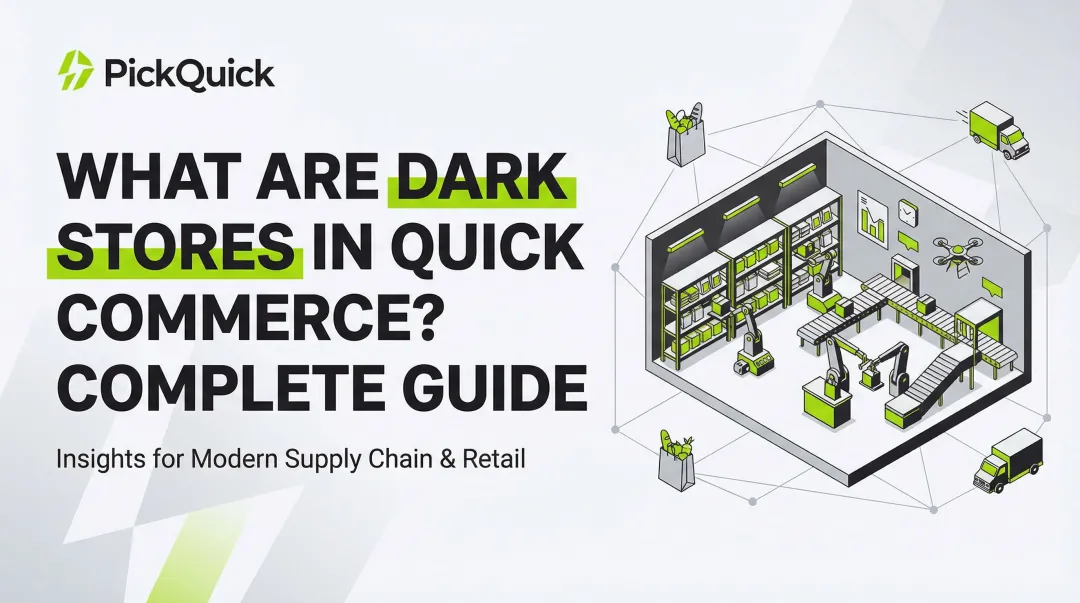
A dark warehouse is a fully automated storage and fulfillment facility that can operate independently of human labor. The term "dark" comes from the fact that machines don't need lighting, heating, or human-friendly conditions to function. In traditional logistics, this means a large distribution center with robotics and Automated Storage and Retrieval Systems (ASRS). In Quick Commerce, the concept scales down into dark stores or micro-fulfillment centers — like those operated by Blinkit, Zepto, or Swiggy Instamart — that serve as inventory-holding points for hyperlocal delivery.
Distinguishing True Dark Warehouses from Standard Automation
While most automated facilities still require human pickers at goods-to-person stations, a true dark warehouse automates the entire picking, sorting, and dispatch workflow. High automation typically uses Goods-to-Person (G2P) systems where robots handle travel and storage, but human workers remain at picking bays. A dark warehouse eliminates the human picker entirely, relying on robotic arms and advanced vision systems for piece-picking.
Full darkness is still out of reach for most operations. Most real-world "dark warehouses" exist on a spectrum between partial and full automation.
Relevance to FMCG and Regional Brands
As Quick Commerce platforms expand across Indian cities, brands placing inventory in platform-managed dark stores are participating in dark warehouse distribution — even without managing the infrastructure themselves.
For regional FMCG brands, this has direct operational implications:
- Automated replenishment determines how quickly your SKUs get restocked after a stockout
- Min-Max inventory logic (where stock is replenished once it drops below a set minimum) controls shelf availability at the pincode level
- Platform-driven fulfillment means your brand's visibility and sales velocity are tied directly to how well the dark store is managed
How Does a Dark Warehouse Work?
The Technology Ecosystem
Dark warehouses depend on tightly integrated software and hardware layers working in concert:
| Software Layer | Primary Function | Role in Operations |
|---|---|---|
| WMS (Warehouse Management System) | Foundational business logic | Manages inventory tracking, order allocation, receiving, and shipping transactions |
| WES (Warehouse Execution System) | Real-time orchestration | Analyzes order priorities and dynamically allocates tasks to prevent bottlenecks |
| WCS (Warehouse Control System) | Hardware execution | Directly controls machinery by translating WMS/WES logic into real-time automation instructions |
These systems coordinate a network of physical components:
- Automated Storage and Retrieval Systems (ASRS)
- Autonomous mobile robots (AMRs)
- Robotic arms and pick-and-place systems
- Conveyor networks and IoT sensors
- Vision systems for item identification
All components communicate together to receive orders, locate inventory, pick items, and route them to dispatch.
The Order Fulfillment Flow
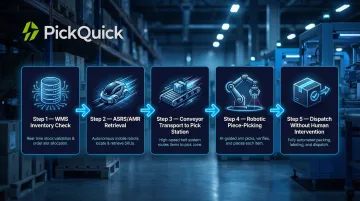
With that infrastructure in place, here's what happens when an order comes in from an e-commerce platform or Quick Commerce app:
- The WMS identifies the nearest inventory location and verifies stock
- The WES directs an ASRS crane or AMR to retrieve the specific bin from high-density storage
- The bin is transported via conveyor to a robotic piece-picking arm equipped with 3D vision
- The robot picks the item, places it in the outbound tote, and the WMS instantly syncs inventory counts
- The order is routed to dispatch without human intervention
The speed difference is dramatic. Boozt, a European e-commerce leader, achieved a record-breaking order fulfillment time of just 63 seconds from checkout to ready-to-ship using an AutoStore system with 1.2 million bins and 1,150 robots, processing up to 190,000 items daily.
The Role of Data and Predictive Intelligence
Machine learning models analyze demand patterns, flag replenishment needs, and schedule maintenance windows. In Quick Commerce dark stores specifically, this translates into Min-Max replenishment logic — platforms use real-time sales data to maintain availability thresholds so that popular SKUs never go out of stock during peak demand windows.
How Min-Max planning works: The system sets a minimum and maximum quantity for every SKU. When inventory dips below the minimum, it automatically triggers a replenishment request to restore stock to the maximum level.
This self-regulating mechanism prevents both stockouts and overstock situations — two of the most common availability failures in high-frequency FMCG categories.
Advantages of Dark Warehouse Management
24/7 Operational Continuity
Automated systems have no concept of shift changes, fatigue, or breaks. A dark warehouse can run uninterrupted around the clock, including weekends and holidays. This is particularly valuable in q-commerce where consumer demand spikes unpredictably.
Swiggy Instamart data reveals massive daily order peaks between 7–11 AM and 4–7 PM, with extreme surges during festivals. During Raksha Bandhan, platforms experience concentrated demand spikes, with 8 PM recorded as the single busiest hour for gifting. Automation ensures that throughput remains consistent during these spikes, preventing SLA breaches and abandoned carts.
Reduced Long-Term Labor Costs
While upfront investment is high, the long-term labor cost savings are substantial — particularly in markets facing rising minimum wages, high attrition in warehouse roles, or chronic labor shortages. The Indian logistics and quick commerce sector faces a severe talent crunch, with attrition rates hovering between 31% and 40% per month as workers frequently switch platforms to maximize daily earnings.
Automation directly neutralizes this risk. Key reductions include:
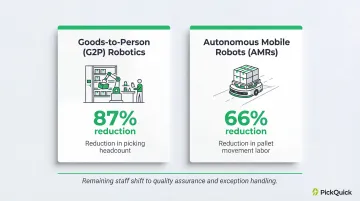
- Goods-to-Person (G2P) robotics cut required picking headcount by up to 87%
- Autonomous Mobile Robots (AMRs) reduce pallet movement labor needs by 66%
- Remaining staff can shift to higher-value roles like quality assurance and exception handling
High Picking Accuracy and Reduced Errors
Robotic picking systems guided by vision AI and barcode/RFID verification deliver accuracy rates of 99.9% to 99.99%, dramatically reducing mis-picks, wrong shipments, and return rates. In contrast, human-driven manual picking typically yields an error rate of 3% to 4%.
The financial impact is significant. Each mis-pick costs an average of $22–$75 in labor, shipping, and waste, with B2B profitability decreasing by 6–10% due to order errors. A facility picking 6,000 items daily with a 1% error rate loses roughly $1,500 per day to mis-picks — reducing that error rate to 0.1% via automation saves over $500,000 annually.
In q-commerce, where customers expect the exact item delivered in minutes, accuracy directly affects customer ratings and platform rankings.
Scalability Without Proportional Cost Increases
Automated systems can absorb demand spikes — during festivals, flash sales, or seasonal surges — without the need to recruit and train temporary workers. Capacity can be increased through software configuration or modular hardware additions. This makes dark warehouses particularly valuable for FMCG brands managing large, high-frequency SKU portfolios.
Space Optimization and Inventory Density
ASRS systems and robotic storage can save 65% to 85% of floor space compared to traditional static racking, allowing a dark warehouse to store far more inventory in the same footprint. Traditional racking wastes massive amounts of vertical space and requires wide aisles for human navigation.
In q-commerce, where dark store square footage is limited and expensive, this density advantage is critical. Dark stores in prime Indian city centers command rental rates of ₹40 to ₹250 per square foot. Space optimization lets operators stock more SKUs in the same footprint — or downsize to a cheaper location without sacrificing range.
Each of these advantages carries a corresponding tradeoff, covered in the next section.
Disadvantages of Dark Warehouse Management
High Upfront Capital Expenditure
A fully dark warehouse requires substantial investment in robotics, ASRS systems, conveyor infrastructure, WMS/WES software, and facility retrofitting — all paid upfront rather than spread across payroll cycles like labor costs.
| Automation Level | Typical CapEx Range | Best Use Case |
|---|---|---|
| Targeted/Partial (AMRs, VLMs) | ₹40 lakh – ₹4 crore | Brownfield retrofits, specific zone optimization |
| Mid-Sized Semi-Automated | ₹4 crore – ₹40 crore | Regional DCs, hybrid manual/robot workflows |
| Large Highly Automated (Lights-Out) | ₹40 crore – ₹120 crore+ | High-throughput mega-hubs, greenfield builds |
A single aisle of crane-based automated storage can exceed ₹16 crore, and facility modifications (electrical upgrades, floor reinforcement, fire protection) can add 10–30% on top of hardware costs. This barrier limits dark warehousing to high-volume operations where ROI can be projected with confidence.
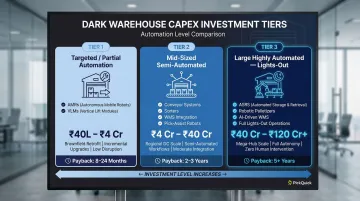
ROI timelines vary significantly by technology. AMRs, which require no fixed infrastructure, can deliver payback in 8 to 24 months. Robotic picking solutions typically see returns in 2 to 3 years. However, complex, fully automated ASRS installations often require 5+ years to break even, making them risky if throughput targets are missed.
Limited Flexibility for SKU Complexity and Exceptions
Automated systems are optimized for high-velocity, standardized SKUs. Irregular item dimensions, fragile packaging, and highly variable product mixes introduce automation challenges that either require costly customization or fall back to manual handling entirely.
Items requiring human judgment — age verification, quality inspection, condition assessment — are particularly hard to automate at scale.
Robotic piece-picking struggles severely with "ugly SKUs". Transparent polybags, bubble-wrap, and shrink-wrap confuse 3D vision systems due to multiple reflective surfaces. Vacuum grippers lose pressure on porous materials, and mechanical claws risk damaging fragile items like fresh produce or glass.
For FMCG brands with wide, diverse catalogs, this can limit the depth of automation achievable. Indian quick commerce platforms actively curate their dark store SKUs, favoring lightweight, stackable, and consistently packaged items to ensure rapid micro-picking.
Technical Complexity and Specialized Expertise Required
Designing, integrating, and maintaining a dark warehouse demands deep expertise in robotics, systems integration, and data infrastructure — skills that are not typically part of a standard warehouse operator's toolkit. Relying on third-party integrators adds cost and can reduce operational flexibility.
Currently, 60% of digital adoption efforts in supply chains fail to deliver promised value due to insufficient investment in workforce learning and development. Automation does not eliminate labor; it shifts the requirement from manual lifters to highly skilled technicians trained in OT cybersecurity, robotics maintenance, and data analytics. When that technical talent is unavailable or undertrained, even minor system failures can cascade into fulfillment halts that directly damage SLA performance.
Cybersecurity Vulnerabilities
A dark warehouse is entirely dependent on networked digital systems. This creates meaningful exposure to cyberattacks, data breaches, ransomware, and system outages. In November 2024, a ransomware attack on supply chain software provider Blue Yonder disrupted logistics and inventory management for major global retailers, including Starbucks and UK supermarket chain Morrisons.
When cloud-connected automation goes offline, the financial impact is devastating: warehouse downtime costs range from ₹4 lakh to ₹85 lakh per hour globally due to missed SLAs, overtime recovery labor, and reputational damage. A single security incident can halt all operations without any manual fallback.
Comprehensive cybersecurity is not optional — it's an operational requirement on par with hardware maintenance. Core safeguards include:
- Network segmentation to isolate OT systems from corporate IT environments
- Strict access controls with role-based authentication across all connected systems
- Incident response planning with documented runbooks for ransomware and system outages
Maintenance Dependency and Single Points of Failure
Robots and automated systems require regular preventive maintenance, software updates, and hardware replacement cycles. Unlike a human workforce, where one absence is absorbed by the team, a failed robot or conveyor jam stops throughput entirely. There is no natural redundancy.
Planned maintenance windows must be factored into operational planning, and redundancy systems need to be built in from the outset. Proactive maintenance driven by predictive analytics (flagging component wear before failure) is far less disruptive than reactive repairs.
Best Practices for Dark Warehouse Management
Start with a Digital Twin Before Physical Implementation
Before committing capital to hardware, build a digital twin — a virtual simulation of the warehouse layout, inventory flows, and automation logic — to test configurations, identify bottlenecks, and validate throughput projections under different demand scenarios.
Siemens utilized their Plant Simulation software to virtually commission a high-bay warehouse for Ferrero, detecting 95% of software errors prior to physical launch and reducing overall commissioning time by 30%. Digital twins are particularly valuable for phased automation rollouts, where catching design flaws early prevents expensive rework mid-deployment.
Phase Automation Incrementally, Not All at Once
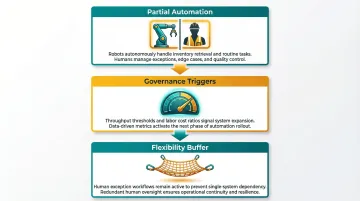
Few operations can or should go fully dark immediately. A best practice approach starts by automating the highest-volume, most repetitive processes first (such as inbound sorting or high-velocity SKU retrieval) and progressively expands automation scope as you validate ROI and teams build operational expertise.
A hybrid model sustains momentum while managing risk:
- Partial automation: robots handle retrieval; humans manage exceptions and edge cases
- Governance triggers: defined throughput thresholds or labor cost ratios signal when to expand automation scope
- Flexibility buffer: keeping human-handled exception workflows prevents total dependency on any single system
Prioritize Replenishment Discipline and Min-Max Optimization
In dark warehouse management, especially in the context of q-commerce dark stores, availability is the most critical metric. Implement a rigorous Min-Max replenishment framework:
- Define minimum stock thresholds below which replenishment is triggered
- Establish maximum stock levels to avoid tying up capital in excess inventory
- Use real-time sales velocity data to adjust these thresholds dynamically by pincode, time of day, and seasonality
This prevents both stockouts and overstock, which directly affect platform search rankings and order fill rates. PickQuick applies this type of replenishment intelligence across its managed dark store network to help brands maintain stable availability metrics across Blinkit, Zepto, and Swiggy Instamart.
Invest in WMS Integration and Real-Time Inventory Visibility
The value of a dark warehouse is only realized if the WMS provides accurate, real-time inventory data across all nodes. Ensure your WMS integrates with every platform and system generating orders — e-commerce platforms, q-commerce apps, ERP systems — and provides visibility down to SKU-level and location-level.
Running WMS and WES on a single, unified cloud-native platform means that when exceptions occur during picking, the outbound plan adapts in real-time — preventing downstream packing stations from stalling. Without this integration, even the most advanced robotics will be undermined by inventory discrepancies and order errors.
Build Redundancy and Maintenance Protocols Into Operations from Day One
Define scheduled maintenance windows during low-demand periods, establish fallback procedures for key system failures, and design physical infrastructure with redundancy (such as multiple conveyor routes or redundant ASRS units for critical SKUs).
Proactive maintenance driven by predictive analytics — flagging component wear before failure — is far less disruptive than reactive repairs. Planning for failure scenarios from the outset prevents catastrophic downtime that can cost ₹ lakhs per hour.
Is a Dark Warehouse Right for Your Brand?
Characteristics of Well-Suited Operations
Dark warehouse investment makes sense for operations with:
- High order volumes of standardized, repetitive SKUs
- Consistent demand with low variability
- Sufficient capital for long-term ROI (3-5+ years)
- Internal or partner expertise to manage automation
- Stable SKU mix without frequent product changes
Industries like food and beverage, FMCG, pharma, and fast fashion tend to benefit most.
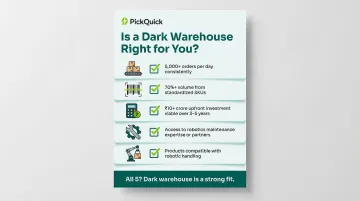
Before committing to full dark warehouse conversion, run through these questions:
- Do you process 5,000+ orders per day consistently?
- Is your SKU mix stable with at least 70% of volume from standardized products?
- Can you justify ₹10+ crore in upfront investment with a 3-5 year payback window?
- Do you have access to robotics maintenance expertise or integration partners?
- Are your products compatible with robotic handling (rigid packaging, clear barcodes, no fragility)?
For Brands Operating in Quick Commerce
If you're a regional FMCG brand distributing through Blinkit, Zepto, or Swiggy Instamart, you're already operating within a dark warehouse ecosystem — even if you don't own the infrastructure. The platform manages dark store automation; your responsibility is reliable replenishment, accurate inventory data, and strong availability metrics.
For brands at this stage, partnering with a specialist Quick Commerce operator is a faster and more capital-efficient path to scale than building proprietary automation. PickQuick, for example, enables regional brands to go live across all major QC platforms within weeks, with end-to-end replenishment management and pincode-level demand visibility.
Hybrid Approaches for Smaller Brands
For smaller brands or those with highly variable, low-volume SKU profiles, a hybrid approach — combining selective automation with human handling for complex tasks — makes more sense than full dark warehouse conversion.
The goal is to match automation to actual operational need. Deploying dense ASRS cubes for standard packaged goods maximizes space, while retaining manual or semi-automated zones for fragile produce, oversized items, and unpredictable packaging delivers the best balance of efficiency and flexibility.
Frequently Asked Questions
What is a dark warehouse?
A dark warehouse is a fully automated storage and fulfillment facility that operates with minimal or no human intervention, relying on robots, ASRS, and WMS software. The term applies to both large-scale distribution centers and, in Quick Commerce, to dark stores serving as micro-fulfillment nodes for rapid delivery.
What is dark logistics?
Dark logistics is the broader practice of running supply chain and fulfillment operations with minimal human touchpoints, encompassing dark warehouses, dark stores, and automated last-mile dispatch systems. It's enabled by robotics, AI, and integrated software that coordinate inventory movement without manual intervention.
What are the four types of warehouse management?
The four main types differ in human involvement, technology investment, and scalability:
- Manual — fully human-driven processes
- Semi-automated — mix of manual and automated systems
- Fully automated / dark warehouse — minimal human presence
- Cloud-based WMS-driven — software-coordinated operations
What is the difference between a dark store and a dark warehouse?
A dark warehouse is a large, fully automated distribution center with no public access, optimized for high-volume B2B or e-commerce fulfillment. A dark store is a smaller micro-fulfillment node (like those used by Blinkit or Zepto) built for rapid last-mile q-commerce delivery within a 2-3 km radius.
Are dark warehouses suitable for small or mid-sized businesses?
Full dark warehouse implementation suits high-volume operations with capital for ₹10+ crore investments. Smaller brands can still benefit by joining platform-managed dark store ecosystems (like Blinkit or Zepto) or adopting selective, phased automation without owning the infrastructure themselves.