Introduction
Most growth-stage FMCG brands in India are fighting the wrong battle. They pour resources into price wars, promotional blitzes, and aggressive trade marketing, all aimed at stealing customers from competitors. Meanwhile, the bigger opportunity sits untapped: growing the total number of people who buy their category in the first place.
This tension between share-capture and market-creation thinking defines the next decade of FMCG growth. For regional dairy, masala, snack, and packaged food brands with strong offline demand (typically ₹5-7 crore monthly), the challenge isn't product quality or home-market recognition. It's structured expansion.
Entering new geographies or channels like Quick Commerce without a clear framework leads to slow go-live timelines, poor dark store availability, and missed sales windows during a period of rapid platform growth.
This article covers the complete category expansion playbook: what it means, why it works, the three-stage framework that drives execution, the types of expansion that deliver ROI, and how Quick Commerce has opened an entirely new frontier for regional brands to scale without the capital intensity of traditional distribution.
TLDR:
- Category expansion grows total buyers, not just market share—unlocking higher margins and less competitive pressure
- The framework has three stages: Market Readiness Assessment, Category Vision Definition, and Growth Execution System
- Geographic + Channel Expansion via Quick Commerce delivers the highest ROI for regional FMCG brands
- Quick Commerce creates new demand occasions through 10-minute delivery that traditional retail cannot serve
- Working with a dedicated QC operator cuts go-live time from months to weeks across Blinkit, Zepto, Swiggy Instamart, and JioMart
What Is Category Expansion Strategy?
Category expansion strategy is the deliberate effort to grow the total addressable market of a category—not by taking share from existing competitors, but by converting non-users into buyers, unlocking new usage occasions, or making the category available in places it hasn't been before.
Brands executing category expansion ask "who isn't buying this yet, and why?" rather than "how do we take customers from Brand X?" That shift in framing changes how budgets are allocated, how products are designed, and which markets are prioritized.
Why This Strategy Matters More Than Share Wars
In underdeveloped categories, the Total Addressable Market (TAM) often far exceeds the actual market size—meaning most potential revenue is still untapped. India's packaged food market is projected to reach ₹17,120 billion by Fiscal 2029, growing at an 11% CAGR. While urban centers currently account for 65-70% of packaged food demand, rural and semi-urban markets are rapidly gaining momentum.
Category expansion tends to generate higher long-term returns because it faces less direct competitive pressure. McKinsey research analyzing 770 companies found that expanding into natural adjacencies generates 1.5 percentage points of annual shareholder returns above industry peers. Brands entering adjacent segments with above-average profitability achieved median returns three percentage points above peers—and up to 15 percentage points more in high-growth, high-margin adjacencies.
Who Should Use Category Expansion Strategy?
Category expansion is most relevant for brands that already have strong product-market fit in one geography or channel but haven't yet scaled to new regions, consumer segments, or distribution channels. This makes it especially applicable to regional champions with ₹5-7 crore monthly in offline demand.
These brands have already proven their product works. What they typically have in place:
- Established manufacturing capacity and supply chain
- Active distributor relationships in their home market
- Consumer trust built through years of offline presence
What they lack is a structured playbook to replicate that success in new pincodes, new cities, or new channels like Quick Commerce without spreading resources too thin or damaging brand trust through poor execution.
Category Expansion vs. Market Penetration
The Ansoff Matrix, developed by H. Igor Ansoff in 1957, provides the foundational framework for understanding growth strategies. It features four quadrants: Market Penetration, Market Development, Product Development, and Diversification.
Market penetration means selling more of the same product to the same market—essentially fighting for share. Category expansion spans market development (same product, new segments or geographies) and sometimes product development (new formats for new occasions). The two strategies differ sharply in resource allocation and risk profile:
- Market penetration optimizes within existing demand — more spend, more distribution, more shelf space
- Market development creates new demand — new geographies, new consumer occasions, new channels
- Category expansion may touch both, but always requires structural change, not just tactical push
Many brands mistake tactical moves — price promotions, SKU additions, increased ad spend — for category expansion. True expansion requires structural changes: entering new channels, building new consumer habits, or investing in category-level education rather than brand-level messaging.
When Balaji Wafers built a ₹5,454 crore empire with 65%+ share in Western India, it wasn't through national advertising or modern trade expansion. It was through dominating the general trade channel with a ₹5 price point, offering 20% margins to kirana owners, and systematically expanding city by city across Gujarat, Maharashtra, and Rajasthan. That's market development—not market penetration.
The Category Expansion Framework
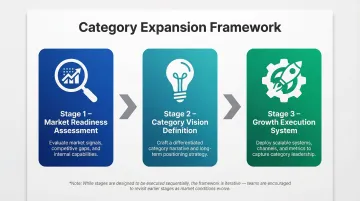
Most successful category expansion strategies follow a three-stage framework: Market Readiness Assessment, Category Vision Definition, and Growth Execution System. These stages are sequential but also iterative as new data comes in.
Stage 1 — Market Readiness Assessment
Brands must identify why the category is underdeveloped in a given market or channel before investing in expansion. The three root causes to diagnose are:
- Awareness gap — Consumers don't know the product exists or its benefits. Common when regional brands enter new states where the category isn't part of daily consumption habits.
- Adoption barriers — Cost, availability, complexity, or emotional resistance blocks purchase. Premium dairy brands, for instance, struggle in price-sensitive markets where consumers default to loose milk from local vendors.
- Distribution gap — The product simply isn't stocked where target consumers shop. For regional FMCG brands, this is the most common barrier: strong demand exists, but the product isn't available in the right pincodes at the right time.
For regional masala or dairy brands, readiness assessment involves analyzing offline demand data, Quick Commerce search volumes, and pincode-level gap analysis to reveal where the category is underserved.
A masala brand with strong pull in Maharashtra might discover through Blinkit search data that consumers in Bangalore are actively searching for regional blends like "lasoon thecha" or "goda masala"—but no local brand is listed. That's a distribution gap, not an awareness problem.
Stage 2 — Category Vision Definition
The brand must define what the category should look like once expanded—who the new users are, what occasions or use cases the product serves, and what variety or price points are needed to reach that expanded base.
AB InBev's Category Expansion Framework (CEF) offers a useful structural reference. The CEF builds a full portfolio spanning different styles and price points to reach more consumers on more occasions. Its core pillars include:
- Variety by taste type and price point
- Occasions development
- Premiumization
- Smart affordability
- Expansion into adjacent segments
Critical principle: Category vision should be consumer-need-led, not product-catalogue-led. Brands that define expansion through the lens of "we have more SKUs to sell" rather than "these consumers have an unmet need we can fulfill" consistently underperform in category expansion.
For Quick Commerce specifically, this means brands must balance smart affordability (entry-level trial packs at ₹10–50) with premiumization (multi-packs or bundles at ₹200–500) to raise Average Order Value and make logistics efficient. QC consumers are building fuller carts with AOVs ranging from ₹500–1,500, so single-serve packs alone won't maximize platform economics.
Stage 3 — Growth Execution System
Execution requires a structured feedback loop: benchmark current performance against category potential, identify the biggest gaps, deploy proven best practices into those gaps, and set quarterly targets with committed investment.
This stage is where most brands fail. They do the strategic work but lack the operational infrastructure to execute consistently across multiple markets or platforms simultaneously.
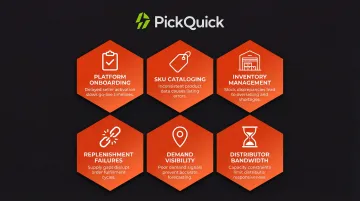
Those gaps aren't abstract—they're specific, recurring, and compounding. Regional brands attempting to self-manage Quick Commerce expansion face six critical operational challenges:
- Complex onboarding and approval cycles across Blinkit, Zepto, Instamart, and JioMart—each with distinct compliance requirements
- SKU mapping and cataloging complexity with platform-specific formatting, variant mapping, and search optimization
- Inventory management across dark stores without Min-Max optimization discipline
- Replenishment failures due to slow RO confirmation, poor packaging compliance, or GRN/DN errors
- Lack of pincode-level demand visibility preventing data-driven expansion decisions
- Distributor bandwidth constraints that can't synchronize PO-to-dispatch cycles with dark store replenishment needs
The execution system must solve all six simultaneously—or brands stall in their initial trial clusters (10–15 dark stores) and never reach full-city scale.
Types of Category Expansion Strategies
Four main types exist, each with different resource requirements and risk profiles:
Consumer Expansion — Targeting non-users or lapsed users. This requires category-level education and addressing adoption barriers, not just brand marketing.
Occasion Expansion — Identifying new consumption moments. Quick Commerce has created an entirely new occasion: impulse + immediate need. 75% of online grocery buyers report increased unplanned purchases in the last six months, driven by 10-minute delivery.
Geographic Expansion — Entering new cities, regions, or pincodes where the category is underrepresented. For regional brands with proven product-market fit in one state, this is where most untapped demand sits.
Channel Expansion — Making the category available through new retail formats like Quick Commerce, modern trade, or direct-to-consumer.
How a brand approaches these four types depends on where it sits in the market.
Market Leaders vs. Challenger Brands
Market leaders use brand equity, distribution muscle, and marketing budgets to expand the category for everyone. Challenger brands identify specific unmet needs or underserved geographies and expand from a focused beachhead.
Bengaluru-based iD Fresh Food pioneered the clean-label category for preservative-free idli/dosa batter. They solved the consumer trust barrier around preservatives and built a daily direct-to-retailer cold-chain model — scaling to close to 3 million customers with an estimated 50-60% share in their core categories. FY25 revenues reached ₹688.2 crore. That's category creation from a challenger position.
The Quick Commerce Advantage for Regional Brands
For regional FMCG brands in India, Geographic + Channel Expansion is the highest-ROI combination. Brands that have proven product-market fit in one state can use platforms like Blinkit, Zepto, and Swiggy Instamart to test demand in new pincodes before committing to physical distribution investment.
Quick Commerce operates on a 2-3km dark store radius. A brand with 85% city-level availability might have 0% availability in high-demand pincodes because a single dark store is out of stock. This creates micro-market opportunities where regional brands can establish category leadership before national players fully localize their assortments.
When Does Category Expansion Strategy Work Best?
Three conditions consistently signal that a brand is ready to expand — and that expansion will actually stick:
- Non-metro cities already represent over 15% of Quick Commerce GMV despite lower population densities, pointing to measurable untapped demand in Tier-2/3 markets that outpaces current supply
- The primary barrier is availability or awareness, not product quality — meaning consumers want the product but can't find it where they shop
- The brand can enter a geography or channel before national competitors establish footholds; regional brands that hold operator rights in their home cities have a structural window before large players move in
The Risk of Premature Expansion
When these three conditions aren't yet met, expansion tends to backfire. Brands that move too early spread inventory and ad budgets across cities where they have no baseline demand, fail to build channel leadership anywhere, and erode the brand trust they built at home. The result is weak fill rates, poor platform visibility scores, and a slower path back to profitability.
Expansion readiness signals:
- Strong offline reorder rates in home market
- High search-to-conversion on existing QC markets
- Evidence of demand in adjacent pincodes with no current coverage
- Brand recognition among new-city consumers who've relocated from the home market
- Monthly sales of ₹25-30 lakh+ on Blinkit indicating platform traction
Best Practices for Executing Category Expansion
Education and Awareness First
Consumer education—not just brand advertising—is the most critical lever for converting non-users. Brands must invest in content that explains what the category does, why it matters in daily life, and how to use the product.
Beyond Meat's strategy highlights this approach: educating consumers on the health and planetary benefits of plant-based proteins to shift diets away from animal-based proteins, thereby increasing the overall size of the category rather than just fighting for brand share.
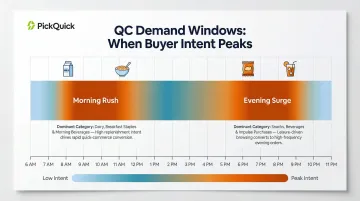
This education-first lens also applies to timing. In India, QC platforms allow brands to map SKUs to specific day-parts and occasions — morning consumption surges for milk and cereals, while afternoon and evening slots see spikes in snacking and beverages. Brands must time their promotions to match this rhythm, targeting golden windows (7–11 AM and 6–10 PM) when buyer intent is strongest.
Innovation and Format Fit
Product formats, pack sizes, and price points must be calibrated to the target market's needs. What works in a home state may not translate directly. For QC expansion, this means optimizing for dark store assortment with fast-moving, high-frequency SKUs only.
Balaji Wafers mastered the ₹5 price point—a trusted, democratic unit of consumption—to achieve 65%+ market share in Western India. That same smart affordability principle applies to QC, but brands must also offer premium multi-packs (₹150-300) to raise AOV and improve unit economics.
Partnerships and Platform Leverage
Executing format and pricing decisions across new markets is operationally complex. Brands rarely have the access or expertise to do it alone — partnering with distributors, operators, or channel platforms that already have consumer trust and infrastructure cuts execution risk and shortens timelines.
For regional brands entering Quick Commerce, working with an operator like PickQuick — which holds pre-existing operator rights across 10,000+ pincodes and partners with 25+ category-leading brands — can cut go-live timelines from months to weeks. PickQuick manages the full QC division, including:
- Platform onboarding across Blinkit, Zepto, Swiggy Instamart, and JioMart
- Pincode-level demand visibility and real-time availability tracking
- Dark store replenishment and Min-Max optimization
Emotional Brand Storytelling at the Category Level
"Category-level" messaging makes the entire category more salient and desirable, not just the brand. Brands that run campaigns addressing why a category matters in everyday life (not just why their product is better) show stronger category penetration gains.
Regional masala brands that educate consumers about authentic regional blends—like Maharashtra's thecha or Tamil Nadu's idli podi—expand the category by creating demand for niche, hyper-local products that national brands don't offer. This is category education paired with regional authenticity.
Category Expansion in the Age of Quick Commerce
Quick Commerce represents a structurally new form of category expansion for offline-dominant brands. 10-minute delivery creates a new demand occasion—impulse + immediate need—that traditional retail cannot serve, effectively creating a new usage context where regional brands can establish category leadership before national players fully localize their assortments.
The sector is projected to grow at a 45% CAGR, reaching $35-40 billion by 2030. As of July 2025, QC reached 33 million monthly transacting users across more than 150 Indian cities. QC now accounts for 70-75% of total e-grocery orders, up from just 35% in 2022.
Platform landscape:
| Platform | Dark Stores | City Coverage | Market Share | Strategic Focus |
|---|---|---|---|---|
| Blinkit | 1,816 | 100+ | ~46-50% | Targeting 2,100 stores by Dec 2025; highest AOV (₹709 projected for 2026) |
| Zepto | 1,000+ | 10+ major urban centers | ~29% | Pure-play QC focus; high dark store density; 1.5-1.6M daily orders |
| Swiggy Instamart | 1,021 | 124 | ~24-27% | Expanding megapods (8-10k sq ft) to house 50,000 SKUs |
| JioMart | 600 | 1,000+ (via 5,000 pincodes) | N/A | Hybrid model leveraging 3,000+ physical Reliance stores |

The Operational Challenge
Most regional brands lack the in-house infrastructure to capture this opportunity. Onboarding, dark store replenishment, Min-Max optimization, and multi-platform catalogue management each require dedicated operational expertise that takes months to build.
The cost structure compounds the difficulty:
- Platform fees consume 35-50% of product value, with mandatory ad spends of ₹10-20 lakh monthly
- Per-SKU listing fees run ₹25,000, making only SKUs with 70%+ gross margins viable
- Direct onboarding takes 45-60 days for Blinkit and 30-45 days for Zepto
- Missing stock in even a few locations damages organic rankings and visibility across the platform
The Solution: End-to-End QC Operators
These barriers are exactly what a dedicated QC operator resolves. PickQuick manages the entire QC division—from platform onboarding across Blinkit, Zepto, Swiggy Instamart, and JioMart to pincode-level demand visibility and real-time availability tracking—so brands expand their category footprint across new cities without building internal operations from scratch.
Brands go live in weeks, not months. PickQuick's operational layer covers:
- Listing and cataloging across all four platforms
- Daily replenishment order (RO) creation and Min-Max optimization
- Store availability improvements and ageing inventory reduction
- Inventory depth planning and dark-store expansion coordination
For brands with ₹5-7 crore monthly offline demand and ₹25-30 lakh+ monthly Blinkit sales, this partnership model eliminates the operational overhead that typically stalls multi-city QC growth—freeing category teams to focus on demand generation rather than platform compliance.
Frequently Asked Questions
What are the different types of expansion strategies?
The four Ansoff-based types are: market penetration (existing product, existing market), market development (existing product, new markets), product development (new product, existing market), and diversification (new product, new market). Category expansion most closely aligns with market development and channel development, where brands take proven products into new geographies or distribution channels.
What is the difference between category expansion and market penetration?
Market penetration focuses on increasing sales to existing users within a market already buying the category—through promotions, increased distribution density, or taking share from competitors. Category expansion focuses on growing the total number of buyers by converting non-users or entering new channels and geographies where the category doesn't yet exist.
What are the 4 categories of products?
The standard consumer product classification includes convenience (bought frequently with minimal effort), shopping (compared on quality and price), specialty (unique characteristics or brand loyalty), and unsought goods (consumers don't actively seek). A product's category type influences which expansion strategy—geographic, occasion-based, or channel-based—is most appropriate.
What is the four fits growth framework?
Originated by Brian Balfour of Reforge, the four fits are: product-market fit, product-channel fit, channel-model fit, and model-market fit. Together, they function as a readiness diagnostic—use them to confirm your product, channels, and business model are aligned before investing in category expansion.
What are the three categories of customers?
The three customer types relevant to category expansion are non-users, light/occasional users, and heavy/loyal users. Expansion strategy should primarily target non-users—people who don't currently buy the category—since converting them directly grows total market size rather than just redistributing existing demand.
How do you measure the success of a category expansion strategy?
Core metrics to track:
- Category penetration rate — share of target population actively buying
- New user acquisition rate and TAM-vs-actual-market gap reduction
- Pincode coverage growth and search-to-conversion rates on new channels
For Quick Commerce specifically, monitor store-level availability, Motherhub ageing, RO discipline, and GRN/DN scores as the operational indicators that sustain expansion.