Introduction
Modern supply chains move products across hundreds of touchpoints—from manufacturer to distributor, warehouse to dark store, and finally to the customer's doorstep. Every handoff carries risk: inconsistent product data, mismatched barcodes, pricing errors, and compliance gaps that trigger costly returns and expansion delays.
GS1 standards solve this by creating a universal language for product identification, data capture, and information sharing. Over 2 million companies across 120 countries use GS1 to exchange accurate product data between any two trading partners, anywhere in the world.
For regional FMCG brands scaling onto quick commerce platforms like Blinkit, Zepto, and Swiggy Instamart, GS1-compliant product data is a mandatory requirement for onboarding—and a foundation for operational success.
This guide covers how to get started with GS1 compliance in India, what the core identification keys mean in practice, how the Identify-Capture-Share framework works, and which industry applications matter most for FMCG and quick commerce operations.
Key Takeaways
- GS1 is a global non-profit that sets supply chain standards used across retail, food, and FMCG — including every major quick commerce platform operating in India
- Core identification keys include GTIN (products), GLN (locations), and SSCC (shipments/pallets)
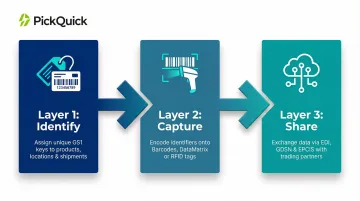
- The GS1 system works in three layers: assign unique codes to products and locations, capture them via barcodes or RFID, then share data across platforms and supply chain partners
- GS1 standards improve supply chain visibility, reduce errors, enable traceability, and support regulatory compliance
- For brands selling on quick commerce platforms, GS1-compliant product data is mandatory for onboarding and catalogue listings
What Is GS1 and Why Does It Matter for Supply Chains?
GS1 is a neutral, not-for-profit international organisation that develops and maintains the world's most widely used supply chain standards. It operates across more than 150 countries through local Member Organisations, serving over 2 million companies globally. The GS1 brand was formed in 2005 through the merger of EAN (European Article Number) and UCC (Uniform Code Council).
The GS1 system traces back to 1973, when the Uniform Code Council introduced the UPC barcode in the United States. Today, GS1 barcodes power over 10 billion transactions every day across more than 1 billion products worldwide.
Key facts about GS1's global reach:
- Active in 150+ countries through local Member Organisations
- Used by over 2 million companies across retail, logistics, and healthcare
- Processes more than 10 billion transactions daily
- Covers 1 billion+ products in active circulation
GS1 standards assign every product, location, and shipment a globally unique identifier. This enables seamless data exchange across retailers, warehouses, e-commerce platforms, and quick commerce networks — with no ambiguity and no manual translation errors. For FMCG brands scaling across platforms like Blinkit, Zepto, or Swiggy Instamart, that consistent product identity is what makes accurate cataloguing, dark store replenishment, and platform compliance possible at speed.
Core GS1 Identification Keys Every Brand Should Know
GS1 defines 12 identification keys that serve as the vocabulary of the GS1 language. Each key uniquely identifies a specific type of supply chain entity—products, locations, shipments, assets, or documents. Here are the most critical keys for supply chain operations:
GTIN — Global Trade Item Number
The GTIN is the unique numerical identifier assigned to every trade item (product or service). It powers barcodes at point-of-sale, inventory management systems, e-commerce listings, and invoicing. Manufacturers assign GTINs to their own products; retailers assign GTINs to private label goods.
GTINs are required for listing products on major retail and quick commerce platforms. Blinkit, for example, explicitly mandates UPCs (which encode GTINs) for product listing and scans them during warehouse inwarding. Missing or invalid GTINs trigger listing rejections and platform penalties.
GLN — Global Location Number
The GLN identifies physical and legal entities: warehouses, distribution centres, stores, hospitals, and departments within an organisation. It ensures that shipments, invoices, and purchase orders reference the correct, unambiguous location—critical for multi-city or multi-warehouse operations.
For brands scaling across multiple dark stores and quick commerce platforms, GLNs enable precise tracking of inventory movements and ensure replenishment orders reach the right destination.
SSCC — Serial Shipping Container Code
The SSCC uniquely identifies logistic units such as pallets and shipping containers. Used alongside Advanced Ship Notices (ASNs), it tells receiving partners exactly what is in each pallet before it arrives—reducing receiving errors and speeding up warehouse intake.
For high-frequency FMCG brands, accurate SSCC usage prevents discrepancy notes (DNs) during motherhub inwarding, which can stall replenishment authorisation and expansion on quick commerce platforms.
Other Keys
- GRAI: Tracks returnable assets in circulation — pallets, crates, and totes
- GIAI: Marks individual fixed assets like manufacturing machinery or medical equipment
- GSIN/GINC: Groups shipments and consignments moving together through the supply chain
GS1 Company Prefix
Brands must obtain a GS1 Company Prefix before creating their own GTINs and GLNs. The process has three steps:
- Apply through GS1 India (the national member organisation for Indian brands)
- Receive your company prefix upon approval
- Generate individual identifiers for each product or location using that prefix
How the GS1 System Works: Identify, Capture, and Share
The GS1 framework operates on three layers—Identify, Capture, and Share—that tie all GS1 standards together. Every implementation follows this sequence.
Identify
The first layer assigns GS1 identification keys (GTIN, GLN, SSCC) to every object in the supply chain, ensuring each product, location, and shipment has a globally unique code that prevents ambiguity across all trading partner systems.
Capture
Identifiers are encoded onto physical data carriers so scanners can read them automatically. Main carrier options include:
- 1D barcodes (EAN/UPC): Used for retail point-of-sale scanning
- GS1-128: Used for cases and logistics labels, encoding additional attributes
- ITF-14: Used for outer packaging and corrugated boxes
- GS1 DataMatrix and 2D barcodes: Used in healthcare and food to encode batch number, expiration date, and serial number in a single symbol
- RFID/EPC tags: Used for non-line-of-sight or real-time inventory reading
Application Identifiers (AIs) are 2-4 digit prefixes that tell scanners what type of data follows:
- AI (01): GTIN
- AI (17): Expiration date (YYMMDD format)
- AI (10): Batch or lot number
The retail industry is migrating toward 2D data carriers (GS1 QR Code and DataMatrix) by 2027 to encode dynamic data alongside the GTIN, enabling better traceability and consumer engagement.
Share
The third layer shares captured data digitally with trading partners through three main mechanisms:
1. GS1 EDI/eCom (EANCOM and GS1 XML)
Used for transactional documents like purchase orders, invoices, and Advanced Ship Notices (ASNs). These standardized formats enable automated data exchange between ERP and WMS systems.
2. GDSN (Global Data Synchronization Network)
Used for synchronising product master data—weights, dimensions, images, nutritional information—across all partners simultaneously. GDSN-certified data pools (like 1WorldSync, Syndigo, and Salsify) automate catalogue updates, reducing listing errors across e-commerce platforms.
3. EPCIS (Electronic Product Code Information Service)
Used for event-level tracking data that answers what, where, when, why, and how at every supply chain touchpoint. EPCIS records discrete events (observation, commission, aggregation, transformation) as a product moves through the supply chain, creating a full audit trail.
EPCIS is especially relevant for food safety regulations like FSMA Rule 204, which mandates Critical Tracking Events (CTEs) and Key Data Elements (KDEs) for certain foods. The FDA's rule does not prescribe a specific format, but most implementations rely on GS1 EPCIS to meet compliance deadlines.
GS1 Traceability Standards and Industry Applications
GS1 traceability standards—built on EPCIS and the identification keys—enable end-to-end product tracking from source to consumer. Key benefits include interoperability between trading partners, faster product recalls, regulatory compliance, and consumer trust.
For example, St. James's Hospital cut recall location time to just 10 minutes using GS1 standards, while McKinsey estimates that GS1-enabled inventory optimisation could reduce global healthcare costs by $40–100 billion, primarily from improved inventory management and reduced medication errors.
Retail and Quick Commerce
In retail and quick commerce, GS1 GTINs are mandatory for product listings on platforms such as supermarkets, e-commerce marketplaces, and quick commerce apps. Accurate GS1 product data—dimensions, weight, images, nutritional information synchronised via GDSN—reduces listing errors, prevents stockouts, and improves search-to-conversion rates.
For regional FMCG and food brands scaling onto quick commerce platforms like Blinkit, Zepto, and Swiggy Instamart, ensuring GS1-compliant product data is one of the first operational requirements. Platforms mandate UPCs for warehouse inwarding and catalogue listings. Blinkit, for instance, scans UPCs during motherhub inwarding and charges ₹50/item for seller-attributed return errors such as partial items or damaged products.
Platforms like PickQuick help brands navigate this by managing GS1 barcode readiness as part of quick commerce onboarding—ensuring brands go live in weeks rather than months with full compliance across all platforms.
Food and Healthcare
Food safety regulations (FSMA Rule 204 in the US, with similar frameworks in other markets) increasingly mandate GS1-based traceability using Critical Tracking Events (CTEs) and Key Data Elements (KDEs). The FSMA 204 compliance date is January 20, 2026.
GS1 standards also underpin healthcare's unique device identification (UDI) requirements for medical devices and the Drug Supply Chain Security Act (DSCSA), enabling pharmaceutical companies to track medications from manufacturer to patient. The DSCSA's November 2024 stabilisation deadline requires electronic interoperable systems, with the FDA recommending EPCIS for data capture and exchange.
Across both sectors, GS1 traceability can pinpoint contaminated or recalled products within hours rather than days, protecting consumers and reducing financial exposure.
The operational advantage is consistent regardless of industry:
- Faster recall isolation — pinpoint affected batches by lot, date, and location
- Reduced liability exposure through documented chain-of-custody records
- Regulatory readiness with audit-ready event data at every supply chain node
Implementing GS1 Standards: A Practical Roadmap
Step 1 — Get a GS1 Company Prefix
Brands start by licensing a GS1 Company Prefix from their national GS1 member organisation. The prefix length determines how many GTINs and GLNs can be generated.
For Indian brands: Register via GS1 India, the only authorised body in India to provide barcodes starting with '890'. Registration fees consist of registration fees, annual subscription fees, security deposit, and GST at 18%. For example, brands with annual sales up to ₹5 crores pay a total fee of ₹48,135 for 1 year (100 barcodes), effective from October 1, 2025.
Step 2 — Assign Identifiers and Prepare Product Data
Once a prefix is obtained, assign identifiers across your full catalog:
- GTINs to every product variant (including size and flavour variants)
- GLNs to each warehouse, dark store, or facility
- SSCCs to each logistic unit
In parallel, prepare product master data for GDSN synchronisation: weight, dimensions, images, allergens, and nutritional information. Trading partners need this data before they can onboard your catalog.
Step 3 — Apply Data Carriers and Label Products
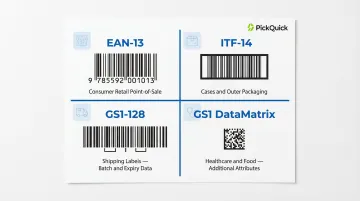
Brands encode each identifier onto the correct barcode or RFID tag and print them on product packaging, cases, and pallets. Match barcode format to application:
- EAN-13: Consumer units for retail point-of-sale
- ITF-14: Cases and outer packaging
- GS1-128: Shipping labels with batch/lot and expiry data
- GS1 DataMatrix: Healthcare and food products requiring additional attributes
Ensure barcodes are clearly visible and scannable—barcode scanability failures during platform inwarding trigger discrepancy notes and block expansion.
Step 4 — Integrate Data Sharing with Trading Partners
Connect internal systems to trading partner networks using two channels:
- EDI — transactional documents (purchase orders, invoices, ASNs) flowing between ERP and WMS
- GDSN-certified data pool — product master data synchronisation with retailers; certified pools include 1WorldSync, Syndigo, Salsify, and Agentrics
If your trading partners or QC platforms require full event-level traceability — common in food and healthcare supply chains — plan EPCIS implementation at this stage. Getting alignment with partners early prevents costly re-integration later.
Frequently Asked Questions
What is GS1 in logistics?
In logistics, GS1 standards provide unique identifiers (GTIN, GLN, SSCC) and data-sharing protocols (EPCIS, EDI, ASNs) that allow shippers, carriers, warehouses, and retailers to track product movements accurately at every handoff point in the supply chain.
What is the full form of GS1 standards?
GS1 is not an acronym with a traditional full form—it is the brand name of the international standards body formed by the merger of EAN (European Article Number) and UCC (Uniform Code Council). The "GS1" name represents the unified global standards organisation operating across more than 150 countries.
How do Indian brands register for GS1 barcodes?
Indian brands register through GS1 India, the official member organisation. After applying and paying an annual subscription fee, brands receive a GS1 Company Prefix used to generate GTINs for each SKU. Barcodes can then be printed on packaging and are valid for use across all retail and quick commerce platforms.
What is the difference between a GTIN and a UPC barcode?
A GTIN (Global Trade Item Number) is the underlying identification number assigned to a product, while a barcode is the physical format used to scan it. In India, GTINs are most commonly encoded in the EAN-13 barcode format. A UPC barcode, used primarily in North America, encodes the same GTIN data but in a different format.
Do brands need GS1 compliance to sell on quick commerce platforms?
Most major quick commerce and retail platforms require products to have valid GTINs and accurate product master data for listing and inventory management. GS1-compliant barcodes and synchronised product data ensure smooth onboarding, correct catalogue listings, and reliable replenishment on platforms like Blinkit, Zepto, Swiggy Instamart, and JioMart.