Introduction
Regional brand owners in India regularly ask whether they need to spend ₹48,000+ on official GS1 barcodes before launching on Quick Commerce platforms. For brands in Dairy, Staples, Masalas, and Snacks with existing modern trade presence, EAN-13 barcodes are already on pack — so the question barely applies.
For brands entering organized retail for the first time, though, the question is real: is GS1 mandatory, or are there alternatives?
This post covers what QC platforms in India actually require, when GS1 is non-negotiable versus optional, and what your practical alternatives are — whether you're scaling from GT/MT into Quick Commerce or going live on Blinkit and Zepto for the first time.
Key Takeaways
- GS1 is the global nonprofit that issues standardized GTINs/UPCs, but it's not the only barcode option available
- You're not legally required to have GS1 barcodes in most cases — the requirement depends on where and how you sell
- Major modern trade retailers and Amazon India require GS1-registered barcodes, cross-checking them against the global database
- Blinkit, Zepto, Swiggy Instamart, and JioMart all require barcodes for listing creation and dark store receiving — enforcement varies by platform
- Scaling across retail and QC platforms without GS1 barcodes early means expensive rework later
What Is a GS1 Barcode?
The Organization Behind the Standard
GS1 is a global, nonprofit standards organisation that introduced the barcode in 1974 and serves as the official issuer of Global Trade Item Numbers (GTINs). A GTIN is a unique identifier that distinguishes your product in the global supply chain, linking it to your business across retailers, distributors, and logistics partners.
When you register with GS1, you receive a company prefix — a unique code that links all your product barcodes directly to your business in the global GS1 registry. This is what separates official GS1 barcodes from reseller barcodes or custom codes: the prefix is registered under your company name, not someone else's.
GTIN Formats: UPC vs. EAN
GTINs come in different lengths depending on region and product type:
- GTIN-12 (UPC): 12-digit format used predominantly in North America
- GTIN-13 (EAN): 13-digit European Article Number used in the rest of the world, including India
In India, EAN-13 is the standard retail format. GS1 India is the only authorised body to issue barcodes starting with the '890' country prefix, which identifies products registered in India.
Two Components: The Barcode and the GTIN
Every GS1 barcode contains two elements:
- The barcode: The scannable visual symbol — the printed black lines on your packaging
- The GTIN: The unique number underneath, tied to your company's entry in the global GS1 registry
When a retailer or quick commerce platform scans your product, this combination confirms ownership, product identity, and authenticity in real time.
Do You Actually Need GS1 Barcodes? The Real Answer
No Universal Legal Requirement
There is no Indian law or international trade regulation that mandates GS1 registration. The Legal Metrology (Packaged Commodities) Rules, 2011 permit barcodes/GTINs as additional declarations but don't require GS1-specific enrollment. The requirement comes from individual retailers, platforms, and supply chain partners — not from regulators.
Internal vs. External Use: The Critical Distinction
If you use barcodes only within your own warehouse or internal systems, any unique code works. GS1 becomes essential when external partners — retailers, distributors, QC platforms, or marketplaces — need to scan and verify your product identity against a trusted registry.
The real question: do your sales channels require verified product identity against a global registry? That's what determines whether GS1 is necessary.
The Reseller Barcode Risk
Third-party barcode resellers sell codes originally issued under pre-2002 GS1 (UCC) prefixes. These codes are not registered under the purchasing brand's name. If a retailer or platform cross-checks the GS1 database, the prefix will show a different company name — not yours.
Amazon India directly addresses this in its Seller Central documentation: "We verify the authenticity of product UPCs by checking the GS1 database. UPCs that do not match with the information provided by GS1 will be considered invalid." Enforcement is strongest for Brand Registry sellers, but the risk of listing removal applies to any seller using non-verified codes.
The Practical Decision Filter
When GS1 is the safest path:
- You're selling to modern trade retailers (DMart, Reliance, Spencer's)
- You're entering Amazon India with Brand Registry enrollment
- You're working with national distributors who integrate product data into their systems
- You plan to scale across multiple retail channels simultaneously
When alternatives may work temporarily:
- You're operating only through your own warehouse or direct channels
- You're in early testing phases on digitally-native platforms
- You're a private label seller using platform-specific IDs
What Do Quick Commerce Platforms in India Actually Require?
Barcode Requirements Across Major QC Platforms
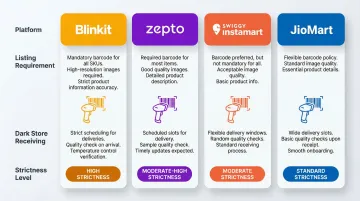
Each major Quick Commerce platform in India has its own onboarding and product listing process, but all four require barcodes for both listing creation and dark store receiving:
| Platform | Listing Requirement | Dark Store Receiving | Source |
|---|---|---|---|
| Blinkit | UPC mandatory for product listing and must be unique for each product | UPC scanned during inwarding; mismatches lead to rejection | Official Seller Hub Guide |
| Zepto | UPC or EAN barcodes mandatory for each SKU during NPI | Barcodes scanned to confirm accuracy during receiving | Industry reports (2025) |
| Swiggy Instamart | UPC/EAN barcode number mandatory for product catalog | Barcodes verified for scannability during GRN processing | Industry sources |
| JioMart | EAN-13 barcodes mandatory on all products | Inwarding process requires EAN-13 barcodes | Platform documentation |
Listing Requirements vs. Dark Store Receiving
A QC platform may not require GS1 registration to create a product listing — but physical dark store receiving is a different matter. Products must be scannable when they arrive.
When your products reach a dark store, warehouse staff scan barcodes during the GRN (Goods Received Note) process. Unscannable or mismatched barcodes trigger immediate catalog or inwarding rejections, generating Discrepancy Notes (DNs) that throttle your replenishment and expansion.
The Blinkit Exemption Loophole
While most platforms demand barcodes upfront, Blinkit offers a narrow testing window. According to the official Blinkit Seller Hub guide, brands without UPCs can email seller-onboarding@blinkit.com with the subject line "Brand Name - Require UPCs" to receive up to 20 UPC exemption codes for initial product listings.
This exemption works for early testing — it doesn't replace the need for real, scannable barcodes once you're scaling.
Brands Already in Modern Trade Have a Head Start
If your brand already sells through modern trade retailers (DMart, Spencer's, or Big Bazaar successors), you likely already have EAN barcodes registered with GS1 India. Those same barcodes transfer directly to QC platforms, making the registration question largely irrelevant.
Regional masala brands, dairy cooperatives, and staples manufacturers routinely carry GS1-registered EANs from offline distribution. On Quick Commerce, those become the product IDs across all channels — no duplication, no re-registration.
PickQuick's Onboarding Removes the Guesswork
For brands entering organized retail and QC for the first time, barcode compliance is one of the first things PickQuick validates during onboarding. The process covers whether existing barcodes meet platform standards, whether GS1 registration is needed, and how to handle gaps — all before the first inventory shipment reaches a dark store.
Alternatives to GS1 Barcodes (and When They Work)
Internal/Custom Barcodes
Brands managing their own warehouses or dark store inventory can use self-generated barcodes created through free barcode generator tools. These work perfectly for internal tracking operations but are not recognizable or verifiable externally.
When this works:
- You're tracking inventory only within your own facilities
- You don't need retailer or platform verification
- You're not entering organized retail or QC platforms
The limitation: Once products move to an external partner — a 3PL, a dark store, a distributor — custom barcodes have no value at the handoff point.
Platform-Assigned Identifiers
Some QC platforms and marketplaces assign their own product IDs during listing creation (similar to Amazon.in's ASIN or FNSKU). For pure-play online sellers without retail ambitions, these platform IDs can serve as functional substitutes in certain contexts.
When this works:
- You're selling exclusively on one or two digital platforms
- You have no plans to enter modern trade or multi-channel retail
- The platform explicitly supports this approach
The limitation: Platform-specific IDs lock you into that ecosystem and cause compatibility issues if you later expand.
GTIN Exemptions
Amazon.in allows sellers enrolled in Brand Registry to apply for a GTIN exemption if they manufacture or own the brand and their products lack barcodes. Blinkit offers a similar limited exemption for up to 20 products during initial onboarding — a useful entry point, but not a long-term solution.
When this works:
- You're a private label or white label seller
- You're testing demand before committing to GS1 investment
- You're operating under a platform's explicit exemption policy
These exemptions are typically temporary, capped at a low SKU count, and unavailable on most traditional retail channels. For brands already running ₹5–7 crore/month in offline demand, they're a workaround, not a strategy.
The Growth Ceiling of Alternatives
Every non-GS1 path hits a wall at the same place: multi-channel scale. A regional dairy brand or masala label that enters modern trade, ships to a national distributor, or lists across Blinkit, Zepto, and Swiggy Instamart simultaneously needs product identifiers that every system in that chain can read and verify. Without GS1 barcodes, each new channel creates a separate reconciliation problem.
Alternatives make sense for brands at the earliest stage of digital testing. For anyone with serious offline distribution already in place, the investment in GS1 registration pays back quickly.
When GS1 Is Non-Negotiable for Indian Brands
Mandatory Scenarios
GS1 barcodes are effectively mandatory when you:
- Sell to modern trade retailers (DMart, Reliance Retail, Spencer's, Big Bazaar successors)
- Export products internationally where global product registries are required
- Work with national distributors who integrate product data into ERP systems
- Sell through platforms that explicitly require GS1-registered GTINs
Modern trade retailers like DMart and Reliance Smart strictly require GS1 standard barcodes for their automated inventory systems. While some retailers may assign internal barcodes on a case-by-case basis if buyer interest is strong, this is the exception, not the rule.
GS1 India Pricing Structure
As of the October 2025 fee structure, GS1 India charges based on company turnover and the number of barcodes required. For a company with annual turnover up to ₹5 Crores:
| Barcode Tier | Total 1-Year Fee (Including GST & Security Deposit) |
|---|---|
| 100 Barcodes | ₹48,135 |
| 1,000 Barcodes | ₹52,560 |
| 10,000 Barcodes | ₹59,050 |
| 100,000 Barcodes | ₹69,375 |
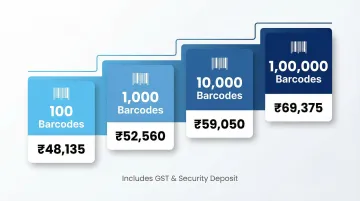
The fee includes a registration fee, annual subscription, 18% GST, and a ₹3,000 security deposit. The subscription also includes access to GS1 India's DataKart platform for managing product data.
The Omnichannel Advantage
Brands with strong offline GT/MT presence planning to scale on Quick Commerce (QC) should register with GS1 India early. The barcode already printed on your physical product becomes the same product ID used across every channel — no remapping required.
In practice, this means:
- Dark store catalogs on Blinkit, Zepto, and Swiggy Instamart pull the same GTIN already on your pack
- Offline shelf stock and QC inventory share a single product record
- Adding new cities or platforms requires no SKU restructuring or compliance rework
Frequently Asked Questions
Do you have to use GS1 for barcodes?
No, GS1 is the global standard but not a legal mandate. The requirement is driven by specific retailers, platforms, or supply chain partners, not by law. Brands selling only through their own channels or platforms that accept alternative IDs may not need GS1.
Is GS1 the only barcode company?
GS1 is the only official issuer of new GS1-standard GTINs and UPCs. Third-party resellers exist that sell barcode numbers from pre-2002 prefixes, but those codes are not registered under the buyer's brand name in the GS1 global database.
Can I sell on Blinkit or Zepto without a GS1 barcode?
Blinkit offers a limited UPC exemption for up to 20 products during onboarding, but barcodes are still required for dark store receiving. Zepto mandates UPC or EAN barcodes for SKU creation during the NPI process, with no publicly documented exemption workflow.
What is the difference between a GTIN and a UPC?
GTIN (Global Trade Item Number) is the umbrella identifier system. UPC is a 12-digit North American format of a GTIN. EAN (13-digit) is the more commonly used format in India and internationally.
How much does a GS1 barcode cost in India?
According to the GS1 India October 2025 fee structure, a company with turnover up to ₹5 Crore pays ₹48,135 for 100 barcodes valid for one year, including GST and a security deposit. The total varies based on how many SKUs need barcodes and whether you're paying for initial registration or annual renewal.
What happens if I use a non-GS1 barcode and a retailer checks it?
If a platform cross-checks the barcode against the GS1 database and finds it registered to a different company — or not registered at all — the listing will be rejected or removed. Blinkit and Zepto both verify barcodes during inbound receiving and NPI, so mismatched or unregistered codes can stall onboarding entirely.