For FMCG brands operating across India's quick commerce platforms—Blinkit, Zepto, Swiggy Instamart, and JioMart—inventory replenishment isn't background logistics. It's the difference between scaling to hundreds of dark stores or getting stuck at 15. This guide covers the fundamentals: what inventory replenishment actually is, the five core methods that drive restocking decisions, the step-by-step planning process, and the best practices that separate high-performing brands from those constantly firefighting stockouts.
Key Takeaways
- Inventory replenishment restocks goods at the right time and quantity to meet demand without overstocking or running out
- Core methods include Reorder Point, Min-Max, Periodic Review, Top-Off, and Demand-Driven replenishment
- Effective planning combines demand forecasting, reorder point calculation, safety stock setting, and ongoing optimization
- Top practices include SKU segmentation, real-time stock visibility, supplier collaboration, and demand-based forecasting
- For quick commerce brands in India, dark store replenishment needs platform-specific Min-Max calibration across Blinkit, Zepto, and Swiggy Instamart — not a one-size-fits-all approach
What Is Inventory Replenishment and Why Does It Matter?
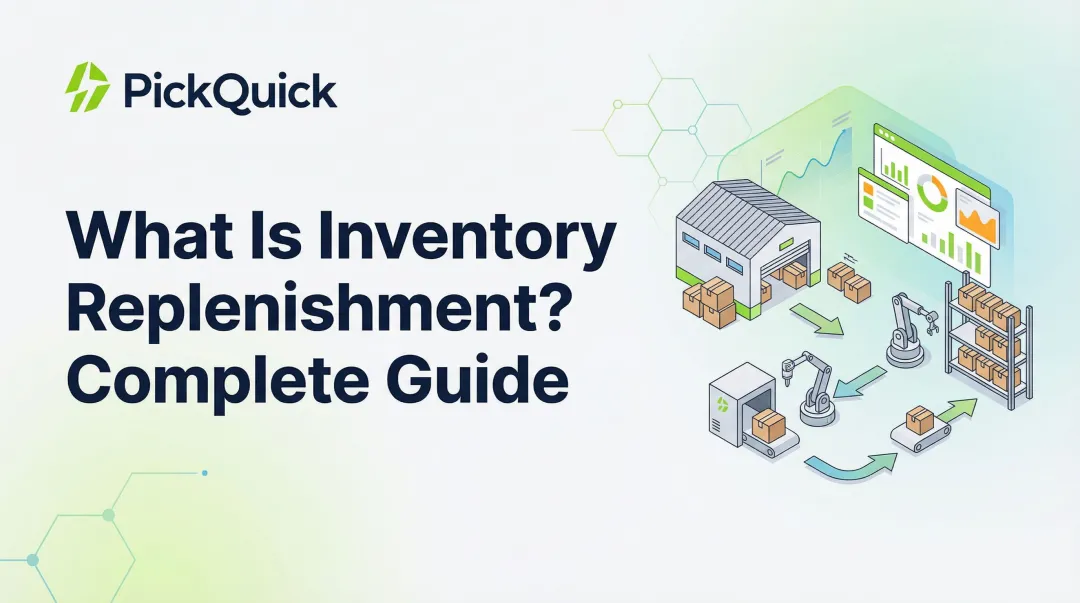
Inventory replenishment is the process of restoring stock levels—either by reordering from suppliers or moving inventory from reserve storage to active picking locations—so the right products are available to fulfill orders at the right quantity, place, and time.
Poor replenishment creates business consequences on both ends:
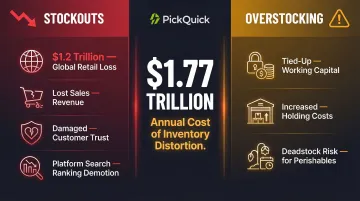
- Stockouts cause lost sales, damaged customer trust, and lower platform search rankings. On quick commerce platforms, availability directly drives visibility. According to IHL Group, global retail loses approximately $1.77 trillion annually to inventory distortion, with out-of-stocks accounting for $1.2 trillion of that total.
- Overstocking ties up working capital, increases holding costs, and risks deadstock—particularly dangerous for perishables and FMCG products with limited shelf life.
Getting replenishment right means understanding where it fits within the broader inventory management picture.
Inventory Replenishment vs. Inventory Control
Inventory control tracks and manages what you already have: counts, locations, and accuracy. Inventory replenishment is proactive action—deciding when to reorder, how much, and from where. Both are part of inventory management, but replenishment is forward-looking while control monitors the present state.
Common Inventory Replenishment Methods
No single replenishment method works for every business or product category. The right approach depends on demand patterns, lead times, storage capacity, and sales channel speed. A quick commerce dark store needs far more frequent replenishment cycles than a traditional warehouse.
Reorder Point Method
Replenishment is triggered automatically when stock falls to a predefined threshold—the reorder point. The formula is:
Reorder Point = (Average Daily Usage × Lead Time) + Safety Stock
Example: A masala brand sells 50 units daily on average, with a 3-day supplier lead time and 25 units of safety stock:
- Reorder Point = (50 × 3) + 25 = 175 units
When inventory hits 175 units, the system triggers an order.
Best for: Items with stable demand and predictable lead times.
Risk: If demand spikes unexpectedly, the reorder point may be breached too quickly, causing stockouts before the next order arrives.
Min-Max (Minimum-Maximum) System
Stock is replenished to a maximum level whenever it hits a minimum threshold. This method is popular in quick commerce dark stores and FMCG operations due to its simplicity and ability to maintain tight availability windows.
Setting accurate min and max levels requires ongoing calibration based on sales velocity and lead time data. PickQuick treats Min-Max optimization as a core operational discipline. Max levels are expanded only when brands meet all of the following:
- Zero stockouts in the review period
- Clean motherhub inventory with no overage
- Confirmed replenishment orders (ROs) submitted on time
- Clean GRN scores with low discrepancy notes
- Consistent sales velocity at or above category benchmarks
Periodic Review Method
Inventory is reviewed at fixed intervals—weekly or bi-weekly—and orders are placed to bring stock back to a target level, regardless of current quantity.
Best for: Businesses with large product catalogs and predictable demand.
Drawback: Stock could run out between review periods, making this method unsuitable for high-velocity quick commerce SKUs.
Top-Off Method
Picking locations are proactively restocked during slow periods or downtime to ensure high-velocity SKUs never run empty when demand peaks. This is especially relevant for retailers, distributors, and quick commerce dark stores managing fast-moving products like dairy, staples, and beverages.
Demand-Driven (On-Demand) Replenishment
Orders are placed based on real-time demand signals rather than fixed schedules. Modern inventory management software ingests POS data, sales velocity trends, and demand forecasts to trigger dynamic replenishment automatically.
Best for: Brands operating across quick commerce platforms where demand shifts quickly due to promotions, hyperlocal events, or seasonal spikes.
Drawback: Requires reliable data infrastructure and clean sales signals—poor data quality leads to erratic ordering behavior.
What Factors Impact Inventory Replenishment?
Demand Variability
Promotions, seasonal spikes, new product launches, and platform-specific trends—like a product going viral on quick commerce—make demand unpredictable. Static reorder points often fail in high-variability environments. Brands need dynamic safety stock policies and real-time demand sensing to avoid stockouts and markdowns.
According to GS1/VICS guidelines, promotions and retail events generate the largest swings in demand, causing the majority of out-of-stocks, excess inventory, and unplanned logistics costs.
Supply Chain Lead Times
Variable or extended lead times—due to supplier delays, logistics disruptions, or production constraints—directly affect how far in advance replenishment orders must be placed. Brands must factor lead time variability, not just average lead time, into their reorder calculations to avoid gaps.
In India's FMCG sector, traditional demand planning managing 50,000+ SKUs across fragmented channels suffers from average forecast errors of 30-45%, leading to chronic stockouts that cost 8-15% in lost sales.
Storage and Capacity Constraints
Limited warehouse or dark store space limits the quantity that can be held at any location, forcing more frequent, smaller replenishment cycles. In quick commerce dark stores, this constraint is especially acute:
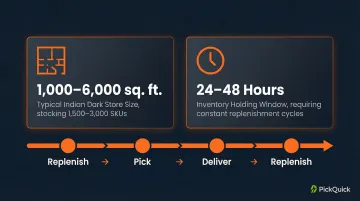
- Indian dark stores typically measure 1,000–6,000 sq. ft. and stock 1,500–3,000 high-demand SKUs
- Micro-fulfillment centers carry just 24–48 hours' worth of inventory, requiring constant, proactive replenishment cycles
How to Plan Inventory Replenishment: A Step-by-Step Guide
Step 1 — Forecast Demand
Use historical sales data, seasonal trends, promotional calendars, and channel-specific velocity data to estimate how much of each SKU you'll need over the planning period.
AI-powered demand forecasting models analyzing over 200 demand signals achieve 90-95% forecast accuracy across SKU portfolios, compared to 55-65% from traditional spreadsheet-based methods. McKinsey research shows that applying AI-driven forecasting reduces errors by 20 to 50%.
For brands on quick commerce platforms, layer in platform-level velocity data — Blinkit and Zepto both expose daily demand signals that significantly sharpen short-horizon forecasts.
Step 2 — Set Reorder Points and Safety Stock
Calculate the reorder point for each SKU using: (Average Daily Usage × Lead Time) + Safety Stock
Safety stock should account for both demand variability and lead time variability — not just a flat buffer. The formula is:
Safety Stock = Z × σD × √(Lead Time)
Where Z is the service level factor and σD is the standard deviation of demand. Target service levels by SKU tier:
| Service Level | Z-Score |
|---|---|
| 95% | 1.65 |
| 98% | 2.05 |
Set higher safety stock for fast-movers (A items) and lower buffers for slow-movers (C items) — this keeps capital efficient without exposing critical SKUs to stockouts.
Step 3 — Segment SKUs with ABC Analysis
Classify inventory into:
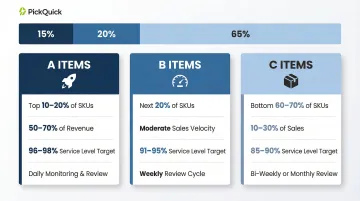
- A items: High-value/high-velocity (top 10-20% of items driving 50-70% of sales)
- B items: Moderate velocity (next 20% of items)
- C items: Low-velocity (remaining 60-70% of items driving 10-30% of sales)
Apply higher service-level targets and tighter replenishment controls to A items. For example:
- A items: 96-98% service level
- B items: 91-95% service level
- C items: 85-90% service level
This prevents capital from being tied up in slow-moving stock while ensuring critical SKUs never run out. Once SKUs are segmented, you have the foundation to choose the right replenishment method for each tier.
Step 4 — Choose and Implement a Replenishment Method
Based on the demand profile and storage context of each SKU or category, select the most appropriate method — Reorder Point, Min-Max, Periodic Review, Top-Off, or Demand-Driven.
For brands operating across quick commerce platforms, the Min-Max system tied to real-time dark store inventory feeds is the most reliable approach. Blinkit, Zepto, Swiggy Instamart, and JioMart all generate daily demand signals, requiring brands to replenish dark stores every 24 to 48 hours. The method you implement here directly determines how tightly your Step 5 review cadence needs to run.
Step 5 — Review and Optimize Continuously
Demand patterns shift, lead times change, and supplier fill rates fluctuate — which means reorder points set today may be wrong next month. Establish a regular cadence — weekly or bi-weekly — to review:
- Forecast accuracy
- Actual vs. planned stock levels
- Supplier fill rates
- Stockout incidents
- Lead time shifts
Adjust reorder points and safety stock levels based on changing demand patterns.
Inventory Replenishment Best Practices
Maintain Real-Time Inventory Visibility Across All Locations and Channels
Replenishment decisions are only as good as the underlying data. Real-time tracking—through inventory management systems, RFID, or WMS integrations—ensures you're acting on accurate stock levels, not outdated manual counts.
This is especially critical for brands selling across multiple quick commerce platforms simultaneously, where stock availability directly affects search ranking and order fill rate. Blinkit requires a 90%+ fill rate; dropping below 80% triggers algorithmic demotion, reducing search ranking, lowering ad visibility, and removing listings from active pincodes entirely.
Collaborate with Suppliers Proactively
Share demand forecasts and promotional calendars with suppliers in advance so they can plan production and delivery accordingly. Establish service-level agreements (SLAs) and track on-time delivery rates and lead time consistency.
For critical SKUs, consider dual-sourcing to reduce single-vendor dependency.
A landmark CPFR implementation between P&G and Walmart resulted in a 70% reduction in inventory levels and improved service levels from 96% to 99%.
Use Demand-Based Forecasting, Not Gut Instinct
Historical data alone is insufficient. Layer in seasonality, market trends, platform-level demand signals, and promotional impacts to build forecasts that are accurate and actionable.
AI-driven forecast error reductions of 20-50% translate into a reduction in lost sales and product unavailability of up to 65%, while warehousing costs fall by 5 to 10%.
Apply SKU-Level Replenishment Rules, Not Blanket Policies
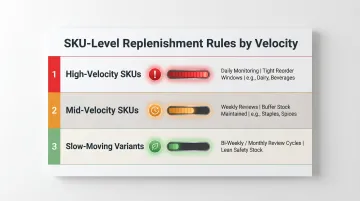
Treat different SKUs differently. Applying uniform replenishment rules across a diverse catalog leads to chronic stockouts on fast movers or excess inventory on slow ones. A simple tiered approach works better:
- High-velocity SKUs (e.g., dairy, beverages): daily monitoring, tight reorder windows
- Mid-velocity SKUs (e.g., staples, spices): weekly reviews with buffer stock
- Slow-moving variants: bi-weekly or monthly review cycles with lean safety stock
For Quick Commerce Brands, Partner with Operators Who Specialize in Dark Store Replenishment
Once SKU-level rules are in place, the next challenge is execution across platforms — and that's where complexity compounds fast.
Managing replenishment across Blinkit, Zepto, Swiggy Instamart, and JioMart simultaneously is operationally complex: each platform runs its own inventory feeds, minimum-level requirements, and restocking windows.
PickQuick's QC operations are built around this complexity. The platform covers 10,000+ pincodes and gives brands:
- Real-time stock tracking and automated replenishment alerts
- Min-Max optimization tailored to dark store demand patterns
- Pincode-level visibility to catch availability gaps before they trigger demotion
- Dark-store level analytics to support expansion from trial clusters to full-city distribution
This allows brands to maintain clean replenishment cycles across all major platforms without managing each dark store individually.
Frequently Asked Questions
What is inventory replenishment?
Inventory replenishment is the process of restocking goods—either from suppliers or from reserve storage—to maintain optimal stock levels and meet customer demand without overstocking or running out.
What is the replenishment cycle in supply chain?
The replenishment cycle is the time between two successive replenishment orders for a product, encompassing demand monitoring, order triggering, order placement, lead time, and stock receipt. Shorter cycles are common in quick commerce; longer cycles in traditional retail.
What are the different strategies available for replenishment?
The main strategies include Reorder Point method, Min-Max system, Periodic Review, Top-Off method, and Demand-Driven replenishment. The best choice depends on demand patterns, lead times, and the type of sales channel.
What is replenishment optimization?
Replenishment optimization is the ongoing process of tuning reorder quantities, safety stock levels, and replenishment triggers to minimize both stockouts and excess inventory, typically supported by data analytics, demand forecasting tools, and SKU segmentation.
What is forecasting and replenishment?
Demand forecasting predicts how much of each product will be needed in a given period, while replenishment uses those forecasts to determine when and how much to reorder. The two work together as the foundation of any effective inventory planning process.
How is CPFR different from VMI?
CPFR (Collaborative Planning, Forecasting, and Replenishment) is a joint process where buyer and supplier share data and co-develop demand forecasts and replenishment plans. VMI (Vendor-Managed Inventory) gives the supplier full control over managing and replenishing the buyer's stock based on agreed inventory levels.