
Introduction
Picture this: A masala brand with ₹6 crore monthly offline demand across Karnataka launches on Blinkit and Zepto. Within two weeks, their 100g Biryani Masala goes out of stock in half the dark stores. Their Sambhar Masala variant shows "available" on the app but never gets delivered. Meanwhile, their operations team has no idea which pack sizes are selling—because they assigned the same SKU code to three different weight variants.
This isn't a hypothetical scenario. It's the reality for dozens of regional FMCG brands entering Quick Commerce without proper SKU management. Poor SKU discipline creates cascading failures across the entire operation:
- Algorithmic demotions that bury products in search rankings
- Phantom inventory that blocks timely replenishment
- Inaccurate demand signals across 1,000+ dark stores
This guide covers what SKU management means for Quick Commerce, how to build a naming system that scales across platforms, and the specific practices that determine whether your brand maintains 90%+ availability or gets buried on page three.
Key Takeaways
- A SKU uniquely identifies each product variant (size, flavour, packaging) for internal inventory tracking — unlike standardized barcodes
- Strong SKU management prevents stockouts, reduces overstocking, and enables accurate demand forecasting across dark stores
- Use 8–12 character alphanumeric codes with no special characters or ambiguous letters (avoid 0/O, l/I)
- On Quick Commerce, SKU availability directly impacts search ranking—stockouts below 80% trigger algorithmic penalties
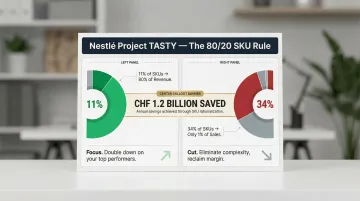
- Apply the 80/20 rule: roughly 11% of SKUs drive 80% of sales; prune underperformers aggressively
What Is SKU Management and Why Does It Matter?
Defining the Stock Keeping Unit
A SKU (Stock Keeping Unit) is a unique alphanumeric code that businesses create internally to identify each distinct product or variant in their inventory. Unlike UPCs or GTINs—which are standardized barcodes assigned by GS1—SKUs are internal codes you design to match how your business thinks about products.
A single product becomes multiple SKUs when you account for variations. A 100g Goldie Masala packet, a 200g pouch, and a 500g jar are three separate SKUs, even though they're the same base product. The same logic applies to different flavors, packaging types, or bundle configurations.
Why SKU Management Exists
SKU management is the systematic practice of creating, organizing, and maintaining these codes to track every sellable unit across your supply chain. It sits within inventory management, but it's the layer everything else depends on.
When you're operating in two cities with 50 SKUs, a spreadsheet might suffice. When you scale to 10 cities, 150 SKUs, and four Quick Commerce platforms simultaneously, the absence of a structured SKU system means you can no longer tell which variant is selling, which is stockout, or where replenishment is failing.
The Business Stakes
Inventory distortion costs the global retail industry $1.73 trillion annually—representing 6.5% of total retail sales. That's the combined cost of out-of-stocks and overstocks bleeding revenue at both ends.
Poor SKU management manifests as:
- Stockouts on high-velocity variants while slow movers sit untouched in dark stores
- Inability to identify underperformers consuming holding costs and warehouse space
- Inaccurate replenishment decisions because you can't distinguish which variant is actually selling
- Data reconciliation nightmares when the same product has different codes across Blinkit, Zepto, and Instamart
- Algorithmic penalties on Quick Commerce platforms where inconsistent availability buries your search ranking
For FMCG brands, the penalty is immediate: 70% of shoppers buy a different brand when their regular choice is out of stock.
How to Build a Scalable SKU Naming System
Establish a Hierarchical Naming Convention
The first and most critical step is creating a standardized format that encodes key product attributes in a logical sequence. Your SKU structure should reflect how your operations team thinks about products. Customer-facing labels and internal identifiers serve different purposes.
A proven hierarchical format includes:
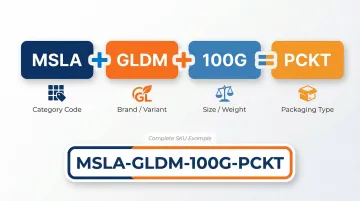
Category + Brand/Variant + Size/Weight + Packaging
Example: MSLA-GLDM-100G-PCKT for a 100g Goldie Masala pocket pack
This structure makes it instantly clear what the product is, which variant it represents, and what configuration it's in— no catalog cross-reference needed.
Keep Codes Short and Scannable
Aim for 8–12 alphanumeric characters. Longer codes increase the chance of human error during picking, packing, and data entry. In dark stores where pickers have 60 to 90 seconds per order, every extra character is a liability.
Avoid:
- Spaces (breaks database queries)
- Slashes, percent signs, hyphens (cause API sync failures)
- Special characters that don't play well with warehouse management systems
Use only uppercase letters (A-Z) and numbers (0-9). This also sets you up for the next rule: eliminating characters that look too similar to each other.
Eliminate Visually Ambiguous Characters
Never begin a SKU with the number zero — it's easily mistaken for the letter O. Similarly, avoid using lowercase "l" where it could be confused with uppercase "I" or the number "1."
Character exclusions:
- Letter O and number 0 (visually identical in many fonts)
- Letter I, lowercase l, and number 1 (all look similar)
- Any character pairing that causes mis-picks during manual scanning
Always use all-caps for consistency across team members, logistics partners, and platform integrations.
Assign Unique SKUs to Every Permutation
A masala in 50g, 100g, and 200g packs is three separate SKUs — not one SKU with a "size" attribute. The same applies to flavor variations, packaging types (pouch vs. jar), or bundle configurations (single unit vs. combo pack).
Sharing a SKU across variants is one of the most common and costly mistakes brands make. It creates:
- Inventory count errors (you can't tell which size is actually low)
- Wrong items being picked and packed
- Inability to track which variant drives sales or suffers from stockouts
Document Your Naming Convention
Build a shared reference guide that defines what each character position represents. Every internal team member, warehouse partner, and quality control operator should work from the same document.
Without this, different teams start improvising their own conventions. The result: duplicate entries, phantom stock, and picking errors that compound with every new SKU you add.
SKU Management Best Practices Every Brand Should Follow
Set SKU-Specific Reorder Points
Don't apply a blanket reorder rule across all products. Each SKU has different velocity and lead time characteristics.
The basic reorder point formula:
Reorder Point = (Average Daily Units Sold × Average Lead Time) + Safety Stock
Products with faster velocity or longer supplier lead times need higher reorder thresholds. Safety stock buffers against demand spikes or supply delays. Calculate it based on demand variability and your target service level.
Group Related SKUs by Similarity
Organize SKUs by size range, flavor family, or packaging type. Grouping enables:
- Better analytics (which variant within a product family drives sales?)
- Faster identification of dead weight (which SKU consumes space without contributing revenue?)
- Sharper merchandising on Quick Commerce platforms like Blinkit and Zepto
Apply the 80/20 Rule Ruthlessly
The Pareto Principle holds true across FMCG: a small percentage of SKUs generates the majority of revenue. But the reality is often more extreme.
Nestlé's Project TASTY revealed that just 11% of its SKUs accounted for 80% of total sales, while 34% of SKUs contributed only 1% of sales. By cutting this unprofitable tail, Nestlé unlocked over CHF 1.2 billion in savings.
Action steps:
- Audit your catalog quarterly
- Identify slow-moving or low-margin SKUs consuming storage and working capital disproportionate to their contribution
- Discontinue or bundle underperformers to free up working capital
Track SKU Velocity and Ratios
Calculate SKU velocity as units sold per day per SKU. Then compare this against your SKU ratio across gross profit bands.
SKU ratio formula:
SKU Ratio = (Number of SKUs in a gross profit range ÷ Total SKUs) × 100
Run this against your equivalent sales ratio. If 40% of your SKUs generate only 5% of sales, that gap is your pruning opportunity.
Use Inventory Management Software
Manual spreadsheets work at small scale but break down quickly as catalog size and channel count grow. McKinsey found that implementing analytical assortment optimization to reduce SKU counts by 36% resulted in 1–2% growth in both sales and gross margins.
Invest in software that:
- Automates reorder alerts based on SKU-specific thresholds
- Tracks real-time stock levels per SKU across locations
- Generates SKU performance reports
- Integrates with sales channels to reduce manual data entry errors
SKU Management on Quick Commerce Platforms: Key Considerations
Dark Store Capacity Constraints
Quick Commerce operates under fundamentally different rules than traditional retail or warehousing. Dark stores have small physical footprints—typically holding between 2,000 and 7,000 SKUs per location. Zepto operates with roughly 5,000 SKUs per store, while Swiggy Instamart's standard dark stores carry 15,000 to 20,000 SKUs.
Every SKU slot must earn its place based on local demand velocity. Unlike a traditional warehouse that can hold hundreds of variants, dark store real estate is priced at a premium. SKU selection must be tightly curated for speed and frequency.
Availability Directly Impacts Algorithmic Visibility
On Blinkit, Zepto, and Swiggy Instamart, stockouts don't just mean a lost sale today—they trigger algorithmic demotions that bury your products in search rankings tomorrow.
Reports indicate that falling below an 80% fill rate triggers algorithmic demotion, dropping a product's search rank and reducing ad visibility. Rebuilding that ranking requires weeks of consistent performance and elevated ad spend.

Maintaining high availability per SKU isn't just an operational metric—it's a commercial lever that directly impacts discoverability and revenue. That's where inventory thresholds become critical.
Min-Max Inventory Optimization
Dark stores operate on a Min-Max replenishment model:
- Min threshold: When stock drops to this level, a replenishment order is triggered automatically
- Max ceiling: The upper capacity limit for that SKU at that specific location
Without per-SKU Min-Max rules calibrated to local demand, brands either overstock dead inventory or face stockouts on best sellers.
PickQuick's pincode-level demand visibility and Min-Max optimization capabilities help brands manage availability across 10,000+ pincodes without operational chaos. Predictive supply modeling adjusts thresholds continuously based on velocity, availability performance, and dark store capacity—so stock levels stay accurate without manual recalibration.
Multi-Platform SKU Mapping Challenge
The same physical product may need to be listed under different catalog IDs, titles, or configurations across Blinkit, Zepto, Swiggy Instamart, and JioMart. Brands need a master SKU framework that maps internal codes to each platform's listing requirements.
Without this, you encounter:
- Inventory mismatches (platform shows available, but dark store has none)
- Fulfillment errors (wrong variant picked because SKU codes don't align)
- Reconciliation nightmares when the same dark store services multiple platforms

PickQuick's unified SKU mapping and catalog manager handles this centrally, keeping catalog accuracy intact across all four platforms.
Common SKU Management Mistakes to Avoid
Reusing SKUs Across Variants
Assigning the same SKU to different sizes, flavors, or packaging types causes:
- Inventory count errors (which variant is actually low?)
- Wrong items being picked and shipped
- Inability to track which variant sells or runs out
Every distinct permutation needs its own unique SKU—no exceptions.
SKU Proliferation Without Pruning
Adding new SKUs for every minor product variation without retiring old ones leads to catalog bloat. The result:
- Increased storage and carrying costs
- Decision fatigue for buyers and pickers
- Reduced conversion rates from too many near-identical listings
This last point catches many brands off guard: on Quick Commerce platforms like Blinkit or Zepto, a crowded listing page with five similar SKUs often converts worse than a focused two-SKU lineup. Audit your catalog quarterly and cut underperformers.
Failing to Align SKU Structures with Logistics Partners
When internal SKU codes don't map cleanly to what your 3PL, dark store operator, or Quick Commerce platform (Blinkit, Zepto, Swiggy Instamart) expects, the fallout is immediate:
- Manual reconciliation across mismatched catalogs
- Delayed replenishment cycles and availability gaps
- Platform listing errors that hurt search ranking and fulfillment SLAs
Establish your SKU framework in collaboration with logistics partners and platform requirements before going live, not as an afterthought once orders start flowing.
Frequently Asked Questions
What is a stock keeping unit?
A SKU (Stock Keeping Unit) is a unique alphanumeric code a business creates internally to identify and track a specific product or product variant in its inventory. Unlike standardized barcodes, SKUs are internal codes covering details like size, color, flavor, or packaging.
What is a product SKU used for?
Product SKUs enable internal inventory tracking, demand forecasting, reorder point management, sales performance analysis, and accurate order picking and fulfillment. For FMCG brands managing high-SKU catalogs across dark stores, accurate SKU data is what keeps replenishment predictable and stockouts rare.
What is the 80/20 rule in inventory?
Roughly 80% of revenue typically comes from 20% of SKUs. Brands use this insight to trim catalogs — focusing resources on high-velocity SKUs and discontinuing underperformers that consume space and capital without pulling their weight.
What are common SKU mistakes to avoid?
The top mistakes include assigning the same SKU to different variants, using ambiguous characters (0 vs O, l vs I), creating too many SKUs without a pruning process, and failing to standardize the naming system across teams and logistics partners.
What are the 5 benefits of inventory management?
Effective inventory management delivers five measurable outcomes: reduced stockouts, lower holding costs, more accurate demand forecasting, better supplier relationships, and improved order fulfillment accuracy. For brands scaling on Quick Commerce, each of these directly shapes platform availability scores and repeat purchase rates.
What are SKU-based services?
SKU-based services include inventory tracking, SKU performance analytics, reorder point automation, catalog management, and end-to-end Quick Commerce operations management. For regional FMCG brands scaling across Blinkit, Zepto, Swiggy Instamart, and JioMart, these services cover everything from SKU mapping and platform onboarding to dark store replenishment at city scale.