Stockouts on Quick Commerce platforms are fundamentally different from traditional retail failures. A dark store stockout happens at hyperlocal scale — your brand might maintain 95% availability in one pincode while sitting at zero in another just 3 kilometres away. City-level averages mask up to 21% of recurring stockouts at the pincode level, creating blind spots that cost brands 15-25% revenue leakage during repeat incidents.
This article covers the root causes of Quick Commerce stockouts, the compounding consequences of ignoring them, and how demand planning software prevents these failures through AI-powered forecasting, automated replenishment, and real-time visibility.
Key Takeaways
- Stockouts on QC platforms trigger immediate lost sales, algorithmic ranking penalties, and customer churn — half of shoppers switch to a competitor the moment a product shows unavailable
- The culprits: inaccurate pincode-level forecasts, reactive replenishment, phantom inventory errors, and unplanned promo spikes
- Demand planning software fixes this by automating Min-Max reorder triggers and giving you SKU-pincode level real-time visibility
- Every unresolved stockout suppresses your sales history — which causes the algorithm to under-order you further the next cycle
- Sustained availability needs AI forecasting paired with weekly SKU reviews and a seasonal demand calendar
Common Causes of Stockouts on Quick Commerce Platforms
A stockout in the Quick Commerce context occurs when a listed SKU shows zero inventory at a dark store, making it unavailable for fulfillment in that pincode. This differs sharply from traditional retail stockouts because QC demand cycles operate at hyper-speed — daily consumption patterns and 10-minute delivery windows leave no buffer for delayed replenishment. Unlike weekly or bi-weekly retail replenishment cycles, Quick Commerce dark stores require near-continuous inventory decisions.
Stockouts on QC platforms typically arise from a combination of forecasting gaps, operational blind spots, and reactive replenishment habits rather than single-point failures.
Inaccurate Demand Forecasting
Relying on static historical data or gut-feel reordering breaks down quickly in Quick Commerce environments. Traditional spreadsheet forecasting in India's FMCG market yields 30-45% error rates, forcing brands into chronic stockouts or expensive inventory buffers. The problem intensifies when brands apply city-level demand averages to pincode-specific dark stores — a masala brand might sell 500 units weekly across Bangalore but experience wildly different velocity between Koramangala (200 units) and Whitefield (50 units).
Forecasting errors hit hardest for high-frequency SKUs where demand patterns shift daily:
- Dairy and beverages: Consumption spikes on weekends and festivals but drops midweek
- Staples and masalas: Platform promotions create 85% YoY order volume surges during festive sales
- Regional products: Biryani masala demand varies between cities; sambhar masala varies within the same city by neighbourhood
Traditional models miss these micro-patterns because they don't incorporate platform-level promotional calendars, regional festive events, or real-time consumption signals.
Delayed or Reactive Replenishment
Teams that wait for stock to fall to zero before placing purchase orders consistently arrive too late. By the time the reorder is processed, approved, dispatched, and the dark store is refilled, sales and search rankings have already suffered.
A typical lag scenario plays out like this:
- Monday morning — low stock detected; brand team flags it on WhatsApp
- Tuesday afternoon — purchase order finally raised after internal discussion
- Wednesday — distributor ships from warehouse
- Thursday — motherhub receives and processes the inbound
- Friday — dark store gets restocked
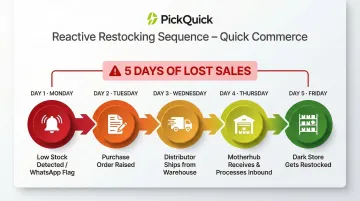
That's five days of lost sales, suppressed search rankings, and missed conversions.
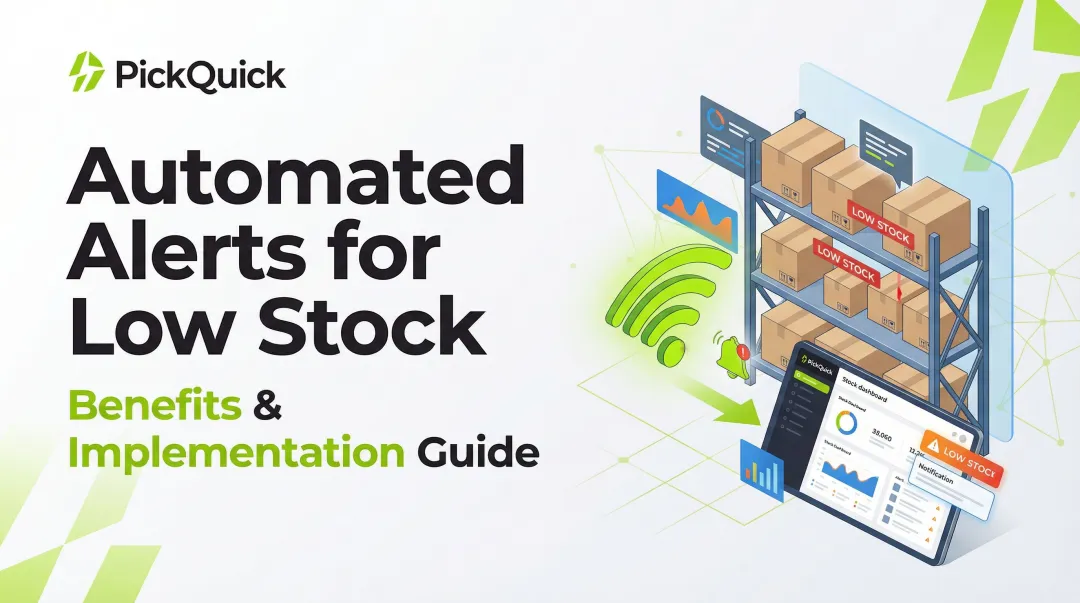
Manual WhatsApp-based coordination between brand teams and dark store operators introduces communication lag and data errors at every handoff. Automated replenishment systems replace these fragmented chains with real-time triggers that fire when inventory approaches minimum thresholds — removing the human delay that makes reactive restocking so costly.
Phantom Inventory and Data Errors
Phantom inventory occurs when the system shows stock as available but the dark store shelf is actually empty — caused by damaged goods, miscounts, or unprocessed returns. Industry estimates put Inventory Record Inaccuracy (IRI) at 50-70% of SKUs in retail at any given time.
In Quick Commerce, phantom stockouts are especially damaging. The system believes stock exists and delays reordering until the discrepancy surfaces, usually when a picker discovers empty shelves mid-order.
Disconnected systems create this problem. When brands use separate tools for ordering, tracking, and platform listings, data mismatches go undetected until a stockout is already live. A brand might see "20 units available" in their inventory management system while Blinkit's Seller Hub shows "0 units" because damaged stock was removed during dark store inwarding but never updated in the brand's records.
Seasonality and Promotional Blind Spots
Unplanned demand surges from festive campaigns, platform-led sales events, or viral product moments catch brands unprepared because their replenishment plans don't model demand uplift scenarios. Unlike traditional e-commerce where festive purchases spike weeks in advance, Quick Commerce sales spike on the exact day of the occasion — Diwali morning, New Year's Eve, regional festivals like Pongal or Onam.
This creates acute problems for regional brands launching in new cities where no local demand baseline exists. A masala brand expanding from Tamil Nadu to Karnataka can't rely on historical data to predict Bangalore's Deepavali demand when they've never operated there before.
What Happens When Stockouts Are Ignored
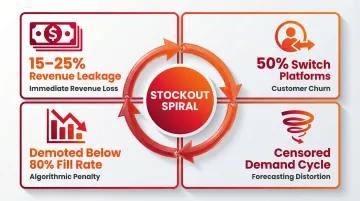
Recurring stockouts trigger compounding consequences: immediate revenue loss, platform ranking penalties with lower search visibility, fulfillment rate degradation, and gradual loss of customer loyalty — effects that are harder to recover from than the original stockout.
Immediate revenue impact: Retailers experience 5-8% sales loss when customers encounter out-of-stock situations. For FMCG brands on Quick Commerce platforms, recurring stockouts result in 15-25% revenue leakage.
Customer churn: 50% of consumers switch to another QC platform to find the same product or brand if it's unavailable, rather than waiting for replenishment. Only 5% are willing to wait. Customers who encounter unavailability repeatedly eventually stop trying — leading to permanent customer loss.
Algorithmic penalties: Blinkit actively demotes brands that drop below an 80% fill rate, suppressing ad visibility and removing listings from active pincodes entirely. The platform's ad system is inventory-led — ads only surface in pincodes where the product is physically present in the nearest dark store. If out of stock locally, ad spend is completely suppressed.
Forecasting distortion: When stockouts suppress actual sales data, the demand signal used for future planning becomes artificially low. This creates censored demand: recorded sales undercount actual customer intent because orders simply couldn't be fulfilled. Each cycle of under-ordering then feeds the next, locking brands into a self-reinforcing spiral of chronic stockouts.
Warning Signs You're About to Experience a Stockout
These early signals give teams a window to intervene before stock hits zero:
- Inventory days-on-hand shrinking faster than replenishment lead time: When high-velocity SKUs drop from 7 days of stock to 3 days but your supplier lead time is 5 days
- Gradual fill rate decline across locations: City-level aggregate stock looks adequate but individual dark stores show declining availability percentages
- Pincode-level out-of-stock flags: Platform dashboards show increasing "out of stock" markers on specific pincodes while central inventory still shows availability
- Motherhub ageing warnings: Inventory approaching expiry dates causes dark stores to automatically slow consumption, creating hidden stockout risk
How Demand Planning Software Prevents Stockouts
Stockouts in quick commerce aren't random — they follow predictable patterns that the right tools can catch before they happen. Demand planning software addresses each failure point: inaccurate forecasts, slow replenishment decisions, miscalibrated buffers, and blind spots across dark store locations.
AI-Powered Demand Forecasting
Machine learning models forecast at the SKU-pincode level, incorporating historical sales, platform promotions, seasonal events, and regional consumption patterns to catch demand shifts before they drain inventory.
Where traditional spreadsheet forecasting produces 15-40% error rates, AI-powered systems reach 5-15% — translating directly into fewer stockouts:
- Reduces stockouts by 60-80% versus manual methods
- Cuts forecast errors by 50%+ by analyzing POS data, weather, festivals, and competitor promotions
- Lowers inventory carrying costs by 20-30% through tighter ordering
- Achieves 85-92% demand accuracy at the SKU level
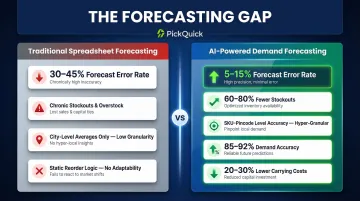
For masalas during festival season or dairy during weekend spikes, this continuous signal-updating prevents the chronic under-ordering that creates stockouts. Static reorder logic based on last month's sales simply can't respond fast enough.
Implement before entering a new city or platform, and as a baseline upgrade for any brand experiencing recurring stockout incidents. Brands at ₹25-30 lakh/month on Blinkit should treat AI forecasting as operational infrastructure, not a nice-to-have.
That forecasting accuracy only pays off when replenishment actually fires in time — which is where automated triggers take over.
Automated Replenishment with Min-Max Optimization
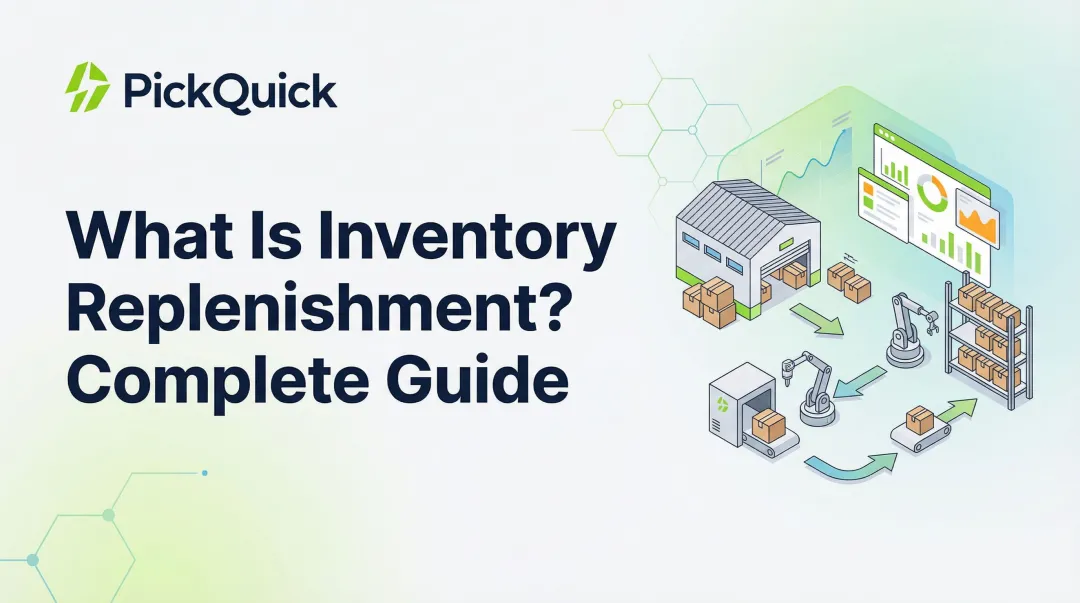
Set intelligent minimum and maximum stock thresholds for each SKU at each dark store location, then configure automated replenishment triggers that fire purchase or transfer orders when inventory approaches the minimum level.
When reorder decisions depend on someone manually reviewing a spreadsheet, stock runs out before the order gets placed. Automated replenishment acts on real-time consumption data the moment a threshold is crossed — no waiting, no missed signals.
PickQuick's dark store Min-Max optimization monitors four critical signals to adjust thresholds dynamically:
- Store-level availability percentage — the primary health indicator
- Motherhub ageing — flags slow-moving inventory before it becomes a problem
- Replenishment order discipline — tracks whether POs are placed on schedule
- Goods received note (GRN) scores — measures inbound accuracy and speed
Strong availability expands Max thresholds; poor performance shrinks them. This feedback loop keeps replenishment calibrated to actual operational reality rather than static assumptions.
Roll this out immediately for high-velocity SKUs, and make it a standard setup step when onboarding to any new QC platform or city.
Safety Stock Calibration for Dark Stores
Applying a flat buffer across all SKUs is one of the most common inventory mistakes in QC operations. Demand planning software calculates safety stock levels by SKU, accounting for supplier lead time variability, demand volatility, and platform-specific fulfillment windows.
When a delayed shipment or unexpected demand spike hits, correctly sized buffer inventory absorbs the disruption before stock hits zero. The calculation for variable demand environments uses:
Safety stock = Z × σD × sqrt(PC/T1)
where Z is the service level factor, σD is the standard deviation of demand, PC is the performance cycle (lead time), and T1 is the time increment.
For high-velocity QC fulfillment, the operating benchmarks are:
- Maintain a minimum of 15 days of inventory at current sales velocity
- Trigger replenishment POs when stock drops to 10 days of supply remaining
- Hold 20-40% buffer stock in high-velocity categories during peak periods
Recalibrate safety stock at least quarterly — and immediately after any stockout incident or new promotional campaign.
Real-Time Inventory Visibility Across Locations
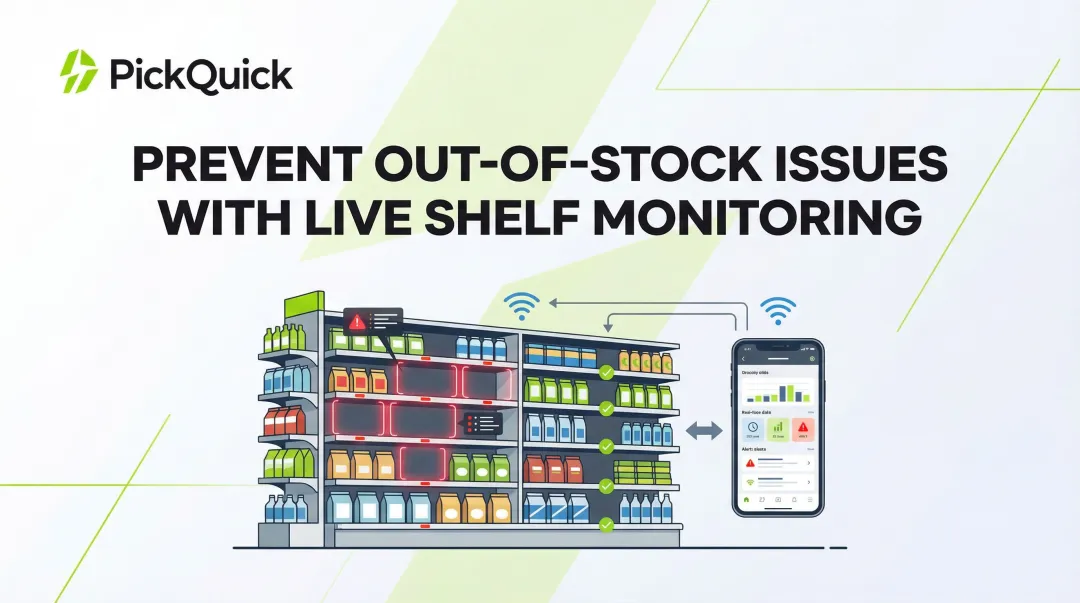
Safety stock calibration only works when teams can actually see what's in stock. Centralizing inventory data from all dark store locations onto a single dashboard — showing live stock levels, days-on-hand by SKU, and threshold alerts — eliminates the phantom inventory problem that quietly inflates apparent availability while actual shelves run dry.
Real-time synchronization across dark stores reduces stockout risk by up to 35% compared to manual tracking. Rather than waiting for end-of-day reports, supply teams can see exactly which pincodes are approaching critical levels and intervene before a live stockout affects platform metrics.
A unified control tower surfaces pincode-level data across Blinkit, Zepto, Swiggy Instamart, and JioMart simultaneously — demand signals, availability percentages, lost sales opportunities, and replenishment status in one view.
Tips for Long-Term Prevention and Control
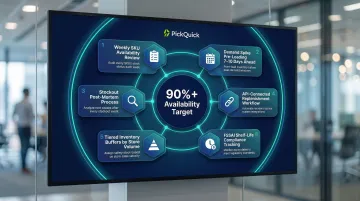
Fixing a stockout after it happens costs more than preventing it. These six practices build the operational discipline that keeps availability metrics consistently above 90%:
- Review SKU-level availability every week — compare planned vs. actual stock across all active dark stores and flag any SKU with a fill rate below 90%
- Map known demand spikes — festive periods, platform sales events, regional holidays — and pre-load extra inventory at least 7-10 days ahead
- Run a structured post-mortem on every stockout incident: document root cause, response time, and revenue impact so patterns across SKUs or locations surface quickly and get addressed
- Connect your demand planning tools to your QC operator's replenishment workflow via API — data should flow automatically, not get reconciled manually through spreadsheets
- Tier your inventory buffers by store volume: 7-day cover for Tier 1 stores (top 20%), 5-day for Tier 2 (next 30%), and 3-day cycles for the rest
- Track FSSAI shelf-life compliance as a stockout risk — Blinkit requires 90-120 days of remaining shelf life at inwarding, and batches rejected at the dark store create immediate availability gaps
Conclusion
Stockouts on Quick Commerce platforms are almost always preventable. They stem from identifiable causes — inaccurate forecasting, reactive replenishment, poor visibility, and seasonal blind spots — that demand planning software is specifically designed to solve. Brands that hold 90%+ fill rates do so through operational discipline, not superior products or stronger market demand.
Brands that invest in proactive inventory operations build a compounding advantage across availability, platform rankings, and customer retention. The tools that make this possible include:
- AI-powered forecasting that accounts for regional demand patterns
- Automated replenishment triggers tied to real dark store stock levels
- Pincode-level visibility that catches location-specific gaps before they escalate
- An operational partner with execution depth across Blinkit, Zepto, Swiggy Instamart, and JioMart
In a market where 50% of customers switch platforms after a single stockout, the brands that grow are the ones that treat availability as an operational system — not a reactive fix.
Frequently Asked Questions
How can demand planning software help prevent stockouts?
Demand planning software prevents stockouts by automating replenishment triggers from real-time consumption data, improving forecast accuracy at the SKU-pincode level through machine learning, and providing live visibility across all dark stores. This shifts inventory management from reactive to proactive, keeping replenishment ahead of depletion.
How do you plan replenishment to avoid stockouts and excess inventory?
Effective replenishment planning sets Min-Max thresholds calibrated to actual demand velocity and supplier lead times, triggering reorders automatically when stock nears its minimum. Buffers are sized to absorb demand volatility without creating overstock, balancing availability against holding costs.
What inventory management techniques and systems help prevent stockouts?
Key techniques include AI-powered demand forecasting, safety stock optimization, automated replenishment triggers, ABC/SKU classification, and real-time inventory tracking. An integrated demand planning platform ties these together by centralizing data and automating decisions across dark stores.
Why should a company avoid stockouts?
Stockouts cause immediate lost revenue, lower platform search rankings (especially on QC platforms like Blinkit and Zepto), permanent customer churn, and distorted demand data that makes future planning less accurate. For Quick Commerce brands, stockout prevention directly drives growth and profitability by maintaining algorithmic visibility and customer loyalty.
How do you optimize SKUs to reduce stockouts and overstocking?
Classify SKUs by velocity and margin using ABC analysis, then apply tighter inventory controls and higher safety stock to fast-moving critical SKUs (A-items). Use demand data to phase out or consolidate slow-movers (C-items) that tie up capital without contributing to availability, focusing resources on SKUs that drive revenue.
Is preventing stockouts the main objective of inventory control?
Preventing stockouts is a primary goal, but inventory control equally targets overstock reduction. The real objective is optimal availability at the lowest holding cost — achieved by balancing both risks through calibrated safety stock, demand forecasting, and dynamic replenishment triggers.