
Introduction
Product catalog optimization is the process of structuring, enriching, and maintaining SKU-level product data so that items appear accurately and rank prominently when shoppers search on Quick Commerce platforms like Blinkit, Zepto, Swiggy Instamart, and JioMart.
For brand managers and e-commerce leads at regional FMCG, dairy, masala, and staples brands scaling on QC, poor catalog quality directly costs search placement, availability visibility, and conversions.
In a 10-minute delivery environment, the margin for error is thin: 54% of shoppers abandon a purchase due to inconsistent product information, and 53% drop off because of incomplete titles or descriptions. Every missing field is a lost sale.
Most brands treat catalog setup as a one-time upload. On QC platforms, that's where discoverability — and revenue — quietly breaks down. This guide covers the platform-specific mechanics of catalog optimization and the exact fields most brands are getting wrong.
Key Takeaways
- Catalog optimization ensures every SKU carries complete, accurate data so it gets found — and bought
- On Blinkit, Zepto, and Swiggy Instamart, weak catalog data gets SKUs suppressed or pushed behind competitors in search
- Title, category mapping, images, attributes, and availability signals are the core fields that drive discoverability
- Brands with clean, enriched catalogs see higher search-to-conversion rates and lower return rates
- It's an ongoing process — each platform's requirements shift, and catalogs need monitoring to stay compliant
What Is Product Catalog Optimization?
Product catalog optimization is the systematic process of improving the completeness, accuracy, and structure of product data at the SKU level so that items are discoverable, correctly categorized, and compelling to purchase across quick commerce platforms like Blinkit, Zepto, and Swiggy Instamart.
Done right, every SKU appears in the right search result, with enough information to convert a shopper before they scroll past. This is distinct from inventory management (which tracks stock levels) and content marketing (which focuses on brand storytelling).
A product catalog contains:
- SKU identifiers (UPC/EAN barcodes)
- Product titles optimized for search
- Category and subcategory taxonomy
- Images (front, back, picker, barcode)
- Attributes (weight, size, variant, ingredients, shelf life)
- Pricing (MRP, selling price, landing price)
- Availability status
Each of these fields directly affects discoverability. Miss one, and your SKU drops in search ranking — or disappears entirely from filtered results.
Why SKU Discoverability Defines Your QC Sales Performance
Quick Commerce search works differently than traditional e-commerce. Shoppers on Blinkit, Zepto, and Swiggy Instamart use short, intent-heavy queries like "500g turmeric powder" and the platform's algorithm surfaces results based on catalog completeness, relevance signals, and real-time availability. Brand loyalty rarely overrides a missing attribute or a mismatched title.
The cost of poor catalog data is immediate:
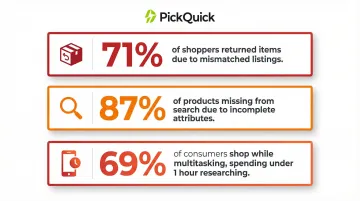
- 71% of shoppers have returned items because the product didn't match the online listing
- 87% of products qualify for an attribute but aren't returned in retailer search results due to missing data
- 69% of consumers participate in "ambient shopping" (buying while multitasking), spending less than an hour researching products
What goes wrong without proper catalog optimization:
- Titles that miss regional search patterns bury your SKU below competitors who use the right keywords
- Missing attributes ("Organic," "Vegan," "No Added Sugar") break filter results entirely
- SKUs land in incorrect categories, missing category-browse sessions completely
- Images that don't meet platform specs suppress click-through rates before a shopper even reads your title
The QC Urgency Factor
Impulse-driven, time-pressured purchases mean shoppers don't scroll past the first screen. A SKU outside the top results doesn't get a second chance in that session.
Availability signals interact directly with catalog data. A SKU that goes out of stock repeatedly gets deprioritised in platform ranking even after restocking. It typically takes 2-3 weeks to rebuild visibility after a stockout.
Poor catalog structure compounds this problem. Without clean attribute data and accurate category mapping, maintaining the replenishment cycles that protect search placement becomes significantly harder.
How Product Catalog Optimization Works on QC Platforms
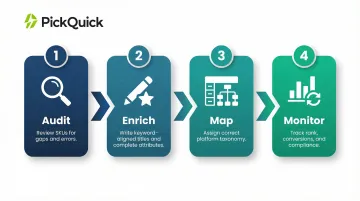
Catalog optimization follows a four-step cycle: audit, enrich, map, and monitor. Each step addresses specific gaps that prevent SKUs from ranking and converting.
Step 1: Audit Your Existing Catalog
A catalog audit reviews each SKU for missing fields, inconsistent naming, incorrect category assignments, and image quality below platform standards. For brands with 50+ SKUs across multiple QC platforms, this is where the most damaging gaps are revealed.
Common audit findings:
- Product titles copied from offline labels without search keywords
- Missing mandatory attributes (FSSAI license, shelf life, pack size)
- Category mismatches that exclude SKUs from browse sessions
- Images below 1000x1000px resolution or lacking required angles
- Barcode and MRP visibility issues that trigger inwarding rejections
Step 2: Enrich and Standardize Product Data
Enrichment means writing keyword-aligned product titles that match how shoppers search, completing all required attributes, and ensuring product images meet each platform's technical standards.
Title structure for QC:
Brand Name + Product Type + Key Variant Descriptor + Net Quantity
Example: "Goldie Rajwadi Garam Masala 100g" instead of "Product A - 100gms"
Regional phrasing differences also affect ranking. In Maharashtra, shoppers search for "atta," while other regions respond better to "wheat flour." Catalog titles need to reflect these local search patterns to capture the full demand signal.
Mandatory attributes include:
- MRP (Maximum Retail Price)
- Net weight and pack size
- Shelf life and manufacturing date
- Ingredients and allergen information
- FSSAI license number
- HSN code and GST classification
Step 3: Map to Platform Taxonomy
Each QC platform has its own category taxonomy and attribute schema. A SKU mapped to the wrong subcategory on one platform won't appear in the right filter results.
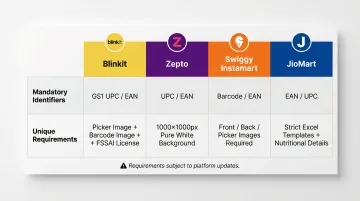
Platform-specific requirements:
| Platform | Mandatory Identifiers | Unique Catalog Requirements |
|---|---|---|
| Blinkit | GS1 UPC/EAN | Picker Image, UPC barcode image, FSSAI license image |
| Zepto | UPC/EAN | Minimum 1000x1000px images on pure white backgrounds |
| Swiggy Instamart | Barcode/EAN | Front, back, and picker-view images |
| JioMart | EAN/UPC | Strict Excel category templates, nutritional details |
A masala product listed under "Grocery Staples" instead of "Spices & Masalas" misses every category-based browse session — regardless of how well the title and attributes are optimized.
Step 4: Monitor, Test, and Maintain
Once a catalog is live, the work isn't done. Platform requirements update without notice, seasonal demand shifts change which keywords convert, and new SKU launches need the same rigor from day one — not after the first poor-performance review.
What monitoring looks like:
- Tracking search rank by SKU and keyword
- Conversion rate analysis by platform
- Availability compliance across dark stores
- GRN/DN (Goods Receipt Note/Delivery Note) scores that signal catalog accuracy
- Category placement verification after platform taxonomy updates
PickQuick's Quick Commerce Control Tower provides real-time stock and availability tracking across 10,000+ pincodes, surfacing pincode-level signals to guide replenishment and catalog adjustments before performance degrades.
Key Fields to Optimize in Your QC Product Catalog
Five fields drive 90% of catalog performance. Nail these, and your SKUs surface in search, browse, and filtered results. Miss them, and your listing quietly disappears from every relevant query.
1. Product Title
A high-performing QC product title includes brand name, product type, key variant descriptor, and net quantity in a format that mirrors how the target shopper searches.
Structure: Brand Name + Product Type + Key Attribute + Size
Example: "Vasant Kolhapuri Garam Masala 100g"
Regional phrasing differences directly affect discoverability. "Lasoon Thecha" (Maharashtrian garlic paste) performs better than "Garlic Spice Mix" in Maharashtra. Titles must include regional terms, cuisine cues, and intensity indicators.
2. Category and Subcategory Mapping
Incorrect taxonomy placement is one of the most common and costly catalog errors on QC platforms. A masala product listed under "Grocery Staples" instead of "Spices & Masalas" misses every category-based browse session and fails in filtered search results.
Why this matters:
- Platforms use category data to determine which SKUs appear in browse navigation
- Filter-based searches exclude SKUs mapped to incorrect categories
- Expansion algorithms prioritize SKUs correctly categorized within high-velocity categories
3. Product Attributes and Specifications
87% of products qualify for an attribute but aren't returned in retailer search results because the brand failed to claim the data. Incomplete attributes cause SKUs to be suppressed in faceted search filters.
Critical attributes for QC platforms:
- Pack size and unit of measure
- MRP and pricing alignment
- Ingredients and allergen information
- Shelf life (minimum 60-120 days required at inwarding)
- FSSAI license number
- HSN code and GST classification
Meeting attribute benchmarks drives a 19% sales uplift.
4. Images
QC shoppers make split-second decisions from thumbnail images. Image quality directly affects click-through rate. Meeting image count benchmarks drives a 36% sales uplift, yet 42% of users struggle to gauge product size because 28% of sites fail to provide "in-scale" images.
Platform image requirements:
- Resolution: Minimum 1000x1000px, JPEG/PNG format
- Background: Plain white background with good lighting
- Primary Image: Front of pack showing brand and product clearly
- Back of Pack: Ingredients, nutritional information, storage instructions
- Picker Image: First layer of packaging as dark store staff will see it
- Barcode Image: UPC/EAN clearly visible for warehouse scanning
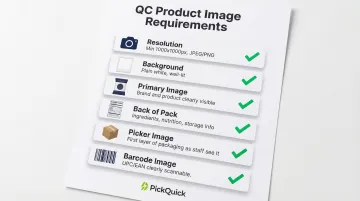
Lifestyle imagery works for brand awareness, but catalog images must be functional and scannable first.
5. Pricing and Availability Consistency
Content quality gets your SKU found. Pricing and availability compliance keeps it live.
Price discrepancies between the QC listing and offline MRP trigger inwarding rejections at the warehouse — and immediate listing suppression. Keeping prices aligned across channels isn't just good practice; it's a compliance requirement.
Availability status must be updated in near-real time. The compliance rules are straightforward:
- Match the printed MRP on physical packaging to the digital listing price exactly
- Sync availability status across all platforms before a SKU goes out of stock
- Treat stockouts as ranking events — it typically takes 2-3 weeks to rebuild visibility after inventory is replenished
Successful brands implement the 15-Day Buffer Rule: always maintain a minimum of 15 days of inventory at current sales velocity at the dark-store level.
Common Mistakes Brands Make With Catalog Optimization
Most regional brands fail at QC not because of bad products, but due to easily avoidable catalog errors.
Mistake 1: Using Vendor-Supplied Data Without Adaptation
Brands that copy-paste vendor-supplied data or lift text directly from offline product labels miss how QC shoppers actually search. The result is titles like "Product A - 500gms" instead of keyword-rich titles aligned to real category queries.
The fix: Rewrite every title using the Brand Name + Product Type + Key Attribute + Size structure, incorporating regional language variants where relevant.
Mistake 2: Treating Catalog Optimization as a Launch Task
Brands that optimize at onboarding and then leave the catalog static lose ranking steadily. Platform algorithms evolve, competitors enrich their listings, and seasonal search trends shift. Taxonomy updates can also silently misplace SKUs that were correctly mapped at launch.
The fix: Schedule quarterly catalog audits and monitor search rank, conversion rate, and availability compliance weekly.
Mistake 3: Treating All QC Platforms Identically
Brands that push the same raw catalog data to Blinkit, Zepto, and Swiggy Instamart without adapting it to each platform's schema end up with incomplete listings, broken filters, or incorrect category placements on one or more platforms.
Platform differences matter:
- Blinkit requires picker images and UPC barcode images
- Zepto demands pure white backgrounds and strict FSSAI inputs
- Swiggy Instamart requires SKU mapping to the master catalog
- JioMart uses strict Excel category templates
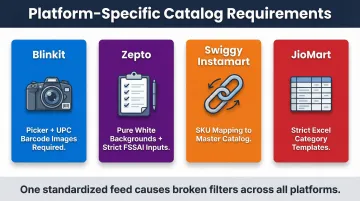
Across 25+ brands and 10,000+ pincodes, the pattern is consistent: brands that maintain platform-specific catalog builds hold ranking far longer than those running a single standardized feed.
Conclusion
Product catalog optimization is not about aesthetics—it is a core operational function that directly determines whether a SKU is discoverable, ranked, and bought on Quick Commerce platforms. Every field in the catalog from title to availability is an active lever for performance.
Regional brands with strong offline demand often underperform on QC not because of product quality or pricing, but because their catalog infrastructure doesn't match the search and discovery mechanics of platforms like Blinkit, Zepto, and Swiggy Instamart.
Closing that gap demands treating catalog management as an ongoing operational discipline, not a one-time setup. The brands that consistently get this right share a few common practices:
- Clean, keyword-rich titles and descriptions built for platform search
- Professional product images that meet platform spec requirements
- GS1-standard barcodes that prevent listing errors and compliance flags
- Consistent inventory replenishment to avoid stockout-driven rank drops
For regional brands already winning in offline GT and MT, the catalog is often the only thing standing between existing demand and QC revenue. Get that right, and the platform works for you.
Frequently Asked Questions
What is product catalog optimization?
Product catalog optimization is the process of improving the completeness, accuracy, and structure of product data at the SKU level to ensure items are discoverable, correctly categorized, and ready to convert shoppers across digital and quick commerce platforms.
What is product content optimization?
Product content optimization is a subset of catalog optimization focused specifically on the written and visual elements of a listing—titles, descriptions, images, and attributes. Brands refine these elements to match how shoppers search, compare, and buy.
What is an example of product catalog optimization?
A masala brand updates its product titles from generic label text like "Spice Mix 100g" to search-aligned titles like "Goldie Rajwadi Garam Masala 100g" and completes missing attributes like pack size and shelf life. The SKU now appears in relevant filter-based searches on Blinkit.
What are 5 key fields to optimize in a product catalog?
The five most impactful fields are: product title, category and subcategory mapping, attributes and specifications, images, and pricing or availability status. Each one directly affects whether a SKU surfaces in platform search and converts.
What is the content of a product catalog?
A product catalog contains SKU identifiers, titles, category assignments, attributes (weight, size, variant, ingredients), images, pricing, and availability status. The completeness of each field determines how a product performs in platform search, filters, and algorithmic recommendations.
Is a product catalog still relevant?
The product catalog is the foundational data layer that determines how SKUs rank in platform search, AI-driven recommendations, and filter-based navigation. On Quick Commerce platforms like Blinkit and Zepto, algorithmic ranking is the primary discovery mechanism—making catalog quality a direct revenue variable.