Introduction
Most brands entering QC assume their bestselling offline SKUs will carry over. They rarely do. A masala brand that dominates GT with a 500g family pack may find that SKU stagnating on Blinkit, while a 50g single-serve variant nobody stocks offline quietly becomes a top seller.
Quick commerce product selection is the structured process of deciding which SKUs from a brand's catalogue belong on platforms like Blinkit, Zepto, Swiggy Instamart, and JioMart — and why. This guide is built for regional and category-leading brands in India with strong offline (GT/MT) demand in dairy, masalas, staples, snacks, and personal care, who are scaling their QC presence and need a clear framework for what to list and how.
QC platforms operate under different demand logic, shelf constraints, and fulfilment economics than offline channels. Product selection is where that difference either works in your favour or against you.
Key Takeaways
- QC product selection is about choosing the right SKUs for platform constraints—not listing your entire catalogue
- Platforms prioritise high-frequency, operationally viable SKUs due to limited dark store shelf space (typically 4,000–12,000 SKUs per standard store)
- Key criteria include purchase frequency, pack size suitability, shelf life, regional demand signals, and category fit
- Selection follows a structured process: catalogue audit, demand validation, platform ops alignment, and iteration after launch
- Brands that get selection right see higher availability scores, better search-to-conversion rates, and faster revenue growth on QC
What Is the QC Product Selection Process (and Why It Differs from Regular E-commerce)?
The QC product selection process is the method by which a brand (or its QC operator) evaluates each SKU against platform-specific criteria, dark store logistics constraints, and local demand signals before submitting for listing approval. It's a filtering exercise designed to identify which products from your full catalogue will actually perform on quick commerce—not just which products you want to sell.
This differs fundamentally from regular e-commerce. On platforms like Amazon or Flipkart, brands can list thousands of SKUs without major shelf penalties. The digital shelf is elastic.
On QC platforms, dark stores stock a tightly curated assortment. Standard micro-fulfilment centres carry between 4,000 and 12,000 SKUs, though larger formats like Swiggy Instamart's Megapods can hold up to 50,000 SKUs. Every slot is competed for, and underperforming products get rotated out quickly—often within 60-90 days if velocity doesn't justify the shelf space.
The goal is a shortlisted set of SKUs built around how QC customers actually buy. That means:
- High conversion rate — products with strong search-to-purchase pull on the platform
- Replenishment feasibility — SKUs that can be stocked and restocked without disrupting dark store operations
- Urgency or impulse fit — items people reach for when they need something in 30 minutes
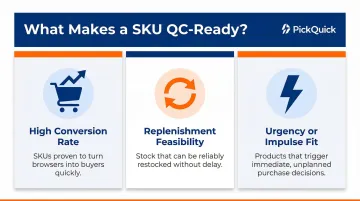
Your top offline sellers won't automatically make this list. What matters is whether a product matches the speed-driven, need-now behaviour of a QC customer.
QC Product Listing Criteria: What Platforms Actually Look For
Purchase Frequency and Demand Intensity
Platforms prioritise SKUs that are ordered frequently and consistently. According to industry research, 58% of Indian QC shoppers now use platforms for their full month's grocery needs, shifting beyond pure impulse purchases. This means platforms evaluate whether a SKU can generate stable weekly sales per dark store—not just occasional spikes.
Products that age in warehouses for 60-90 days face higher storage charges and possible delisting. Exact velocity benchmarks are proprietary, but platforms consistently assess whether a SKU can maintain rotation without tying up dark store shelf space.
Pack Size and Price Point Fit
QC customers buy for immediate or near-term consumption, not bulk stocking. This fundamentally changes which pack sizes perform. A 500g masala pack that dominates offline may underperform compared to a 50g or 100g variant on QC. ₹50-₹500 MRP is the effective range—impulse-buy territory where customers act on immediate need without budget planning.
Average Order Values are rising across platforms (Blinkit ₹660, Zepto ₹550, Swiggy Instamart ₹514), but individual SKUs still need to fit the "buy now" mindset. Smaller pack sizes aligned with daily-use quantities consistently outperform bulk or value packs designed for monthly stocking.
Shelf Life and Storage Requirements
Platforms will reject or deprioritise products with short shelf life relative to replenishment cycles. Dark stores require a minimum 30-90+ day shelf life to manage inventory turnover without constant expiry losses.
Products requiring cold chain infrastructure (2-8°C storage) face additional scrutiny. India's cold chain infrastructure faces challenges like power shortages and space constraints, so brands must assess whether their SKUs can maintain quality through dark store storage, handling, and last-mile delivery without relying on infrastructure platforms may not support consistently.
Category Affinity and Impulse/Urgency Fit
SKUs that satisfy an immediate craving, sudden household need, or are embarrassing/inconvenient to buy in-store get preferential listing treatment. In India, this translates to strong performance in:
- Dairy & beverages – daily consumption, immediate need
- Masalas & spices – cooking urgency, recipe-specific blends
- Staples – run-out scenarios, emergency top-ups
- Snacks – impulse cravings, entertainment purchases
- Personal care – urgency and convenience purchases
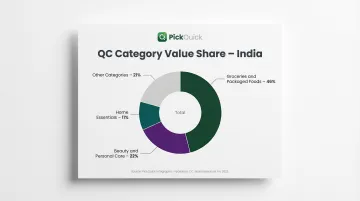
Groceries and packaged foods account for 46% of QC value share, with Beauty and Personal Care at 22% and Home Essentials at 11%. Categories that don't fit impulse or urgency logic struggle regardless of offline strength.
Regional Demand Relevance
Category fit matters, but so does geography. Platforms evaluate whether a brand's SKUs have demonstrated local demand in the specific city or pincode cluster before approving a listing. Brands with strong state-level GT/MT presence have a significant advantage—offline sales velocity is a proxy signal platforms use to assess demand potential.
Regional brands like Sweet Karam Coffee and Chitale Bandhu have doubled their sales in new states by leveraging QC as a distribution bridge for local flavours. The key is presenting credible demand data showing the SKU has proven pull in the target geography.
How the QC Product Selection Process Works: Step by Step
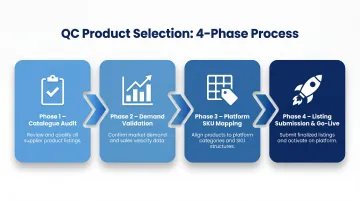
The process moves through four phases: catalogue audit → demand validation → platform-specific SKU mapping → listing submission and go-live. Each phase filters your catalogue further, ensuring only operationally viable, demand-backed SKUs reach platform shelves. (Post-live performance review is covered separately in the next section.)
Step 1: Catalogue Audit and SKU Shortlisting
The first step involves reviewing the brand's full SKU range and filtering based on listing criteria—pack size, shelf life, category fit, price point—to create a primary shortlist. For most brands, this means identifying 8-20 SKUs for an initial QC launch, not the full catalogue.
Key filters applied:
- Pack sizes matching immediate consumption patterns
- Shelf life meeting 30-90+ day minimum thresholds
- Price points within ₹50-₹500 impulse-buy range
- Category alignment with high-frequency QC purchase behaviour
- Packaging suitability for rider crates and picker handling
The goal isn't to preserve every SKU your sales team loves. Cut anything that doesn't match QC purchase logic — every SKU that passes this filter has to earn its dark store slot.
Step 2: Demand Validation Using Local and Platform Data
Shortlisted SKUs need validation against actual demand signals. This means analysing offline sales data by geography, examining search volume trends on platforms themselves, and ideally using pincode-level demand visibility to identify where each SKU is likely to generate consistent orders.
Operators like PickQuick track real-time availability and demand patterns across 10,000+ pincodes, providing visibility into which SKUs perform in which micro-markets. This granular data prevents the common mistake of launching products with strong national awareness but weak local pull in your target city.
Validation checkpoints to clear before moving forward:
- Offline GT/MT sales velocity in target city/state
- Platform search volume for product category and variants
- Pincode-level demand signals showing consistent purchase patterns
- Competitive density assessment in target dark store clusters
Step 3: Platform-Specific SKU Mapping and Documentation
Each SKU must be mapped to the correct platform category structure, with EAN/barcode validated and all required documentation prepared for submission. This includes:
- FSSAI licence and manufacturing details
- Brand authorisation letters if using distributors
- Product images (front of pack, back of pack with regulatory info, picker image, barcode image)
- MRP compliance and pricing alignment
- Catalogue details (brand name, product name, variant, pack size, dimensions, gross weight, ingredient list, HSN code, GST)
Each platform—Blinkit, Zepto, Swiggy Instamart, JioMart—has slightly different onboarding documentation requirements. Blinkit's process takes 20-22 business days through direct registration, while Zepto's ranges from 15 to 45 days depending on category review load.
Step 4: Listing Submission, Dark Store Allocation, and Go-Live
After submission, the platform's category team reviews the SKU against their current assortment gaps and demand thresholds. If approved, they allocate inventory slots across relevant dark stores and coordinate with the brand or operator for the first stock inward.
This step can stretch to weeks without an established operator relationship. Brands working with QC operators who hold existing platform relationships and operator rights can reduce go-live timelines from months to weeks — bypassing discovery, compliance verification, and vendor sourcing phases entirely.
Critical distinction: Getting platform approval doesn't mean you're live and discoverable. The SKU must be allocated to dark stores in your priority city and actually stocked before customers can order it. Many brands confuse approval with being truly live.
Key Factors That Influence QC Product Selection
Dark Store Geography and Catchment Demographics
A product popular in a Tier 1 south Indian city may have zero traction in a north Indian dark store. City-level and pincode-level assortment customisation is essential, not optional. Masala is particularly pin-code driven—regional niche blends like Maharashtra's Thecha or Tamil Nadu's Idli Podi outperform national blended SKUs like generic Chole Masala in their home markets.
Platform coverage is heavily concentrated in Delhi NCR, Mumbai, and Bengaluru, with selective expansion into Tier-2 cities. Understanding where your brand has existing offline recognition and demand pull is critical to selecting which SKUs to launch in which cities.
Platform Inventory Economics
Platforms manage Min-Max stock thresholds per SKU per dark store. If a brand cannot guarantee consistent replenishment to avoid stockouts, the SKU risks being delisted. Replenishment reliability is effectively a backdoor selection criterion that brands overlook.
Increasing sales velocity improves organic rank, while stockouts severely damage visibility. Availability is the primary driver of organic ranking on QC platforms—70% of consumers will search for an out-of-stock product on Amazon or Flipkart rather than wait for it to return.
Brands must assess whether they can maintain 95%+ availability across dark stores for each SKU. If not, that SKU shouldn't be listed yet.
Competitive Shelf Pressure
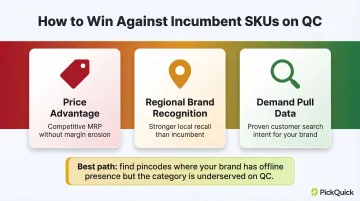
If a category already has a dominant SKU from another brand occupying that slot in a given dark store, a new entrant needs a strong differentiation signal to justify displacement. This could be:
- Price advantage (but not at the expense of margin sustainability)
- Regional brand recognition stronger than the incumbent
- Demand pull data showing customers actively search for your brand
Assess competitive density before finalising your listing SKUs. Entering a crowded national category with a me-too product rarely displaces an entrenched incumbent. The more reliable path: identify pincodes where your brand has offline recognition but the category is underserved on QC — that gap is where regional brands consistently win listings.
Common Mistakes and Misconceptions in QC Product Selection
Assuming Offline Bestsellers Will Automatically Win on QC
The most common misconception is that top offline sellers will automatically perform on QC. This is flawed because offline purchase involves browsing, touch, and planned buying, while QC is impulse and urgency-driven. The 500g family pack that dominates offline may sit unsold on QC while a 50g single-serve variant nobody stocks offline becomes your hero SKU.
Purchase intent differs sharply. Offline shoppers plan, compare, and stock up. QC shoppers need something now—for tonight's dinner, this morning's coffee, or a sudden craving. The best offline SKU may not match QC purchase intent at all.
Listing Too Many SKUs Too Early
Brands that attempt to list 50+ SKUs on launch overwhelm their replenishment capacity, dilute inventory across dark stores, and end up with low availability scores on all SKUs rather than strong scores on a few.
This fragmentation damages organic visibility and prevents the platform from expanding any SKU because none demonstrate stable performance.
A focused launch approach means starting with 8-15 high-confidence SKUs. Prioritise:
- Proven offline demand that translates to QC purchase intent
- Pack sizes matched to QC basket behaviour
- SKUs your supply chain can replenish reliably
Once these SKUs stabilise with 95%+ availability and consistent velocity, expand the assortment gradually.
Confusing "Approved for Listing" with "Truly Live"
Many brands assume platform approval means they're live and discoverable. The SKU may not be allocated to any dark store in their priority city. Being truly live on QC means the SKU is allocated to dark stores, physically stocked, and available for orders in the pincodes you're targeting.
You need visibility into dark store allocation and actual stock levels, not just approval status. Without this, you may think you're live while customers in your target city see "currently unavailable" on every search.
Frequently Asked Questions
What is quick commerce?
Quick commerce (Q-commerce) is a form of on-demand retail that promises delivery in under 30-45 minutes, fulfilled from local dark stores or micro-fulfilment centres. It is distinct from regular e-commerce in its speed, tightly curated assortment, and impulse-driven purchase model.
What is the difference between Q-commerce and e-commerce?
The three key differences are delivery speed (minutes vs. days), assortment size (tightly curated 4,000-12,000 SKUs vs. broad catalogue), and purchase intent (impulse/urgency vs. planned shopping). This is why product selection for QC demands a fundamentally different approach than traditional retail listing.
What is the product selection process?
The QC product selection process covers four key stages: catalogue audit, demand validation, platform-specific SKU mapping, and go-live coordination. The goal is to list only operationally viable, demand-backed products—not a brand's full catalogue.
How many SKUs should a brand list when starting on quick commerce?
Most brands should start with a focused set of 8-15 high-confidence SKUs rather than their full catalogue, prioritising proven demand, correct pack sizes, and strong replenishment capability. Once these stabilise with high availability and consistent velocity, expand the assortment gradually based on performance data.
What products sell best on Blinkit and Zepto?
High-frequency daily-use categories—dairy, staples, masala/spices, beverages, snacks, and personal care—perform best on Indian QC platforms. Strong regional recognition and pack sizes suited to immediate consumption (not bulk stocking) drive the highest velocity.
How long does it take to get listed on quick commerce platforms?
Direct brand outreach typically takes 4-12 weeks, covering documentation, category review, and dark store allocation. Brands working with an established QC operator—one with existing platform relationships and operator rights—can go live 3-5x faster through pre-prepared compliance and platform credibility.