Introduction
A decade ago, supply chain design in retail FMCG followed a predictable formula: centralized warehouses on city outskirts, weekly replenishment cycles, delivery measured in days, and deep inventory buffers to absorb uncertainty. Quick commerce dismantled this model entirely. Today, the defining questions are different—not whether to stock inventory, but where to position it, how fast it can move, and whether it justifies its space in the system.
Quick commerce didn't merely accelerate delivery. It forced a structural redesign of how inventory is held, how replenishment works, how last-mile delivery is treated, and how brands think about their entire upstream-to-doorstep flow. For FMCG and regional brands, understanding these shifts is no longer optional.
Blinkit's GOV doubled from ₹12,469 crore in FY24 to ₹28,273 crore in FY25, with Swiggy Instamart and Zepto posting comparable growth. This article breaks down exactly what changed — from dark store placement and replenishment cadence to last-mile economics — and what it means for brands operating in this channel.
Key Takeaways
- Quick commerce replaced centralized warehousing with hyperlocal dark stores within 2-3 km of consumers
- Inventory philosophy shifted from "stock deep and forecast broadly" to "stock lean and replenish frequently"
- Pincode-level demand data — not weekly sales reports — now drives assortment and replenishment decisions
- Last-mile delivery is no longer a cost problem to minimize — it's the core customer promise
- Regional FMCG brands that don't adapt face stock-outs, platform ranking drops, and direct revenue loss
How Quick Commerce Flipped Traditional Supply Chain Logic
The Old Model: Centralized and Forecast-Led
Traditional FMCG supply chains ran on extended timelines and deep inventory buffers. Retailer holding periods averaged 14 days, with distributor replenishment cycles every 8.5 days. General Trade retailers were serviced weekly or fortnightly.
Warehouses ranging from 10,000 to 100,000+ sq ft sat in industrial zones, shipping to stores on 1–7 day SLAs.
The assumption: deeper stock buffers and longer lead times could absorb demand uncertainty. Scale was the organizing principle — not speed.
The Inversion: Speed Replaced Scale
Quick commerce introduced a fundamental inversion. Speed became the organizing principle. Inventory transformed into a perishable, live asset—if it doesn't move quickly, it doesn't justify space. The old "stock more to be safe" logic broke when dark stores started running on thin buffers with multiple daily restocks.
Consumer Expectations Accelerated the Shift
Post-COVID urban consumers began benchmarking all delivery experiences against the fastest option available, not the category standard. A 2024 survey found that 76% of online grocery buyers are interested in 10-minute delivery, up from 57% in 2021. The launch of sub-30-minute delivery signaled that speed is no longer premium—it's the baseline.
Upstream Pressure on FMCG Supply Chains
That consumer shift forced FMCG majors to rethink urban replenishment cycles entirely. Daily or alternate-day restocks became inadequate almost immediately. Dark stores running lean inventory in high-density zones needed multiple replenishments per day. The old rhythm of weekly forecasting and bulk shipments couldn't hold.
The Core Mindset Shift: From Predict to Respond
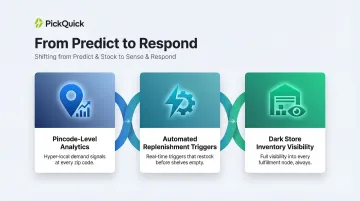
Supply chain strategy moved from "predict and stock" to "sense and respond." Real-time demand signals at the hyperlocal level—not quarterly forecasts—now drive decisions. This demands entirely new capabilities:
- Pincode-level analytics to track demand at a neighbourhood scale
- Automated replenishment triggers replacing manual ordering cycles
- Dark store-level inventory visibility to prevent stockouts before they surface
Dark Stores and Decentralized Fulfillment: The New Infrastructure
A dark store is a compact fulfillment center with no walk-in shoppers, positioned within a 2-3 km radius of residential clusters. Unlike traditional warehouses on city peripheries built for bulk storage, dark stores are built for rapid picking and immediate dispatch.
How Dark Stores Redesigned the Fulfillment Model
The operational design prioritizes speed at every step:
- Tight picking layouts reduce picker walk time to seconds
- Minimal handling steps from shelf to rider handoff
- Orders picked and packed in under 2 minutes using optimized pathways
Zepto employs Pick-to-Light systems that reduce average picking time for a 5-item basket to less than 120 seconds. Blinkit's store tech packs products in under two minutes through smart pick-path optimization. In quick commerce, last-mile delivery is the core product experience — not a phase to optimize later.
SKU Compression and Velocity Filtering
Dark stores carry 2,000-4,000 fast-moving items compared to tens of thousands in traditional warehouses. Recent expansions into "Megapods" have pushed this to 10,000-12,000 sq ft facilities capable of housing 45,000-50,000 SKUs, but the assortment logic remains velocity-driven.
Products that don't turn quickly are removed. Assortment is driven by:
- Purchase frequency
- Impulse relevance
- Local demand patterns
That velocity logic shapes not just what gets stocked, but where. To serve demand within minutes, platforms replaced large central warehouses with many smaller micro-fulfillment nodes spread across cities.
The Shift to Decentralized Networks
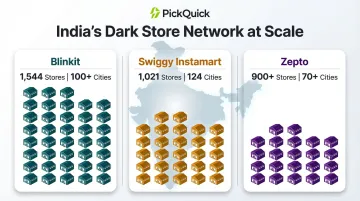
Blinkit operates 1,544 dark stores across 100+ cities, with plans to reach 2,000 by December 2025. Swiggy Instamart manages 1,021 stores across 124 cities, while Zepto operates 900+ stores in 70+ cities.
This decentralization created a new middle-mile requirement: replenishing dark stores from regional hubs on tight, predictable cycles. Brands that rely on traditional distributor-push models find this cadence difficult to meet without a dedicated QC operations layer.
The Brand Implication
Winning on QC platforms isn't just about listing products. It's about ensuring those products are in the right dark store, at the right time, in the right quantity.
Availability at the dark store level directly determines platform search ranking and conversion. A brand with 85% city-level availability may have 0% availability in specific high-demand pincodes—representing real lost revenue.
Leaner Inventory, Smarter Replenishment
Traditional retail tied up capital in deep stock, measured in weeks of cover. Quick commerce flips that logic entirely—lean buffers, high velocity, and a KPI shift from "how much is in the warehouse" to "how fast is inventory turning, and how close are we to zero stock-outs."
Min-Max Optimization and Real-Time Replenishment
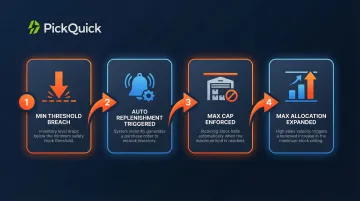
Every SKU in a dark store has a minimum threshold (below which replenishment triggers automatically) and a maximum level (to avoid overstocking limited shelf space). Getting these numbers right at the pincode level is critical—miscalibration leads to stock-outs or wastage.
How Min-Max Works in Practice:
- Min triggers automatic replenishment orders when inventory drops below threshold
- Max prevents overstocking in limited dark store space
- Performance metrics (availability, velocity, clean GRNs) determine Max expansion
- Strong performers see Max limits increase, enabling greater inventory allocation
Traditional weekly or monthly audits are incompatible with QC's pace. Brands and operators need live inventory visibility across all dark store locations, with auto-replenishment signals and dynamic stock transfers between nodes. Inventory replenishment in stores occurs multiple times daily, not weekly.
Demand Prediction at the Hyperlocal Level
QC platforms analyze demand by locality, time of day, day of week, and consumption behavior—not city-wide. A product that sells in one neighbourhood may sit unsold 3 km away.
Blinkit uses neighborhood-level data on product searches and purchase patterns to drive assortment localization. Zepto launched "Zepto Atom," a subscription-based analytics platform providing brands with pincode-wise market share data and minute-by-minute sales insights.
For brands accustomed to city-level or regional forecasting, this means building pincode-level demand models, real-time SKU tracking, and the operational muscle to act on those signals—fast.
The Technology Stack Powering QC Supply Chains
AI and Predictive Analytics
QC supply chains rely on AI to forecast demand at the SKU level for individual dark stores, trigger replenishment signals, and optimize stock placement. Zepto uses self-learning algorithms that automatically adjust parameters based on historical trends and error rates.
Modern WMS platforms use AI-led inventory planning to predict demand spikes driven by weather, time of day, or local events. These systems can reduce stockout risk by up to 35% compared to manual forecasting.
Real-Time Tracking and IoT
RFID tagging, automated storage systems, and GPS-enabled route optimization allow platforms to track every item from supplier dispatch to customer doorstep. That end-to-end visibility is what makes 10-30 minute delivery windows operationally feasible at scale.
To accelerate picking speed, Zepto has invested in physical automation across its dark stores:
- ASRS (Automated Storage and Retrieval Systems) for high-density inventory access
- Linear sorters to route items rapidly across picking zones
- Put-to-light machines to guide pickers with minimal cognitive load
Route Optimization and Last-Mile Tech
AI-driven delivery zone planning, real-time rider allocation, and continuously recalculated routes reduce the time between order placement and dispatch handoff. Swiggy Instamart achieves an average delivery time of approximately 12.6 minutes.
EV adoption is growing rapidly across the sector. Key milestones as of 2024:
- Blinkit reached 27,884 active EV delivery partners by March 2024, targeting 100% EV by 2030
- Swiggy scaled its EV fleet to 7,500 active electric vehicles in 2024
What This Supply Chain Shift Means for FMCG and Regional Brands
Upstream Impact on FMCG Brands
FMCG brands currently derive 30-60% of their online sales from Quick Commerce platforms. This channel shift is forcing adaptations in SKU sizing, packaging formats, and production planning.
Products increasingly need to be designed for:
- Faster consumption cycles
- Easier picking (clear labeling, scannable barcodes)
- Quicker replenishment (smaller pack sizes, shelf-stable formats)
These product-level changes expose a deeper problem: traditional GT/MT supply chain setups weren't built for QC's speed requirements. To bypass 2-4 day replenishment cycles that cause stock-outs, FMCG majors like HUL are piloting direct-to-kirana and direct-to-QC distribution models, absorbing warehousing costs to ensure continuous availability.
The Regional Brand Challenge
Regional brands scaling to multi-city QC face operational complexity that most aren't staffed to handle internally. Managing replenishment across Blinkit, Zepto, Swiggy Instamart, and JioMart—each with different dark store networks and assortment logics—creates compounding coordination challenges:
- Platform-specific Min-Max calibration
- Different replenishment cycle timings
- Varying compliance and packaging requirements
- Separate catalog and SKU mapping standards
These failures compound quickly. A stock-out on one platform signals poor operational discipline, dragging down rankings and visibility across all of them simultaneously. Brands with strong offline demand but weak QC infrastructure cede platform share to competitors who show up consistently.
The Operator Model Solution
Leading regional brands are bridging this gap by working with dedicated QC operators. PickQuick, for instance, manages the full operational scope across 10,000+ pincodes and all major platforms for 25+ category-leading brands, handling:
- Replenishment scheduling and Min-Max calibration
- Dark store-level inventory tracking
- Platform compliance and catalog management
- Multi-platform coordination across Blinkit, Zepto, Swiggy Instamart, and JioMart
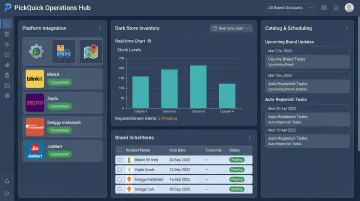
This lets brands go live across QC platforms in weeks rather than months — without hiring a dedicated in-house operations team.
Frequently Asked Questions
How does the quick commerce supply chain work?
QC supply chains are built around hyperlocal dark stores stocked with fast-moving SKUs, positioned within 2-3 km of customers. Orders are picked and packed in minutes, riders dispatch immediately, and inventory is replenished multiple times daily using real-time demand data.
What are examples of quick commerce?
Key QC platforms in India include Blinkit (10-minute grocery delivery), Zepto (groceries and essentials), and Swiggy Instamart. They cover groceries, FMCG, fresh produce, personal care, and electronics accessories with sub-30-minute delivery promises.
How is quick commerce different from traditional e-commerce supply chains?
Traditional e-commerce relies on centralized warehousing and multi-day delivery windows. QC operates through decentralized dark store networks, lean SKU assortments (2,000-50,000 products), and sub-30-minute delivery driven by hyperlocal inventory placement within residential neighborhoods.
What is a dark store in quick commerce?
A dark store is a small, closed fulfillment center (no public access) located within a residential area, stocking 2,000-50,000 fast-moving products. It's designed specifically for rapid picking and dispatch rather than retail shopping, with layouts optimized for sub-2-minute order preparation.
How do FMCG brands adapt their supply chain for quick commerce?
FMCG brands shift from periodic replenishment to multiple daily restocks, adjust SKU pack formats for fast picking, and maintain real-time inventory visibility across platform dark stores. Most also bypass traditional distributor networks in favor of direct-to-QC distribution models.
What are the biggest supply chain challenges in quick commerce?
Stock-outs, replenishment velocity, and unit economics are the toughest pressures in QC supply chains. Brands must hold lean inventory buffers across decentralized dark stores while absorbing the high infrastructure and last-mile costs that speed demands.