Introduction
Modern businesses manage hundreds of suppliers across procurement, logistics, and retail channels—yet many still rely on email chains, spreadsheets, and fragmented workflows to onboard them. This manual approach creates delays, errors, and compliance gaps that cost organizations an average of 14-21 days and up to $35,000 per supplier (global benchmark), according to Forrester's Total Economic Impact research.
Despite the availability of advanced automation tools, 47-61% of organizations still use spreadsheets for supplier data management, exposing themselves to regulatory risks and audit failures that compound over time.
What follows is a practical breakdown of what supplier onboarding software actually does, how to evaluate platforms in 2026, and why Quick Commerce onboarding in India operates by a different set of rules entirely.
TLDR:
- Automation cuts onboarding from 14-21 days (up to $35,000/supplier) down to 1-5 days and under $2,500
- Spreadsheet-dependent organizations face compounding compliance gaps — and most haven't switched yet
- Essential features include self-service portals, automated compliance checks, configurable workflows, and ERP integration
- Top platforms in 2026: HighRadius, SAP Ariba, Coupa, Gatekeeper, HICX, Precoro, and Zycus
- Quick Commerce onboarding in India requires specialized operators to handle platform compliance and city-level assortment at speed
What Is Supplier Onboarding Software?
Supplier onboarding software is a digital platform that manages the end-to-end process of registering, verifying, and activating new suppliers. It covers everything from document collection and compliance checks to approval workflows and ERP integration, replacing what was traditionally a manual, fragmented process.
Core capabilities typically include:
- Document collection and validation
- Tax ID and banking verification
- Compliance screening (sanctions, ESG, financial risk)
- Multi-step approval routing
- Two-way ERP synchronization
- Audit trail creation
One common point of confusion: supplier onboarding software is distinct from vendor management software. Onboarding handles the initial setup — getting a supplier registered, verified, and activated in your systems. Vendor management picks up from there, covering performance monitoring, contract management, risk assessment, and ongoing relationship maintenance.
Accounts Payable (AP), procurement, and supply chain teams are the primary users. In this context, "supplier" covers any external partner being integrated into a business's operations — from raw material vendors to retail distributors.
Common Challenges in Supplier Onboarding
Manual, Fragmented Processes
Organizations relying on email chains, shared drives, and spreadsheets face:
- Inconsistent data collection
- Long approval cycles
- High risk of human error
- Duplicate vendor records
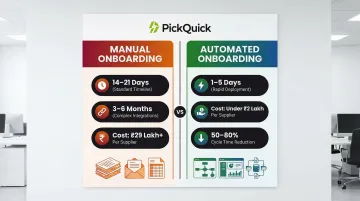
Manual onboarding takes an average of 14-21 days for standard suppliers and can stretch to 3-6 months for complex integrations. In contrast, automated platforms reduce cycle times by 50-80%, compressing onboarding to 1-5 days and cutting per-supplier costs from over ₹29 lakh to under ₹2 lakh.
Inconsistent Compliance Tracking
When procurement teams use different tools for financial risk screening, ESG certification, sanctions checks, and tax validation, compliance becomes siloed and difficult to audit. This fragmentation creates real-world consequences:
- Regulatory fines: Fragmented compliance tracking exposes organizations to penalties under GST, FSSAI, and trade compliance frameworks — particularly when documentation gaps surface during audits rather than at onboarding.
- Failed audits: Incomplete or inconsistent records make audit preparation painful and expose organizations to penalties.
- Reputational damage: Compliance failures can damage brand credibility and supplier trust.
Poor Supplier Experience
Compliance breakdowns don't just create internal exposure — they ripple outward. A confusing onboarding process damages supplier relationships from the start. Vendors who encounter:
- Repeated follow-ups for missing information
- Unclear document requirements
- Long wait times without status updates
...tend to deprioritize that business or slow their response times. In competitive supplier markets, a smooth onboarding process is often what determines whether a preferred vendor stays engaged or shifts attention elsewhere.
Scalability Bottlenecks
What works for 50 suppliers doesn't scale to 500+. As organizations expand across geographies, product lines, or sales channels, manual processes break down. Teams need city-level or category-level segmentation, multi-currency support, and regional compliance tracking—capabilities that spreadsheets simply cannot provide at scale.
Must-Have Features in Supplier Onboarding Platforms
Self-Service Supplier Portal
This is the foundation of any modern onboarding platform. Suppliers should be able to:
- Submit documents and certifications
- Update their profiles in real time
- Track approval status
- Receive automated reminders
A self-service portal reduces back-and-forth emails, accelerates data collection, and improves supplier satisfaction by providing transparency and control.
Automated Compliance and Document Verification
Platforms should automatically validate:
- Tax IDs (GST, PAN, W-9, etc.)
- Banking details
- Insurance certificates
- Regulatory documentation
Validation occurs against internal policies and external databases, including sanctions screening. Automated compliance checks create audit trails that simplify regulatory reporting and reduce the risk of penalties.
Critical compliance features:
- Real-time sanctions and watchlist screening
- Automated expiry tracking for certifications
- Configurable compliance rules by supplier tier or region
- Audit-ready documentation repositories
Configurable Approval Workflows
Different suppliers require different approval paths based on:
- Risk tier (low, medium, high)
- Category (raw materials, services, logistics)
- Region (domestic, international)
- Contract value
Look for platforms that allow multi-step routing with conditional logic—without requiring IT support to configure. High-risk suppliers receive appropriate scrutiny while low-risk vendors move through quickly.
ERP and Procurement System Integration
These workflows only hold value if supplier data flows directly into your ERP. Without two-way sync with systems like SAP, Oracle, NetSuite, or Microsoft Dynamics, manual re-entry causes:
- Duplicate vendor master records
- Split spend across multiple records
- Missed volume discounts
- Duplicate payments
- Incorrect tax IDs and banking information
According to McKinsey, 82% of organisations spend one or more days per week resolving master data quality issues caused by poor integration and manual processes.
Real-Time Tracking and Dashboard Visibility
Procurement teams need a single view of onboarding status across all suppliers—from pending documents to final approval. Real-time dashboards provide:
- At-a-glance status updates
- Bottleneck identification
- Faster audit preparation
- Performance metrics (average onboarding time, approval cycle length, compliance pass rates)
This visibility prevents delays from going undetected and enables proactive management of the onboarding pipeline.
Top Supplier Onboarding Tools to Know in 2026
These platforms cover a range of use cases — from enterprise procurement to SMB-friendly portals. Use the breakdowns below to match each tool against your team's size, existing tech stack, and compliance requirements.
HighRadius
HighRadius targets mid-to-enterprise AP teams with AI-powered onboarding, automated KYC/KYB verification, and self-service supplier portals. The platform claims a 90% reduction in onboarding time and integrates natively with SAP, Oracle, and NetSuite.
- Automated KYC/KYB verification out of the box
- Strong ERP integrations (SAP, Oracle, NetSuite)
- Outcome-based pricing model (contact for quote)
G2 Rating: 4.3/5 (232 reviews)
SAP Ariba
SAP Ariba routes supplier onboarding through the SAP Business Network, where suppliers self-manage their profiles and compliance documents. It's the natural fit for organizations already running SAP infrastructure — the integration is tight and the workflow is familiar.
- Automated onboarding workflows with integrated risk monitoring
- Suppliers access and update their own data directly
- Best for: Large enterprises on SAP ecosystems
Pricing: No public pricing
G2 Rating: 4.1/5 (746 reviews)
Coupa
Coupa centralizes supplier data, built-in compliance checks, and spend management under one roof. For procurement teams wanting a unified source-to-pay platform, continuous risk monitoring and multi-domain risk assessments are included natively.
Pricing: Free tier available; Verified: $549/year; Premium Support: $499+/year
G2 Rating: 4.2/5 (561 reviews)
Gatekeeper
Where most platforms lead with procurement, Gatekeeper leads with contracts. Its AI Autobuild™ and Kanban workflow engine handles onboarding alongside contract lifecycle management — and the platform reports up to 90% faster third-party onboarding and compliance checks. Best for teams where contract compliance is the primary bottleneck.
Pricing: Essentials, Pro, Enterprise, and Enterprise Custom tiers
G2 Rating: 4.5/5 (90 reviews)
Other Notable Platforms
| Platform | Best For | Pricing | G2 Rating |
|---|---|---|---|
| HICX | Supplier master data governance; "single front door" for all suppliers | Contact for pricing | 3.5/5 (1 review) |
| Precoro | SMBs needing simpler workflows and a supplier portal | From $499/month | 4.7/5 (194 reviews) |
| Zycus | AI-powered source-to-pay with embedded onboarding via Zycus Supplier Network | Contact for pricing | 3.6/5 (13 reviews) |
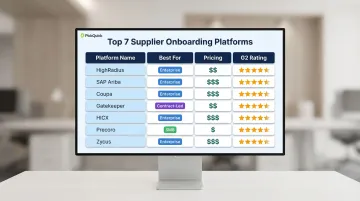
Most enterprise platforms price on request, with costs varying by organization size and module selection.
How to Choose the Right Supplier Onboarding Solution
Start with Your Operational Reality
Before evaluating platforms, identify where your current process breaks down:
- Slow approvals holding up procurement cycles
- Compliance gaps creating audit exposure
- Inconsistent or incomplete supplier data
- Missing ERP integration forcing manual workarounds
Each problem points to a different solution. Compliance-heavy operations need automated verification and full audit trails. High-volume or multi-region teams should prioritize configurability and geographic scalability.
Evaluate Integration Depth and Scalability
A platform is only as good as its ability to sync with the tools already in use. Check:
- Which ERP and procurement systems are natively supported
- Whether integration requires middleware or custom development
- How the platform handles data mapping and field customization
- Whether it can scale with increasing supplier volumes or geographic expansion
Poor integration feeds directly into master data problems — one industry survey found 82% of organizations spend days per week resolving data quality issues caused by disconnected systems.
Weigh the Total Cost of Ownership
Beyond licensing fees, account for:
- Implementation costs
- Onboarding fees (for your team and suppliers)
- Training time
- Ongoing support costs
Some platforms charge per supplier or per module — costs that compound as operations grow. Request itemized pricing before committing, and build your ROI case around time saved, error reduction, and compliance risk avoided.
Quick Commerce Onboarding: A Different Kind of Supplier Challenge
For brands entering Quick Commerce channels—platforms like Blinkit, Zepto, Swiggy Instamart, and JioMart in India—the onboarding challenge is fundamentally different from traditional procurement onboarding.
QC onboarding goes well beyond documents and tax forms. It requires:
- City-level assortment readiness
- Dark store replenishment setup
- Pincode-level demand planning
- Platform-specific catalog and pricing compliance
- Packaging and barcode validation
- FSSAI licensing and GST registration (APOB/VPOB) per state
Why Regional Brands Struggle with DIY QC Onboarding
Regional brands that try to navigate QC onboarding independently often face:
- Blinkit onboarding alone takes 20-45 days without operator support, per Unicommerce's 2026 seller guide
- Each platform runs separate compliance, catalog, and replenishment processes — multiplying the coordination burden
- Stockouts and replenishment failures block expansion to additional dark stores, stalling growth
India's Quick Commerce market reached $6-7 billion USD in GMV in 2024 and is projected to grow at a 40% CAGR through 2030, according to Bain & Company's 2025 report. FMCG brands report that 30-60% of their online sales are now driven by Quick Commerce, making QC onboarding a strategic priority.
The Managed Operator Model
Given that scale, managing QC onboarding manually isn't viable for most regional brands. Some instead partner with a dedicated QC operator. PickQuick operates this way—managing the full onboarding-to-growth engine for regional brands across Blinkit, Zepto, Swiggy Instamart, and JioMart.
PickQuick handles:
- Complete packaging and compliance readiness
- Barcode and GS1 certification
- Professional product imaging
- Catalog creation across all platforms
- Seller Hub setup and Min-Max inventory planning
- Dark store replenishment and real-time availability tracking
- Multi-city expansion management
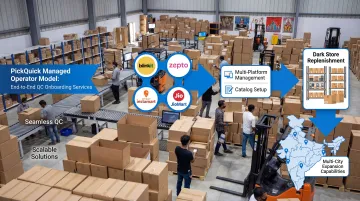
Brands typically go live across QC platforms 3-5x faster than through traditional onboarding—measured in weeks, not months. For category-leading regional brands with ₹5-7 crore/month+ in offline demand, that speed translates directly into captured revenue before competitors establish a foothold in the same dark stores.
Frequently Asked Questions
How do you verify a vendor?
Vendor verification typically involves validating business registration documents, tax IDs (GST, PAN), banking details, insurance certificates, and conducting sanctions screening. This can be done manually or through automated compliance checks built into onboarding software that cross-reference external databases in real time.
What are the 5 C's of onboarding?
The 5 C's are Compliance, Credibility, Capability, Capacity, and Communication. Together, they cover regulatory adherence, financial stability, operational competence, volume capacity, and supplier responsiveness — giving procurement teams a structured way to evaluate readiness before activation.
What is the difference between supplier onboarding and vendor management?
Supplier onboarding is the initial setup process: collecting documents, running checks, and activating the supplier in your systems. Vendor management is the ongoing function of monitoring performance, managing contracts, assessing risk, and maintaining the relationship over time.
How long does supplier onboarding typically take?
Manual onboarding can take 14-21 days for standard suppliers and 3-6 months for complex integrations. Automated platforms reduce this to 1-5 days depending on the supplier's responsiveness and the complexity of compliance requirements.
What documents are typically required for supplier onboarding?
Key documents include business registration or licenses, tax identification (GST/PAN), banking details, insurance certificates, relevant industry certifications, and signed contractual agreements. Regulated sectors like food and pharma often require additional compliance certificates such as FSSAI or ISO.
Can supplier onboarding be fully automated?
Most onboarding platforms can automate document collection, data validation, compliance checks, and approval routing. However, complex risk assessments, contract negotiations, or high-value supplier evaluations still benefit from human review.