Introduction
Quick Commerce platforms like Blinkit, Zepto, and Swiggy Instamart have fundamentally changed how consumers discover and buy everyday products in India. With the sector generating $6–7 billion in GMV in 2024 and capturing over two-thirds of all e-grocery orders, winning on these platforms requires more than just getting listed.
Most brands focus heavily on distribution and pricing. The brands actually driving consistent QC sales share one critical advantage: optimized product listings that the platform algorithm favours and shoppers can act on instantly.
In a market where purchase decisions compress to mere seconds per product, listing quality isn't a cosmetic concern. It's operational infrastructure — as foundational as pricing or distribution.
This guide covers why product listing optimization matters on Quick Commerce platforms in India, what it directly affects — visibility, conversion, and ranking — and which gaps are quietly costing brands sales right now.
Key Takeaways
- Product listing optimization ensures algorithms and shoppers instantly understand what you're selling — and why to buy it
- Shoppers on Blinkit and Zepto decide in under 10 seconds, making listing clarity directly tied to conversion rates
- Poor listings trigger lower search rankings, higher bounce rates, and algorithmic de-prioritization
- Optimization impacts both organic ranking and paid ad performance on Blinkit and Zepto
- It's not a one-time setup—listings need quarterly reviews based on platform changes and performance data
What Is Product Listing Optimization on Quick Commerce?
Product listing optimization is the systematic process of improving every visible and backend element of a product's page on a QC platform. This includes:
- Product title and description
- Images and pack size details
- Keywords and category tags
- Backend attributes specific to each platform
All of these are refined to maximize search visibility and shopper conversion.
Quick Commerce platforms have their own algorithms, consumer behaviour patterns, and display formats. Blinkit, Zepto, Swiggy Instamart, and JioMart each require platform-specific strategies. What works on Amazon doesn't automatically translate to a dark-store-powered 10-minute delivery app.
At its core, listing optimization is about making sure a shopper searching for your product can find it, understand it instantly, and add it to cart — without hesitation.
Key Advantages of Product Listing Optimization
The advantages below are operational and measurable. Each connects to trackable metrics: impressions, conversion rate, CTR, ranking position, return rate, and availability score. Brands that optimize consistently pull ahead of those that treat listing setup as a one-time task — and the gap widens over time.
Higher Search Visibility and Discoverability on QC Platforms
Optimized listings—with correctly structured titles, relevant category tags, and keyword-rich descriptions—rank higher in platform search results, making products visible to more relevant shoppers.
How it works in practice:
QC platform algorithms index product titles and descriptions to match user search queries. A listing titled "Atta 5kg" will underperform against "Whole Wheat Atta 5kg | Chakki Fresh | High Fibre" because the latter matches more specific search intents.
Why this matters:
- Most QC users search with functional, specific terms ("chakki atta," "masala for biryani," "paneer 200g")
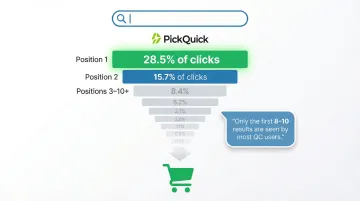
- Listings matching these terms closely appear in the first 8-10 results—the only ones most users see
- The first organic search result captures 28.5% of clicks, dropping to 15.7% for second position
- A brand invisible in search won't get orders — even if the dark store is fully stocked
KPIs impacted:
- Search impressions
- Click-through rate (CTR)
- Organic ranking position
- Share of search within category
When this advantage matters most:
Critical when a brand is new to a QC platform with no sales history, or when launching into a new city where brand awareness is low.
Improved Conversion Rate and Impulse Purchase Capture
A listing with high-quality images, clear pack size, accurate pricing, and concise description converts browsers into buyers—especially on QC where impulse purchases dominate.
How it works in practice:
QC shoppers are mid-task (grocery refills, snack cravings, last-minute cooking needs) and evaluate products in seconds. A listing that communicates pack size, variant, price, and key feature in the first visual glance removes friction and captures the add-to-cart decision before doubt sets in.
Why this matters:
- Incomplete listings—missing weight, unclear variants, low-resolution images—cause shoppers to skip products entirely
- 71% of shoppers have returned items due to incorrect product content
- Listings with more images convert at a higher rate 53% of the time
- Every unconverted impression wastes ad spend if the brand is running sponsored placements
KPIs impacted:
- Conversion rate (orders per impression)
- Add-to-cart rate
- Return rate
- Cost per acquisition on sponsored listings
When this advantage matters most:
In high-competition categories — masalas, dairy, snacks, staples — multiple brands appear in the same results and shoppers decide in a split second. Listing quality is often the only differentiator.
Sustained Ranking Stability Through Availability and Engagement Signals
QC algorithms factor in listing content plus performance signals—add-to-cart rate, purchase rate, and critically, product availability. Optimized listings that stay in stock and consistently generate engagement maintain stable or improving ranking positions over time.
On Blinkit and Zepto, a listing that goes out of stock is suppressed or removed from search results entirely. Brands with well-optimized listings that also maintain healthy Min-Max replenishment levels sustain their ranking even through demand spikes. Poor listings or inconsistent stock create a visibility cycle that's costly to recover from.
Why ranking stability matters:
- Ranking on QC isn't static — it degrades when engagement signals drop
- A listing that consistently converts signals relevance, and the algorithm surfaces it more frequently
- Stockouts trigger algorithmic demotion and require 2-3 weeks to rebuild visibility after replenishment
- Brands building ranking stability through sustained listing quality don't need to rely entirely on paid ads
KPIs impacted:
- Availability score
- Ranking consistency over time
- Organic impressions
- Sponsored ad quality score
- Repeat purchase rate
When this advantage matters most:
For high-frequency SKUs — dairy, atta, masalas, daily snacks — demand is steady and predictable. Any drop in availability or listing quality hands that demand directly to a competitor.
What Happens When Product Listing Optimization Is Missing or Ignored
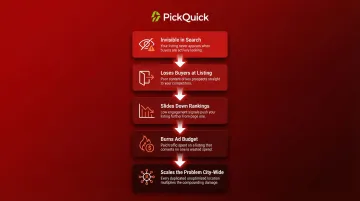
On quick commerce platforms, an unmanaged listing doesn't just underperform — it actively decays. Unlike traditional e-commerce, Blinkit and Zepto surface results within seconds of a search, which means poor optimization creates compounding losses that are slow and costly to reverse:
- Fails to surface in search results when your title and keywords don't match how shoppers actually type their queries — so the product is live but effectively invisible
- Loses buyers at the listing itself when pack weight, MRP, or ingredient details are missing, sending high-intent shoppers straight to a competitor
- Slides down the rankings as low engagement signals train the algorithm to de-prioritize the listing, making recovery slow and expensive
- Burns ad budget when sponsored placements on Blinkit or Zepto drive clicks to a listing that doesn't convert, pushing cost per order well above target
- Creates a flawed rollout template when the same unoptimized listing gets replicated across new cities and dark stores, scaling the problem rather than the brand
How to Get the Most Value from Product Listing Optimization
Product listing optimization works best as an ongoing operational discipline — something you revisit regularly, not just at launch.
Start with the fundamentals:
- Ensure every listing has a structured title (brand + product type + key attribute + pack size)
- Include at least 3 high-resolution images: pack front, back, and in-use shot
- Write an accurate description that mirrors how the target shopper searches for the product
Review and refresh based on performance data:
- Regularly audit CTR, conversion rate, and ranking position by SKU
- If a listing gets impressions but doesn't convert, the issue is likely the image or description
- If it's not getting impressions, the issue is the title or keyword structure
For brands scaling across Blinkit, Zepto, and Swiggy Instamart in multiple cities:
Managing listing quality across platforms gets complex fast — each platform has its own ranking logic, image specs, and keyword behavior. At this stage, the diagnostic process above needs to run city by city and SKU by SKU, not just at the catalog level.
This is where operators like PickQuick add practical value. Rather than managing listing optimization in isolation, they handle it as part of full platform operations — covering replenishment, availability, and pincode-level performance tracking across 10,000+ pincodes simultaneously. Every SKU gets optimized against each platform's current ranking signals, not a generic template.
Conclusion
Product listing optimization is the operational layer that determines whether a brand's investment in distribution, dark store replenishment, and QC advertising actually translates into visible, converting products. Without it, the rest of the infrastructure goes to waste.
Brands that optimize consistently and act on performance signals build a self-reinforcing advantage: better listings drive higher conversion, conversion signals improve search rank, and stronger rank generates more organic visibility — a cycle that competitors with neglected listings struggle to break into.
In a market where consumers decide in seconds and platforms reward engagement with visibility, a well-optimized listing is what turns platform presence into actual revenue.
Frequently Asked Questions
Frequently Asked Questions
Why is product listing optimization important?
On Quick Commerce platforms, a listing is the only place a shopper sees your brand before deciding to buy. Optimized listings appear in more searches, convert more visitors, and build the engagement history that sustains ranking over time.
What is product listing optimization?
Product listing optimization is the process of improving every element of a product's page on a QC or e-commerce platform: title, images, description, keywords, and category tags. The goal is to increase search visibility and turn more page visits into purchases.
How often should product listings be updated on Quick Commerce platforms?
Review listings at least once a quarter. Update sooner when launching a new variant, entering a new city, running a promotion, or seeing a drop in impressions or conversion rate.
Which elements of a QC product listing have the biggest impact on conversions?
The primary image, title clarity (pack size and brand name), and accurate pricing are what shoppers assess in the first 3-5 seconds. These three elements have the highest impact on add-to-cart decisions.
What happens to your QC ranking if your listing quality is poor?
Poor listing quality leads to low engagement signals — low CTR, high bounce, weak conversion — which the platform algorithm reads as low relevance. Over time, this lowers search rank and reduces organic impressions.
Can product listing optimization help with both organic ranking and paid ads on QC platforms?
Yes. A well-optimized listing improves organic ranking by building engagement signals, while making paid (sponsored) placements more efficient because clicks are more likely to convert, lowering cost per order on ad campaigns.