Introduction
India's quick commerce market has evolved from experimental 30-minute delivery to a genuine retail force, with the sector reaching $6–7 billion in 2024 and projected to hit $27–50 billion by 2030. Today, over two-thirds of online grocery orders arrive through quick commerce platforms, and 33 million monthly users across 150+ cities now expect groceries, FMCG, and daily essentials in under 15 minutes.
Two platforms sit at the center of this shift: Zepto and Swiggy Instamart. For consumers, the choice comes down to delivery speed, pricing, and pincode availability.
For regional FMCG brands, the stakes are higher. Many struggle to decide where to invest first — and which platform will actually convert their offline demand into consistent quick commerce revenue. Platform choice directly shapes visibility, sales velocity, and city-level growth.
The real strategic question is how brands build consistent, well-optimised presence on both platforms — without drowning in operational complexity.
Key Takeaways
- Zepto operates as a pure-play quick commerce platform with ~1,000 dark stores across 70+ cities, known for sub-11-minute median delivery and strong South India presence
- Instamart runs on Swiggy's super-app ecosystem — 124 cities, 1,021 dark stores, and a built-in food-ordering demand base
- Delivery speed varies by pincode: Zepto typically leads in dense metro dark store zones, while Instamart's pace tracks its local network coverage
- FMCG brands on both platforms capture distinct city-level and demographic demand that a single-platform listing misses entirely
- The real challenge is managing the operational complexity of running both platforms at once, not picking one over the other
Zepto vs Instamart: Quick Comparison
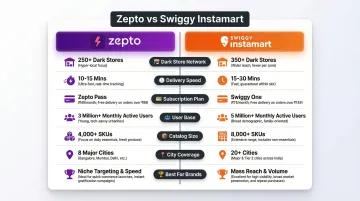
| Factor | Zepto | Swiggy Instamart |
|---|---|---|
| Parent Company | Standalone quick commerce (founded 2021) | Swiggy quick commerce vertical (launched 2020) |
| Dark Store Network | ~1,000+ stores across 70+ cities | 1,021 stores across 124 cities |
| Delivery Promise | ~11 minutes median delivery time | ~12.5–13 minutes average delivery time |
| Subscription Plan | Zepto Pass (₹19–₹299/month) | Swiggy One (bundled food + grocery) |
| Primary User Base | Gen-Z/millennials, affluent metro households | Swiggy food ordering base, broader city reach |
| Catalog Size | 45,000+ SKUs | Up to 50,000 SKUs (Megapods) |
| Best For (Brands) | Mid-premium products, South India strongholds | Variety acceptance, broader geographic reach, masala/regional categories |
Important note on market share: According to a Business Standard report on Zepto's ₹3 billion annualised GOV milestone, third-party market share figures vary significantly by geography and methodology. In November 2025, Swiggy publicly disputed HSBC's market positioning claims — a reminder that single "winner" rankings rarely capture the full picture. Both platforms lead in different metros, customer segments, and categories. City-by-city performance matters more than any aggregate ranking.
What is Zepto?
Zepto is a standalone quick commerce platform built entirely around the dark store model, with a sub-10-minute delivery promise. Founded in July 2021 by Aadit Palicha and Kaivalya Vohra, it reached a $7 billion valuation by October 2025 and reported ₹11,110 crore in FY25 operational revenue, a 149% year-on-year jump. Unlike Swiggy Instamart, Zepto is not attached to a food delivery super-app — quick commerce is its only business.
Core Operational Strengths
Zepto operates ~1,000 dark stores across 70+ cities, processing approximately 1.7 million daily orders. Its speed advantage comes from dark store density in select Tier-1 cities, particularly in South India — with 20+ new dark stores across Tamil Nadu in cities like Coimbatore, Tiruchirappalli, Madurai, Vellore, and Salem.
That density directly drives delivery performance. The platform reports median delivery times of 11 minutes, with micro-fulfillment centers averaging 2,500–3,000 sq. ft. placed near high-demand residential clusters.

Platform Features and Catalog Depth
Zepto Pass, the subscription programme priced between ₹19 and ₹299 per month, offers free deliveries on orders above ₹99 and discounts up to 20%. The programme crossed 1 million subscribers in its first month after launch in March 2024.
The platform's catalog has expanded well beyond groceries, now offering 45,000+ SKUs across:
- Groceries and FMCG staples
- Fresh produce
- Electronics and fashion
- Personal care and home care
- Pharmacy (launched August 2025 for 10-minute medicine delivery)
For regional FMCG brands, Zepto presents a "difficult to list but easy to expand" dynamic—initial approval can be stringent, but brands that achieve listing see stable demand and straightforward store-level expansion. Mid-premium masala brands, in particular, tend to see strong repeat purchase rates once listed — category recognition built through offline retail translates directly into consistent QC orders.
What is Swiggy Instamart?
Swiggy Instamart is the quick commerce vertical within the Swiggy super-app, leveraging Swiggy's existing delivery infrastructure, restaurant-ordering user base, and tech stack. Launched in 2020, Instamart allows users to switch seamlessly between food delivery and grocery ordering within a single app—over 30% of Swiggy users engage with more than one service on the platform.
Core Competitive Advantages
Instamart reported ₹14,683 crore in Gross Order Value for FY25, an 82% year-on-year increase. The platform expanded to 124 cities with 1,021 active dark stores and reached 7.1 million average monthly transacting users.
Instamart's primary advantage is broader geographic reach. While Zepto focuses on dense metro coverage, Instamart's network extends deeper into Tier-2 cities—one in four new users in FY25 came from non-metro areas.
Supporting this geographic push, Instamart is phasing out smaller store formats in favour of larger hybrid stores (3,500-4,500 sq ft) and deploying "Megapods" (10,000-12,000 sq ft) capable of housing up to 50,000 SKUs, enabling deeper assortments and a wider range of regional brand variants.
Integration with Swiggy One
Swiggy One membership bundles food delivery and grocery benefits, offering free deliveries and discounts on Instamart orders above ₹199. The mechanic is straightforward: a user ordering dinner through Swiggy Food sees Instamart promotions in the same session, driving grocery add-ons without a separate acquisition cost. For brands, this means incremental visibility tied to a high-frequency food ordering habit.
Category Strength
Instamart excels in category variety. By Q2 FY26, non-grocery items accounted for 26% of sales, with strong performance in:
- Fresh produce and staples
- Masala and regional food categories (highest variety acceptance in India)
- Personal care and beauty
- Pharmacy (through PharmEasy partnership)
For masala and staples brands, this category mix translates directly—Instamart's regional assortment depth means both CTC spices and blended masalas can be stocked and discovered at the city level, not just in top metros.
Zepto vs Instamart: Head-to-Head on Key Factors
Delivery Speed and Dark Store Network
Delivery Speed: Zepto reports median delivery times of 11 minutes, while Instamart reduced its national average to 12.5-13 minutes in FY25. However, these averages mask significant pincode-level variation. Zepto often leads in cities where it maintains dense dark store coverage—particularly Bengaluru, Hyderabad, and Chennai. Instamart's speed depends on Swiggy's local network density, which varies considerably across its 124-city footprint.
Following government advisories about gig worker safety in January 2026, both platforms removed explicit "10-minute" delivery promises from their marketing, though actual delivery times remain competitive.
Dark Store Strategy: Zepto uses micro-fulfillment centres (2,500-3,000 sq ft) optimised purely for speed. Instamart deploys hybrid formats—phasing out smaller stores for 3,500-4,500 sq ft locations and larger Megapods (10,000-12,000 sq ft) that balance speed with catalog depth.
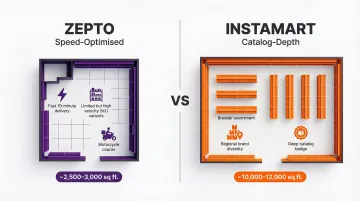
This architectural difference matters for brands: Zepto's stores prioritise velocity SKUs with limited variants; Instamart's larger formats accommodate more regional brands and niche variants.
Geographic Coverage
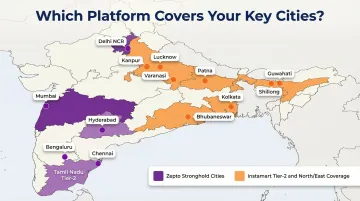
Zepto operates in 70+ cities; Instamart covers 124 cities. But coverage alone doesn't tell the full story.
Zepto's strongholds:
- South India metros (Bengaluru, Hyderabad, Chennai)
- Mumbai, Delhi NCR, Pune
- Recent Tier-2 expansion in Tamil Nadu
Instamart's advantages:
- Broader Tier-2 penetration through Swiggy's existing network
- Stronger presence in North and East India cities where Zepto has limited coverage
- One in four new users from non-metro cities
For regional FMCG brands, the practical implication is clear: the "better" platform depends heavily on which cities matter for your offline distribution. A Tamil Nadu dairy brand will find Zepto's recent expansion compelling; a Gujarat-based masala brand may find Instamart's reach more valuable.
Pricing, Fees, and Subscription Value
Consumer Pricing:
Both platforms use dynamic pricing with platform fees, delivery charges, and minimum order values that vary by time, location, and demand.
Zepto Pass (₹19-₹299/month) offers free delivery on orders above ₹99 and discounts up to 20%. Pilot data showed Pass users increased average spending by over 30%.
Swiggy One bundles Instamart with Swiggy Food delivery perks, with free deliveries on orders above ₹199. For households already ordering food on Swiggy, this cross-service subscription adds clear value that a standalone grocery app can't match.
Average Order Value (AOV) provides insight into consumer behaviour:
- Zepto's AOV ranges from ₹430 to ₹550
- Instamart's AOV was ₹514 in FY25, an 11.7% year-on-year increase
For Brands:
Trade terms, margin structures, and fee models vary between platforms. Zepto's "difficult to list" reputation reflects more stringent commercial negotiations upfront—brands that clear the bar tend to see stable, high-velocity demand. Instamart's integrated Swiggy ecosystem typically offers more standardised onboarding, which can accelerate time-to-shelf for regional brands entering new cities.
Product Catalog and Category Depth
SKU Counts:
- Zepto: 45,000+ SKUs
- Instamart: Up to 50,000 SKUs (Megapods)
Category Expansion: Non-grocery categories now account for 20-25% of quick commerce sales across platforms. Both Zepto and Instamart are aggressively expanding into electronics, beauty, fashion, and pharmacy.
Regional Brand Accommodation:
Instamart leads on regional brand variety, particularly for masala, staples, and local FMCG categories. Larger store formats and the integrated Swiggy ecosystem enable deeper local catalogs and stronger city-level differentiation.
Zepto's micro-fulfillment model prioritises velocity SKUs with limited variants. Regional brands face higher listing barriers—but once approved, they tend to see stable, high-frequency demand, especially at mid-premium price points.
User Experience and App Interface
Both platforms offer polished app experiences optimised for speed. Key differentiators:
Zepto:
- Clean, focused interface prioritising search and reorder
- Category-led discovery
- Standalone app (no cross-service distractions)
Instamart:
- Integrated within Swiggy super-app (one-tap switching between food and grocery)
- Benefits from Swiggy's mature search algorithm and personalisation
- Cross-promotion with Swiggy Food orders
For brands, this distinction has a practical implication: Instamart benefits from Swiggy's existing food-ordering user base, while Zepto's standalone model attracts users specifically intent on grocery. The conversion profiles differ meaningfully by category.
Which Platform is Better for Your Brand?
For most FMCG, food, staples, and personal care brands, the real question isn't which platform wins—it's which platform fits your category, city mix, and margin structure. In most cases, presence on both platforms is the stronger play, not a forced choice between them.
Decision Framework by Category and City
Choose Zepto if your brand:
- Targets young urban professionals in South India metros
- Operates in mid-premium positioning with strong brand differentiation
- Has high velocity in Bengaluru, Hyderabad, Chennai, Mumbai, or Delhi NCR
- Can meet stringent initial listing requirements
- Prioritises stability and predictable demand over broad geographic reach
Choose Instamart if your brand:
- Benefits from broader Tier-2 city coverage
- Offers regional variants and category depth
- Operates in masala, regional foods, or cooking accompaniment categories
- Has strong Swiggy ecosystem fit
- Targets consumers who bundle food and grocery ordering
Choose both if your brand:
- Operates across multiple cities with varying platform dominance
- Seeks to capture different demographic cohorts in the same city
- Can manage the operational complexity of multi-platform presence
- Has offline demand of ₹5-7 crore/month or more to justify dual-platform investment
The Operational Complexity Challenge
Managing both platforms independently creates significant overhead:
- Separate onboarding and approval cycles
- Platform-specific catalog management and SKU mapping
- Independent dark store replenishment and Min-Max optimisation
- Separate advertising budgets and campaign management
- Fragmented availability tracking across pincodes
- Different compliance requirements and packaging standards
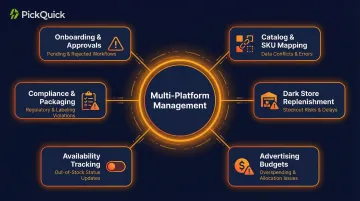
For regional and mid-size FMCG brands, this complexity often delays multi-platform expansion or results in poor availability metrics that throttle growth.
Advertising and Visibility Opportunity
That operational overhead is worth managing — because the advertising upside is substantial. Quick commerce platforms are projected to generate ₹4,900 crore in advertising revenue in 2026, up from ₹3,000 crore the previous year. Brands allocate up to 50% of digital ad spend to QC apps, with conversion rates 10-15% higher than traditional e-commerce.
Zepto crossed ₹1,000 crore in annualised advertising revenue through its in-house "Jarvis" platform. Instamart offers integrated promotional campaigns with strong repeat purchase behaviour. Brands investing in platform ads on both Zepto and Instamart see 10-15% higher search-to-conversion rates.
PickQuick: Managed Multi-Platform Operations
PickQuick manages end-to-end quick commerce operations—from onboarding and dark store replenishment to advertising and availability tracking—across Zepto, Swiggy Instamart, Blinkit, and JioMart. Operating across 10,000+ pincodes, PickQuick enables category-leading FMCG brands to go live on both platforms in weeks rather than months, without building internal QC teams or managing hundreds of fragmented vendor relationships.
The service handles:
- Platform-specific onboarding and compliance
- Unified catalog management and SKU mapping
- Predictive inventory and replenishment cycles
- Min-Max optimisation across both platforms
- Consolidated advertising budgets and campaign management
- Real-time pincode-level availability tracking
If your brand has strong offline demand (₹5-7 crore/month) and wants to scale on both Zepto and Swiggy Instamart without operational overhead, reach out to PickQuick to explore a managed QC partnership.
Conclusion
Zepto and Instamart aren't straightforward substitutes—they lead in different geographies, serve overlapping but distinct user cohorts, and offer different value propositions for consumers and brands. For consumers, the right app depends on city, category, and whether they prefer standalone quick commerce or integrated super-app convenience.
For brands, the question is not which platform to choose but how to build consistent, well-optimised presence on both. Quick commerce is availability-first: being present on only one platform means missing demand the other captures entirely.
For regional brands with strong offline presence, the path forward is clear:
- Scale onto both platforms with clean replenishment and stable availability metrics
- Treat multi-platform presence as table stakes, not a growth experiment
- Convert quick commerce from a trial channel into a primary revenue driver
The competitive dynamic between Zepto and Instamart will continue evolving as both platforms expand their networks, deepen their catalogs, and compete for advertising budgets. Brands that build multi-platform operations now will be best positioned as India's quick commerce market grows from $6–7 billion today to $27–50 billion by 2030.
Frequently Asked Questions
How does Instamart work in India?
Swiggy Instamart operates through a network of dark stores (fulfilment centres) located close to residential areas. When you place an order through the Swiggy app, it's routed to the nearest stocked dark store, where pickers assemble your order and dispatch it via delivery partners for 10-20 minute delivery.
Is Zepto a quick commerce?
Yes, Zepto is a pure-play quick commerce company built around the dark store model and a sub-10-minute delivery promise. Unlike Instamart (part of Swiggy) or Blinkit (owned by Zomato), Zepto operates independently — without a parent food delivery app backing it.
What are Instamart and Blinkit?
Both are quick commerce platforms in India delivering groceries and FMCG products in 10-20 minutes. Instamart is Swiggy's grocery vertical within its super-app, while Blinkit is a standalone QC platform owned by Eternal Ltd (Zomato's parent company).
Which is faster — Zepto or Instamart?
Delivery speed varies significantly by city and pincode. Zepto often leads in its core dark store cities, particularly in South India (Bengaluru, Hyderabad, Chennai), with median delivery times around 11 minutes. Instamart's speed depends on Swiggy's dark store network density in your area, averaging 12.5-13 minutes nationally. Neither universally wins on speed across all locations.
Should a brand list on both Zepto and Instamart?
Yes — each platform captures different city-level and demographic demand, so listing on only one means missing real revenue. The main challenge is operational complexity: separate onboarding, catalogue management, replenishment cycles, and advertising per platform. That's why many brands work with operators like PickQuick for unified multi-platform management.