Introduction
India's quick commerce sector has exploded into a ₹24,500+ crore market, with Zepto capturing 29% market share as the nation's second-largest 10-minute delivery platform. What most brands miss, though: selling on Zepto costs significantly more than the advertised commission rate suggests.
Through 2024-2025, Zepto has hiked its commissions as it races toward a ₹10,000+ crore IPO (approximately $1.22 billion) planned for mid-2026. The platform's overall take rate has climbed to 22-23%, and when you stack warehousing fees, handling charges, payment gateway costs, and mandatory advertising spends, the total effective cost of selling on Zepto reaches 30-35% of your selling price — a reality most brands only discover after going live.
This guide breaks down Zepto's complete commission structure, exposes every hidden fee, provides category-wise rate breakdowns, compares costs across Blinkit and Swiggy Instamart, and shows you exactly how to stay profitable despite rising platform costs.
TLDR: Key Takeaways
- Zepto's base commission ranges from 10–25% depending on product category
- Total effective costs hit 30–35% when warehousing, handling, ads, and gateway fees are included
- Zepto raised its platform take rate to 22–23% in 2025 as it prioritizes IPO readiness
- Brands doing ₹25–30 lakh+ monthly GMV can negotiate below rack rate — sometimes cutting effective commission by 3–5 percentage points
- Selling across Blinkit, Swiggy Instamart, and Zepto simultaneously strengthens your hand in rate negotiations with any single platform
How Zepto's Seller Commission Model Works
The Marketplace Model and Take Rate Economics
Zepto operates a marketplace where brands supply inventory to Zepto's 1,000+ dark stores nationwide, and Zepto charges a percentage of each sale as commission. The platform charges a take rate—retaining 22–23% of Gross Order Value (GOV) across the platform as of early 2025, not a flat listing fee.
Commission is calculated as a percentage of your selling price (MRP minus any platform discount), with Zepto remitting the net amount after deducting all applicable fees.
Zepto uses a Category Manager-driven negotiation model. You don't upload products and accept fixed rates—terms are discussed directly with Zepto's category team. Larger brands with higher GMV consistently secure better rates than smaller D2C entrants.
Settlement Cycles and Payment Timing
Zepto settles payments weekly, though some contracts specify twice-monthly cycles with a 15–20 day lag. Your payout is total sales minus the following deductions:
- Platform commissions
- Fulfillment charges
- Return penalties
- GST at 18% on platform fees
- TDS at 0.1% under Section 194-O (reduced from 1% in October 2024)
Category-Dependent Commission Structure
Zepto maintains category-based commission rates, unlike Blinkit's March 2025 shift to a dynamic price-band model (2% for items under ₹500, 18% for items above ₹1,200). The broad rate ranges by category look like this:
| Category | Approximate Commission Range |
|---|---|
| Staples & Daily Essentials | 10–15% |
| Snacks & Packaged Foods | 14–18% |
| Personal Care & Higher-Margin | 18–25% |
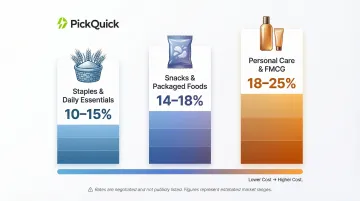
Rates are negotiated during onboarding and aren't publicly listed.
Who Qualifies as a Seller vs. Brand Partner
Zepto distinguishes between individual sellers and established brand partners. National and regional brands with proven offline distribution (typically ₹5–7 crore+ monthly offline demand) negotiate custom rates directly with Category Managers. Smaller sellers pay standard rack rates with limited flexibility.
The Full Cost Picture: Every Fee Zepto Sellers Actually Pay
Warehousing and Storage Fees
Base commission is only the entry ticket. Zepto requires sellers to stock inventory in its dark stores and charges for space usage. Storage fees typically operate on a tiered structure based on how long inventory sits:
- Days 1-30: Lower per-unit or per-cubic-foot rate
- Days 31-60: Increased rate as inventory ages
- 60+ days: Highest rate, incentivizing fast turnover
A SKU sitting 45+ days in a dark store can accumulate storage fees that exceed its gross margin contribution.
Handling and Packaging Charges
Zepto charges for pick-and-pack operations at the dark store level—separate from base commission. These handling fees cover:
- Inwarding costs when stock arrives at the dark store
- Picking and packing each order for delivery
- Quality checks and barcode scanning
Brands often underestimate these charges at onboarding, only to find they shave 3-5% off net margins once orders start flowing.
Payment Gateway Fees and Tax Deductions
Before settlement, Zepto deducts:
- 18% GST on all platform fees, commissions, and listing charges
- 0.1% TDS under Section 194-O (reduced from 1% effective October 2024)
Sellers must account for GST on commissions charged by Zepto and ensure GST input tax credits are claimed accurately during monthly reconciliation.
Promotional and Visibility Fees
Organic discovery on Zepto is virtually non-existent for new brands. To rank higher in search, secure banner placements, or run discount campaigns, brands pay **mandatory advertising fees** separate from commission:
- Entry packages: ₹5-6 lakh bundled spend to secure initial visibility
- Zepto Atom subscription: ₹30,000/month for detailed analytics and insights
- Sponsored listings: CPM and CPC models for banner ads and search placement
These retail media investments are a standard budget line for any brand serious about visibility on Zepto.
Worked Example: What a Brand Actually Receives
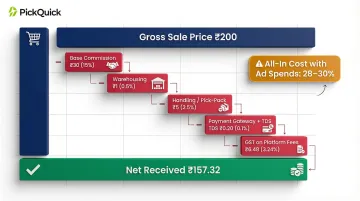
Here's how the deductions stack up for a product selling at ₹200:
Gross Sale Price: ₹200
Deductions:
- Base commission (15% for packaged foods): ₹30
- Warehousing/storage (₹1/unit for 30 days): ₹1
- Handling/pick-pack fee (₹5/unit): ₹5
- Payment gateway + TDS (0.1%): ₹0.20
- GST on platform fees (18% on ₹36): ₹6.48
| Summary | Amount |
|---|---|
| Total Deductions | ₹42.68 |
| Net Amount Received | ₹157.32 |
| Effective Cost (before ads) | 21.3% |
| All-in Cost (with ad spends of ₹10-15/unit) | 28-30% of selling price |
Category-Wise Commission Rates on Zepto
Zepto's commission structure reflects margin profiles and velocity by category. While Zepto doesn't publish a public rate card, industry reports and seller onboarding data reveal the following ranges:
| Category | Commission Range | What Drives the Rate |
|---|---|---|
| Grocery & Staples | 10–15% | Thin margins on essentials; volume-led |
| Packaged Foods & Snacks | 15–18% | Impulse-buy profile; moderate margin buffer |
| Personal Care & FMCG | 18–25% | High gross margins (60–70%); premium placement value |
Grocery & Staples (10–15%)
Everyday essentials—rice, flour, pulses, cooking oil—carry the lowest commission rates. These products drive traffic and order frequency, but their thin gross margins leave little room for Zepto to extract higher fees without pushing brands into losses.
Packaged Foods & Snacks (15–18%)
Snacks, biscuits, beverages, and packaged foods land in the mid-tier range. These items fuel impulse buying—the core of quick commerce economics—and carry slightly better margin buffers than raw staples, which is why Zepto prices them higher.
Personal Care & FMCG (18–25%)
Personal care, health, and wellness products face the steepest commissions. Brands in these categories typically run gross margins of 60–70%, giving Zepto strong incentive to prioritize placement for them — and to charge accordingly.
Negotiation Leverage for High-GMV Brands
Sellers crossing ₹25-30 lakh monthly GMV often unlock better terms. During onboarding, always request a detailed rate card and negotiate based on your projected volume and multi-platform presence. Commission rates are also just one layer — logistics fees, return charges, and promotional levies add to the total cost picture.
Why Zepto Has Been Raising Commissions
The Financial Reality: 177% Loss Growth Despite Revenue Surge
In FY25, Zepto reported a 129% year-on-year revenue increase, reaching ₹9,669 crore. But rapid dark store expansion and customer acquisition drove net losses up 177% to ₹3,367 crore (from ₹1,214 crore in FY24). Commission hikes are a direct response to this widening cash burn.
The $4 Billion Run-Rate and IPO Optics
Despite losses, Zepto's growth velocity is hard to ignore. CEO Aadit Palicha announced in January 2025 that the company crossed a $3 billion annualized Gross Order Value (GOV), tripling in just eight months. The company now nears a $4 billion run-rate and has confidentially filed for a $1.22 billion IPO targeting mid-2026.
To justify its $7 billion private valuation in public markets, Zepto must show a credible path to profitability. Raising the platform take rate from historical levels to 22-23% shifts the burden of cash burn from investors onto sellers and consumers.
Industry-Wide Margin Pressure
Zepto isn't alone in this shift. Across quick commerce, take rates are climbing as platforms move from growth-at-all-costs to monetization:
- Blinkit hiked commissions through 2024-2025 as it scaled dark store density
- Swiggy Instamart has announced plans to push its take rate to 20-22%
- Flipkart Minutes remains the outlier, offering 0% commission on items under ₹1,000 to capture market share
Established players are clearly prioritizing monetization over seller subsidies — and that shift is structural, not temporary.
Zepto vs. Blinkit vs. Swiggy Instamart: A Fee Comparison
Blinkit's Dynamic Price-Band Model
In March 2025, Blinkit abandoned fixed category commissions and shifted to a price-band model:
- Under ₹500: 2%
- ₹500–₹700: 6%
- ₹1,200+: 18%
This creates a clear strategic opportunity: keep Blinkit SKUs under ₹500 to exploit the 2% slab, while pushing premium or bundled SKUs on Zepto where category rates are fixed.
Swiggy Instamart's Push Toward 20-22%
Swiggy Instamart ran at ~15% take rates through 2024, with targets to reach 20–22% by end of 2025. As of early 2025, those hikes haven't fully landed — making it the most cost-stable of the three major platforms right now. For brands in cost-sensitive categories like staples or dairy, this matters:
- Lower effective take rates than Zepto or Blinkit in most food categories
- No aggressive price-band restructuring (yet)
- Cross-sell advantage via Swiggy's food-delivery user base
The Flipkart Minutes Arbitrage
Flipkart Minutes launched with a disruptive 0% commission policy for products under ₹1,000 to buy market share. This won't hold permanently, but right now it's a high-margin secondary channel brands can use during Zepto contract renewals — particularly to demonstrate platform optionality at the negotiating table.
Platform Comparison Table
| Platform | Commission Model | Base Commission Range | Ad Spend Minimums | Strategic Focus |
|---|---|---|---|---|
| Zepto | Category-based | 10–25% | ₹5–6 lakh entry + ₹30k/mo | Pre-IPO margin expansion |
| Blinkit | Price-band | 2% (<₹500) to 18% (>₹1,200) | ₹2–3 lakh/month | High-AOV electronics/premium |
| Swiggy Instamart | Category-based | 15% scaling to 20–22% | ₹8–10 lakh quarterly | Food-delivery cross-sell |
| Flipkart Minutes | Promotional | 0% (<₹1,000) | Self-serve/Variable | Aggressive market capture |
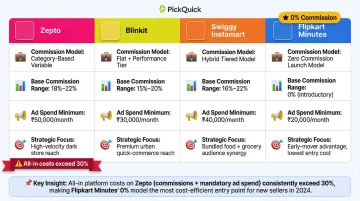
Takeaway: Brands must segment catalogs strategically. Low-priced items thrive on Blinkit's 2% tier, while Flipkart Minutes offers a temporary safe haven from Zepto's 30%+ all-in costs.
How to Stay Profitable on Zepto as Commissions Rise
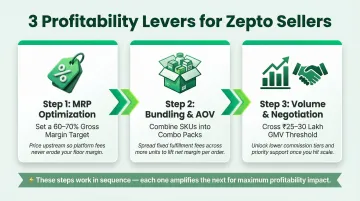
MRP Optimization: The 65%+ Gross Margin Rule
Because all-in costs routinely hit 30-35%, traditional e-commerce pricing destroys margins on quick commerce. Industry analysts warn that brands need 60-70% gross margins to absorb platform commissions, fulfillment fees, storage costs, and advertising spends.
Set your MRP specifically for the quick commerce channel, ensuring enough buffer before applying platform discounts. Model the full cost stack—commission + warehousing + handling + ads—before finalizing pricing, not after.
Beating Fixed Fees with Bundling and High-AOV Combos
Zepto charges fixed per-unit fees for inwarding, storage, and fulfillment. Selling single, low-ticket items destroys profitability. To maximize margins:
- Bundle products into combo packs
- Increase Average Order Value (AOV) per SKU
- Dilute fixed logistics fees across a higher revenue base
A ₹50 single-serve snack might lose money after fees, but a ₹200 combo pack of four units spreads fixed costs and improves net margin significantly.
Volume and Assortment Strategy
Once bundling and AOV are optimized, the next lever is scale. Brands with higher velocity SKUs and broader assortments gain more negotiation leverage with Zepto.
Focus on fast-moving, high-turnover products to build GMV first, then negotiate better rates. Brands crossing ₹25-30 lakh/month in GMV often unlock improved commission terms and better ad-wallet conditions.
The Operator Model Advantage
Working with a dedicated quick commerce operator like PickQuick means commission negotiations, dark store replenishment, advertising budgets, and availability metrics are managed as part of a single consolidated operation. Brands that handle this independently often absorb margin erosion from fragmented vendor management and reactive ad spending.
PickQuick manages 25+ category-leading brands across 10,000+ pincodes on all major QC platforms. Consolidating advertising budgets at the operator level enables larger quarterly commitments, multi-brand campaign allocations, and premium placement that individual brand accounts rarely access.
The operator model also enforces replenishment discipline, clean GRN/DN scores, and 98%+ availability metrics. This matters because Zepto's algorithm prioritizes availability over sales volume. Brands with poor availability face Max level reductions and slower city expansion, which directly limits revenue recovery regardless of commission rates.
Frequently Asked Questions
What commission and fees does Zepto charge sellers in India?
Zepto charges category-dependent base commissions ranging from 10% (staples) to 25% (personal care/FMCG). On top of this, sellers pay warehousing fees, handling charges, payment gateway costs, and mandatory advertising spends. The total effective cost typically reaches 30-35% of the selling price.
Why did Zepto remove all fees?
Zepto initially charged zero or minimal fees as a growth strategy to attract sellers and build its catalog. As it shifted focus to unit economics and IPO readiness through 2024-2025, the platform reversed course and steadily raised commissions to improve its take rate to 22-23%.
Is it profitable to sell on Zepto?
Profitability is category- and margin-dependent. Brands with 60-70% gross margins, strong GMV (₹25-30 lakh+ monthly), and negotiated rates fare better. Model the full cost stack—not just the base commission—before committing.
How do I register as a seller on Zepto?
Submit an application via Zepto's seller portal, provide GST registration, FSSAI license (for food/FMCG), business PAN, and bank account details. Zepto verifies documentation and assigns a Category Manager who negotiates commercial terms before you go live.
Is Zepto trustworthy?
Yes. Zepto is a legitimate, well-funded quick commerce platform operating in major Indian cities, backed by institutional investors, valued at $7 billion, and approaching a 2026 public IPO. The company operates 1,000+ dark stores and holds 29% market share in India's quick commerce sector.
How long does it take to go live as a Zepto seller?
Onboarding typically takes 4-8 weeks from application to first inventory live in dark stores, depending on documentation readiness and category manager availability. Brands with complete compliance documentation and an established offline supply chain move through the process faster.
Want to protect margins while scaling on Zepto? PickQuick manages end-to-end Quick Commerce operations—from dark store replenishment to platform compliance—for category-leading FMCG brands across Blinkit, Zepto, Swiggy Instamart, and JioMart. Contact Swapnil at swapnil@letspickquick.com or +91 94276 41749 to discuss your Quick Commerce strategy.