Introduction
For FMCG, food, dairy, and consumer brands, managing inventory expiration dates isn't just operational housekeeping—it's a direct lever controlling product quality, customer trust, and profitability. In high-velocity Quick Commerce channels where customers expect dairy delivered in 10 minutes and masalas dispatched within the hour, expiry management transforms from a compliance checkbox into a competitive advantage.
The cost of poor expiry management extends far beyond simple write-offs. FSSAI's December 2024 advisory now mandates that Quick Commerce platforms deliver food products with at least 30% or 45 days of remaining shelf life—non-compliance means platform delisting risks, regulatory action, and lasting reputational damage. Brands flagged with expired stock at dark stores have no room to appeal.
On Blinkit specifically, expired inventory triggers algorithmic throttling: the platform deliberately slows dark store consumption to prevent customer-facing expiry losses, effectively capping your growth regardless of demand.
This article covers why expiry management matters in the QC era, the key practices that prevent losses (FEFO rotation, automation, demand alignment), warning signs your system is failing, and a scheduling checklist to sustain discipline at scale.
TL;DR
- FEFO rotation by actual expiry date—not arrival sequence—cuts perishable waste up to 50%
- Lot-level tracking with automated alerts stops expired stock before it reaches customers or triggers penalties
- Demand forecasting aligned to shelf-life windows prevents overstocking, the root cause of most expiry losses
- Near-expiry promotions recover commercial value before stock becomes unsellable
- Audits, supplier shelf-life agreements, and warehouse training sustain expiry discipline at scale
Why Inventory Expiry Management Matters
Expiry management directly affects product freshness, customer satisfaction, and brand trust on platform. For perishable-heavy categories like dairy, masala blends, and packaged foods sold through Quick Commerce platforms, customers expect ultra-fresh products delivered within minutes. A single expired product incident can trigger negative reviews, platform rating drops, and permanent customer churn—70% of QC shoppers switch brands instantly during stockouts, and freshness failures accelerate that defection.
Financial Performance Impact:
The cost of poor expiry management scales fast. Key global benchmarks:
- Food waste represents ~33% of a company's total revenue, with global costs projected to reach USD $540 billion by 2026
- 14% of food valued at $400 billion is lost between harvest and retail, with another 17% wasted at retail and consumer levels
- 51% of retail leaders attribute this waste primarily to poor inventory management and overstocking
Platform Availability and Ranking:
In Quick Commerce environments, expired stock flagged at a dark store triggers immediate out-of-stock statuses, hurts platform availability scores, and can lead to SKU suppression or delisting. When motherhub inventory ages, platforms like Blinkit algorithmically slow dark store consumption to prevent expiry losses—directly capping your expansion potential regardless of sales velocity.
Regulatory Compliance:
Food and FMCG brands in India must comply with FSSAI labelling and shelf-life regulations. FSSAI's December 2024 advisory strictly mandates that e-commerce and Quick Commerce platforms deliver food products with a minimum of 30% or at least 45 days of remaining shelf life. Expired stock in trade channels attracts penalties up to ₹5 lakh, product recalls, and reputational risk.
Proactive vs. Reactive Cost Comparison:
Catching near-expiry stock early—with enough time to run a targeted promotion or transfer inventory to faster-moving locations—enables partial recovery of commercial value. Discovering expiry only during physical counts forces total write-offs with zero recovery. A 20% markdown promotion recovers most of your cost; a surprise write-off at month-end recovers none of it.
Best Practices for Managing Inventory Expiration Dates
Effective expiry management requires a combination of operational method, technology, supplier coordination, and team discipline. No single practice works in isolation—these strategies function as an integrated system.
Implement a First-Expired, First-Out (FEFO) System
FEFO prioritizes stock rotation based on the batch or lot with the earliest expiry date, not the arrival date. This distinction is critical for products where two batches received on different dates can have different manufacturing dates and therefore different remaining shelf lives.
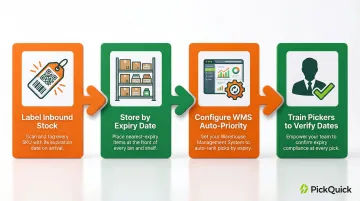
How to operationalize FEFO:
- Label inbound stock with batch numbers and expiry dates at receiving
- Store earlier-expiry batches at the front of picking locations
- Configure WMS or inventory software to auto-prioritize FEFO during order fulfillment
- Train pickers to verify expiry dates before selecting inventory
Research demonstrates that implementing FEFO instead of traditional FIFO reduces perishable product waste by up to 50%, making it the foundational rotation method for dairy, bakery, and short-shelf-life categories.
Use Real-Time Tracking and Automated Expiry Alerts
Inventory management software with lot-level expiry tracking captures batch and expiry data at inbound, maintains live visibility of stock across expiry tiers, and removes reliance on manual checks that fail at scale.
Configure tiered alert thresholds:
- 60-day alert: Enables redistribution to faster-moving locations
- 30-day alert: Triggers promotional planning and markdown coordination
- 10-day alert: Forces immediate clearance or disposal decisions
For brands operating across multiple QC platforms and dark stores, pincode-level stock visibility is what separates proactive expiry monitoring from reactive write-offs. PickQuick's platform tracks inventory age across 10,000+ pincodes simultaneously, giving regional FMCG brands a live view of which nodes are aging out—before the expiry window closes.
Optimize Demand Forecasting to Prevent Overstocking
Overstocking is the root cause of most expiry losses. Ordering more than what sells within the shelf-life window creates excess inventory that ages out. NielsenIQ data shows a 4% out-of-stock rate across global FMCG resulted in nearly €2 billion in missed sales—but overstocking creates equally severe margin destruction through write-offs. For Indian quick commerce, where dark store shelf space is constrained and delivery windows are tight, the margin for error is even smaller.
Align forecasting with shelf life:
- Use historical velocity data to set order quantities matching actual throughput within usable shelf-life windows
- Segment by product shelf-life profile—dairy may require daily reorders in smaller quantities, while packaged masalas can operate on weekly cycles
- Incorporate seasonal demand patterns and promotional calendars into forecasts
- Monitor actual consumption against forecasts to refine accuracy continuously
The returns are measurable: one online grocery retailer reported a 49% decrease in food waste after implementing AI-driven demand forecasting, with ML-based methods improving prediction accuracy by 20-42% over conventional approaches—cutting overstocking and stabilizing fresh food prices at the same time.
Design Promotions to Clear Near-Expiry Inventory
Near-expiry stock still has margin in it—if you move fast. Proven clearance tactics:
- Flash discounts targeting price-sensitive customers willing to purchase short-dated products
- Bundling near-expiry items with fast-moving products to accelerate consumption
- Channeling stock to bulk or institutional buyers before the expiry window closes
- Partnering with food banks or discount retailers for socially responsible clearance
Critical coordination requirement: Clearance strategies only work if picking, packaging, and listing changes are executed in time. Spontaneous markdowns without operational alignment fail to move sufficient volume. Coordinate promotions with fulfillment and platform operations at least 7-10 days in advance for short-shelf-life products.
Strengthen Supplier Agreements and Team Training
Minimum Remaining Shelf-Life (MRSL) clauses: Specify the minimum shelf life required upon inbound receipt (e.g., 70% of total shelf life remaining). This ensures short-dated stock is rejected at receiving rather than discovered weeks later in the warehouse.
Team training requirements:
- Warehouse staff must understand FEFO protocols during picking
- Receiving teams must log batch and expiry data accurately at inbound
- Supervisors must know when to escalate short-dated stock for management review
- Coordination across procurement, warehouse, and sales teams prevents misaligned ordering
Even the best software fails without consistent human execution. Quarterly training refreshers and unannounced spot audits at receiving and picking stations are what keep protocols from slipping under operational pressure.
Signs Your Expiry Management Needs Immediate Attention
Expiry management issues surface as recurring small problems that signal systemic gaps. Watch for these warning signals.
Recurring Write-Offs and Waste Spikes
When expired or near-expired write-offs appear regularly in inventory reconciliation — not as occasional exceptions — your operation has a systemic problem. The likely culprits:
- FEFO protocols are not being followed consistently at the bin level
- Demand forecasting is misaligned with actual shelf-life cycles
- Inbound receiving checks are missing expiry validation steps
Benchmark: ECR Retail Loss research found that shrinkage across the FMCG grocery sector costs 2.31% of turnover globally. Closer to home, a regional FMCG snacks brand reduced expiry and return losses from 4.2% to 0.7% of gross sales by implementing automated FEFO protocols and real-time sales tracking.
Frequent Stockouts on Fresh Batches Alongside Excess Aged Stock
Simultaneous stockouts on newly received inventory and excess quantities of older, shorter-dated stock signal broken rotation logic. This pattern results from improper bin placement or FIFO habits overriding FEFO protocols, creating both waste and availability failures simultaneously.
Customer Complaints or Returns Related to Product Freshness
Receiving any complaints about near-expiry or expired products means expiry checks at packing or dispatch are failing. In quick commerce — where delivery is promised within 10-30 minutes — customers expect products that are fresh, not products that are simply in-stock.
The consequences compound fast:
- A single expired product incident triggers platform rating drops
- Repeated complaints invite category-level scrutiny from platform ops teams
- Recent FSSAI inspections of Quick Commerce warehouses seized over 1,900 expired or misbranded food units — a signal that regulatory enforcement is accelerating
For regional brands building QC presence, one freshness incident is a reputational event, not just an ops metric.
Building an Expiry Management Schedule
Expiry management is an ongoing process, not a one-time fix. Consistent cadence of checks at different intervals keeps the system healthy. The right frequency depends on the shelf-life profile of the SKU.
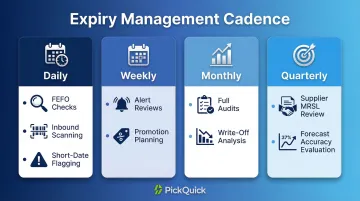
Expiry Management Frequency Table:
| Cadence | Tasks |
|---|---|
| Daily | FEFO compliance check during picking; scan/verify expiry on inbound receiving; flag short-dated stock for escalation |
| Weekly | Review expiry alert reports from inventory software; identify batches entering near-expiry window; initiate promotion or redistribution planning for at-risk stock |
| Monthly | Full expiry audit across all storage locations; reconcile physical batch counts against system records; review write-off totals and root cause analysis |
| Quarterly | Evaluate supplier MRSL compliance; review demand forecasting accuracy against actual consumption; adjust reorder quantities and lead times based on expiry performance data |
Not every SKU needs the same level of attention. Cadence should reflect how quickly a product moves and how narrow its shelf-life window is.
Short-shelf-life products like dairy and fresh bakery products require daily mini-audits and tighter reorder cycles. Staples and packaged goods with longer shelf lives can follow weekly or monthly schedules — reducing audit overhead while keeping write-off rates low.
Conclusion
Expiry management is a revenue protection discipline, not just a compliance task. Brands that track, rotate, and clear stock proactively protect margins, maintain platform availability, and build customer trust through product freshness.
As brands scale across multiple cities and dark stores on platforms like Blinkit, Zepto, and Swiggy Instamart, expiry management complexity compounds quickly. Structured systems, real-time visibility, and operationally disciplined replenishment partners become non-negotiable at that scale.
Brands that build expiry management into their core operations — not bolt it on later — see fewer write-offs, stronger availability metrics, and more consistent platform performance across every node.
Frequently Asked Questions
What is expiry management?
Expiry management is the process of tracking, monitoring, and acting on product shelf-life data across inventory to ensure goods are sold or used before they expire. It covers practices like FEFO rotation, batch tracking, and date-based notifications that prevent waste and regulatory violations.
What is the expiration date in inventory management?
In inventory management, the expiration date (or expiry date) is the date beyond which a product is no longer considered safe, effective, or sellable. It is used to prioritize stock rotation, trigger reordering decisions, and manage write-off risk.
How to manage expiry dates?
Implement FEFO rotation to prioritize earliest-expiring stock first. Use inventory software with batch-level expiry tracking and automated alerts. Audit stock regularly at daily, weekly, and monthly intervals. Coordinate with suppliers on minimum shelf-life requirements upon delivery.
What is a best practice for managing excess or expiring inventory?
Act early using tiered expiry alerts to identify near-expiry stock with enough lead time to run promotions, create bundles, offer markdowns, or redirect to alternate channels. Early action preserves commercial recovery options before the window closes and a full write-off becomes unavoidable.
What's the difference between "sell by" and "use by"?
"Sell by" is a retailer-facing date indicating when a product should be sold or removed from shelves—it may still be usable afterward. "Use by" is a consumer-facing safety date after which the product should not be consumed. Both are relevant for managing inventory rotation and customer expectations.
What happens if expired stock is found in a dark store?
Expired stock in a dark store triggers immediate delisting from the platform catalog, a compliance flag, and potential penalties from platforms like Blinkit or Zepto. Routine cycle counts and expiry audits — ideally weekly for high-velocity perishables — are the primary defense against this.