Introduction
Scaling a regional dairy or masala brand from general trade dominance to Quick Commerce presence across multiple Indian cities seems straightforward until the first stockout hits. Brands that own shelf space in traditional retail often struggle when their products vanish from dark stores in just 2-3 cities, let alone 10. The result? Search rankings plummet, conversion rates drop, and customers switch to competitors instantly.
The problem isn't logistics alone. Poor multi-location inventory management directly impacts your brand's visibility, sales velocity, and customer retention across every platform you operate on.
When a product runs out of stock at even a handful of Blinkit dark stores in Bengaluru, the platform doesn't just record a lost sale: it actively deprioritizes your brand in search results across the entire city, compounding revenue loss for weeks.
This article covers seven practices that help brands scaling across Blinkit, Zepto, Swiggy Instamart, and JioMart turn inventory management into a measurable competitive advantage.
Key Takeaways
- Multi-location inventory management means controlling stock across dark stores in multiple cities and QC platforms from a single operational view
- Seven practices cover everything from centralized dashboards and Min-Max rules to demand forecasting, procurement, and city onboarding SOPs
- Clean inventory execution directly improves platform rankings, search visibility, and conversion rates
- Stock inconsistency across even 2-3 cities suppresses QC growth — inventory is a growth lever, not just an ops task
- With the right system, brands scale from 1 to 10+ cities 3-5x faster than standard QC onboarding timelines
What Is Multi-Location Inventory Management in Quick Commerce?
Multi-location inventory management in Quick Commerce is the process of tracking, replenishing, and optimizing stock levels across multiple dark store locations, cities, and platforms at the same time. The operational tempo is fundamentally different from traditional warehouse management:
- Pickers have 60 to 90 seconds to locate and pack orders
- Replenishment cycles run every 24-48 hours, not every 7-15 days
- Demand signals shift by the hour, not by the week
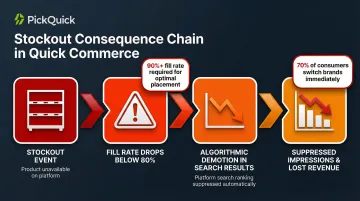
What makes this especially high-stakes: QC platforms treat inventory availability as a ranking signal. When your masala brand goes out of stock at a Blinkit dark store in Bengaluru, you lose more than that sale. Blinkit actively demotes brands whose fill rate drops below 80%, requiring a sustained 90%+ rate for optimal placement.
A single stockout event can compound into weeks of suppressed search visibility and lost revenue across the entire city.
Key Challenges Brands Face With Multi-Location QC Inventory
The Visibility Gap
Most regional brands entering Quick Commerce at scale manage inventory using disconnected WhatsApp groups, distributor calls, or Excel sheets. While 72% of product discovery in India happens on WhatsApp, this informal coordination creates dangerous lag between stock depletion and replenishment action—especially when the same SKU must be live across 20+ dark stores in three cities. Without real-time visibility, brands discover stockouts only after platform rankings have dropped.
Demand Variability Across Cities and Pincodes
A masala brand may see 3x higher velocity in one Hyderabad neighborhood compared to another just 5 km away. Demand in Quick Commerce is hyper-localized: mustard oil dominates in Kolkata while coconut oil leads in Kerala. Applying uniform reorder quantities across all locations causes chronic overstocking in some stores and stockouts in others. The result is working capital tied up in slow-moving stock while faster pincodes lose sales.
Platform-Specific Compliance Challenges
Blinkit, Zepto, and Swiggy Instamart each have different catalog requirements, Min-Max thresholds, and replenishment lead times. Key shelf-life requirements alone vary significantly:
- Blinkit requires 90–120 days remaining shelf life at inwarding
- Zepto demands at least 60% shelf life remaining for food products
- Each platform sets its own inwarding windows and compliance checkpoints
Without standardized processes across all three, brands run into inwarding rejections, catalog delistings, and compliance disputes that stall city-level expansion.
7 Best Practices for Multi-Location Inventory Management
Best Practice 1: Build a Centralized Inventory Dashboard Across All Locations
The foundation of multi-location control is a single dashboard aggregating real-time stock levels across all dark stores, cities, and platforms—not separate logins for each platform or city-level reports shared over WhatsApp.
What the dashboard must show:
- Current stock vs. Min-Max thresholds per dark store
- Platform-wise availability percentages with instant stockout flags
- SKUs approaching depletion with replenishment alerts
- Pincode-level drill-down capability for demand analysis
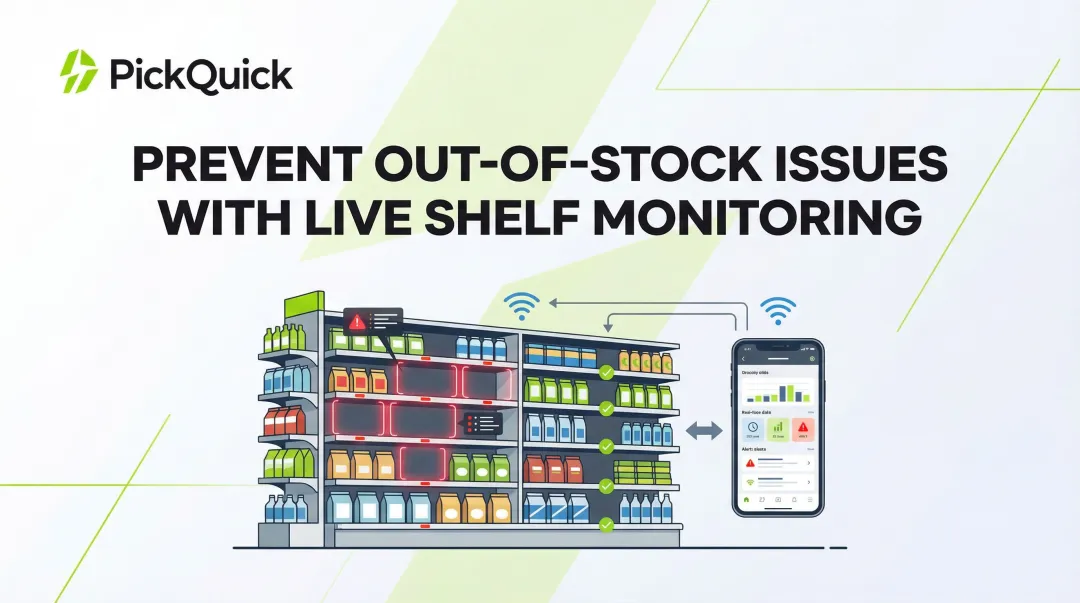
Traditional retail loses 4-8% of sales to out-of-stocks, but Quick Commerce impact is far worse: 70% of consumers immediately switch brands when their preferred item is missing. Centralized dashboards prevent "phantom inventory" scenarios where stock exists nationally but is unavailable in the specific 2-3 km radius where a customer searches.
Best Practice 2: Standardize SKU Naming and Catalog Setup Across Platforms
Inconsistent SKU naming across Blinkit, Zepto, and Swiggy Instamart prevents brands from reconciling stock across platforms and creates catalog errors that trigger delistings.
Standardization in practice means:
- Master SKU list with unified product names, pack sizes, and barcodes
- Consistent MRP formatting and product imagery
- Replicated catalog structure when onboarding each new platform or city
- Unified product attributes (weight, dimensions, HSN codes)
For regional masala brands, this includes embedding regional terminology (for example, "Lasoon Thecha" for Maharashtra, "Idli Podi" for Tamil Nadu) and cuisine cues ("Kolhapuri," "Chettinad") directly into product names. Without this foundation, cross-platform reconciliation breaks down and compliance errors slow city expansion at exactly the wrong moment.
Best Practice 3: Set Location-Specific Min-Max Replenishment Rules
Min-Max replenishment sets a minimum stock level that triggers replenishment and a maximum level that caps inventory to prevent dead stock. These thresholds must be calibrated per dark store—not applied as blanket rules across all locations.
Why location-specific rules matter:
A high-velocity dark store in a dense urban pincode may require a Min of 20 units and Max of 80 for a given SKU, while a lower-velocity location in the same city needs a Min of 5 and Max of 20. Applying the wrong thresholds ties up working capital or causes stockouts.
Blinkit's platform has specific replenishment windows and receiving schedules—Min-Max rules must account for platform-specific lead times, not just brand-side supply cycles. Consistently clean availability and fast RO cycles also trigger automatic Max expansion on Blinkit, directly unlocking greater capacity and store reach.
Best Practice 4: Use Location-Based Demand Forecasting
Demand for FMCG, dairy, and masala products varies significantly by city, neighborhood, and season in India. Brands must use historical sales data at the pincode level rather than relying on aggregate monthly numbers.
Critical forecasting triggers for Indian QC markets:
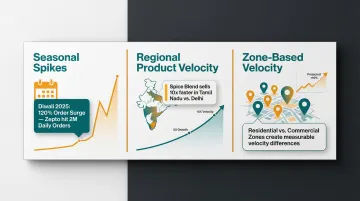
- During Diwali 2025, QC order volumes surged 120%, with Zepto hitting 2 million daily orders in a single week
- A spice blend can sell 10x faster in Tamil Nadu than Delhi—aggregate forecasts miss this entirely
- Proximity to residential clusters vs. commercial zones creates measurable velocity differences within the same city
Platforms like Zepto now offer brand intelligence tools providing minute-by-minute updates and pincode-level performance maps, enabling brands to forecast demand at a level of granularity that wasn't available even two years ago.
Best Practice 5: Centralize Procurement and Replenishment Scheduling
Fragmented procurement—where each city or distributor independently places replenishment orders—creates supply inconsistency, inflates logistics costs, and makes consolidated purchasing terms impossible.
Benefits of centralized procurement:
- Consolidated order batching across all cities
- Predictable delivery schedules to dark stores
- Ability to shift inventory between locations when one store overshoots Max and another nears Min
- Negotiating leverage with suppliers
For brands managing 5+ cities, a single operator handling consolidated procurement replaces dozens of fragmented vendor relationships—and the replenishment discipline that results directly improves platform availability scores.
Best Practice 6: Run Regular Availability Audits Across All Platforms
Availability audits are scheduled checks—daily or weekly—verifying each SKU is live, in stock, and correctly priced across every dark store and platform. This differs from checking warehouse stock because QC platforms can show products as "unavailable" due to catalog issues, pricing violations, or dark store-level depletion even when supply exists.
Business impact of poor availability:
QC platforms deprioritize brands with low in-stock rates in search algorithms, directly reducing impressions and conversion. Availability becomes a marketing metric as much as an ops metric. Blinkit expects brands to sustain fill rates above 90%—dropping below 80% triggers algorithmic demotion.
Regular audits catch:
- Catalog errors causing products to show as unavailable
- Pricing violations triggering automatic delisting
- Dark store-level stockouts while central inventory exists
- Platform-specific compliance failures
Best Practice 7: Build Standardized SOPs for Onboarding New Cities
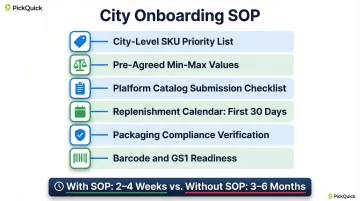
Brands that struggle to replicate inventory success across new cities typically lack documented standard operating procedures. Each new city launch becomes a from-scratch exercise taking 3-6 months instead of weeks, accumulating errors that hurt early availability metrics.
What a city onboarding SOP should include:
- City-level SKU priority list (not all SKUs need day-1 launch)
- Pre-agreed Min-Max values based on expected demand tier
- Platform catalog submission checklist
- Replenishment calendar for the first 30 days
- Packaging compliance verification workflow
- Barcode and GS1 readiness confirmation
Standard onboarding timelines range from 4 to 12 weeks, but brands with repeatable onboarding playbooks—or operator partners with pre-existing infrastructure—can go live in 2-4 weeks. The difference between months and weeks compounds when scaling to 5+ cities simultaneously.
How to Know If Your Multi-Location Inventory Strategy Is Working
Track three core KPIs to measure inventory performance:
1. Platform-Level In-Stock Rate (Availability %) Per Dark Store
Benchmark: Maintain 95-98% availability across all active dark stores. Industry best practice suggests 95-98% On-Shelf Availability (OSA) as optimal performance. Below 90% triggers algorithmic penalties on most platforms.
2. Inventory Turnover Rate Per SKU Per City
Benchmark: High-velocity FMCG and dairy SKUs should turn over every 3-7 days in Quick Commerce, compared to 15-30 days in traditional retail. Slower turnover indicates overstocking or poor demand forecasting.
3. Stockout Frequency
Benchmark: Zero stockouts per SKU per month at the dark store level. Even a single stockout event can suppress rankings for weeks.
Review performance separately by city and platform. A brand can have 95% availability on Blinkit in Mumbai while running chronic stockouts on Zepto in Pune—only location-level reporting catches this discrepancy.
That city-level visibility also has a direct impact on ad performance. On Blinkit, ads only surface in pincodes where products are physically present—if stock is out locally, ad spend goes to zero no matter the budget. Brands with strong availability see better returns on platform ad spend because impressions convert at higher rates.
Conclusion
Multi-location inventory management in Quick Commerce is directly tied to algorithmic ranking, conversion rates, and city-level growth. Availability directly drives discoverability, conversion, and customer loyalty on QC platforms where algorithmic ranking rewards operational excellence.
The seven best practices covered in this guide work as a connected system:
- Centralized visibility across all dark store locations
- Standardized catalogs to maintain platform consistency
- Location-specific Min-Max rules calibrated to local demand
- Demand forecasting to stay ahead of replenishment cycles
- Centralized procurement to consolidate purchasing power
- Regular availability audits to catch stockouts early
- City onboarding SOPs to replicate success at scale
Brands that implement all seven build compounding operational advantages as they expand to new cities — converting inventory management from reactive firefighting into a repeatable growth playbook.
For brands scaling across multiple QC platforms and cities, PickQuick handles dark store replenishment, Min-Max optimization, and city-level onboarding across Blinkit, Zepto, Swiggy Instamart, and JioMart — so your team stays focused on expanding GMV, not managing operational complexity. Get in touch to learn how PickQuick's centralized inventory management supports multi-city Quick Commerce expansion.
Frequently Asked Questions
What is multi-location inventory management?
Multi-location inventory management is the process of tracking, replenishing, and optimizing stock across multiple locations simultaneously. In Quick Commerce, this means managing inventory across dark stores in multiple cities and platforms like Blinkit, Zepto, and Swiggy Instamart from a centralized operational view.
How do you manage inventory across multiple dark stores efficiently?
Efficient dark store inventory control comes down to three levers:
- Centralized dashboard — real-time stock visibility across all locations
- Location-specific Min-Max rules — calibrated to each store's demand velocity
- Standardized replenishment schedule — running multiple cycles daily
What is Min-Max optimization in Quick Commerce?
Min-Max optimization sets minimum stock thresholds (triggering replenishment) and maximum stock limits (preventing overstock) for each SKU at each dark store location, calibrated to that specific location's demand velocity.
How does stockout affect a brand's ranking on Quick Commerce platforms?
QC platforms use in-stock availability as a ranking signal—brands with frequent stockouts are deprioritized in search results, reducing impressions and conversion even after stock is restored. Blinkit demotes brands whose fill rate drops below 80%, requiring sustained 90%+ availability for optimal placement.
What is the difference between centralized and decentralized inventory control for multi-city brands?
Centralized control means procurement, replenishment, and catalog management are coordinated from a single team or operator, while decentralized means each city or distributor manages independently. Centralized control is more efficient and scalable for QC operations, enabling consolidated purchasing and consistent availability metrics.
How long does it typically take to onboard a new city on Quick Commerce platforms?
Without a standardized SOP or existing operator infrastructure, city onboarding typically takes 3-6 months. Brands with documented playbooks and pre-existing platform relationships can compress this to 2-4 weeks.