Key Takeaways
- QC seller onboarding covers everything needed to get your brand registered, listed, stocked, and live across platforms like Blinkit, Zepto, Swiggy Instamart, and JioMart
- Key steps include KYC and documentation, catalog setup, dark store inventory allocation, pricing compliance, and go-live activation
- Poor onboarding creates listing rejections, out-of-stock penalties, low visibility, and delayed revenue
- Your go-live speed depends on catalog readiness, dark store relationships, pricing compliance, and platform-specific content standards
- Brands working with experienced QC operators go live 3–5x faster and face fewer post-launch issues
What Is the QC Seller Onboarding Process—and Why Does It Matter?
QC seller onboarding is the structured workflow that takes your brand from "intent to sell" to "live and fulfilling orders" on platforms like Blinkit, Zepto, Swiggy Instamart, or JioMart. It covers identity verification, catalogue submission, inventory seeding, pricing setup, and activation.
How QC Onboarding Differs from E-Commerce
Traditional e-commerce platforms rely on centralised warehouses where inventory sits until an order arrives. Quick commerce platforms work differently — through dark stores, micro-fulfilment centres serving specific pincodes within a 2–3 km radius. Your brand must be allocated to specific dark stores in specific pincodes, which makes supply chain integration a core part of onboarding, not an afterthought.
A product is only "available" to a customer if it's physically stocked in the dark store serving their pincode — your national warehouse inventory simply doesn't exist on these platforms. That hyperlocal reality changes everything: how you plan inventory, structure your catalogue, and sequence fulfilment.
Why Onboarding Quality Impacts Your Performance
Brands that onboard with incomplete catalogues, poorly structured content, or poor stock planning suffer immediate consequences:
- Low search visibility from day one
- High out-of-stock rates that compound over time
- Lower conversion during the critical first weeks when the algorithm is learning your SKUs
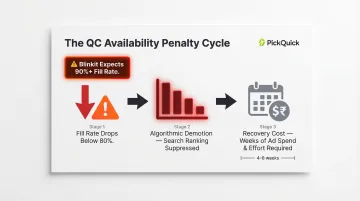
Blinkit expects brands to maintain a fill rate above 90%; falling below 80% triggers algorithmic demotion, reducing search ranking and ad visibility. A 24 to 72-hour stockout can require weeks of consistent performance and elevated advertising spend to rebuild lost organic ranking.
How the QC Seller Onboarding Process Works
While each platform has slightly different portals and requirements, the core onboarding flow across Blinkit, Zepto, Swiggy Instamart, and JioMart follows a predictable sequence. Understanding this end-to-end flow helps you avoid delays and prepare the right inputs at each stage.
On QC platforms, onboarding isn't just about listing products — it also involves the operational backend: dark store assignments, Min-Max inventory settings, and replenishment cadences. These operational elements are often the least understood parts of the process for first-time brands.
Step 1: Brand Registration and KYC
Platforms require strict regulatory compliance because they operate as B2B2C models where brands supply inventory directly to platform-owned or franchised dark stores.
Mandatory documentation typically includes:
- GSTIN certificate
- Business PAN card
- Bank account details (cancelled cheque)
- Trademark or brand authorisation letter
- FSSAI Central License (for food/FMCG brands)
- Authorised signatory details
The most significant compliance challenge is APOB (Additional Place of Business) registration. Under GST rules, if you store goods in a third-party warehouse — like a Blinkit dark store — in a different state, that location must be declared as an APOB. Registration takes 1–3 weeks per state. Initiating it late is the primary cause of go-live delays.
Incomplete or inconsistent documentation is the most common bottleneck here. Mismatches between your GSTIN, PAN, and bank account details trigger manual verification queues that add days to your timeline.
Step 2: Catalog Creation and Content Standards
Each QC platform has specific catalog requirements: product titles, image dimensions, weight/volume declarations, HSN codes, and category mapping. Content errors at this stage lead to listing rejections or poor organic search visibility once live.
Mandatory catalog elements include:
- Brand name, product name, variant, and pack size
- High-resolution images (Front of Pack, Back of Pack, Picker Image, Barcode Image)
- MRP, selling price, and landing price
- Dimensions and gross weight
- HSN code and GST classification
- Shelf life, ingredient list, and FSSAI details
- Accurate category mapping
Common content mistakes:
- Omitting pack size from the title — listing "Goldie Chilli Powder" instead of "Goldie Chilli Powder 100g" directly reduces search discoverability
- Placing a masala product under "Spices & Seasonings" instead of "Blended Masalas" — wrong category mapping affects platform recommendations and search ranking
Platforms require GS1-standard barcodes (GTIN-13/EAN-13) on every SKU. Non-compliant barcodes or tampered MRP labels trigger inwarding rejections at the dark store.
Step 3: Dark Store Allocation and Inventory Seeding
This step is unique to QC — and the most operationally complex. The platform assigns your brand to specific dark stores in target pincodes based on demand data, and you must deliver initial inventory stock to those stores.
Platforms typically start new brands with a trial cluster of 10–15 dark stores rather than a citywide launch. This seeding phase tests four performance metrics before expanding your footprint:
- Sales velocity
- Picker accuracy
- Availability maintenance
- Packaging quality
Strong performance across trial stores triggers automatic expansion to additional dark stores and pincodes.
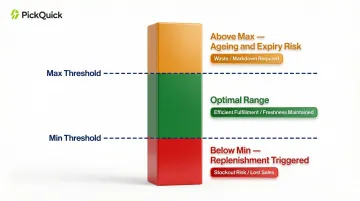
Getting Min-Max quantities right from day one prevents out-of-stock penalties and availability metric drops:
- Min — the inventory threshold at which a dark store triggers a replenishment order
- Max — the ceiling on how much stock that store can hold
- Setting Max too low increases stockout risk; setting it too high creates ageing and expiry penalties
Step 4: Pricing, Margin, and Platform Compliance Setup
You must configure your MRP, selling price, and platform-specific discounts while accounting for commission structure, introductory promotional requirements, and competitive pricing benchmarks in your category.
Pricing components:
- MRP — printed on pack (Maximum Retail Price)
- SP — what customers pay on the platform (Selling Price)
- LP — what the platform pays you (Landing Price)
LP-SP alignment is critical. Incorrect landing prices create Debit Notes (DN) and Credit Notes (CN) that cause payout friction. Pricing misalignment is a frequent reason brands lose "in-stock" positioning to competitors early on.
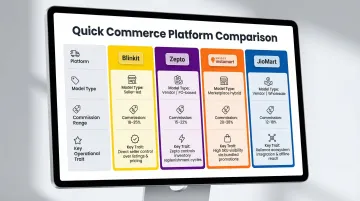
Commission structures vary by platform and price tier:
- Blinkit: 2% to 18% based on price tier
- Zepto: 8% to 25%
- Swiggy Instamart: 15% to 25%
- JioMart: Platform-negotiated rates
Step 5: Go-Live Activation and Initial Visibility Optimisation
At go-live, your listings become discoverable, orders begin flowing, and the platform's ranking algorithm starts evaluating availability, conversion rate, and order fulfilment speed.
The first 2–4 weeks establish your platform rank. Launch with your highest-demand SKUs — not your full catalog. Too many SKUs thin inventory across dark stores and push up out-of-stock rates; too few leaves demand on the table.
Identify your 10–20 highest-velocity SKUs from offline or general trade data and prioritise those for QC launch. Going live with a focused, well-stocked set of high-demand products in fewer pincodes outperforms a scattered launch across many SKUs and markets.
Key Factors That Affect QC Onboarding Outcomes
Catalog Readiness
Brands with incomplete, inconsistent, or unformatted product data experience the longest onboarding delays. Platform review queues reject non-compliant listings, and each resubmission cycle adds days to the go-live timeline.
What slows approval:
- Wrong images or missing image types (FOP, BOP, Picker, Barcode)
- Missing product attributes (pack size, weight, shelf life)
- Incorrect HSN codes or GST classification
- Poor barcode scanability or non-GS1 barcodes
- Weak FSSAI manufacturing print quality
Dark Store Relationships and Operator Access
Brands with no prior QC experience often underestimate how critical pre-existing relationships with dark store managers and platform category teams are. Getting allocated to the right dark stores in high-demand pincodes requires negotiation, data, and operator-level access that new brands typically don't have.
Specialized QC operators who already hold operator rights across thousands of pincodes can dramatically shorten this step for regional brands entering new cities. PickQuick's existing operator rights across 10,000+ pincodes enable 3-5x faster go-live compared to brands onboarding independently.
Platform-Specific Requirements
Blinkit, Zepto, Swiggy Instamart, and JioMart each have different seller portals, content standards, commission structures, and compliance checklists. Brands attempting to onboard across multiple platforms simultaneously without platform-specific expertise often create inconsistencies that slow approval times.
Platform differences:
- Blinkit: Seller-led model with strict LP-SP alignment requirements
- Zepto: Vendor/PO model, difficult to list but easy to expand once listed
- Swiggy Instamart: Vendor/PO model emphasising availability over sales velocity
- JioMart: Marketplace format emphasising bulk pack sizes and monthly purchasing patterns
SKU Selection and Initial Inventory Depth
Launching with too many SKUs leads to inventory thinning across dark stores and high out-of-stock rates. Launching with too few misses demand.
How to approach initial SKU selection:
Start with your highest-velocity offline SKUs first. Use your general trade or modern trade sales data to identify the 10-20 SKUs with the strongest repeat demand. These are the products that will establish your operational discipline and earn platform trust before you expand breadth.
Replenishment Planning from Day One
Brands that don't establish a replenishment cadence before go-live run out of stock in their first week. Poor availability metrics follow quickly, and platforms can de-list brands from high-demand pincodes as a result.
What platforms expect:
- Blinkit's RO (Replenishment Order) cycles run multiple times daily
- Consistent stock flow from motherhubs to dark stores signals operational maturity
- Clean GRNs, low DN scores, and zero ageing inventory reduce platform risk
- Strong availability and stable ROs earn Max level increases, which set how much inventory dark stores can pull from motherhubs
Common Mistakes Brands Make During QC Seller Onboarding
Treating QC Onboarding Like Standard E-Commerce Onboarding
Brands accustomed to listing on Amazon or Flipkart assume QC platforms work similarly. They underestimate the operational complexity of dark store logistics, multi-platform content standards, and availability-driven ranking systems. This leads to under-preparation and costly delays.
The key difference: E-commerce platforms reward sales velocity and customer reviews. QC platforms reward availability and fulfilment speed. Blinkit prefers a brand with 400 orders/day and 98% availability over a brand with 1,200 orders/day and 60% availability.
Attempting Multi-Platform Onboarding Simultaneously Without a Coordinated Plan
Brands that try to go live on Blinkit, Zepto, and Swiggy Instamart at the same time without a centralized operations setup stretch resources across catalog management, inventory allocation, and compliance — resulting in poor listings and stockouts on every platform simultaneously.
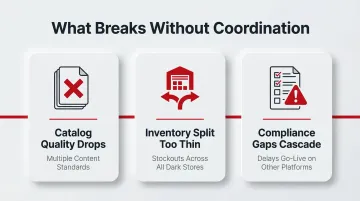
Without coordination, three things break at once:
- Catalog quality drops as teams rush to meet multiple content standards
- Inventory gets split too thin, triggering stockouts across all dark stores
- Compliance gaps on one platform delay go-live on others
Standard onboarding takes 20 to 45 days per platform. Managing simultaneous onboarding across four platforms without coordination extends timelines to 2-3 months and creates operational chaos.
Confusing Go-Live with Completion
Onboarding doesn't end when your products appear on the platform. The post-go-live period (first 4-6 weeks) is when availability scores, conversion rates, and fulfilment speed are being established and ranked. Brands that don't manage this phase actively often see early listings deprioritised by the algorithm.
The algorithm evaluates post-launch performance to decide whether you get broader distribution:
- Strong performance — expands your Max limits and increases dark store allocation
- Poor performance — shrinks your Max, reduces store count, and caps your scale potential
Best Practices to Accelerate QC Seller Onboarding
Prepare a QC-Ready Catalog Before Approaching Any Platform
The single highest-impact action before initiating onboarding is preparing platform-compliant product data. This means standardised titles with pack sizes, high-resolution images on white backgrounds, correct HSN and FSSAI details, and accurate weight/volume declarations.
What QC-ready looks like:
- GS1-registered barcodes on every SKU
- Four image types per SKU (FOP, BOP, Picker, Barcode)
- Clear FSSAI manufacturing details and expiry date visibility
- Carton labelling with barcode, product name, batch, MRP, and expiry
- Packaging strength validated for drop resistance and unit hygiene
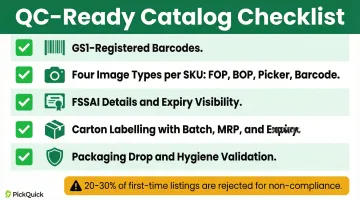
Platforms typically reject 20-30% of first-time listings for missing or non-compliant data — getting this right upfront eliminates that delay entirely.
Start with a Focused SKU Set in High-Demand Pincodes
Identify your 10-20 highest-velocity SKUs from offline or general trade data and prioritise those for QC launch. Going live with a focused, well-stocked set of high-demand products in fewer pincodes outperforms a scattered launch across many SKUs and markets.
PickQuick uses pincode-level demand visibility to decide initial assortment, concentrating stock in high-demand pincodes where velocity signals are strongest rather than deploying inventory uniformly across a city.
Use Operator-Level Partnerships to Bypass the Steepest Onboarding Hurdles
Brands with no existing QC presence can cut their onboarding timeline by weeks by working with an established QC operator. An operator with pre-existing relationships brings three things a brand cannot build quickly on its own:
- Pre-negotiated dark store allocations and platform category team access
- Compliant catalog templates that pass first-time listing checks
- Operator rights to regional brands that eliminate the discovery and negotiation phase
PickQuick manages 25+ category-leading brands across 10,000+ pincodes, getting brands live across QC platforms in weeks rather than months — including plug-and-play regional depth when platforms expand into new cities.
Establish a Replenishment and Availability Management System Before Go-Live
Set Min-Max inventory levels per dark store, schedule regular replenishment runs, and track availability metrics in your first month. Brands that treat availability as a KPI from day one maintain stronger platform rank and avoid the out-of-stock penalties that derail early momentum.
Best practices for replenishment:
- Use Daily Run Rate (DRR) tracking rather than weekly stock reviews
- Monitor real-time availability at pincode and store level
- Maintain predictable replenishment cycles that signal platform algorithms about brand reliability
- Prevent motherhub ageing by matching supply to dark store consumption velocity
- Track Discrepancy Notes (DN) and resolve inwarding issues immediately
Blinkit will not expand brands that create work for their motherhub teams. Clean inwarding and packaging compliance are what separate brands that scale regionally from those that stall at a handful of dark stores.
Frequently Asked Questions
What is the seller onboarding process?
Seller onboarding on QC platforms is the step-by-step process of registering your brand, submitting documentation and catalog data, allocating inventory to dark stores, configuring pricing, and activating listings. It covers both compliance requirements (GSTIN, FSSAI, barcodes) and operational setup (dark store allocation, Min-Max planning, replenishment cadence) unique to quick commerce.
How long does it take to onboard a brand on Blinkit or Zepto?
Onboarding timelines range from 4 to 12 weeks depending on catalog readiness, documentation completeness, and dark store availability. Blinkit's standard timeline is 20 to 45 business days; Zepto can onboard brands within 15 business days if selection criteria are met. Operators with pre-existing platform relationships and ready catalog infrastructure can compress this to 2 to 3 weeks.
What documents are required for QC platform seller onboarding?
Standard documentation includes GSTIN, PAN, FSSAI (for food/FMCG brands), trademark registration, cancelled cheque, and authorised signatory details. Food brands also need to ensure products have a minimum shelf life of 30% or at least 45 days remaining before expiry at delivery. Requirements may vary slightly by platform, and APOB registration is mandatory for multi-state dark store supply.
Can a brand onboard on multiple QC platforms at the same time?
Simultaneous multi-platform onboarding is possible but requires a coordinated approach. Each platform has different portals, content standards, and compliance requirements. Without a centralized operator managing each portal in parallel, brands routinely see timelines stretch by two to three months from mismatched content and compliance gaps.
What are the most common reasons brands fail or stall during QC onboarding?
The top failure points are incomplete catalog data, missing KYC documentation, no dark store inventory plan, and pricing misalignment. Poor motherhub inwarding quality—carton labelling errors, barcode scanability issues, weak packaging—triggers listing rejections and post-go-live out-of-stock penalties more than any other operational mistake.
What happens after a brand goes live on a Quick Commerce platform?
The post-go-live phase involves active availability management, replenishment cadence execution, and performance monitoring. The platform's algorithm ranks listings based on availability, conversion rate, and fulfilment speed. Brands that hold high availability and replenishment discipline through the first 4 to 6 weeks earn Max expansion and broader dark store allocation—setting the trajectory for long-term visibility.