Introduction
Quick commerce has fundamentally changed how products reach customers. Behind every 10-minute delivery is a fulfillment node most brands never see: either a dark store or a micro fulfillment center. These two models form the backbone of India's ₹6-7 billion quick commerce market, which captured over two-thirds of all e-grocery orders in 2024 and is projected to grow at over 40% annually through 2030.
For brands, this comparison is operational, not academic. The type of node your products are stocked in directly affects availability metrics, replenishment cycles, and sales velocity across platforms like Blinkit, Zepto, and Swiggy Instamart.
In India's quick commerce ecosystem, dark stores dominate by a wide margin:
- Blinkit: 1,301 dark stores
- Swiggy Instamart: 1,021 dark stores
- Zepto: 1,000+ dark stores
Understanding how these fulfillment models work determines whether your brand holds the 98% availability that platforms prioritize or enters the stockout cycle that stalls category growth.
Key Takeaways
- Dark stores are repurposed retail spaces for online-only fulfillment: manual or semi-automated picking, typically 3,000–15,000 sq. ft.
- MFCs use robotics and vertical storage in 3,000–10,000 sq. ft. to maximize picking speed through automation
- Core difference: dark stores prioritize flexibility and lower setup costs; MFCs prioritize throughput speed and automation
- In India, dark stores are the dominant model—all major QC platforms operate through dark store networks
- Brand success on either model comes down to replenishment discipline and consistent availability
Dark Stores vs Micro Fulfillment Centers: Quick Comparison
Here's how the two models stack up across the dimensions that matter most for quick commerce operations.
| Category | Dark Store | Micro Fulfillment Center |
|---|---|---|
| Business Model | Converted or purpose-built retail space for online order picking only; no consumer access; shelf layouts optimized for picker routing | Small warehouse engineered for automated high-speed fulfillment near urban demand clusters; minimal human labor |
| Typical Size | 3,000–15,000 sq. ft.; often repurposed retail or commercial space in urban/peri-urban zones | 3,000–10,000 sq. ft.; standalone or embedded within larger stores; Fabric's MFCs go as small as 6,000 sq. ft. |
| Automation Level | Variable — fully manual to lightly automated; Zepto's pan-India automation improved outbound productivity by 45% | Highly automated — robotics, AS/RS systems, conveyors, AI slotting; Exotec's Skypod picks up to 600 bins/hour |
| Setup Cost | ₹20–40 lakhs ($25,000–$50,000); lower when repurposing existing space; higher per-order cost at scale | ₹2.5–4.2 crore ($3–5 million) capex; lower per-order cost at volume — drops to $0.13 vs. $0.49 for manual picking |
| Fulfillment Speed | Suited for 10–30 min delivery; Swiggy Instamart averaged 13 minutes nationally (September 2024) | Engineered for sub-10-min order prep; Carrefour's Exotec deployment retrieves any SKU within 2 minutes |
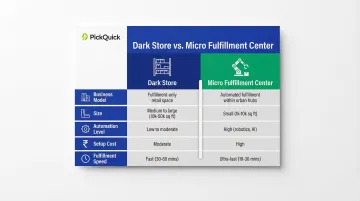
Scale reference: Blinkit operates 1,301 dark stores covering 5.2 million sq. ft.; Swiggy Instamart runs 1,021 stores across 4 million sq. ft. — both at the high end of the dark store model.
What is a Dark Store?
A dark store is a fulfillment-only facility closed to the public, where staff pick, pack, and dispatch online orders. The layout typically resembles a retail store—aisle-based shelving—but is optimized for picker routing, not customer browsing. According to MHI Solutions, dark stores serve as "small warehouses or distribution centers, using automated material handling equipment and small staff to process high volumes of orders," strategically located in densely populated communities to enable faster delivery.
The model accelerated sharply post-pandemic when lockdowns pushed consumers toward online shopping and quick-commerce platforms emerged to satisfy instant delivery needs. In India, QC platforms like Blinkit (formerly Grofers), Zepto, and Swiggy Instamart built their entire fulfillment networks on the dark store model from the ground up rather than converting existing retail space.
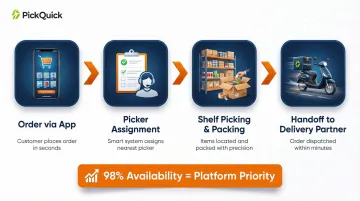
Operational structure:
- Orders come in via app
- Picker receives assignment
- Picks items from shelves
- Packs and hands to delivery partner
Dark stores can operate with minimal to moderate automation, making them accessible for regional operators. India's two largest QC networks show how fast this model scales:
| Platform | Active Dark Stores | Cities | Total Footprint |
|---|---|---|---|
| Blinkit (March 2025) | 1,301 | 100+ | 5.2 million sq. ft. |
| Swiggy Instamart | 1,021 | 124 | 4 million sq. ft. |
Swiggy has also shifted from 2,500–2,800 sq. ft. stores to larger 3,500–4,500 sq. ft. formats to support higher SKU counts.
Use Cases of Dark Stores
Dark stores excel in high-SKU environments where product variety matters more than pure picking speed. Grocery, FMCG, personal care, and food staples benefit from shelf-based layouts that accommodate large assortments more easily than automated MFCs.
SKU capacity varies widely by store format:
- Standard dark stores: 8,000–15,000 SKUs
- Blinkit's current catalog: 30,000+ products
- Swiggy Instamart "Megapods" (8,000–12,000 sq. ft.): 50,000+ SKUs
Dark stores are the backbone of quick commerce in India. Every major QC platform node operates as a dark store by design, whether it's a Blinkit hub or a Zepto fulfillment point. For brands, this means their products live in a dark store by default the moment they list on these platforms.
Critical operational consideration: Since dark stores depend on human pickers, availability (in-stock rate) is a direct function of how reliably inventory is replenished. Blinkit's internal ranking system prioritizes availability above all other factors—the platform prefers a brand with 400 orders/day and 98% availability over a brand with 1,200 orders/day and 60% availability. Stockouts trigger visibility drops and Max level reductions, directly limiting expansion potential.
What is a Micro Fulfillment Center?
A micro fulfillment center (MFC) is a compact, technology-driven fulfillment node typically under 10,000 sq. ft., designed to process high volumes of orders with minimal human labor. AutoStore describes them as "a dedicated space for grocers to store and process goods to be sold online," using "a strategic combination of warehouse robotics and humans to fulfill each order." Attabotics adds that they are "geographically located within city limits to put inventory closer to customers to allow faster delivery and returns."
MFCs use robotics (such as automated storage and retrieval systems), vertical shelving, and AI-driven slotting to achieve picking speeds that manual workers cannot match. Because MFCs process orders automatically, they can handle rapid demand spikes without proportionally increasing labor.
Global market projections indicate strong investment momentum:
- Mordor Intelligence: $8.54 billion (2026) → $25.89 billion (2031) at 24.84% CAGR
- Grand View Research: $4.67 billion (2023) → $37.74 billion (2030) at 34.8% CAGR
- Interact Analysis: $3.5 billion by 2030 at 65% CAGR
Technology providers and deployments:
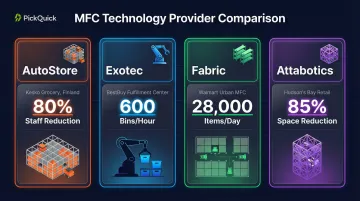
- AutoStore: Dense cube storage deployed by Finnish grocer Kesko, reducing same-day delivery time to 6 hours and cutting in-store picking staff by 80%
- Exotec: Skypod system picking 600 bins per hour; Carrefour's French deployment processes over 630 order lines per hour with just two employees in 6,662 sq. ft.
- Fabric: Solutions as small as 6,000 sq. ft.; Dallas deployment processes 28,000 items per day in 13,000 sq. ft.
- Attabotics: 3D robotic supply chain system deployed by Nordstrom to reduce space requirements and speed deliveries
While MFCs are expanding rapidly in the US and Europe, India's QC platforms currently operate primarily on dark store models. MFC-style automation is beginning to appear in larger fulfillment hubs—Zepto recently automated its pan-India supply chain, processing 2.5 million FMCG units daily and improving outbound manpower productivity by more than 45%.
Use Cases of Micro Fulfillment Centers
MFCs work best for categories with concentrated SKU demand, high order frequency, and tight delivery windows: grocery, pharmacy, or top-selling FMCG items where automation can be calibrated around predictable demand patterns.
Key characteristics that define where MFCs fit:
- SKU range: Fabric's MFCs support 5,000–40,000 SKUs; Carrefour's Exotec deployment stores 165,000+ items in 6,662 sq. ft.
- Capital requirement: Higher upfront investment than dark stores; requires deep demand forecasting to justify automation costs
- Who operates them: Platform-level infrastructure and large-scale retailers — not individual brands
The economics favor established operators, not early-stage entrants.
Practical distinction for brand teams: Brands don't choose whether they're stocked in an MFC or dark store—the platform decides the infrastructure. What brands control is how well their SKUs are positioned, priced, and replenished within whatever node they're assigned to.
Dark Store vs Micro Fulfillment Center: What Works Better for Your Brand?
The comparison factors that actually affect brand outcomes extend beyond infrastructure specs. Key considerations include delivery speed, replenishment complexity, SKU assortment flexibility, cost implications passed to brands (platform fees, storage), and availability reliability.
Fulfillment Outcomes: Manual vs. Automated
Implementing MFC automation yields measurable improvements:
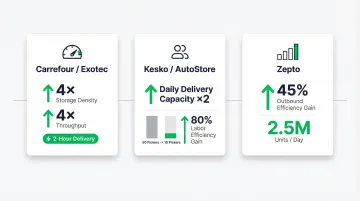
- Carrefour (Exotec): 4x storage density increase, 4x throughput improvement, enabling 2-hour home delivery by accessing any SKU within two minutes
- Kesko (AutoStore): Doubled daily delivery capacity, reduced in-store pickers from 50 to 10
- Zepto: 45% increase in outbound manpower efficiency after scaling automation pan-India
For brands operating on Indian QC platforms today, the dark store model is the operational reality. The more relevant question is not "which model" but "how do I perform better within the dark store infrastructure?" Key levers include Min-Max inventory optimization, timely replenishment, and strong availability metrics.
Situational Guidance for New Geographies and Hybrid Models
MFC-style thinking becomes relevant when a brand's product is among the top 50 SKUs in a category and a platform decides to automate its picking.
For brands expanding quickly across cities, multi-node dark store coverage delivers speed-to-market faster than waiting for MFC infrastructure to mature. Dark stores enable rapid, low-cost network expansion — critical during India's current land-grab phase — while automated MFCs significantly cut variable per-order picking costs at scale.
Real-World Impact
Zepto's automation rollout is the clearest illustration of this in action. Processing 2.5 million FMCG units daily through automated systems, the platform achieved 45% productivity gains while maintaining flexibility across a wide SKU assortment. That combination — network density plus selective automation — is where India's QC infrastructure is heading.
Managing dark store replenishment across multiple platforms and pincodes is operationally demanding. Brands working with a dedicated QC operator like PickQuick can achieve stable availability metrics without building that capability in-house — going live in weeks rather than months through pre-optimized catalog setup, Min-Max planning, and unified platform management.
Conclusion
Dark stores and MFCs are not competing choices for brands—they represent different layers of the QC supply chain. For most regional and national FMCG brands in India, the dark store is the operative model today. Success within it depends on replenishment discipline, assortment planning, and platform relationships.
Across dairy, masala, and personal care categories alike, the common thread is availability. Platforms prioritize it above everything else—and the consequences of getting it wrong are immediate:
- Maintaining 98%+ in-stock rates unlocks store expansion and better visibility
- Stockouts trigger visibility drops that suppress discovery
- Repeated gaps lead to Max level reductions that stall growth
Getting availability right within the dark store framework is what separates brands that scale from those that plateau.
Frequently Asked Questions
What is the difference between a dark store and a micro-fulfillment center?
Dark stores are converted or purpose-built retail spaces used only for fulfilling online orders with manual or semi-automated picking, typically 3,000–15,000 sq. ft. MFCs are compact, highly automated facilities using robotics for faster throughput, typically under 10,000 sq. ft. Dark stores offer more assortment flexibility and lower setup costs; MFCs offer more speed at scale.
What is a micro-fulfillment center?
A micro-fulfillment center is a small-footprint facility (typically under 10,000 sq. ft.) that uses robotics and AS/RS systems to pick and pack online orders rapidly. Positioned near urban consumer clusters, MFCs enable same-day or ultra-fast delivery while keeping per-order costs low at high volumes.
What is the main purpose of a micro-fulfillment center?
The primary purpose is to cut order preparation time and last-mile delivery distance by placing automated fulfillment infrastructure close to customers. Automation makes a measurable difference here—automated picking can cost 70–75% less per order than manual picking at equivalent volumes.
What is the difference between a dark store and a warehouse?
A warehouse is a large-scale storage facility focused on bulk inventory holding and outbound distribution, typically located near transportation hubs. A dark store is a smaller, customer-proximate facility (3,000–15,000 sq. ft.) designed exclusively for picking and dispatching individual online orders rapidly.
What is the difference between a distribution center (DC) and a fulfillment center (FC)?
A distribution center handles bulk goods movement between supply chain nodes (manufacturer to retailer), dealing in pallets and cases. A fulfillment center processes individual consumer orders directly (B2C), handling small, item-level orders. Dark stores and MFCs are specialized types of fulfillment centers optimized for speed and urban proximity.
Which model is more relevant for brands selling on Quick Commerce platforms like Blinkit and Zepto?
In India's QC ecosystem, dark stores are the dominant model used by all major platforms—Blinkit operates 1,301, Swiggy Instamart runs 1,021, and Zepto manages 1,000+. Brands should focus on excelling within the dark store model through strong replenishment practices and availability management rather than choosing between models.