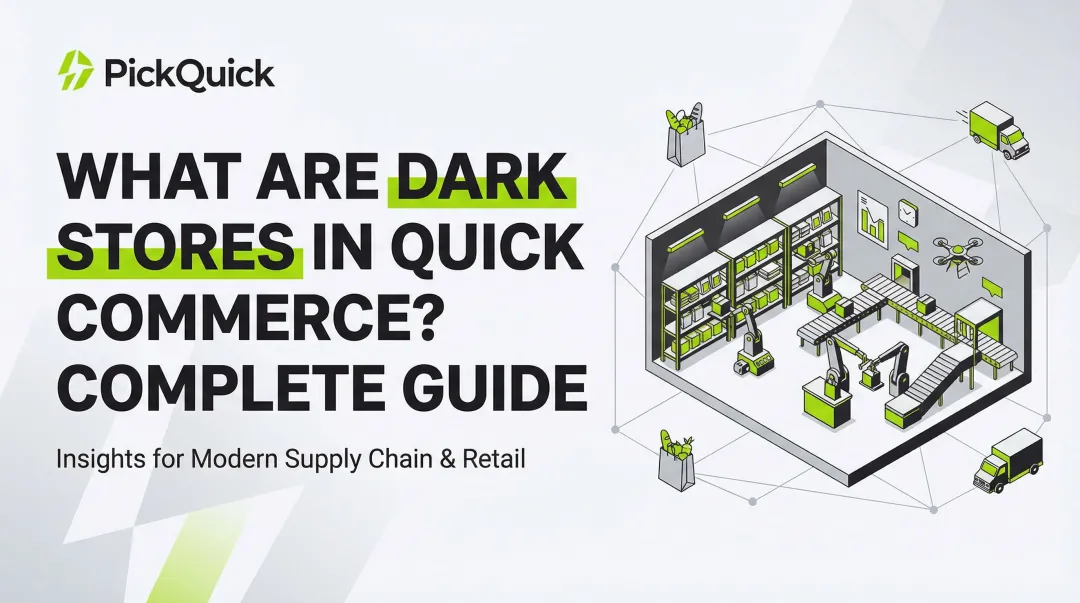
This is the operational reality of seasonal planning on India's quick commerce platforms. Unlike traditional retail, where stockouts mean delayed revenue, QC stockouts trigger algorithmic penalties that compound losses far beyond the event itself. Dark stores operate with finite SKU slots and replenishment cycles measured in hours, not days. When demand spikes during Diwali, Holi, or IPL season, there's no safety net.
This guide provides a practical framework for forecasting seasonal demand and managing dark store inventory across Blinkit, Zepto, and Swiggy Instamart — timed to India's festival calendar and built for the operational constraints QC platforms impose.
Key Takeaways
- QC demand spikes harder and faster than retail, with limited reactive restocking windows
- Forecasting accuracy depends on historical sell-through data, platform signals, and pincode-level demand variance
- Min-Max optimization must be recalibrated before peak seasons, not during
- Multi-platform inventory requires SKU-level staggering, not uniform distribution
- Diwali, Navratri, and other peak windows require planning 6–8 weeks out — most brands start too late
Why Seasonal Demand Forecasting on Quick Commerce Is a Different Beast
Unlike traditional retail where stockouts can be covered by nearby stores or reorders within days, QC dark stores operate with finite SKU capacity and replenishment lead times measured in hours. India's quick commerce market reached $6–7 billion in 2024 and is growing at 40% annually — but this growth is built on demand-matched replenishment, not safety stock.
India's festival calendar is one of the most complex forecasting inputs in any market. Each event drives category-specific surges that vary by region, city, and even pincode:
- Pongal spikes staples and masalas in Tamil Nadu while demand holds flat in the north
- Eid drives confectionery and gifting SKUs in UP and Maharashtra but barely registers in Karnataka
- Holi creates a national surge in colours, sweets, and snacks within a 48-hour window
- IPL season and wedding season lift snacks, beverages, and dairy across metro dark stores
Diwali shifts annually — November 12 in 2023, October 31 in 2024, October 20 in 2025 — and lunar calendar drift makes year-over-year comparisons unreliable without date normalization.
Platform availability scores add another layer of pressure. Blinkit requires sustained fill rates above 90%; falling below 80% triggers algorithmic demotion, reducing search rank and removing listings from active pincodes. On Zepto, stockouts cause products to disappear from search results entirely.
A brand that goes out of stock during a 48-hour festive window doesn't just lose those two days of revenue — it loses rank visibility for weeks afterward, compounding losses far beyond the stockout event itself.
Demand compression makes accuracy mission-critical. Unlike multi-week shopping seasons, QC demand surges happen in 48–72 hour windows around key festivals. During Holi 2024, Swiggy Instamart hit 700,000 orders in a single day, while Zepto recorded 600,000 orders. The cost of under-preparation is concentrated and immediate.
Preparing too much carries its own penalties. Typical dark stores stock 2,000 to 12,000 SKUs depending on format and platform. Brands that over-buffer inventory tie up shelf slots, push up storage costs, and block space for faster-moving SKUs — making the balance between too much and too little stock especially critical in this format.
How to Build a Seasonal Demand Forecast That Works for QC Brands
Start with historical sell-through data: pull at least 2 years of platform-level sales segmented by city, pincode cluster, and SKU. The goal is to pinpoint which products spiked, by how much, and how early the surge began relative to each major event.
Brands newer to QC can request category trend data from platform account managers or tap real-time analytics through tools like Zepto Atom, which delivers minute-level updates and PIN-code level performance maps. Either way, the data foundation comes first.
Identify Your Seasonal SKUs First
Not every SKU is seasonal. Segment your catalogue into:
- Evergreen products: steady velocity year-round, minimal demand fluctuation
- Seasonal SKUs: documented 30%+ velocity spike around specific events (Diwali sweets, Holi gulaal, Raksha Bandhan gift packs)
Only seasonal SKUs need aggressive pre-peak stocking. Applying the same logic across your full catalogue leads to waste and tied-up capital.
Factor In Pincode-Level Demand Variance
Aggregated city-level data masks critical micro-patterns. City-level averages can miss up to 21% of recurring stockouts at the hyperlocal level. A premium ghee brand may see 4x demand in South Bengaluru pincodes during Ugadi but flat demand in North Bengaluru.
Pincode-level granularity is what separates accurate forecasting from guesswork. Platform dashboards like Blinkit's Seller Hub surface this data directly; operators like PickQuick track sales, availability, and demand across 10,000+ pincodes at the dark store level, which feeds more precise stocking decisions in the weeks before peak events.
Layer in External Demand Signals
Historical data tells you what happened, not what will happen. Supplement with:
- Festival dates and lunar shifts — Eid-ul-Fitr moved from April 22 in 2023 to March 31 in 2025
- Regional weather patterns — dairy demand shifts with summer heat
- Local events — state elections, IPL finals (IPL evenings see 10–30% order volume increases)
- Platform-run sale events — Blinkit category promotions or Zepto flash sales amplify organic demand unexpectedly
Set Your Forecast Timeline
Planning calendar framework:
- Weeks 1–2 — Data analysis and seasonal SKU identification
- Weeks 3–4 — Supplier PO placement and confirmation
- Weeks 5–6 — Dark store stock loading and Min-Max adjustments
- Weeks 7–8 — Buffer for demand adjustment and reactive restocking
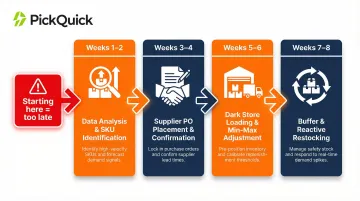
Brands that begin this process 2 weeks before a festival are almost always starting too late. During the 2025 festive season, Blinkit paused new product intake until October 31 due to warehouses at full capacity — highlighting the need for early inventory placement.
Dark Store Inventory Tactics to Survive (and Thrive) During Peak Seasons
Min-Max settings built for average velocity will not hold during a 3x demand spike. Min (minimum stock threshold triggering a replenishment order) and Max (maximum units a dark store can hold for a SKU) must both be recalibrated before peak season begins — not during it.
Failing to adjust these values ahead of time is one of the most common and costly errors brands make. Min-Max values function as store-level holding limits that determine inventory consumption capacity. Max expands only when brands demonstrate zero stockouts, clean GRNs, confirmed ROs on time, and strong velocity. Getting this foundation right unlocks everything else below.
Pre-load Dark Stores Strategically, Not Uniformly
The instinct to push maximum stock to every dark store equally is wrong. Rank dark stores by historical festive-season sell-through velocity for each SKU, then:
- Front-load the top 20–30% of stores first
- Maintain a buffer at regional redistribution points
- Enable reactive restocking to remaining stores as demand materializes
Pincode-level demand data is the right input for this decision. PickQuick uses pincode-level expansion planning to identify which dark stores warrant front-loading and which should receive reactive replenishment — keeping inventory concentrated where velocity actually supports it.
Set Dynamic Reorder Triggers
Static reorder points fail during peak demand because velocity changes too quickly. During the 2-week peak window:
- Switch to daily replenishment review cycles (not weekly)
- Set reorder triggers at a higher percentage of Min stock (e.g., reorder at 60% of Min instead of 30%)
- Prevent stockouts before the next replenishment cycle can arrive
Inventory replenishment in dark stores occurs multiple times daily, with RO cycles running continuously. RO turnaround time directly affects platform rankings, so speed here is not optional.
Manage Shelf Life and Perishability During Peaks
For dairy, masala, and FMCG brands, pre-loading dark stores with high volumes of perishable or shelf-sensitive products (packaged milk, fresh spices, baked goods) carries spoilage risk if demand doesn't materialize as forecast. Wastage for the Fruits & Vegetables category in quick commerce is estimated at 20%.
Batch-and-rotate discipline during the peak window:
- Stagger inflows so earlier stock always moves first
- Track manufacturing dates and expiry visibility at the carton level
- Maintain active inventory ageing control at the motherhub
Once the peak window closes, execute a clearance protocol before dead stock accumulates:
- Trigger platform promotions on near-expiry stock
- Reallocate surplus from low-velocity to high-velocity dark stores
- Reset Min-Max values back to baseline within 48–72 hours of peak close
Build a Post-Peak Wind-Down Plan
Seasonal inventory management doesn't end when the festival does. Excess stock held into the slow season blocks shelf slots, distorts future Min-Max baselines, and ties up working capital. A structured wind-down prevents all three.
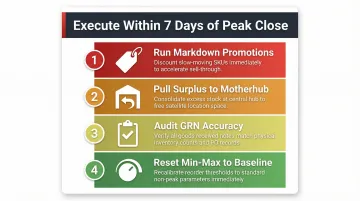
Key actions to execute within the first week after peak:
- Run markdown promotions on near-expiry or slow-moving units before they age out
- Pull surplus inventory back to the motherhub rather than leaving it at low-velocity dark stores
- Audit GRN accuracy and flag any receiving discrepancies from the peak window
- Reset Min-Max values to pre-peak baselines and document the actual peak velocity data for next year's planning
Managing Inventory Across Multiple QC Platforms Simultaneously
Blinkit, Zepto, and Swiggy Instamart each operate different dark store networks with different coverage pincodes, different platform promotion schedules, and different inventory compliance norms. A single brand cannot apply a uniform inventory push across all three and expect consistent results.
Platform footprint and coverage:
| Platform | Dark Stores | Cities Served |
|---|---|---|
| Blinkit | 1,301 (March 2025) | 100+ |
| Swiggy Instamart | 1,021 (March 2025) | 124 |
| Zepto | 1,000+ (October 2025) | 10 |
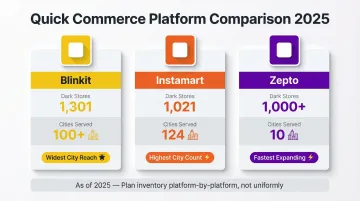
Stock needs to be planned platform-by-platform based on each platform's pincode footprint and historical conversion data. Blinkit localized its 2025 festive calendar across different city newspaper editions, adapting to regional traditions — 'Deepavali' in Bengaluru versus 'Diwali' in Delhi.
The inventory synchronization risk: When brands manage stock separately per platform without a unified view, they over-commit inventory to one platform and run short on another during the same peak event. This cross-platform cannibalisation prevents optimal allocation.
Brands working with PickQuick get a single, consolidated view across all three platforms through the Quick Commerce Control Tower. The operational difference is significant:
- Real-time inventory visibility across all pincodes and platforms
- Smarter stock allocation decisions ahead of and during peak events
- Stable availability metrics instead of reactive firefighting
- One operator relationship replacing three separate vendor conversations with misaligned reporting cycles
Seasonal Inventory Mistakes That Cost Brands Their Rankings
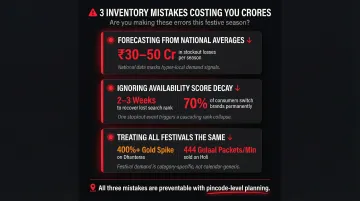
Mistake 1 — Forecasting from national averages: National or citywide average sales data systematically understocks high-demand pincodes while overstocking low-demand ones — creating simultaneous stockouts and dead inventory in the same city. For a typical ₹500 Cr Indian FMCG company, 30% forecast errors lead to ₹30–50 Cr in stockout losses.
Mistake 2 — Ignoring platform availability score decay: Every day a brand is out of stock during a peak window, its platform search rank drops. Even a 24-hour stockout can result in a ranking drop that takes 2–3 weeks to recover. By the time stock is replenished, the brand may sit on page 3 instead of page 1. Clawing that rank back takes weeks of sustained availability, not just a restock. Approximately 70% of consumers switch to a competing brand when their preferred product is unavailable — and most never return.
Mistake 3 — Treating all festivals the same: The data makes the differences hard to ignore. During Dhanteras 2025, gold purchases increased more than 400% YoY on Swiggy Instamart, while Holi saw 444 packets of gulaal ordered per minute. Diwali gifting demand for premium snacks, Navratri's staples surge, and Pongal's dairy spike each follow a different curve. Applying the same inventory multiplier across all three misallocates both budget and stock — every time.
Frequently Asked Questions
How far in advance should brands start planning for seasonal demand on Quick Commerce platforms?
6–8 weeks is the recommended lead time, covering data analysis, supplier ordering, and dark store loading. Brands starting within 2 weeks of a peak event are unlikely to secure adequate supply or adjust Min-Max settings in time to prevent stockouts.
What is Min-Max inventory optimization and why does it matter for dark stores?
Min-Max sets the floor (reorder trigger) and ceiling (maximum stock) for each SKU at each dark store location. Before peak seasons, these thresholds must be raised to match higher velocity — without exceeding the store's physical capacity — to ensure availability without overstocking.
How do seasonal demand spikes differ across Blinkit, Zepto, and Swiggy Instamart?
Each platform has different pincode coverage, consumer demographics, and promotional calendars. The same brand SKU may see its Diwali spike a day earlier on Zepto than on Blinkit, depending on the platform's catalogue push schedule, user base, and regional promotional timing.
What are the biggest inventory mistakes brands make during India's festival season on QC?
The top two mistakes are using city-level averages instead of pincode-level data, and failing to adjust Min-Max settings before the peak window begins. Both cause stockouts during the peak window, triggering algorithmic rank penalties that compound revenue losses.
How does pincode-level demand data improve seasonal forecasting accuracy?
Pincode-level data reveals micro-demand patterns invisible at the city level, allowing brands to pre-load the right dark stores with the right SKUs. This prevents simultaneous stockouts in high-demand pincodes and dead stock at locations where category demand is flat.