Introduction
Quick Commerce has rewritten the rules of consumer intent. On Blinkit or Zepto, the window between "I need milk" and "I've bought milk" is under 10 minutes—and if your SKU is out of stock in that moment, the sale is gone permanently. There's no "notify me when available" button, no wishlist fallback. The customer switches to a competitor or abandons the category entirely.
Most brand teams still talk about inventory in the language of warehouses and purchase orders. They track what's sitting in the motherhub, monitor bulk shipment schedules, and review weekly sales reports. But the metric that actually drives revenue gets missed: whether your product is visible and orderable at the dark-store level, pincode by pincode, right now.
This article breaks down why SKU availability tracking is an operational lever that directly affects revenue, platform rankings, and brand growth on Quick Commerce. You'll see how dark-store-level visibility gaps form, what they cost, and what tracking the right signals actually looks like in practice.
Key Takeaways
- SKU availability tracking monitors whether each product is in stock and visible on QC platforms across specific dark stores and pincodes in real time
- A stockout on Blinkit or Zepto means your SKU vanishes from search results—availability directly drives sales, not just fulfilment
- Core advantages: protecting revenue from stockouts, triggering replenishment before stock runs dry, and keeping SKUs visible on platform search
- Without tracking, replenishment and ad-spend decisions run on stale data—burning budget while sales windows close
- Pincode-level monitoring with fast replenishment cycles captures the most recoverable revenue
What Is SKU Availability Tracking?
SKU availability tracking is the practice of monitoring, at a product-by-product level, whether each SKU is currently in stock and purchasable by a consumer on Quick Commerce platforms. This visibility operates at three levels:
- Dark store: Is the SKU stocked at the specific fulfilment node?
- City: Is availability consistent across all dark stores in a metro?
- Pincode: Can a customer at a specific address actually place an order?
Unlike traditional inventory management, which tracks what's in a warehouse, SKU availability tracking focuses on the consumer-facing layer: what's actually live and orderable on Blinkit, Zepto, Swiggy Instamart, and JioMart at any given moment.
A thousand units sitting in your motherhub mean nothing to a customer in Koramangala if those units haven't reached the local dark store serving that pincode.
This feedback loop tells a brand whether its products are reachable by customers actively searching, and whether replenishment is happening fast enough to sustain revenue. Availability tracking is the mechanism that determines whether your brand is visible, rankable, and converting — at every dark store, every day.
Key Advantages of SKU Availability Tracking
The advantages below are focused on measurable, operational outcomes—not theoretical improvements. They're particularly relevant for brands operating across multiple QC platforms and cities simultaneously, where manual oversight becomes operationally impossible.
Each advantage connects to metrics brand and operations teams typically track:
- Revenue and fill rate
- Platform ranking and organic visibility
- Ad efficiency and ROAS
- Replenishment velocity
Advantage 1: Preventing Stockout-Driven Revenue Loss
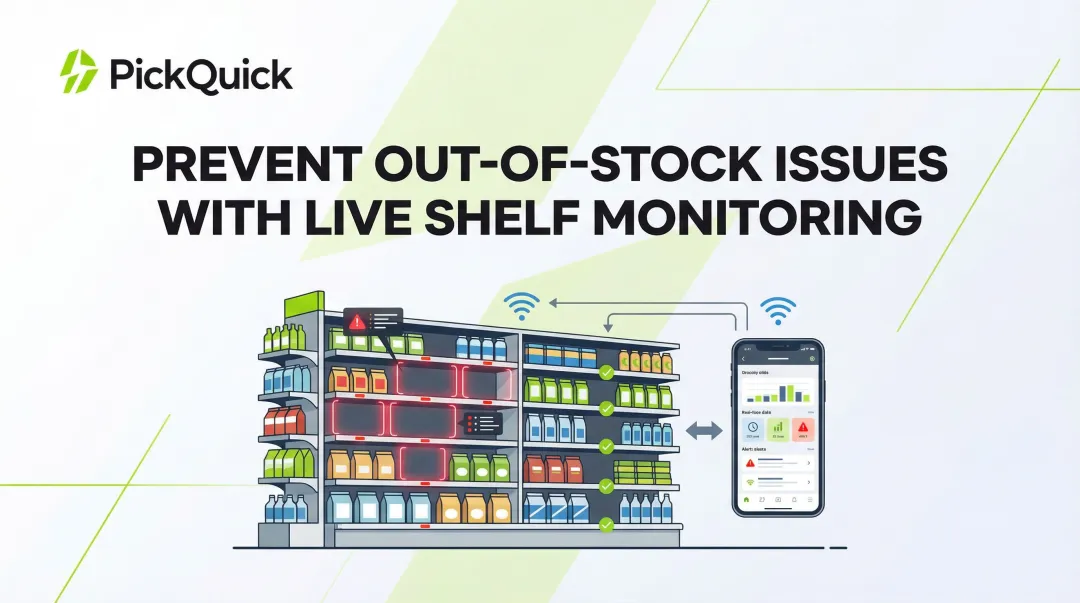
In Quick Commerce, an out-of-stock SKU doesn't show a "sold out" message. It simply vanishes from the platform's listings and search results entirely. A high-intent buyer has no visible path to purchase—they either buy a competitor's product or abandon the category.
Real-time availability tracking surfaces these gaps the moment they occur, rather than hours or days later through sales reports. This allows teams to trigger replenishment before the stockout window widens.
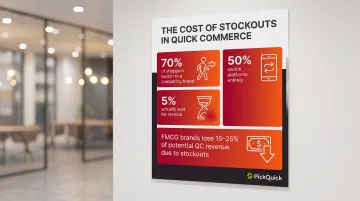
Revenue lost during a stockout window on QC is unrecoverable. 70% of quick commerce shoppers switch to a competing brand when their preferred item is unavailable, and 50% switch platforms entirely. Only 5% are willing to wait for the item to return in stock.
The ad spend problem compounds this. Brands running platform ads for SKUs that are simultaneously out of stock in key pincodes burn budget on clicks that cannot convert. Between 5% and 12% of retail media budgets are wasted advertising out-of-stock products.
Blinkit's ad system is inventory-led: ads only surface in pincodes where the product is physically present in the nearest dark store. If your product is out of stock locally, ad spend is completely suppressed in that area, regardless of your budget.
KPIs impacted:
- Fill rate
- Revenue per SKU
- Availability rate by dark store
- Ad ROAS
- Lost-sale frequency
Most critical during: festivals, weekends, and seasonal spikes — and for high-velocity SKUs where a 6–12 hour stockout dents daily revenue. In dairy and staples, a single stockout breaks habitual reorder loops. The average FMCG brand loses 15–25% of potential quick commerce revenue due to stockout incidents.
Advantage 2: Enabling Smarter Replenishment and Demand Planning
Availability tracking at the pincode or dark-store level provides a granular, real-time signal of where demand is outpacing supply, making it far more actionable than weekly sales reports or aggregate inventory counts.
Consistent availability data allows brands to move from reactive replenishment (restocking after stockouts occur) to predictive replenishment (restocking based on depletion trends before availability drops).
Min-Max optimization (setting minimum and maximum inventory thresholds per dark store based on local demand patterns) becomes possible only when a brand has reliable, location-level availability data. AI-powered demand forecasting reduces stockouts by 60–80% and inventory holding costs by 20–30% compared to traditional spreadsheet methods.
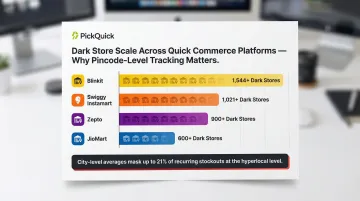
Teams stop wasting resources on bulk replenishment to locations that already have sufficient stock while underprioritizing high-demand pincodes. The scale of the problem is significant: with Blinkit operating 1,544+ dark stores, Swiggy Instamart 1,021+, Zepto 900+, and JioMart 600+, city-level averages mask up to 21% of recurring stockouts at the hyperlocal level.
KPIs impacted:
- Dark store fill rate
- Days of inventory on hand
- Replenishment cycle time
- Overstock rate
- Stockout frequency
Where it matters most: brands scaled across multiple cities or 5,000+ pincodes, where manual replenishment oversight breaks down without data-driven triggers. PickQuick provides pincode-level demand visibility and manages replenishment across 10,000+ pincodes, eliminating the operational lag most in-house teams face at this scale.
Advantage 3: Protecting Platform Visibility and Organic Ranking
Quick Commerce platforms algorithmically deprioritize or entirely suppress products that have low or inconsistent availability. This means a brand with frequent stockouts progressively loses its search ranking, independent of how much ad spend it deploys.
Tracking availability consistently allows brands to maintain the minimum in-stock thresholds required to hold their organic position in category and keyword results — a compounding advantage as rank improves over time.
Organic rank on QC platforms directly determines search-to-conversion rate. On Instacart, 40% of all clicks on search results go to the top three products, which enjoy a 20% higher CTR than the next three items. A stockout penalty pushing your product to page two effectively flatlines organic sales.
The platform penalties are specific and steep:
- Blinkit requires a sustained 90%+ fill rate; dropping below 80% triggers algorithmic demotion, reducing both search ranking and ad visibility
- Zepto's algorithm de-ranks out-of-stock SKUs aggressively — a two-day stockout can set back search placement by weeks
Sustained availability builds the algorithmic trust that reduces dependence on paid placements over time.
KPIs impacted:
- Search rank position
- Organic impressions
- Search-to-conversion rate
- Platform health score
- GMV contribution from organic vs. paid
Where it matters most: new city launches and competitive category entries, where early algorithmic trust determines whether a product grows organically or stays permanently dependent on paid support.
What Happens When SKU Availability Tracking Is Missing or Ignored
Without structured availability tracking, most brands restock based on last week's sales reports — not today's actual shelf status. By the time a stockout shows up in the numbers, the damage is already done.
Common operational consequences:
- Stockouts go undetected for hours or days, with no alert triggering replenishment until the sales dip is already visible in weekly reports
- Ad budgets keep running against out-of-stock SKUs in specific pincodes — generating impressions and click costs with zero conversion potential
- Replenishment becomes uneven: overstocking in low-demand locations while high-demand ones run dry, creating simultaneous waste and lost revenue
- Platform ranking erodes quietly, making it harder and more expensive to rebuild visibility after extended stockout periods
The cost compounds over time. Each stockout event signals the algorithm to rank the product lower and conditions consumers to expect it to be unavailable — both outcomes that erode future ad efficiency. Recovering from an algorithmic penalty typically takes 2-3 weeks of consistent performance above 80% fill rate, plus elevated ad spend to rebuild the lost organic ranking position.
How to Get the Most Value from SKU Availability Tracking
Availability tracking delivers the most value when it's applied at the right level of granularity, reviewed on a cadence that matches replenishment lead times, and used to trigger actions—not just generate reports.
Track at Pincode Level, Not City Level
Tracking availability at the pincode or dark-store level reveals where demand is outpacing supply. City-level averages hide stockouts that are costing revenue in specific neighbourhoods. Brands need visibility into which dark stores are running low, not just whether the motherhub has stock.
Set Thresholds That Trigger Replenishment
The data is only useful if it's connected to replenishment workflows. Brands should establish clear availability thresholds: if stock in a dark store drops below a defined level, a replenishment order gets automatically flagged or triggered—rather than discovered after the fact during a manual review.
Most in-house teams lack the infrastructure to act on this data in real time. PickQuick manages replenishment across 10,000+ pincodes with pincode-level demand visibility built into the workflow—eliminating the lag between a stockout signal and an actual response.
Unify Tracking Across All Platforms
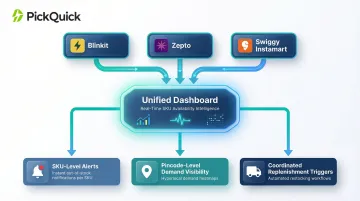
A brand running on Blinkit, Zepto, and Swiggy Instamart simultaneously needs unified visibility across all three. Fragmented platform-by-platform reviews create blind spots and slow response times. Unified tracking prevents a common failure mode: discovering stockouts on one platform while sitting on excess inventory on another.
Key requirements for cross-platform tracking:
- Single dashboard covering all active QC platforms
- Alerts triggered at SKU level, not just category level
- Replenishment logic that accounts for per-platform demand patterns
Conclusion
SKU availability tracking is an operational control mechanism — one that determines whether a brand's products are reachable, rankable, and revenue-generating on Quick Commerce platforms at any given moment.
The returns compound over time. Brands that maintain consistent availability across dark stores:
- Build stronger algorithmic rank on Blinkit, Zepto, and Swiggy Instamart
- Earn higher organic search visibility without additional ad spend
- Convert paid traffic more efficiently because products are actually in stock when demand hits
Treating availability as a passive metric — something to check weekly rather than monitor daily — erodes rank, wastes ad budgets, and hands category share to brands with tighter operational controls. The brands winning on Quick Commerce are not necessarily the biggest. They're the ones with the fewest stockout hours.
Frequently Asked Questions
What is SKU availability?
SKU availability refers to whether a specific product (identified by its Stock Keeping Unit code) is currently in stock and purchasable on a platform or in a specific location. On QC platforms, an unavailable SKU is simply not shown to consumers—it disappears from search results entirely.
How does SKU availability tracking differ from regular inventory management?
Inventory management tracks what stock is physically held in a warehouse or system. SKU availability tracking goes further: it monitors whether that stock is translating into a live, purchasable listing on a consumer-facing platform. In Quick Commerce, dark store inventory directly determines visibility, making this distinction critical.
What is a good SKU availability rate for Quick Commerce platforms?
While exact benchmarks vary by platform, category leaders typically target availability rates above 95% across their active dark stores. Sustained rates below this threshold tend to trigger algorithmic ranking penalties on platforms like Blinkit and Zepto, where 80% is considered a failure threshold.
How does poor SKU availability affect a brand's ranking on QC platforms?
QC platforms factor availability history into product ranking algorithmically. Consistent stockouts signal low reliability, causing rankings to drop over time. Recovering lost positions after stock is restored typically requires weeks of stable performance and higher ad spend.
Can SKU availability be tracked across multiple QC platforms simultaneously?
Yes, cross-platform tracking is possible and important for brands active on Blinkit, Zepto, Swiggy Instamart, and JioMart simultaneously. Unified tracking prevents the blind spots that occur when each platform is reviewed in isolation and enables coordinated replenishment decisions across all channels.
How often should brands monitor their SKU availability on Quick Commerce?
For high-velocity SKUs, availability should be monitored daily or in near-real-time. Replenishment triggers should activate before availability drops below critical thresholds, not after stockouts already appear in sales data.