: Complete Guide](https://file-host.link/website/letspickquick-mrnrhk/assets/blog-images/52a14fc2-572d-4d84-b6cd-57b830278431/1774905433436462_67388a2b3c564cd7ad1d6826b970fbe0/360.webp)
Introduction
If your brand moves serious offline volume—dairy, masalas, staples, snacks—Swiggy Instamart is no longer optional. The quick commerce sector hit USD 5 billion in CY2024 and is projected to reach USD 27–50 billion by CY2028, capturing over two-thirds of all e-grocery orders and roughly 10% of total e-retail spending. Instamart alone operates 1,021 dark stores across 124 cities, posting a Gross Order Value of ₹14,683 Crores in FY2024–25.
Most brand teams recognize they need to be on Instamart. But the actual registration process is poorly understood. This is a B2B supply arrangement—not a standard marketplace listing—requiring strict compliance, operational discipline, and continuous dark store replenishment.
This guide covers the complete registration process: eligibility criteria, required documents, step-by-step onboarding, commercial terms, and what happens after you go live—including catalog optimization, pricing hygiene, and advertising strategy.
Key Takeaways
- Swiggy Instamart operates through dark stores, not restaurant-style storefronts—brands supply inventory B2B to Instamart's fulfillment network
- Registration requires GSTIN, FSSAI license (for food products), PAN, bank details, brand authorization, and structured product catalog with HSN codes
- The vendor empanelment process runs through Swiggy's partner portal; approval timelines vary by category and city demand
- Getting listed is only the start — sustained growth requires replenishment discipline, catalog quality, MRP parity, and consistent advertising investment
- Working with an operator like PickQuick reduces onboarding time from months to weeks while managing dark store replenishment across all QC platforms
What Is Swiggy Instamart and Who Can Sell on It?
Swiggy Instamart is the quick commerce grocery vertical of Swiggy, fulfilling orders in 10-30 minutes using a network of dark stores stocked with everyday essentials. As of March 2025, the platform operates 1,021 dark stores spanning 4 million square feet across 124 cities, serving 7.1 million Average Monthly Transacting Users.
Instamart is a B2B supplier model, not an open marketplace like Amazon. Brands supply inventory to Instamart's dark stores, and Instamart retails those products to end customers. You're selling to Swiggy, not through Swiggy.
Eligible product categories include:
- Grocery staples (rice, flour, pulses, cooking oils)
- Dairy products (milk, curd, paneer, butter)
- Snacks and beverages (chips, biscuits, soft drinks, juices)
- Packaged foods (ready-to-eat meals, sauces, condiments)
- Personal care (soaps, shampoos, skincare)
- Household essentials (detergents, cleaners, paper products)
- Masalas and spices (both CTC and blended varieties)
Getting listed isn't automatic. Instamart curates its supplier base based on category demand by city and operational reliability — you need to show consistent replenishment capacity and real-time inventory readiness for designated dark stores.
Instamart vs. Swiggy Food Delivery — What's the Difference?
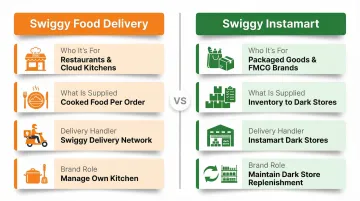
These are two separate platforms with different registration pathways, documentation, and operating models. Here's how they compare:
| Swiggy Food Delivery | Swiggy Instamart | |
|---|---|---|
| Who it's for | Restaurants and cloud kitchens | Packaged goods and FMCG brands |
| What you supply | Cooked food per order | Inventory to dark stores |
| Who handles delivery | Swiggy's delivery network | Instamart dark stores (pick, pack, deliver) |
| Your operational role | Manage your own kitchen | Maintain replenishment to assigned dark stores |
Documents Required for Swiggy Instamart Registration
Missing or mismatched documentation is the primary reason for registration delays and rejections. Prepare these documents before starting your application:
Core Business Documents:
- GSTIN Certificate – Required for all taxable goods; the GST address must match your registered business address exactly
- PAN Card – Business PAN or Proprietor's PAN
- Bank Details – Cancelled cheque or bank statement (Current Account preferred); account holder name must match GST registration
- Business Proof – Shop & Establishment License, incorporation certificate, or partnership deed
- Product Catalog – SKU data covering product names, MRP, pack sizes, HSN codes, UPC/EAN barcodes, and product images
Beyond the standard business documents, specific product categories require additional compliance proof before approval.
Category-Specific Compliance:
- FSSAI License or Registration – Mandatory for all food, beverage, and dietary supplement products. Smaller food businesses (annual turnover below ₹12 lakhs) need FSSAI Registration (Form A); those above this threshold require an FSSAI License (Form B)
- Drug License – Required for OTC pharmaceuticals and regulated health products under the Drugs and Cosmetics Act, 1940
- BIS Certification – Products under the Bureau of Indian Standards compulsory scheme must carry the ISI mark
- Brand Authorization Letter – Distributors registering on behalf of a brand owner need written authorization from that brand
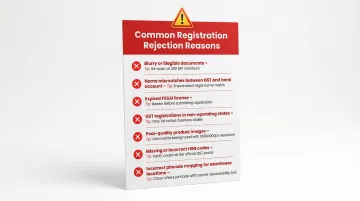
Common rejection reasons include:
- Uploading blurry or illegible documents
- Name mismatches between your GST certificate and bank account
- Submitting an expired FSSAI license
- GST registrations in states where the brand doesn't operate
- Poor-quality or inconsistently sized product images
- Missing or incorrect HSN codes
- Incorrect pincode mapping for warehouse locations
How to Register Your Brand on Swiggy Instamart: Step-by-Step
Swiggy Instamart onboarding follows two primary pathways: (1) Direct vendor empanelment via Swiggy's partner portal (most common for new entrants), and (2) Inbound outreach through Swiggy's category management teams (more common for established brands with strong offline presence).
Step 1: Submit Initial Expression of Interest
Visit the Swiggy Instamart Partner portal and complete the New Brand Onboarding form. You'll provide:
- Company name and legal entity details
- Product category and subcategory
- City presence and distribution footprint
- Product range and SKU count
- Contact information for authorized signatory
Swiggy pre-screens applications based on category fit and city-level demand. Not all submissions proceed to full onboarding—Instamart curates its seller base to maintain supply reliability and category balance.
Step 2: Complete Business and Compliance Details
Once shortlisted, you'll submit complete business documentation:
- GSTIN and PAN
- FSSAI number (for food products)
- Registered address and authorized signatory details
Upload all files as PDF or JPEG, under 5MB per file. Verification takes 7 to 15 working days, during which Swiggy's compliance team reviews every document for accuracy and completeness.
Step 3: Submit Product Catalog
Prepare a structured product catalog with the following mandatory elements for each SKU:
- Brand name, product name, and variant
- Pack size and unit of measurement
- MRP (Maximum Retail Price)
- HSN code and GST classification
- UPC/EAN barcode number
- Product dimensions and gross weight
- Shelf life and storage instructions
- Ingredient list (for food products)
- Four product images: Front of Pack, Back of Pack, Picker Image, and Barcode Image
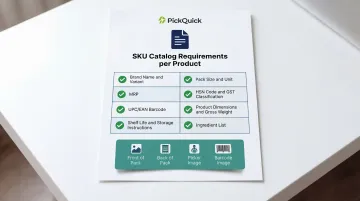
Catalog quality directly affects how quickly your brand goes live and how well it performs in search. Poor catalog preparation—wrong HSN codes, missing images, unclear pack size descriptions—leads to listing rejections or low search visibility even after approval.
Step 4: Agreement Signing and Commercial Terms
Swiggy will share commercial terms including:
- Commission/margin structure – Typically ranges from 15% to 25% depending on product category, though exact figures are negotiated case-by-case
- Payment cycles – Generally processed weekly or bi-monthly; trade receivables carry a credit period of 0 to 60 days
- Return policies – Terms for handling damaged goods, expiry management, and unsold inventory
- SLA requirements – Replenishment order confirmation timelines, dispatch schedules, and availability expectations
Brands review, negotiate if needed, and sign digitally or through an account manager. One-time non-refundable fees may apply depending on the category, though standard upfront registration fees are generally not charged.
Step 5: Onboarding Verification and Go-Live
After agreement execution, Swiggy's onboarding team verifies all details, sets up the brand in the system, and assigns relevant dark stores. You'll receive instructions for dispatching initial inventory to designated dark stores.
Your products become visible to consumers only after inventory is successfully inwarded and catalog listings are approved. Go-live depends on that first stock inward — nothing activates before it.
Brands managing this process independently should expect 2–4 months from initial application to first sale. That timeline compresses significantly when documentation, catalog preparation, and dark store coordination are handled by a dedicated operator. PickQuick manages this end-to-end for regional FMCG brands, typically getting them live on Swiggy Instamart within weeks rather than months.
What Happens After Registration: Catalog, Pricing, and Going Live
Getting registered is only the beginning. Consistent availability, correct pricing, and well-structured catalog listings drive actual sales on Instamart.
Dark Store Replenishment Cycle
Brands must ensure regular stock supply to Swiggy's dark stores based on demand signals. Stockouts directly hurt discoverability and ranking—Instamart's algorithm prioritizes availability over sales velocity. A brand maintaining 98% availability with 400 orders/day will rank higher than one with 1,200 orders/day at 60% availability.
Replenishment follows a predictive supply model: platform demand and pincode-level signals trigger replenishment orders (ROs). Common execution failures that reduce trust and throttle expansion include:
- Slow RO confirmation after platform triggers
- Missed dispatch cut-off times
- Frequent delivery note (DN) discrepancies during GRN processing
Advertising and Visibility Tools
Swiggy offers a self-serve advertising platform for brands to drive visibility and ROI. Available ad formats include:
- Keyword Ads – Bid on specific search terms to appear at the top of search results
- Display Ads – Visually rich banners on homepage and category pages for brand awareness
- Item Boosts – Highlighted placements in "Previously Ordered" sections or as last-minute cart add-ons
- Search Inline Banners (SILB) – High-impact native banners appearing mid-scroll within search results
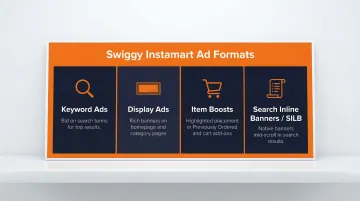
Ad spend is structured around Cost-Per-Impression or Cost-Per-Click models, with budgets set daily or per campaign. Brands managing multiple SKUs across cities benefit from consolidated advertising budgets and quarterly planning—operators like PickQuick pool budgets across dozens of brands to achieve stronger negotiation leverage and premium placement.
Pricing Hygiene and MRP Parity
Under the Legal Metrology (Packaged Commodities) Rules, 2011, it is illegal to sell any packaged commodity at a price exceeding the printed MRP. Swiggy defines its Gross Order Value as the total monetary value of orders at Maximum Retail Price, except for un-packaged items like fresh produce.
MRP on the platform must match physical retail MRP. Discrepancies can lead to listing removal, penalties, or regulatory action. Brands must align quick commerce pricing with their GT/MT channel to avoid channel conflict and maintain pricing discipline across all retail touchpoints.
Scaling Across Cities and Pincodes
For brands managing multiple SKUs across cities or scaling to new pincodes, operational complexity increases significantly. You'll need to:
- Maintain buffer inventory at the local dark-store level
- Coordinate replenishment across multiple cities simultaneously
- Optimize catalog listings for regional preferences
- Manage advertising budgets across different markets
- Track pincode-level availability and demand signals
Brands that handle these operations in-house often find execution quality dropping as city count grows. PickQuick manages dark store replenishment, catalog optimization, and platform ads across Instamart, Blinkit, Zepto, and JioMart as a single integrated operator. With real-time visibility into 10,000+ pincodes and consolidated ad budgets across 25+ category-leading brands, PickQuick functions as a complete Quick Commerce division for regional FMCG brands scaling nationally.
Common Mistakes That Delay Swiggy Instamart Onboarding
Treating Instamart Like a Marketplace
The most frequent mistake: brands approach Instamart registration like Amazon or Flipkart. They expect to upload a catalog, manage listings independently, and fulfill orders from their own warehouse. Instamart doesn't work that way.
You're supplying inventory to Swiggy's dark stores — which means coordinating dispatch schedules, maintaining availability across multiple locations, and managing replenishment order cycles. It's a B2B supply arrangement requiring alignment on logistics, billing, and replenishment, not just a catalog upload.
Document Mismatches and Compliance Gaps
Document errors are the second most common reason onboarding stalls. The top compliance blockers include:
- Expired FSSAI licenses (valid for less than 6 months beyond application date)
- GST registrations in states where the brand doesn't currently operate
- Name mismatches between GST certificates and bank account details
- Missing brand authorization letters
- Blurry or illegible file uploads that fail verification
Review every document before submission. Your FSSAI license should be valid for at least 6-12 months beyond your application date.
Catalog Quality Trap
Submitting a poorly structured catalog — wrong HSN codes, missing images, vague pack size descriptions — causes listing rejections or poor search rankings even after going live. Treat catalog preparation as a priority, not an afterthought.
Each SKU requires:
- Four high-quality images: Front of Pack, Back of Pack, Picker Image, Barcode Image
- Accurate HSN codes and complete ingredient lists
- Product names formatted to include brand, variant, and pack size
Example of poor catalog entry:
- Product Name: "Masala"
- Pack Size: "100g"
- HSN Code: Missing
Example of optimized catalog entry:
- Product Name: "Goldie Kolhapuri Chicken Masala 100g"
- Pack Size: 100g
- HSN Code: 09109990
- Images: All four formats uploaded in 1200x1200px resolution
- Ingredient List: Complete with allergen information
- FSSAI License: Visible in Back of Pack image
Frequently Asked Questions
How to become a seller on Swiggy Instamart?
Brands register as vendors/suppliers through Swiggy's partner portal at swiggy.com/instamart-partner and supply inventory to dark stores — they don't operate individual storefronts. Eligibility requires GSTIN, FSSAI license (for food products), operational capability for real-time inventory updates, and category fit with city-level demand.
What are the requirements for Instamart store?
An "Instamart store" refers to a dark store operated by Swiggy itself — brands don't run their own Instamart stores. Brands supply products to existing dark stores after completing vendor registration, document verification, catalog submission, and agreement signing.
How much does Swiggy Instamart charge sellers?
Swiggy typically charges brand vendors a commission ranging from 15% to 25% depending on product category, margins, and negotiated terms. Exact commission structures are agreed upon during commercial term discussions and vary by category. Additional costs may include inwarding fees, storage/ageing fees, and fulfillment charges.
How much is the onboarding fee in Swiggy?
There is no standard upfront registration fee for Instamart vendor onboarding. Promotional funding commitments and platform fees may apply depending on your category and agreed commercial terms.
How to run ads on Swiggy Instamart?
Instamart offers in-app advertising options for listed brands, typically managed through a dedicated brand account manager or Swiggy's self-serve advertising platform. Ad formats include keyword ads, display banners, item boosts, and search inline banners. Ad spend is separate from vendor margin and structured around CPC or CPM models.
How to earn money from Instamart?
Brands earn by supplying products at negotiated trade prices to Instamart's dark stores, which then retail directly to consumers. Revenue growth depends on four operational pillars:
- Availability: Maintaining 95%+ stock levels across dark stores
- Catalog quality: Optimized listings with accurate images and descriptions
- Advertising: Sponsored placements and keyword bidding for visibility
- Replenishment discipline: Clean cycles and low delivery non-fulfillment (DN) rates
Ready to scale your brand on Swiggy Instamart and other quick commerce platforms? PickQuick manages end-to-end Quick Commerce operations for regional FMCG brands scaling across platforms—handling onboarding, catalog optimization, dark store replenishment, and advertising across Blinkit, Zepto, Instamart, and JioMart. Contact Swapnil at +91 94276 41749 or swapnil@letspickquick.com to discuss your brand's Quick Commerce strategy.