Introduction
Most brands approaching Zepto expect a simple, published commission rate card—like Amazon's 0–30% category fees or Flipkart's fixed seller charges. They Google "Zepto commission rate," find an indicative range, and model margins based on a single percentage. That assumption is expensive. Zepto's commission structure is fundamentally different: rates are commercially negotiated, not published; trade margin terminology replaces transaction-level fees; and the headline percentage is just the starting point. Promotional deductions, return charges, and platform fees add 5–10 percentage points of hidden cost that erode profitability before you notice.
This guide is for brand owners, distributors, and FMCG sellers evaluating Zepto — or already selling on it — who need to understand not just what the rate is, but how it's set, what drives it, and what actually gets deducted before payout.
We walk through the end-to-end commercial model, break down what's covered and what isn't, and expose the margin traps that catch brands off guard. The goal: give you the tools to model true unit economics before you sign any commercial terms.
Key Takeaways
- Zepto's commission is commercially negotiated with a dedicated Category Manager—no fixed published rate exists
- Typical ranges: 10–15% for grocery/staples, 15–18% for packaged foods, 18–25% for personal care and FMCG
- Commission is not the only deduction—promotional fees, RTV charges, and platform processing fees reduce net payout by an additional 5-10%
- Higher volumes (₹25–30 lakh+/month) and strong sell-through unlock meaningfully better negotiated rates
- Model all deductions before listing—margin math that skips platform fees routinely misleads
What Is Zepto's Commission Model?
Zepto's commission is a commercially negotiated fee — expressed as a percentage of MRP — that Zepto retains for providing platform access, fulfillment infrastructure, and customer reach. Unlike Amazon and Flipkart, which publish category-wise flat rates any seller can look up, Zepto's terms are bilaterally negotiated directly with each brand's Category Manager.
This means two brands in the same category can carry different effective rates, depending on brand strength, volume commitments, and negotiation leverage.
Trade Margin vs. Commission Terminology
Zepto often frames its commercial arrangement as a "trade margin" rather than a "commission." In practice, this distinction has real operational consequences.
Under the trade margin model, Zepto purchases inventory from sellers at a discount to MRP rather than collecting a transaction-level fee on each order. That framing affects:
- Invoice structure — how the purchase transaction is documented
- GST treatment — which party charges and claims input tax credit
- Accounting recognition — how revenue and cost-of-goods flow on both sides
The net economic effect is similar either way — Zepto retains a percentage of the selling price — but the contractual and compliance structure differs meaningfully.
Indicative Rate Bands by Category
Based on industry reports and seller community data, indicative commission ranges vary by category margin profile and velocity:
| Category Type | Indicative Commission Range | Notes |
|---|---|---|
| Grocery & Staples | 10–15% | Lower-margin, high-velocity categories |
| Packaged Foods & Beverages | 15–18% | Mid-range margin profile |
| Personal Care & FMCG | 18–25% | Higher-margin categories with premium placement value |
| Overall Platform Take-Rate | 22–23% (reported avg) | Reflects Zepto's push for profitability in 2025 |
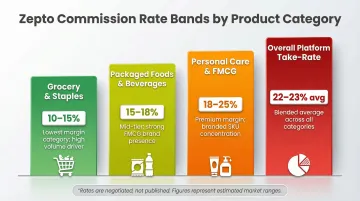
These ranges are starting points for negotiation. Your actual rate will shift based on brand scale, SKU uniqueness, competitive intensity in your category, and the volume commitments you're willing to put on paper.
How Zepto's Commission Model Works
End-to-End Commercial Flow
Seller interest form → Category Manager assignment → Commercial term negotiation → New Product Introduction (NPI) → Purchase order generation → Inventory supply to warehouse → Zepto-managed fulfillment → Deductions → Bi-monthly payout
Step 1: Category Manager Negotiation
Once you express interest in selling on Zepto, you're assigned a dedicated Category Manager (CM). The CM is your sole commercial contact and holds authority over:
- Trade margin percentage
- Launch cities and SKU prioritization
- Promotional budget commitments
- Return-to-Vendor (RTV) terms
- Payment timelines
No self-serve dashboard exists for configuring these terms. Everything is discussed and agreed bilaterally. Strong brands with proven offline demand negotiate better terms; new or unproven brands face higher margin demands and stricter conditions.
Step 2: New Product Introduction (NPI) and Listing
After commercial alignment, the CM initiates NPI. You'll need to submit:
- SKU data (product name, pack size, MRP, barcodes)
- Product imagery
- Category documentation (FSSAI for food, GST registration, brand authorization)
Approval takes 5–10 working days. Delays occur most often due to incomplete documentation, barcode issues, or category-specific compliance gaps.
Step 3: Purchase Order Flow and Inventory Supply
Zepto generates purchase orders based on forecasted demand and platform strategy. Sellers supply goods directly to Zepto's fulfillment centers (dark stores), not to end customers. Zepto then manages redistribution across its 900+ dark stores and handles all last-mile delivery.
This model shifts inventory ownership and compliance burden to the platform side — but sellers lose direct control over stock placement and availability.
Step 4: Deductions and Payout Calculation
That fulfillment structure also shapes how your payout gets calculated. The payout is not simply "selling price minus commission" — here's the full deduction chain:
Example: ₹1,000 MRP Product at 18% Trade Margin
- Selling Price (MRP): ₹1,000
- Trade Margin Deduction (18%): ₹180
- Promotional Discount (seller-funded): ₹50
- Platform Processing Fee (estimated 2%): ₹20
- Net Payout to Seller: ₹750
Effective cost to seller: 25% of MRP, not the headline 18%.
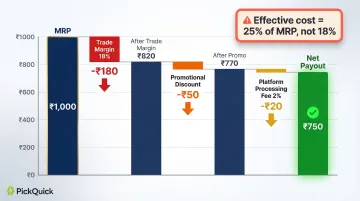
This example excludes RTV charges for expired or damaged inventory, which vary by category and are deducted from future payouts.
What Zepto's Commission Covers — and What It Doesn't
What Is Included in the Commission/Trade Margin
- Product listing and visibility on the Zepto app
- Order management and processing
- Picking and packing at the dark store level
- Last-mile delivery by Zepto's delivery fleet
- Customer service for order-related queries
Sellers do not manage delivery staff or last-mile logistics.
What Is NOT Included — Additional Costs Sellers Must Account For
In-app advertising and sponsored placements: Charged separately against an ad wallet or deducted from payouts. These costs are distinct from the base commission. According to industry reports, quick commerce platforms are projected to generate ₹4,900 crore in ad revenue in 2026, up from ₹3,000 crore the prior year. Large FMCG brands now allocate 5-6% of their total ad budgets to quick commerce.
Seller-funded promotional discounts and flash sale participation: Brands agree to co-invest in promotional campaigns, which are deducted from payouts or invoiced separately.
Return-to-Vendor (RTV) charges: For unsold, expired, or damaged inventory. RTV terms are negotiated with the Category Manager and vary by category. These charges can accumulate quickly for slow-moving SKUs or products with short shelf lives.
APOB GST Registration Cost
Beyond the costs above, there's a compliance layer most sellers underestimate: GST registration for every state where Zepto dark stores hold your inventory.
To supply Zepto's dark stores across multiple states, sellers need Additional Place of Business (APOB) GST registration in each operating state. This sits entirely outside the commission structure and is the seller's responsibility.
Under the CGST Act, 2017, businesses storing goods in third-party warehouses or dark stores in states outside their primary GST registration must obtain separate GST registration in each such state. Establishments in different states under the same PAN are treated as distinct taxable persons — movement of goods between them is a taxable supply.
CBIC clarification (Sept 2025) reiterates this requirement explicitly.
For a brand expanding from one city to 10 cities across 5 states, this means 5 separate GST registrations, each requiring separate filing, reconciliation, and compliance overhead — an operational and administrative cost that compounds with every new state you enter.
Key Factors That Affect Your Zepto Commission Rate
Product Category and Gross Margin Profile
Zepto calibrates its commercial expectations to the margin profile of the category. High-margin categories like personal care and wellness attract higher commission demands (18-25%), while low-margin staples like basic groceries operate at the lower end (10-15%).
| Category Type | Indicative Commission | Margin Profile |
|---|---|---|
| Grocery & Staples | 10-15% | Low margin, high velocity |
| Snacks & Packaged Foods | 14-18% | Mid-range margin |
| Personal Care & FMCG | 18-25% | High margin, premium placement value |
Brand Scale, Velocity, and Sell-Through Consistency
High-volume brands with predictable demand signal lower fulfillment risk to Zepto, giving them stronger negotiating leverage. A brand doing ₹25-30 lakh+ monthly on quick commerce is in a materially better negotiating position than one just entering the platform.
Quick commerce in India reached approximately ₹11,000 crore in monthly GMV as of January 2026, growing nearly 100% year-on-year. Brands that contribute meaningfully to that volume command better terms.
Promotional and Advertising Commitments
Brands that agree to higher promotional budgets often negotiate a lower headline trade margin. Understanding this trade-off—lower commission vs. higher ad spend—is an important lever in commercial discussions. Marketing budgets of ₹25,000 to ₹1,00,000 per month are typical for meaningful in-app visibility. Some brands reduce their effective commission by 2-3 percentage points by committing to annual advertising spends in the ₹10-15 lakh range.
Competitive Intensity in the Category
In crowded categories, Zepto has more negotiating power and may push for higher margins or greater promotional participation. In categories where a brand has unique regional demand with limited competition, leverage shifts to the brand.
Brands working with a Quick Commerce operator like PickQuick, which manages commercial relationships across 25+ category-leading brands on Zepto and other platforms, gain negotiating leverage that independent brands rarely access on their own. Multi-brand volume commitments and consolidated ad budgets open up better margin terms and preferential campaign placements that single-brand deals simply don't unlock.
Payout Timeline and Cash Flow Modelling
Zepto typically operates a bi-monthly settlement cycle with a 15-20 day lag from invoice date. For a brand with ₹50 lakh in monthly Zepto sales, the working capital tied up in pending settlements can exceed ₹30 lakh at any given time. Factor this gap into your margin model, particularly if you're running tight inventory cycles.
Common Misconceptions and Margin Traps on Zepto
Misconception 1: "Zepto Has a Fixed, Published Commission Rate"
Many sellers Google "Zepto commission rate" and anchor to a number (often 2-18% or 10-25% from third-party sources) without understanding these are indicative ranges, not contractual rates. The actual rate is negotiated with your Category Manager and can vary significantly based on brand strength, volume commitments, and promotional spend.
Entering negotiations without understanding how rates are set leads to either accepting unfavourable terms or mismodelling margins at the planning stage. The reported average platform take-rate of 22-23% in 2025 reflects Zepto's push for profitability, but your specific rate could be higher or lower.
Misconception 2: "Commission Is the Only Cost"
The most common margin trap is treating trade margin as the only deduction. In practice, promotional deductions, RTV charges, ad wallet debits, and processing fees add 5-10 percentage points of effective cost on top of the headline trade margin.
Example Comparison:
| Cost Component | Stated Commission Scenario | Effective Cost After All Deductions |
|---|---|---|
| Selling Price (MRP) | ₹1,000 | ₹1,000 |
| Trade Margin (18%) | ₹180 | ₹180 |
| Promotional Discount | ₹0 (not factored) | ₹50 |
| Platform Processing Fee | ₹0 (not factored) | ₹20 |
| RTV Exposure (estimated 2%) | ₹0 (not factored) | ₹20 |
| Net Payout | ₹820 | ₹730 |
| Effective Cost % | 18% | 27% |
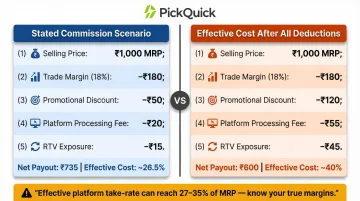
According to industry reports, brands and sellers incur charges for storage, warehousing, and deliveries, increasing the overall share retained by quick commerce platforms to 30-35% of the selling price.
Misconception 3: "A Low Commission Rate Guarantees Profitability"
Brands sometimes prioritize negotiating down the commission rate without modelling full unit economics. A 12% commission on an underpriced product with high returns and heavy promotional spend can still result in negative margins.
Run a full margin model before agreeing to any commercial terms. At minimum, model:
- Confirm MRP against category benchmarks before listing
- Deduct trade margin from your effective realisation
- Budget promotional spend monthly or quarterly, not as a surprise
- Factor APOB compliance costs across every target city
- Estimate ad spend needed to maintain search visibility
- Calculate RTV exposure based on shelf life and actual velocity
Brands that skip this step often discover the channel is unprofitable only after committing to terms they can't renegotiate.
Frequently Asked Questions
How much does Zepto charge sellers?
Zepto's commission ranges from 10-25% depending on product category, brand strength, and volume commitments. The exact rate is negotiated bilaterally with Zepto's Category Manager. Additional deductions for promotions, advertising, and platform fees reduce effective net margins by another 5-10 percentage points.
Can I sell my products on Zepto?
Yes. Manufacturers, brand owners, distributors, and authorized resellers are eligible. Required documents include a GST certificate, PAN, FSSAI registration (food products), and APOB registrations for multi-city supply. Onboarding runs through Zepto's brand registration portal with a dedicated Category Manager assigned.
Why does Zepto charge processing fees?
Processing and platform fees cover the infrastructure costs of order handling, dark store operations, and last-mile delivery. These are either bundled into the trade margin or charged as discrete fees depending on the commercial terms agreed with the Category Manager.
What is the difference between Zepto's commission and trade margin?
Zepto uses "trade margin" terminology in commercial discussions — both terms describe the same mechanic where Zepto retains a percentage of MRP. The framing matters because it affects how invoices are raised, how GST is applied, and how accounting is structured. Under the trade margin model, Zepto purchases from the seller at a discount to MRP.
How long does Zepto take to release seller payouts?
Zepto typically operates a bi-monthly settlement cycle with a 15-20 day lag from invoice date. Sellers should reconcile invoices against settlement statements to catch missed credits or incorrect deductions, as payment timing directly impacts working capital for high-frequency brands.
Does Zepto charge separately for ads and promotions?
Yes. In-app advertising is charged separately from the trade commission — either deducted from payouts or billed against a dedicated advertising wallet. Promotional discounts are typically seller-funded or structured as a co-investment with Zepto, with costs deducted from future payouts.