Introduction
Every food business in India must secure FSSAI authorization before starting operations. Yet confusion around Registration vs. License remains one of the most common compliance missteps. Businesses routinely apply for the wrong category, triggering rejections, penalties, or operational shutdowns.
The distinction isn't just bureaucratic. The credential you hold determines what you can legally do: sell locally, distribute across states, export, or supply to quick commerce platforms like Blinkit and Zepto.
India's food processing market reached ₹30,49,800 crore (US$354.5 billion) in 2024, contributing 8.80% of manufacturing GVA and 13% of total exports. This guide breaks down exactly which category applies to your business — and what's at stake if you get it wrong.
Key Takeaways
- FSSAI Registration covers petty businesses with turnover below ₹1.5 crore (as of April 2026) — simpler documentation, faster processing
- State License suits single-state operators with turnover between ₹1.5–50 crore
- Central License is required for multi-state operations, import/export, or e-commerce businesses
- Registration numbers start with "2"; License numbers start with "1"
- Wrong category risks illegal operations, fines up to ₹5 lakh, and platform removal
- E-commerce FBOs must obtain Central License regardless of turnover
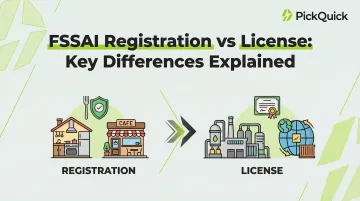
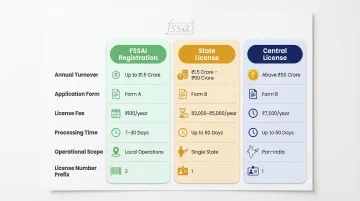
FSSAI Registration vs License: Quick Comparison
| Parameter | FSSAI Registration | FSSAI State License | FSSAI Central License |
|---|---|---|---|
| Turnover Threshold | Up to ₹1.5 crore (revised April 1, 2026) | ₹1.5 crore to ₹50 crore | Above ₹50 crore |
| Business Scale | Petty FBOs, home kitchens | Medium-scale, single-state | Large, multi-state, e-commerce |
| Application Form | Form A | Form B | Form B |
| Government Fee | ₹100/year | ₹2,000–5,000/year | ₹7,500/year |
| Processing Time | 7–30 days | Up to 60 days | Up to 60 days |
| Geographic Validity | Local operations | Single state | Pan-India |
| FSSAI Number Starts With | 2 | 1 | 1 |
| Validity | Perpetual (from April 2026) | Perpetual (from April 2026) | Perpetual (from April 2026) |
Key Changes (Effective April 1, 2026)
The April 2026 amendments significantly raised the thresholds, moving many mid-size food businesses from Registration into License territory:
- Basic Registration: Up to ₹1.5 crore (previously ₹12 lakh)
- State License: ₹1.5 crore to ₹50 crore (previously ₹12 lakh to ₹20 crore)
- Central License: Above ₹50 crore (previously above ₹20 crore)
Licenses and registrations issued on or after April 1, 2026, now carry perpetual validity, per the FSSAI Order dated March 27, 2026. This eliminates the 1–5 year renewal cycle — meaning food businesses no longer need to track expiry dates or risk lapses due to missed renewals.
What is FSSAI Registration?
FSSAI Registration is the entry-level food safety authorization for petty Food Business Operators (FBOs) under the Food Safety and Standards (Licensing and Registration of Food Businesses) Regulation, 2011. It's mandatory for businesses with annual turnover not exceeding ₹1.5 crore.
Eligibility Conditions
You qualify for Registration if you meet these criteria:
- Production capacity up to 100 kg/litre per day (excluding milk and meat)
- Milk procurement up to 500 litres per day
- Slaughtering capacity: 2 large animals, 10 small animals, or 50 poultry birds per day
- Distribution of food at religious/social gatherings (not catering)
- Operation as petty retailer, hawker, or temporary stall holder
Documents Required
Registration uses Form A with minimal documentation:
- Photo ID proof
- Address proof
- Business registration proof
- List of food products
- Self-attested hygiene declaration
What Registration Allows
Registration gives you legal standing to operate, display your FSSAI number on packaging, and build consumer trust — but it comes with clear operational limits.
What it covers:
- Legal protection from penalties
- Display of FSSAI number on packaging
- Consumer trust and access to local retail channels
What it doesn't cover:
- Multi-state or large-scale distribution
- Export eligibility
- Full quick commerce platform access (most platforms require a State or Central License)
Who Should Apply
Registration suits small-scale operators with hyper-local reach:
- Street food vendors and temporary stall operators
- Home bakers and early-stage cloud kitchens
- Small kiranas stocking packaged food
- Cottage food producers selling within their locality
A home-based pickle maker in Jaipur selling through WhatsApp and neighborhood stores with monthly revenue under ₹1.25 lakh would typically apply for Registration, not a State or Central License.
What is FSSAI License?
FSSAI License is mandatory for medium and large Food Business Operators with annual turnover exceeding ₹1.5 crore. It comes in two categories: State License and Central License.
State License
Issued by the State Food Safety Commissioner for businesses operating within a single state with turnover between ₹1.5 crore and ₹50 crore.
Applies to:
- Mid-scale manufacturers
- Distributors and storage units
- Transporters
- Retailers with higher volumes
Central License
Issued directly by FSSAI headquarters for businesses operating across multiple states or engaged in specific high-risk activities.
Required for:
- Multi-state operators
- Importers and exporters (requires IEC code)
- E-commerce FBOs regardless of turnover
- Large manufacturers (turnover above ₹50 crore)
- Operators at airports, seaports, railways, and defence establishments
Compliance Obligations
License holders must maintain:
- Designated food safety officer
- Food safety management system (HACCP/GMP)
- Periodic inspections and audits
- Strict record-keeping protocols
- License number displayed on all packaging
Documentation Requirements
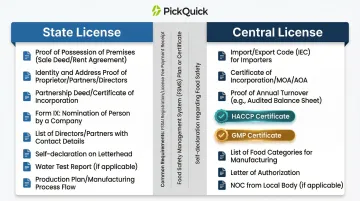
License applications (Form B) require:
- Blueprint/layout plan of premises
- List of directors/partners
- Equipment and machinery details
- Water analysis report (chemical & bacteriological)
- Proof of premises possession
- Recall plan
- HACCP/GMP certificate (Central License only)
Processing Timelines
- Registration: 7–30 days
- State License: Up to 60 days
- Central License: Up to 60 days
Understanding these timelines helps you plan ahead — especially if your business is approaching the ₹1.5 crore threshold or expanding across states.
Use Cases of FSSAI License
State License Profile
Applicable for businesses operating within a single state:
- Regional masala brand distributing across Maharashtra only
- Dairy processor operating in Karnataka with ₹5 crore turnover
- Cold storage facility serving Tamil Nadu distributors
- Mid-scale bakery chain with stores in one state
Example: A masala brand with strong offline presence in Gujarat generating ₹8 crore annually needs a State License — not Registration.
Central License Profile
Once a brand crosses state lines or scales to national platforms, Central License becomes mandatory:
- Masala or FMCG brand expanding to 3+ states
- Brands listing on Blinkit, Zepto, or Swiggy Instamart nationally
- Importers bringing ingredients from overseas
- Large manufacturers with turnover above ₹50 crore
- Brands supplying through dark stores in multiple cities
Example: A dairy brand with ₹15 crore offline revenue in Karnataka expanding to quick commerce across Mumbai, Delhi, and Bangalore would need a Central License — State License isn't enough for multi-city platform supply.
FSSAI Registration vs License: Which One Does Your Food Business Need?
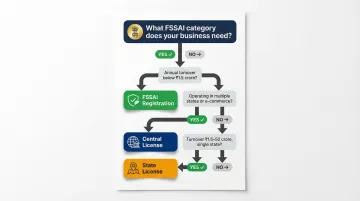
The right FSSAI category depends on three factors: your annual turnover, the scale of your operations, and the type of activity you conduct. Use this framework to identify where your business falls.
Decision Framework
Choose Registration if:
- Turnover is below ₹1.5 crore annually
- Production is under 100 kg/litre per day
- Operations are local or within one city
- You operate as a home baker, street vendor, or petty retailer
Choose State License if:
- Turnover is ₹1.5–50 crore annually
- You operate only within one state
- You manufacture, store, distribute, or transport at mid-scale
- You're a retailer with higher volumes
Choose Central License if:
- Turnover exceeds ₹50 crore
- You operate in multiple states
- You import or export food products
- You run an e-commerce food business
- You manufacture for national distribution
The Activity Exception
Even if turnover qualifies for Registration, certain activities legally require a License. Manufacturing and supplying to organized retail or quick commerce platforms requires at least a State License. For brands operating across multiple cities on platforms like Blinkit, Zepto, or Swiggy Instamart, a Central License is mandatory.
Getting the category wrong isn't just a paperwork issue — it carries serious legal and commercial consequences.
Consequences of Wrong Category
Operating without proper authorization under Section 63 of the FSS Act 2006 results in:
- Imprisonment up to 6 months
- Fine up to ₹5 lakh
- Double penalties for repeat offences
- Daily fines up to ₹1 lakh for continuing violations
- License cancellation
- Forced business closure
- Platform disqualification (Blinkit, Zepto, Swiggy Instamart)
Per FSSAI's own guidelines, any FBO manufacturing without the correct endorsement faces prosecution under the FSS Act — regardless of whether the turnover threshold was technically met.
Real-World Impact: Getting FSSAI Right When Scaling on Quick Commerce
Quick commerce platforms enforce strict FSSAI compliance during onboarding. The license category must match your operational scale.
Platform Documentation Requirements
- Blinkit: FSSAI license mandatory for food & beverage
- Zepto: FSSAI License mandatory for food, groceries, edibles
- Swiggy Instamart: FSSAI mandatory for food, beverage, health supplements, pet food
E-Commerce Central License Mandate
E-commerce FBOs must obtain Central License regardless of turnover. This applies to brands selling on quick commerce platforms at scale.
Multi-State Operations
FBOs operating in multiple states must obtain a Central License for their Head Office, plus separate licenses for each unit.
Compliance Gap Scenario
A regional masala brand with ₹10 crore offline sales in Karnataka holds a State License. When expanding to Blinkit and Zepto across Mumbai, Delhi, and Bangalore, the brand now operates multi-state and through e-commerce channels: both triggers for Central License requirement. Holding only a State License at this stage creates a compliance gap that blocks onboarding or triggers platform removal.
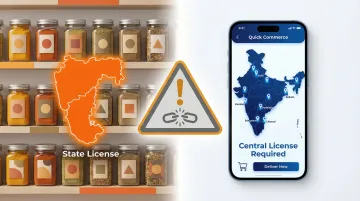
This is where operational support makes a measurable difference. For brands managing multi-city Quick Commerce expansion, PickQuick handles complete onboarding including documentation verification across 10,000+ pincodes, reducing go-live timelines from months to weeks.
Upgrading Your License
Upgrading from Registration to State License, or State to Central License, is a defined FSSAI process. Brands should plan this proactively as they scale. Key steps include:
- Assess your current turnover and operational footprint before listing on new platforms
- Identify whether multi-state or e-commerce activity triggers a Central License requirement
- Initiate the upgrade application before receiving compliance notices or platform rejections
Conclusion
Registration isn't inferior to a License — it's the correct choice for small-scale food operators. License (State or Central) is correct for businesses at medium-to-large scale or crossing state lines. Getting this right from the start means no compliance gaps when platforms request documentation during onboarding.
Food brands preparing for multi-city Quick Commerce expansion need FSSAI compliance sorted before they scale — not after. Unresolved compliance is one of the most common reasons brands face Blinkit, Zepto, or Swiggy Instamart onboarding delays. With perpetual validity kicking in from April 2026 and revised turnover thresholds already in effect, confirming the right category now saves time, money, and platform momentum later.
Frequently Asked Questions
Frequently Asked Questions
Is a food license the same as an FSSAI certificate?
No. FSSAI Registration certificate and FSSAI License are both issued by FSSAI but differ in scope. Registration suits petty/small businesses; License (State or Central) applies to medium-to-large operations. They are legally distinct documents.
Who needs an FSSAI license in India?
Any Food Business Operator with annual turnover exceeding ₹1.5 crore (revised April 2026) needs an FSSAI License: either State (up to ₹50 crore, single state) or Central (above ₹50 crore, multi-state, import/export, or e-commerce).
What are the different types of FSSAI licenses?
Three categories exist: Basic Registration (petty FBOs, up to ₹1.5 crore), State License (₹1.5–50 crore, single state), and Central License (above ₹50 crore, multi-state, import/export, e-commerce). Applications for all three go through the FoSCoS portal.
How much does an FSSAI license cost in India?
FSSAI Registration costs ₹100/year. State License fees range from ₹2,000–5,000/year depending on business category. Central License costs ₹7,500/year. Modification and renewal fees also apply.
How long is an FSSAI license valid?
Both Registration and License issued on or after April 1, 2026, have perpetual validity. Previously, validity ranged from 1–5 years (renewal due 30 days before expiry), and licenses issued before this date follow the old renewal cycle until upgraded.
Do I need a license to sell homemade food in India?
Home-based food sellers with turnover below ₹1.5 crore and production under 100 kg/day qualify for FSSAI Registration (not full License). Selling through e-commerce platforms or crossing turnover thresholds triggers an upgrade to State or Central License.